
Gold at $4,600 Isn’t “Inflation” — It’s a Liquidity Regime + Governance Risk Reprice
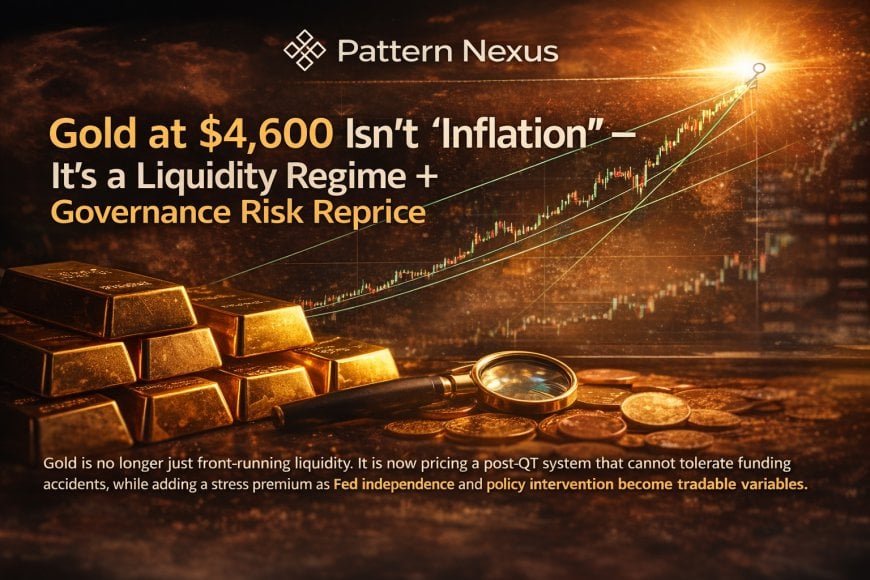

QT didn’t “fade out.” It was ended by policy choice, and replaced with reserve management and bill purchases to keep the plumbing stable.
When the system starts forcing rates down through side-doors (agency MBS buying) while the Fed is under pressure, gold stops acting like a commodity and starts acting like a credibility hedge.
Year-end repo stress and record SRF usage are a reminder: the “liquidity rail” is enforced by operations, not speeches.
The Rail and the Alarm Zone
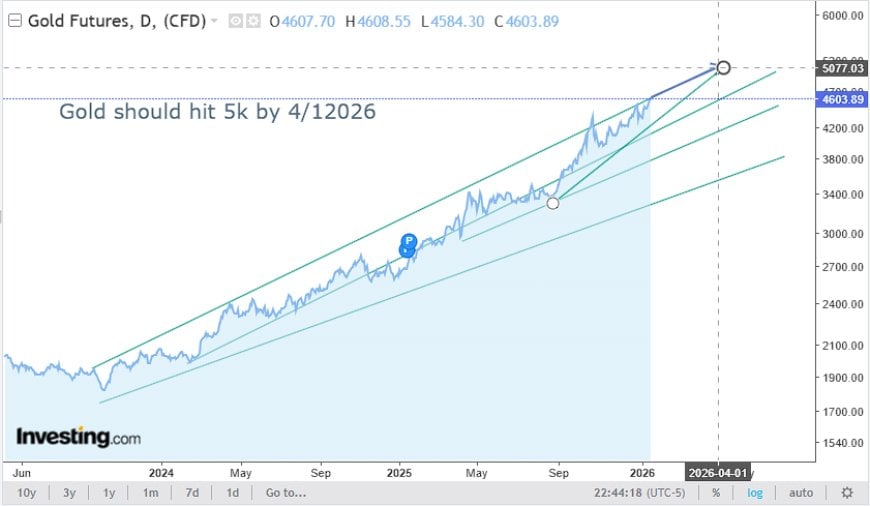
Gold at $4,600 is not a normal repricing. The move only makes sense when the reader separates two layers that get blended together in mainstream narrative.
Layer 1: the baseline rail. This is the post-QT liquidity slope. It is the market pricing a system that cannot run sustained tightening once buffers are depleted. The language will vary, but the operating reality is simple: the plumbing has to work, reserves have to remain ample, and funding markets cannot be allowed to seize.
Layer 2: the stress premium. This is what shows up when the rules of money and rates become politically and institutionally unstable. When “independence” becomes a tradable variable and rate suppression becomes a political objective, gold doesn’t drift higher. It accelerates up the upper rail, because it’s pricing the probability distribution of intervention and credibility decay.
Rail behavior = structural liquidity support. Upper-rail behavior = stress premium. A true “alarm zone” is when policy starts looking forced rather than discretionary.
This is why the “$5k by 4/1/26” projection doesn’t read like a meme inside this framework. If the baseline rail holds and the premium stays bid, continuation targets become mechanical. If the premium compresses, price can fall back into the rail without breaking the thesis.
The Last 6 Weeks: December Fed Plumbing → January Rate Suppression
The reason the gold move looks “crazy” is because most people are missing the sequence. The sequence matters, because it shows the system switching modes in real time.
1) Late October: the Fed pre-announces the end of QT
On October 29 the Fed announced it would cease runoff starting December 1. The operational shift is the point: roll over Treasury principal, reinvest agency principal into Treasury bills, and use Treasury bill purchases as needed to maintain an ample level of reserves. This is the moment “runoff discipline” got formally subordinated to plumbing stability.
When the central bank stops shrinking the balance sheet and commits to bill operations to keep reserves ample, the system is telling you there is a functional tightening limit.
2) December 10: rate cut + formal reserve-management operations
At the December meeting the Fed cut the policy rate to 3.50–3.75%. That’s the headline, but the balance-sheet implementation is the real transmission: increase SOMA through Treasury bill purchases (and short Treasuries if needed) to maintain ample reserves, roll Treasury principal, and reinvest agency principal into bills. That is the post-QT rail being operationalized.
Then the December follow-through mattered: officials signaled a slower future easing path than markets were pricing at the time. That “hawkish on paper, supportive in plumbing” mix is exactly how modern regimes operate: talk discipline, run stabilization.
3) Late December: the plumbing proves the point
Year-end funding markets showed the usual stress, but the scale matters. The Fed’s Standing Repo Facility hit record usage (banks borrowed roughly $74.6B on the final trading day of 2025) while the Fed was also operating in bills. SOFR popped into the high end of the range before easing. This is what “liquidity rail” looks like in practice: the system doesn’t wait for a crisis headline, it uses facilities and purchases to keep rates and funding conditions from snapping.
Record facility usage doesn’t have to mean “collapse.” It means the system is actively managing liquidity so the short end stays controlled. That’s supportive by design.
4) January: direct rate suppression shows up through housing and consumer credit
Then January added the political layer. The administration ordered the FHFA to direct Fannie Mae and Freddie Mac to purchase up to $200B of MBS. Treasury framed it as an attempt to offset the Fed’s ongoing MBS runoff and narrow MBS-Treasury spreads. That is not a symbolic move. It is a targeted spread-compression tool aimed at mortgage rates without waiting for the Fed to do it through the front door.
At the same time, proposals like a one-year 10% cap on credit card APR push the same signal into consumer credit: suppress borrowing costs by mandate when the debt system becomes politically intolerable. Whether every proposal becomes law is not the point. The point is that rate suppression has become a visible objective.
5) The governance shock: when “Fed independence” becomes a market input
Finally, the credibility layer lit up. Powell publicly stated the DOJ served the Fed with grand jury subpoenas and threatened a criminal indictment, explicitly framing it as leverage tied to interest rate policy rather than the stated pretexts. Markets immediately priced it as institutional risk, and safe-haven demand surged.
On January 12, gold breached $4,600 as the Powell-Trump rift and geopolitical tensions drove safe-haven flows. This is not mysterious inside this framework. The baseline rail was already in place from December. The governance shock activates the premium.
- December installed the rail: QT ended, reserve management purchases and bill reinvestments became explicit policy.
- Year-end validated the rail: bills + SRF kept the short end contained during stress.
- January added suppression tools: agency MBS buying to narrow spreads and push mortgage rates lower.
- January added the premium: Fed independence shock turns credibility into a tradable variable.
Liquidity Expansion in the Pattern Nexus Framework
Liquidity expansion is not a single dial. It is a stack of mechanisms that keep the machine functional when leverage, rollover needs, and political tolerance collide. Over the last month, all the layers showed themselves.
1) Fed layer: from QT to “ample reserves” operations. Ending runoff and explicitly committing to purchases and reinvestments to maintain ample reserves is liquidity expansion in operational clothing. It doesn’t need to be branded as QE to function like support.
2) Funding layer: facilities enforce the corridor. The Standing Repo Facility is a control lever. It becomes visible when dealers and banks need balance sheet, and it is used to keep the short end from destabilizing. Year-end was a demonstration.
3) Housing layer: agency balance sheets as a rate tool. FHFA-directed MBS buying is a spread-control program. It targets mortgage rates via market structure rather than by changing the policy rate. That is modern intervention: outcomes enforced through mechanisms.
4) Political layer: rate suppression as an objective. When the system starts debating caps and mandates in consumer credit, it’s telling you the same thing as the MBS program: high borrowing costs are politically unstable, and policy will look for ways to push them down.
5) Software rails layer: stablecoins and collateral demand. Regulated stablecoin issuance backed by cash and short-term Treasuries increases the strategic value of the short end and collateral. That reinforces why bills and short-duration management keep showing up at the center of policy.
A system that has reached the tightening limit, is enforcing stability through operations, and is now adding political pressure and credibility decay on top of the baseline liquidity slope.
This is why “rail” language matters. It gives a measurable map:
- Rail holds: baseline liquidity slope intact even if price consolidates.
- Upper rail pins: stress premium active and persistent.
- Premium compresses: price falls back into the rail without breaking the regime thesis.
- Rail failure: structural invalidation only if price breaks the lower rail and stays there while policy re-anchors without support.
Pattern Nexus Lens
The modern state doesn’t have to announce control. It can implement control through infrastructure: reinvestment rules, bill purchases, repo facilities, agency balance sheets, and compliance rails. When those levers become visible, markets reprice the regime.
Gold sits at the intersection because it’s a credibility hedge with a liquidity engine underneath it. When the rail is installed (December) and the premium activates (January), gold stops behaving like a commodity and starts behaving like a regime signal.
This is what control-systems macro looks like: stabilization through mechanisms, suppression through side-doors, and credibility risk priced in real time.
FAQ
What was the “Fed action in December” that matters most for gold?
The operational shift: QT ended, reinvestment rules changed, and the Fed formalized bill purchases to maintain ample reserves. The rate cut is important, but the plumbing decisions are the rail.
How does agency MBS buying fit the framework?
It’s spread suppression. It targets mortgage rates by creating demand for MBS and narrowing MBS-Treasury spreads, offsetting the Fed’s ongoing MBS runoff. Even if the macro effect is debated, the signal is clear: policy is willing to use agency balance sheets to push rates down.
Is record SRF usage a crisis signal?
Not automatically. It is evidence that the Fed is encouraging facility usage to keep funding markets orderly and maintain rate control. It supports the “managed rail” thesis.
What would invalidate the rail thesis?
Sustained rail failure: price breaks below the lower rail and stays there while policy re-anchors without ongoing support, and plumbing stress stops requiring operational backstops. A more common outcome is premium compression, which is not a thesis break.
Sources
These sources support the continuation framework (our prior gold posts), the December Fed balance-sheet and reserve-management shift, the year-end funding market actions, and the January rate-suppression and governance catalysts tied to the current gold breakout.
- Pattern Nexus — Gold Front-Runs Liquidity (Again)
- Pattern Nexus — Gold Didn’t Moon: New Liquidity Rail / QT Ends
- Federal Reserve — Policy Normalization (QT ends Dec 1; reinvestments into T-bills)
- Federal Reserve — FOMC Statement (Dec 10, 2025 rate cut)
- Federal Reserve — Implementation Note (reserve management purchases; reinvestments into T-bills)
- Reuters — Fed signals slower easing path after December meeting
- Reuters — Fed buying + record repo facility use steadies year-end funding markets
- Reuters — Bessent: MBS buys aim to match Fed runoff
- Reuters — Trump order: Fannie/Freddie to buy $200B MBS
- Federal Reserve — Powell statement on subpoenas / threatened indictment (Jan 11, 2026)
- Reuters — Gold breaches $4,600 on safe-haven demand and Powell-Trump rift
- Reuters — Banks warn consumers will be hurt by Trump’s proposed 10% credit card APR cap
あなたの反応は?
 いいね
0
いいね
0
 嫌い
0
嫌い
0
 愛
0
愛
0
 面白い
0
面白い
0
 ワオ
0
ワオ
0
 悲しい
0
悲しい
0
 怒っている
0
怒っている
0

Founder of Pattern Nexus. I research markets, macro, geopolitics, AI, history, ancient systems, and the patterns most people overlook. I’m also building Market Radar, a trading scanner designed to read pressure, risk, confirmation, and setup quality before chasing a move. Pattern Nexus is where I connect the dots between data, history, technology, and the bigger system playing out around us.














コメント (0)