
Compute Control
Compute is a controllable chokepoint. Advanced chips require rare tools, rare know-how, and permissioned supply chains. Export controls, fab constraints, and cloud gates now throttle AI capabilities as a new layer of modern power.
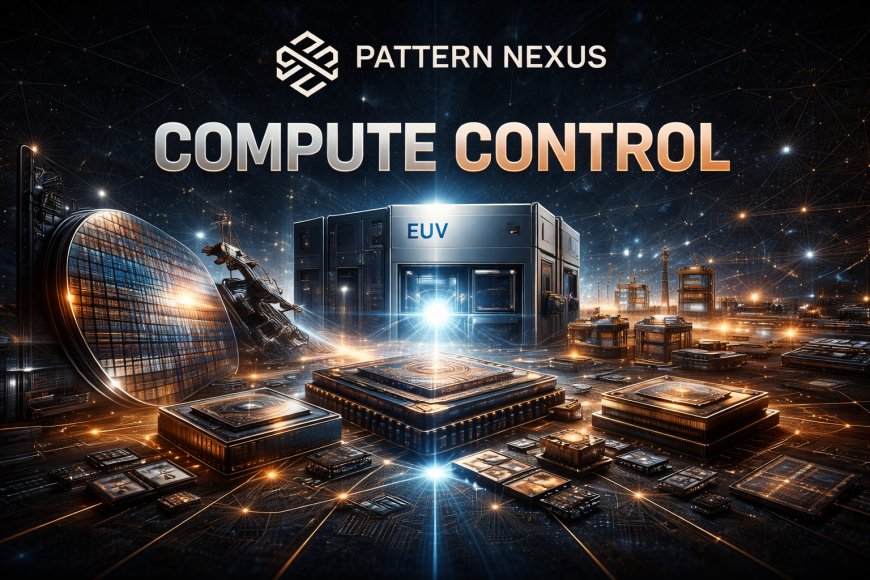
Compute Control
Compute is no longer just a commodity input to productivity. It is a strategic resource that can be gated, throttled, and permissioned. In the control-systems era, chips, fabs, packaging capacity, and AI data-center buildouts have become enforcement infrastructure—capable of shaping outcomes without laws, borders, or conventional coercion.
Summary
Compute control is the next enforcement layer after money and standards. It is physically rooted, industrially scarce, and centrally networked. Unlike many resources, advanced compute is not merely “owned.” It is produced through an ecosystem of bottlenecks—high-end lithography, specialized manufacturing tools, ultra-pure inputs, advanced packaging capacity, HBM supply, high-speed networking, and cloud-scale delivery.
This creates a structural reality: if you can gate the bottlenecks, you can throttle the frontier. You do not need to ban “AI.” You do not need to censor ideas. You only need to constrain the throughput required to train, deploy, and scale the most capable models. The mechanism is not morality. It is capacity and permission.
System Reality: In the compute era, the decisive question is not “who has the best ideas?” It is “who can access the frontier throughput?”
As of late 2025, the control system is no longer theoretical. High-volume production has begun at new U.S. advanced-node capacity. Advanced packaging remains a persistent bottleneck even as capacity expands. Export controls have iterated from item bans to capability thresholds, to cloud and ecosystem logic, then back again through rescissions and guidance. The enforcement surface is changing in real time because the prize is not market share. It is the speed of capability diffusion.
Compute as a Control Layer
Most people still treat compute as an input—like steel, electricity, or bandwidth. That framing is now obsolete. Compute is an enabling substrate for modern advantage across:
- Weapons modeling and simulation
- Signals intelligence and pattern extraction
- Cyber offense and defense
- Industrial optimization and automation
- Biotech discovery pipelines
- Financial modeling and market infrastructure
- Language, persuasion, and narrative systems
When compute becomes a general-purpose amplifier across military, industrial, and informational domains, it becomes a strategic resource. Strategic resources are never “free markets” for long. They become governed—directly or indirectly—through control points that can be enforced.
The compute layer is uniquely suited to control because it satisfies three conditions:
- Scarce at the frontier: Leading-edge chips and tools are limited by industrial reality, not just capital.
- Centralized production: The highest tiers of capability concentrate in a small number of firms, toolmakers, and geographies.
- Networked distribution: Compute is increasingly delivered through clouds and managed platforms where denial is easier than seizure.
Myth vs Mechanism: Myth: compute is just technology. Mechanism: compute is a gateable infrastructure layer.
The shift is civilization-level: you can now shape a rival’s trajectory without occupying territory, sanctioning every company, or banning every idea. You only need to manage the rate at which high-end throughput enters the system, and ensure that attempts to route around the valves remain costly.
The Compute Stack: Where Control Lives
Compute is not one thing. It is a stack. Control emerges where the stack has the highest friction and the fewest substitutes.
Text Diagram:
Materials → Tools → Lithography → Fab process → Yield → Packaging → HBM → Networking → Data-center power → Cloud access → Model training → Deployment
Control can be applied at any arrow. The system chooses the arrows with the least political cost and the highest enforcement reliability.
At the top of the stack, “AI” looks abstract. At the bottom of the stack, it becomes brutally physical. Advanced compute requires:
- precision tools measured in nanometers
- repeatability across millions of process steps
- defect control at extreme tolerances
- advanced packaging that can move power and data at massive densities
- HBM supply that matches accelerator demand
- power infrastructure that can sustain continuous load
- high-speed interconnect that keeps clusters coherent
When people say “chips,” they are compressing a civilization-scale manufacturing process into one word. That compression is why the control layer is misunderstood.
Hidden Constraint: The compute bottleneck is not “inventing a chip.” It is reproducing the industrial stack at scale, with yield, reliability, packaging, memory, networking, and continuous improvement.
This is also why control is durable. Every arrow is a learning curve. You can spend money to accelerate parts of the chain, but you cannot buy time at the frontier without already having time.
Fabs Are Not Factories—They Are Time Machines
The most advanced fabrication plants do not behave like normal factories. In a typical factory, you can add shifts, add machines, expand throughput, or substitute suppliers. Leading-edge semiconductor manufacturing does not scale that way.
Fabs are time machines because:
- lead times are measured in years, not quarters
- tool installation and calibration is slow and fragile
- yields improve through accumulated process learning
- each node shrink requires new physical constraints and methods
- ramp speed is bounded by defect learning, not by hiring
This creates a strategic effect: once a country or bloc is ahead at the leading edge, it is not easily caught. The gap is not a single breakthrough. It is sustained compound learning.
System Reality: Fabs are not built to “produce chips.” They are built to produce learning curves that compound for years.
This is why industrial policy targets fabs. The United States’ CHIPS and Science Act hard-coded the idea that compute capacity is not just “industry.” It is national infrastructure.
By late 2024, TSMC’s first Arizona fab began high-volume production on N4. In 2025, TSMC publicly described construction completion milestones for the second fab structure and broke ground on a third fab site in April 2025 aimed at future N2 and A16 process technologies by the end of the decade. This is what a control-system redesign looks like in physical form: slow, capital-intensive, politically negotiated, and absolutely irreversible once it ramps.
At the same time, the U.S. leading-edge manufacturing story is no longer only “TSMC in Arizona.” Intel’s Arizona expansion narrative has increasingly been positioned around advanced nodes, EUV tool deployment, and large campus scale. Whether or not every ramp hits schedule, the direction is the point: compute sovereignty is being built like energy sovereignty—through domestic capacity, redundancy, and control of failure modes.
Second-Order Effect: “Onshoring fabs” is not just about jobs. It is about shifting where the valves are physically located.
Chokepoints: EUV, Tools, Materials, Packaging
Compute control works because the ecosystem contains hard chokepoints—places where substitutes are weak and timelines are long.
EUV Lithography
Extreme ultraviolet (EUV) lithography remains one of the clearest chokepoints in the modern industrial world. It is not simply a machine. It is a convergence of optics, plasma physics, contamination control, and precision mechanics. EUV enables the most advanced process nodes by patterning features at extreme scales.
EUV is also an enforcement point because it is rare and politically gateable. Reporting as of December 2025 continues to reflect the same structural reality: EUV shipments to China never materialized, and restrictions expanded over time through U.S.-led pressure and allied export controls.
Hidden Constraint: If you cannot access EUV, you can still make chips—but scaling cost-effectively at the frontier becomes structurally harder.
DUV and the “Good Enough” Frontier
The story did not stop at EUV. A 2025 reality has become clearer: high-end DUV tools can be pushed further through multi-patterning, process tricks, and relentless engineering, at the cost of yield, time, and money. Reporting in late 2025 described China upgrading older ASML machines and using DUV systems to sustain 7nm-class output for certain applications. That matters because it defines what throttling actually means: not “stop progress,” but “raise the cost curve and slow the diffusion of the best throughput.”
System Reality: Control systems rarely produce zeros. They produce friction, inefficiency, and time delay.
Semiconductor Manufacturing Equipment
EUV is the headline, but the deeper mechanism is the equipment ecosystem. Advanced manufacturing requires fleets of deposition, etch, metrology, inspection, and process control tools. Each category has its own supply chain and knowledge base.
This is why export-control regimes target not only chips, but tools. Cutting off one tool category can bottleneck an entire node, because the manufacturing process is only as strong as its weakest step, and the weakest step moves as rivals adapt.
Materials, Chemicals, and Ultra-Pure Inputs
Modern chips are chemistry as much as electronics. Ultra-pure gases, specialized photoresists, wafers, and process chemicals sit beneath the abstraction of “technology.” Restrictions or chokepoints at the materials layer can quietly cap output, yields, or reliability without ever appearing as a dramatic “ban.”
Advanced Packaging and the CoWoS Era
The frontier is no longer only about shrinking transistors. It is also about stitching compute together through packaging—moving data and power across dense interconnects while integrating HBM stacks at scale. Advanced packaging has been a persistent bottleneck across 2024–2025, and the industry response has been expansion, not relief.
By 2025, reporting and company commentary consistently framed advanced packaging capacity as a gating factor for AI accelerators, with Nvidia transitioning its needs across CoWoS variants as architectures evolved. Even as capacity expanded rapidly, the bottleneck remained because demand expanded faster. This is a core Pattern Nexus principle: control layers intensify when demand growth outruns infrastructure expansion.
Second-Order Effect: The compute bottleneck migrates. When lithography is constrained, packaging and HBM become the new choke. When packaging expands, power and grid connection become the new choke.
Export Controls as System Design
Export controls are often treated as political actions—temporary, reversible, symbolic. In reality, modern export controls operate more like system design: an attempt to shape the topology of global capability over time.
A key shift occurred when controls expanded from “specific items” to “capability thresholds” and “end-use logic.” Starting with broad U.S. actions in October 2022, the framework iterated through subsequent rules and refinements, including additional restrictions and rule updates in late 2024 affecting advanced computing and semiconductor manufacturing equipment.
System Reality: Modern export controls are not a wall. They are valves that regulate capability throughput.
Then the control system made a revealing move. In January 2025, BIS published a “Framework for Artificial Intelligence Diffusion” rule structure that attempted to formalize a global licensing architecture for advanced computing items and AI diffusion risk. Compliance was scheduled to bite in mid-May 2025. In May 2025, BIS announced the rule’s rescission and replaced it with guidance and an enforcement posture, while describing an intention to pursue a different approach.
This matters because it shows how governance actually behaves in the control-systems era. It is not a single law. It is iterative architecture. When industry backlash, diplomatic friction, or enforcement complexity becomes too high, the control system changes form without changing purpose.
By September 2025, U.S. government reporting summarized continued iterations in the controls landscape, including changes in entity listings and guidance tied to Chinese AI chips. The message is consistent across the variants: control is shifting from “lists of items” to “ecosystem compliance,” and from “hardware only” toward the broader chain of access, servicing, and usage.
Myth vs Mechanism: Myth: export controls are “policy.” Mechanism: export controls are adaptive architecture—continuously revised to keep the valve system tight.
Cloud Compute as the New Border
The most important shift in compute control is that compute is increasingly delivered as a service. This changes the enforcement surface.
When compute is local, enforcement requires intercepting physical supply chains. When compute is cloud-delivered, enforcement can occur through:
- account access
- regional availability
- usage monitoring
- capacity quotas
- contract eligibility
- validated end-user structures and compliance categories
This is why compute is a control layer. The “border” becomes the cloud login, the procurement contract, the compliance certification, or the data-center build permit. The geopolitical contest shifts from seizing territory to controlling access to throughput.
Hidden Constraint: When compute is rented, denial is easier than seizure.
Cloud borders also shift the political optics. Instead of “blocking a country,” enforcement becomes “risk management,” “terms of service,” “validated end users,” and “compliance posture.” That is exactly how control systems scale: not by declaring enemies, but by redefining eligibility.
AI Throttling: Capabilities, Not Speech
The enforcement logic of compute control is not to ban ideas. It is to constrain capability scaling. This is a fundamentally different form of governance.
AI throttling works because frontier AI capability is compute-intensive. Training and deploying advanced models requires sustained throughput across large accelerator fleets, high-bandwidth interconnects, and power-dense data centers. If you can:
- limit advanced accelerators
- limit packaging and HBM integration
- limit high-end networking
- limit cloud-scale access
- limit service, parts, and tool upgrades
Then you can shape the global pace of capability diffusion without ever touching “speech.”
System Reality: The new censorship is not content censorship. It is throughput censorship.
This is why some proposals moved toward “trained capability” as the control surface, including concepts that would treat model weights as a controlled item class. Even when those frameworks are rescinded, the direction remains visible: governance is migrating upward from hardware toward capability objects, while enforcement remains anchored in physical throughput.
Countermoves and Workarounds
Control systems create incentives. Incentives produce countermoves. Compute control therefore generates predictable adaptation pathways:
- Indigenous substitution: building domestic toolchains and process alternatives over time.
- Node shifting: focusing on older nodes with scale, yield, and cost advantages.
- Architectural optimization: extracting more capability from less compute via model and system efficiency.
- Service routing: accessing compute through third-country clouds, subsidiaries, or intermediaries.
- Maintenance leverage: extending the life of existing equipment through servicing, parts, and tool upgrades.
This is why control systems rarely “solve” competition. They shape the slope. They buy time. They force inefficiency into the rival system. They raise the cost of frontier participation.
Second-Order Effect: Compute control does not eliminate capability. It changes the economics of capability, and economics changes speed.
What This Means for Markets and States
Compute control is not just geopolitics. It is industrial allocation and market structure.
For states, compute becomes a sovereignty test. If a country cannot secure:
- reliable access to advanced chips and tools
- advanced packaging and HBM supply chains
- power infrastructure for data centers
- cloud-scale platforms with trusted supply chains
Then it becomes dependent—not just economically, but strategically. Its modernization path becomes permissioned.
For markets, compute control implies that “AI winners” are not only the best model builders. They are the actors with:
- secure accelerator allocation
- packaging capacity and priority
- HBM access
- data-center power buildouts
- regulatory and export-control resilience
- allied supply-chain positioning
System Reality: In the compute era, industrial capacity and compliance posture become alpha.
This also reframes the AI boom. If compute is controlled, then AI is not simply a “software revolution.” It is an industrial mobilization. The winners are those who can coordinate capital, power, supply chains, and regulation under one coherent throughput strategy.
Pattern Nexus Lens
Compute is the control layer that completes the chain.
Money controls participation through rails and clearance. Standards control participation through compatibility and certification. Energy controls participation through uptime and load. Compute controls participation through capability throughput.
This is why the world is reorganizing around chips, fabs, packaging lines, and data centers. Not because technology is fashionable. Because technology has become enforceable infrastructure.
System Reality: Whoever controls frontier compute controls the speed of the future.
FAQ
Is compute control just about one country versus another?
No. The deeper mechanism is structural: capability concentrates where bottlenecks concentrate. States and blocs then govern the bottlenecks.
Can software overcome hardware constraints?
Efficiency gains matter, but frontier capability still requires sustained throughput. Optimization changes the slope, not the existence of the bottleneck.
Why focus on fabs instead of just buying chips?
Because buying chips becomes permissioned under export-control regimes. Building capacity is a sovereignty hedge, even if it is expensive.
Is “AI throttling” inevitable?
If compute remains scarce and strategic, throttling is the default behavior of the system—whether through law, markets, corporate risk controls, or allied compliance architecture.
Sources
- CHIPS and Science Act (Public Law 117-167)
- TSMC Arizona: Public milestones for Fab 21 phases (N4 in high-volume production; later phases and timelines)
- TSMC press release (Mar 4, 2025): U.S. investment expansion and Arizona site status
- Federal Register (Jan 15, 2025): Framework for Artificial Intelligence Diffusion
- BIS press release (May 13, 2025): Rescission of the AI Diffusion Rule
- Congressional Research Service (Sep 19, 2025): U.S. Export Controls and China—Advanced Semiconductors
- Reuters (Dec 17, 2025): China’s AI chip mobilization and EUV restriction context
- Financial Times (Dec 2025): China upgrades older lithography tools to boost AI chip output
- Reuters (Jan 16, 2025): Nvidia on CoWoS packaging transitions and capacity constraints
- ASML press release (Dec 2, 2024): Updated export restrictions outlook for 2025
- Reuters (Jan 17, 2025): Dutch export-control disclosure context and ASML China exposure
Hva er din reaksjon?
 Liker
0
Liker
0
 Misliker
0
Misliker
0
 Kjærlighet
0
Kjærlighet
0
 Morsom
0
Morsom
0
 Wow
0
Wow
0
 Trist
0
Trist
0
 Sint
0
Sint
0

Founder of Pattern Nexus. I research markets, macro, geopolitics, AI, history, ancient systems, and the patterns most people overlook. I’m also building Market Radar, a trading scanner designed to read pressure, risk, confirmation, and setup quality before chasing a move. Pattern Nexus is where I connect the dots between data, history, technology, and the bigger system playing out around us.


















Kommentarer (0)