
Debt Is Not Income: How Asset-Based Living Legally Escapes the Tax Trap
The tax system taxes transactions, not wealth. Learn how borrowing against appreciated assets allows individuals to legally fund their lives without triggering income or capital gains taxes—and why this is a structural feature of modern finance, not a loophole.
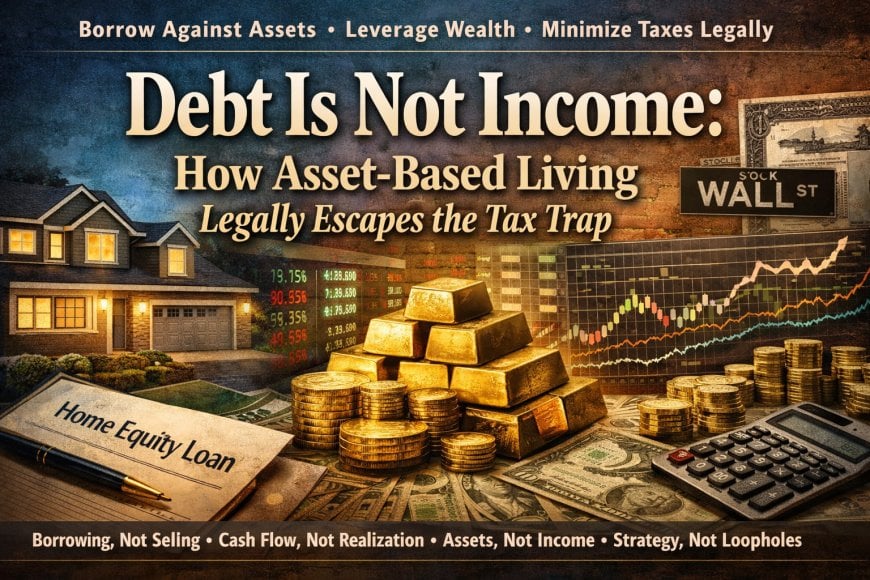
The tax system does not punish wealth. It punishes transactions. Income is taxed. Sales are taxed. Realization is taxed. Borrowing is not. This report explains how asset appreciation, leverage, and balance-sheet strategy allow individuals to legally fund their lives without triggering taxable events—and why this is not a loophole, but a structural feature of the modern financial system.
Executive Summary
The most misunderstood fact in modern finance is simple: wealth is not taxed. Transactions are. Individuals who structure their financial lives around income remain perpetually exposed to taxation. Individuals who structure around assets minimize taxable events by default.
This is not secrecy. It is balance-sheet design. Borrowing against appreciated assets allows liquidity without realization, consumption without income, and flexibility without triggering tax liability. This framework scales from ordinary homeowners to sophisticated multi-asset portfolios.
The Income Illusion
Most people conceptualize money incorrectly. They think in terms of earnings, wages, and paychecks. That framing hardwires taxation into daily life.
The system was not designed around income. It was designed around balance sheets. Income is merely one line item. Assets, liabilities, equity, and cash flow are the real control variables.
When someone says “I make $X per year,” they are declaring a taxable identity. When someone says “I control $X in assets,” they are operating in a different domain entirely.
Why Taxes Follow Events, Not Wealth
The tax code does not assess value in stasis. It responds to movement.
- Earning income creates a taxable event
- Selling an appreciated asset creates a taxable event
- Receiving distributions creates a taxable event
- Transferring assets creates a taxable event
Appreciation without realization does nothing. Holding assets does nothing. Net worth growth does nothing. Taxes require motion.
Debt Is Not Income
Borrowed money is not income because it is offset by an obligation. When debt is issued, assets increase and liabilities increase by the same amount. Net worth does not change at inception.
No gain has occurred. No income has been realized. No tax is triggered.
This is not a loophole. It is the foundational distinction that allows credit markets to exist at all.
The Core Asset-Based Living Mechanic
The strategy used by financially sophisticated actors follows a repeatable pattern:
- Acquire assets that appreciate, cash flow, or both
- Allow equity to compound over time
- Borrow against that equity at controlled leverage
- Use borrowed funds for living expenses or reinvestment
- Service or roll debt through cash flow, refinancing, or asset growth
No sale occurs. No income is created. Liquidity is obtained without taxation.
The Scaling Ladder: From Household to Portfolio
Household Level: A homeowner with equity accesses liquidity through a HELOC or cash-out refinance. Living expenses are funded without selling the home or generating income.
Small Investor Level: Rental properties generate cash flow to service debt. Appreciation expands borrowing capacity. Refinancing extracts equity tax-free.
Portfolio Level: Diversified assets support securities-backed lines of credit. Liquidity becomes continuous, flexible, and event-free.
The difference is scale, not legality.
Asset Classes That Support This Strategy
Any asset can support asset-based living if it satisfies lender criteria.
- Real estate with stable valuation and income
- Public equities held in marginable accounts
- Private businesses with predictable cash flow
- Other recognized collateral assets
The limiting factor is not the tax code. It is collateral quality and risk management.
Separating Legal Strategy From Tax Evasion
Tax minimization involves structuring activity to reduce taxable events.
Tax evasion involves concealing income, falsifying records, or violating reporting requirements.
Borrowing against assets, deferring realization, and using depreciation or leverage as designed are explicitly legal. They are widely disclosed, regulated, and professionally advised.
The Real Risks No One Mentions
This strategy is powerful, but not forgiving.
- Excess leverage converts tax efficiency into fragility
- Rising rates increase servicing costs
- Asset volatility can trigger margin calls
- Poor liquidity planning forces unwanted sales
The system rewards restraint. It punishes overconfidence.
The Pattern Nexus Lens
The tax system, credit markets, and asset markets form a single integrated control structure.
Those who operate at the income layer remain trapped inside taxable flows. Those who operate at the balance-sheet layer minimize taxation naturally by avoiding events.
This is not hidden knowledge. It is simply never taught.
The system does not ask whether this is fair. It asks whether you understand how it works.
Hva er din reaksjon?
 Liker
0
Liker
0
 Misliker
0
Misliker
0
 Kjærlighet
0
Kjærlighet
0
 Morsom
0
Morsom
0
 Wow
0
Wow
0
 Trist
0
Trist
0
 Sint
0
Sint
0

Founder of Pattern Nexus. I research markets, macro, geopolitics, AI, history, ancient systems, and the patterns most people overlook. I’m also building Market Radar, a trading scanner designed to read pressure, risk, confirmation, and setup quality before chasing a move. Pattern Nexus is where I connect the dots between data, history, technology, and the bigger system playing out around us.















Kommentarer (0)