
🚫 The 1% Down Payment Trap: Why “Affordable Homeownership” Isn’t What It Seems
Rocket Mortgage’s “1% down payment” program sounds like an opportunity—but it’s actually a financial trap. Here’s why ultra-low down payments create long-term risk, negative equity, and constant expenses that drain real wealth.

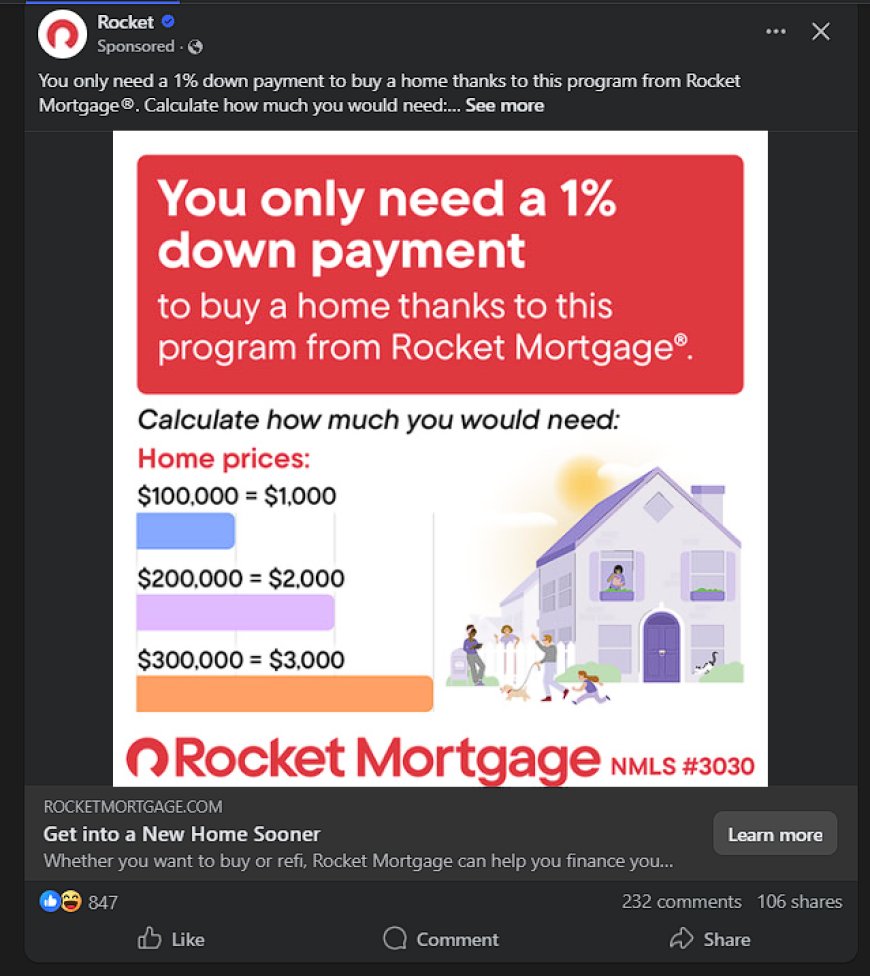
🚫 Don’t Ever Do 1% Down — Here’s Why It’s a Trap
In my view: this isn’t an opportunity — it’s bait. The shiny “1% down” headline is engineered to sell leverage to people who can least afford it.
What the Ad Doesn’t Say
3.5% was already bad; 1% is worse. At 3.5% down (think FHA), you’re near zero equity after closing costs and mortgage insurance. At 1% down, you’re effectively underwater on day one. A 2% price dip can trap you in the house with no way out.
A house is a cash-demanding asset. You’re signing up for property taxes, insurance (often with add-ons like flood/fire), HOA fees, and unplanned repairs — roof, HVAC, plumbing, electrical. Any one of these can be four to five figures. A home is capital-intensive and illiquid.
Low down = high monthly burden. Tiny equity means bigger principal, higher PMI, and often a worse rate. That leaves no room for saving or investing elsewhere.
The Risk Transfer Game
These “low down” programs shift risk off lenders and onto you. If you default, the system is protected by insurance and fees. You’re the one who loses the house, the credit score, and any cash you put in.
The Numbers Behind the Caution
- Even at ~3.5% down, early-stage delinquencies are higher than conventional loans — and that’s with more equity than 1% down.
- Total homeowner costs have climbed dramatically in recent years — before you factor major repairs.
- Seasoned buyers wait for the right entry instead of stretching into thin-equity purchases.
Reality Check: A House Always Needs More Money
Your payment isn’t the whole picture. Expect ongoing outflows: utilities, landscaping, pest control, appliance replacement, driveway/sidewalk, foundation or moisture issues, code updates, and the big-ticket items (roof, windows, siding). The house will ask for more money — repeatedly.
What “Ready to Buy” Actually Looks Like
- 10–20% down (minimum) plus closing costs.
- 6 months of reserves (after you close).
- Budget for maintenance (1–3% of home value per year as a rule-of-thumb).
- PMI-free or PMI-short path, fixed-rate, and payment comfort at today’s rates.
Renting is not “throwing money away.” It’s buying optionality and time while you build liquidity and avoid being house-poor.
Bottom Line
Low-down ads are engineered to sell you on possession while ignoring position. Real wealth is the opposite. If you can’t buy with meaningful equity and real cash buffers, don’t buy yet. Stack cash, strengthen your position, and enter on your terms — not the lender’s marketing cycle.
Sources
- Urban Institute – FHA loans and comparative risk
- Freddie Mac – Homeownership expenses analysis
- Wall Street Journal – Should you buy in this market?
Tags: #HousingTrap #HomeBuyingTruth #RocketMortgage #1PercentDown #DebtIsNotWealth #HousePoor #MortgageMyths #FinancialLiteracy #OwnResponsibly #PatternNexus
Hva er din reaksjon?
 Liker
0
Liker
0
 Misliker
0
Misliker
0
 Kjærlighet
0
Kjærlighet
0
 Morsom
0
Morsom
0
 Wow
0
Wow
0
 Trist
0
Trist
0
 Sint
0
Sint
0













Kommentarer (0)