
Geopolitical Activity Report: Mid-December 2025
A systems-level geopolitical breakdown of Dec 10–21, 2025, as sanctions hardened into blockades, deterrence shifted toward modular escalation, and multiple theaters—from Venezuela to Taiwan to Southeast Asia—quietly reset global risk baselines.
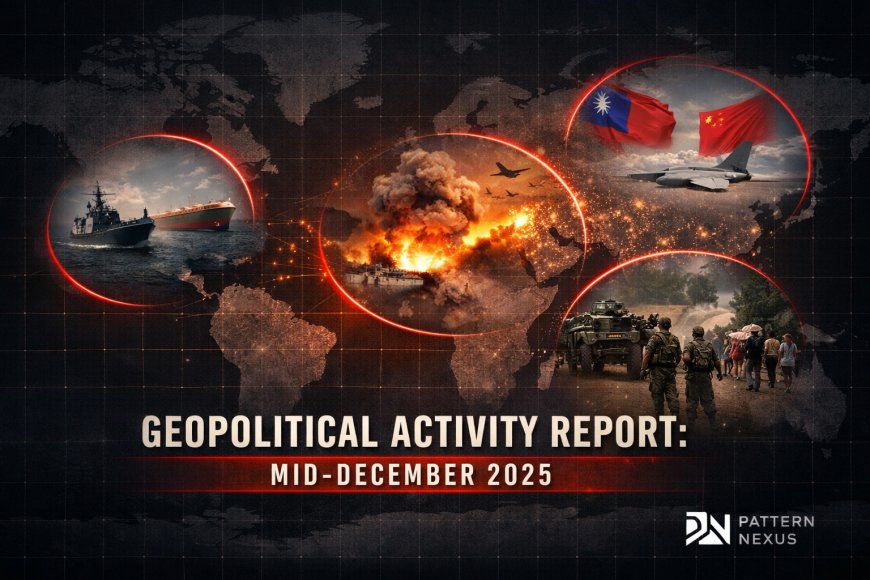
This was not “a chaotic news cycle.” It was a week where coercion tools hardened into doctrine: maritime interdiction as economic warfare, precision strikes as deterrence maintenance, arms packages as time-buying, and border conflicts as magnets for great-power mediation. The signal is simple: escalation is being normalized in modular pieces, packaged as enforcement, counter-terror, or “defense assistance,” while the global system adapts to a higher baseline of friction.
Executive Summary
Venezuela moved from sanctions pressure to blockade logic. The key development wasn’t a statement. It was the operational act: a second major tanker interdiction in international waters and the widening claim that interdiction can be treated as “enforcement,” even when the vessel itself isn’t clearly sanctioned.
Washington’s constraint mechanisms failed to bite. Congressional efforts to limit the Venezuela campaign did not impose an immediate brake, keeping the escalation toolkit wide and largely executive-driven.
China–U.S. tensions remained centered on Taiwan, but the week’s signal was precedent. The Taiwan arms package is deterrence-by-time-buying; the Venezuela blockade template is coercion-by-maritime-control. Beijing will read both as pattern, not isolated events.
Syria showed deterrence maintenance. High-volume strikes against ISIS targets signal that attacks on U.S. forces still trigger rapid kinetic overmatch, even amid broader strategic reprioritization.
ASEAN became a major theater overnight. Thailand–Cambodia border fighting created mass displacement, and both China and the U.S. moved to mediate ahead of regional diplomacy—competitive stabilization is now a default behavior.
Sudan reminded the world that drones are rewriting “protected status.” Peacekeepers and civilian sanctuaries are increasingly targetable in drone-saturated civil wars, eroding post–Cold War assumptions about institutional immunity.
Bottom line: The system is drifting toward a higher friction equilibrium. Escalation is being broken into smaller “legible” modules (interdictions, strikes, arms packages, “counter-terror” raids), each easier to justify domestically, but collectively more destabilizing.
Timeline (Dec 10–21)
This timeline emphasizes high-signal items with direct state action, escalation movement, or diplomatic reconfiguration.
- Dec 10–12: Venezuela theater intensifies in maritime enforcement posture; sanctions and interdiction logic becomes the center of gravity.
- Dec 13: Palmyra-area attack in Syria kills U.S. personnel; sets conditions for a retaliatory strike package.
- Dec 15–19: U.S. moves forward on a large Taiwan arms package; China issues predictable counter-signaling.
- Dec 19–20: U.S. executes high-volume strikes on ISIS targets in Syria; deterrence reasserted.
- Dec 20–21: Second major Venezuela-linked tanker interdiction reported; regional and great-power commentary escalates; Thailand–Cambodia border conflict expands humanitarian footprint; mediation competition intensifies.
Venezuela: Blockade Logic Goes Operational
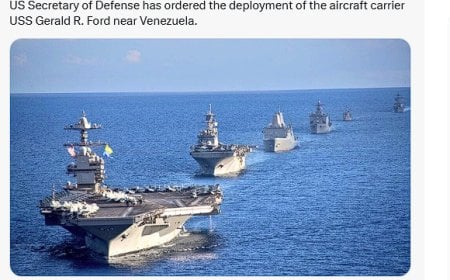
The Venezuela story this week is not primarily about rhetoric. It is about a shift in how the United States is using maritime power to convert sanctions into physical constraint. In practice, that means interdiction, boarding, and seizure logic applied at scale in or near the Caribbean operating environment, with the implicit claim that economic warfare can be executed as “law enforcement” even when the legal boundaries are contested.
What changed: The U.S. reportedly interdicted a second large oil tanker carrying Venezuelan crude in international waters. This matters because it turns “sanctions” into “movement denial,” and movement denial is the functional core of blockade logic.
Why the second interdiction matters
A first interdiction can be framed as an outlier or a special case. A second interdiction defines pattern. It tells shippers, insurers, brokers, and flag registries that the risk model has changed. Once the market believes interdiction risk is persistent, “legal compliance” becomes less important than “avoidance behavior.” That is how blockades work even before they are declared as blockades.
The legality fight is not academic
Reports that the interdicted vessel may not have been explicitly sanctioned are central. If enforcement is applied to “associated” flows rather than named targets, the real message is that the U.S. is willing to operate on a doctrine of economic containment, not just sanctions compliance. That expands coercive power, but it also expands reputational and precedent risk.
Caracas counter-options (and why they’re dangerous)
Venezuela’s plausible counters are limited, but not harmless. Naval escort, harassment, legal escalation, and asymmetric disruption are all on the table. Even a low-probability escort attempt increases the chance of an incident chain: warning shots, collision risk, misread intent, domestic political escalation, and eventual kinetic exchange that neither side planned.
PN read: Venezuela is being turned into a template theater for “sanctions plus interdiction.” The template is the point. The crude is the mechanism. The precedent is the payload.
Washington: The Internal Fight Over Escalation
When you hear “land strikes” and “opposition inside the administration,” treat it as an argument about escalation geometry. Maritime interdiction is coercive but externally legible as “enforcement.” Land strikes are coercive and legible as “war.” The internal fight is about which tool preserves domestic legitimacy while preserving strategic leverage.
Why Congress matters even when it loses
The relevant fact from this window is that constraint attempts did not lock down the executive. That doesn’t prove a land campaign is imminent. It means the institutional brake did not engage during the exact period when the policy posture hardened. When brakes don’t engage during acceleration, you should assume higher variance outcomes become more likely, not lower.
The administration’s logic: deny revenue, deny momentum
The stated logic is classic coercion: cut off the revenue stream that sustains regime durability and security apparatus capability. The operational question is whether that can be achieved by maritime control alone. If it cannot, the system pressure naturally pushes toward step-up options: strikes on infrastructure, strikes on enabling networks, or direct action against nodes of state power.
Key distinction: Maritime interdiction is coercion with plausible deniability. Land strikes are coercion with political ownership. “Opposition inside the administration” is often just a fight over who owns the consequences.
China–U.S.: Taiwan, Trade Surplus, and Coercion Signaling
This week’s China signal is not a single event. It’s two lanes running in parallel: the security lane (Taiwan arms) and the economic lane (trade surplus and tariff escalation fears). Both lanes converge on the same meta-point: each side is hardening its willingness to use coercion while trying to keep the coercion “legible” as defensive or corrective.
Taiwan arms package: time-buying through asymmetric capacity
The U.S. advanced a major Taiwan arms package. The operational meaning is not “war is imminent.” The operational meaning is “the U.S. is investing in Taiwan’s ability to survive the opening phase of coercion,” which is how you shape Beijing’s calculus. China’s response is predictable, but the repetition is the point: repetition turns outrage into routine, and routine reduces the stabilizing effect of outrage.
Economic lane: trade surplus, tariffs, and legitimacy
Reports of record-scale trade surplus and Beijing’s warnings about tariff spirals frame the economic conflict as mutual destruction, but it is also a negotiation posture: China wants to keep market access while maintaining industrial dominance. For the U.S., the political system is increasingly willing to treat trade architecture as a national security variable. That means geoeconomics is now the primary battleground even when the military theater captures headlines.
PN read: Venezuela’s blockade template is not only about Venezuela. Beijing will read it as a demonstration that the U.S. is willing to fuse law enforcement narrative with maritime movement denial. That’s a Taiwan-adjacent precedent risk whether Washington intends it or not.
Syria: Deterrence Maintenance via High-Volume Strike
After U.S. personnel were killed near Palmyra, the U.S. conducted high-volume strikes against ISIS targets across central Syria. The strategic message is straightforward: U.S. deterrence credibility still requires visible retaliation when U.S. forces are hit. This is not about territorial conquest. It’s about maintaining the perception that “attacking U.S. forces produces immediate cost.”
Why “high volume” matters
Precision strikes are now normal. High-volume precision strikes are designed to overwhelm narrative minimization. They are meant to be seen, discussed, and internalized by adversaries and partners. In a world where attention is fragmented, volume is sometimes how states ensure deterrence messaging survives the news cycle.
The hidden risk: interaction effects
When the U.S. demonstrates rapid kinetic reach in Syria while running coercive maritime operations in the Caribbean, multiple actors update their models simultaneously: proxy networks, regional partners, and great-power competitors. Even if the theaters are unrelated, perception is not compartmentalized. The week’s pattern reinforces that the U.S. is comfortable using force in discrete packages rather than in singular “war declarations.”
Russia–Ukraine: Negotiation Motion vs. Unchanged War Aims
The Ukraine lane this week featured a familiar duality: talk formats shift, diplomats move, proposals circulate, and yet intelligence assessments and public statements suggest core war aims remain sticky. That combination is not contradictory. It’s common in long wars: negotiation is used to shape coalition cohesion and resource flow while battlefield leverage remains the primary language.
Why “format” changes matter
When talks formats shift, it often signals that someone believes the prior structure was not extracting concessions. New formats are attempts to reweight influence: who sits at the table, who drafts, who guarantees, who pays, and who gets blamed for failure. Europe’s role is not cosmetic; it is the financial and political backbone of sustained resistance.
Unchanged aims: the hard constraint on peace narratives
If war aims remain unchanged, peace proposals become tests of endurance rather than paths to settlement. That doesn’t mean talks are useless. It means talks are part of the war, not an exit from it.
ASEAN Shock: Thailand–Cambodia Border War and Mediation Competition
If your feed is U.S.–China–Middle East heavy, this is where you likely missed a major signal: Thailand–Cambodia fighting expanded with substantial casualties and mass displacement. The significance is not only humanitarian. It is geopolitical, because instability in Southeast Asia is now a magnet for competitive mediation by great powers.
Why this escalated into a great-power interest
Southeast Asia is a strategic surface: trade routes, supply chains, basing access, and diplomatic alignment. A border conflict that displaces hundreds of thousands becomes a regional stress test. When stress rises, alignment becomes negotiable, and negotiability attracts major powers.
Competitive stabilization is the new default
Reports indicate both China and the United States moved to mediate ahead of regional meetings. This is not pure altruism. It is strategic positioning: who is seen as the stabilizer, who gets invited into the room, and who earns credibility with ASEAN capitals.
PN read: The world is shifting from “great powers intervene militarily” to “great powers intervene diplomatically for influence,” but the incentive structure is the same: control the terms of de-escalation, and you control the post-crisis alignment.
Sudan: Drone War Normalizes “Unprotected” Institutions
Sudan continues to demonstrate a grim modern reality: drones erase the practical meaning of “protected status.” Reports of major civilian casualties and attacks affecting peacekeepers underscore that civil wars are becoming technologically asymmetric without becoming less lethal. Drones lower the cost of striking, increase the frequency of strikes, and widen the set of targets that can be hit with plausible deniability.
The strategic implication
In drone-saturated conflicts, international institutions must either harden (physically and politically) or accept irrelevance. “Neutrality” does not automatically protect logistical hubs, hospitals, bases, or camps. This is a systems shift with global consequences because it is replicable everywhere.
Risk Map: What This Week Set Up Next
Venezuela: the escalation ladder is now visible
- Base case: interdictions continue, insurers and shippers price in avoidance, exports reroute, legal fights intensify.
- Step-up risk: escort attempts or harassment create an incident chain; domestic politics force “retaliatory” postures on both sides.
- Break case: strikes broaden beyond maritime enforcement into infrastructure or enabling networks, shifting the conflict from coercion to war optics.
China/Taiwan: routine outrage becomes operational drift
- Base case: arms package advances, China signals, drills continue, the cycle repeats.
- Step-up risk: China uses economic coercion or gray-zone actions to punish partners and test U.S. response bandwidth.
- Break case: a maritime incident forces crisis management, and Venezuela-style interdiction precedent becomes part of the narrative battle.
ASEAN: mediation becomes alignment leverage
- Base case: ceasefire talks stabilize, displacement becomes the long-tail burden.
- Step-up risk: prolonged instability invites external security “assistance” pathways that reshape regional posture.
- Break case: spillover disrupts trade routes or supply nodes, forcing broader security responses.
PN Lens: The New Baseline Is Modular Escalation
The dominant pattern across this week is not “conflict.” It is modular escalation. States are increasingly using smaller, repeatable actions that are politically legible and operationally effective: interdictions instead of declarations, strike packages instead of occupations, arms shipments instead of treaties, mediation instead of intervention.
The danger is that modular escalation lowers the psychological threshold for action. Each module feels containable. Each module is easier to justify. But the system result is cumulative friction: higher miscalculation probability, higher insurance costs, higher supply risk, higher alliance stress, and a world where “peace” is merely the space between modules.
The hidden continuity: Coercion is becoming normalized as a form of governance in international systems. The question is no longer “will coercion be used?” The question is “which coercion module is now politically acceptable?”
FAQ
Is the Venezuela situation a real blockade or just sanctions enforcement?
Functionally, repeated interdictions that deny movement are blockade-like even if the legal label is disputed. Markets respond to function, not semantics.
Does Taiwan arms news mean war is imminent?
Not necessarily. It is time-buying and deterrence shaping. The risk is operational drift: repeated cycles create normalization and misread intent.
Why does a Thailand–Cambodia border conflict matter globally?
Because Southeast Asia is a strategic surface for trade and alignment. When a regional crisis invites competitive mediation, it becomes a proxy contest for influence without needing formal proxy forces.
Why focus on Sudan in a week dominated by “big power” headlines?
Because Sudan shows the replicable future of conflict: drones, institutional vulnerability, and the erosion of “protected” status. It’s a template problem, not a local tragedy only.
Sources
Primary reporting referenced from the coverage window. Use these for verification and deeper reads.
- Reuters reporting on U.S. interdiction of a second Venezuelan-linked tanker and associated policy context. (Dec 2025)
- Reuters reporting on U.S. House action related to constraining the Venezuela campaign. (Dec 2025)
- Reuters reporting on U.S. Taiwan arms package procedures and China response signaling. (Dec 2025)
- Reuters reporting on U.S. strikes against ISIS targets in Syria following the Palmyra attack. (Dec 2025)
- Reuters/AP reporting on Thailand–Cambodia clashes, displacement, and mediation dynamics. (Dec 2025)
- Reuters/AP reporting on Sudan drone attacks, civilian casualty reporting, and peacekeeper impacts. (Dec 2025)
- Reuters reporting on Russia–Ukraine negotiation format discussion and intelligence framing on war aims. (Dec 2025)
Care este reacția ta?
 Îmi place
0
Îmi place
0
 Dezaprobat
0
Dezaprobat
0
 Iubire
0
Iubire
0
 Amuzant
0
Amuzant
0
 Wow
0
Wow
0
 Tristețe
0
Tristețe
0
 Înfuriați
0
Înfuriați
0

Founder of Pattern Nexus. I research markets, macro, geopolitics, AI, history, ancient systems, and the patterns most people overlook. I’m also building Market Radar, a trading scanner designed to read pressure, risk, confirmation, and setup quality before chasing a move. Pattern Nexus is where I connect the dots between data, history, technology, and the bigger system playing out around us.










Comentarii (0)