
The Lock-In Economy: Why America’s Housing Market Remains Frozen
The Lock-In Economy: Why America’s Housing Market Remains Frozen (2025) Meta Description: Rates above 7 percent created a lock-in freeze as homeowners cling to ultra-low mortgages. Here’s how it distorts supply, demand, demographics, and policy—and what could finally break it.

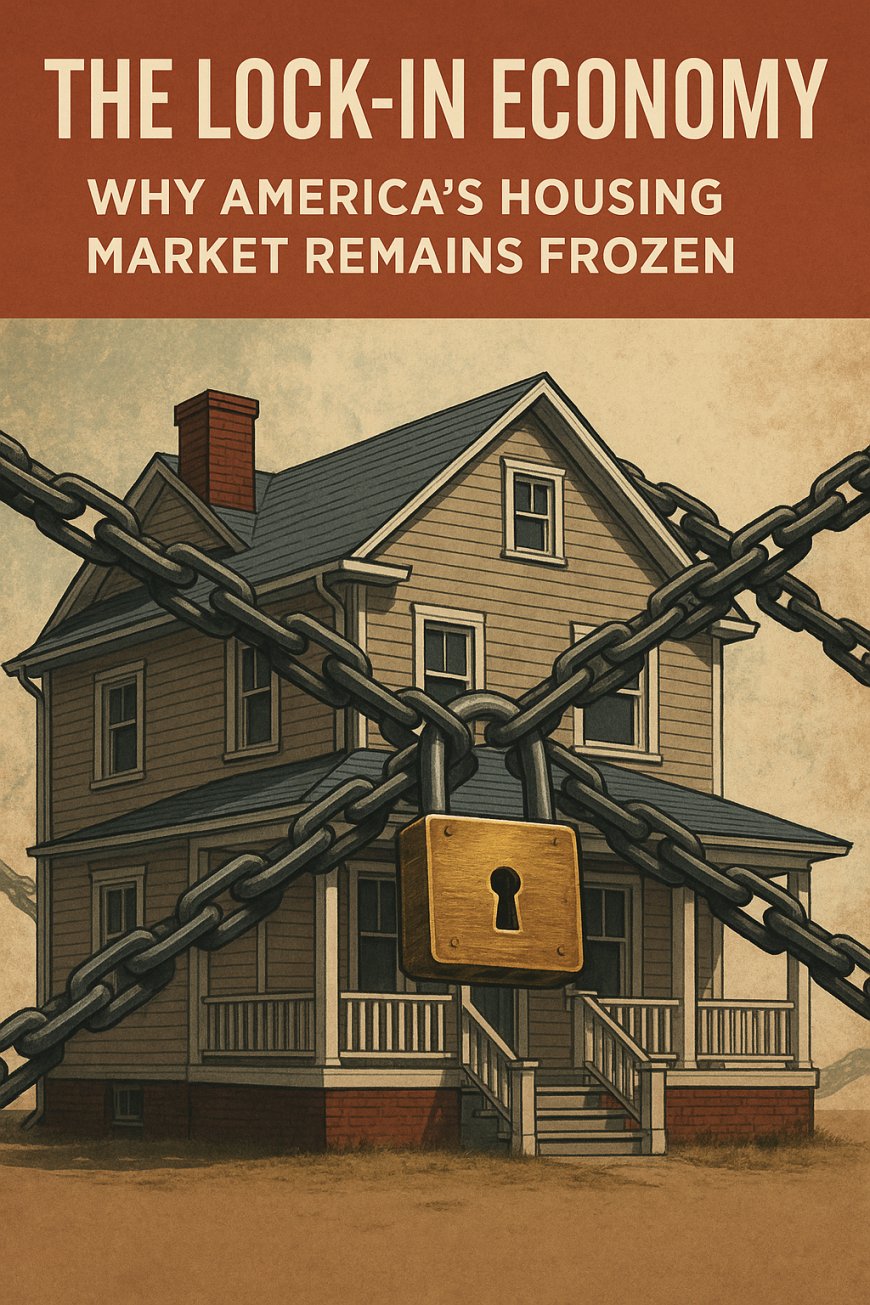
The Lock-In Economy: Why America’s Housing Market Remains Frozen
“Freedom, once locked in, is just another cage.”
I watch this from both sides of the fence: as a systems thinker, trader of signals and feedback loops, and as someone who’s lived the consequences in brick and drywall. Over the years I’ve bought, rehabbed, and managed homes through storms of policy, inflation, and human behavior. The U.S. housing market isn’t just a marketplace anymore—it’s a machine of interlocking gears, each feeding back into the next. The biggest gear grinding beneath the surface is the lock-in effect—the quiet trap of cheap money turned to stone.
The Handcuff of the Ultra-Cheap Mortgage
When rates sat between 3 % and 4 %, it felt like catching lightning in a bottle. People refinanced, stretched, built equity. But when the 30-year fixed jumped above 7 %, those golden handcuffs snapped tight. The same mortgages that once symbolized freedom now define captivity. As of late 2025, the average 30-year sits near 6.7 %, and J.P. Morgan Research projects home-price gains of roughly 3 % this year. That might sound steady—but it masks paralysis.
I feel it personally. Across my own portfolio—eight properties, three in remodel—I carry financing locked between 4 % and 5 %. On paper, that’s a dream. In reality, it’s inertia. If I sell, I surrender that rate and walk into a 7 % loan. Even if I profit, I lose the leverage edge that made the deal work in the first place. Multiply that psychology across tens of millions of owners, and you get the macro pattern we’re in now: supply suffocated not by crisis, but by comfort.
According to NAR data, existing-home sales hover near 4.1 million annualized, with total inventory around 1.55 million units—a 4.6-month supply. That’s lean by historical standards. The result is a self-feeding loop: owners hold → supply shrinks → buyers face higher rates and fewer choices → demand cools but never collapses → the freeze continues. It’s not recession; it’s suspended animation.
Demographics & Hidden Demand Engines
The deeper I look, the more I realize this system isn’t just economic—it’s demographic. Aging Boomers sit atop a vast share of America’s housing stock, often debt-free or with ultra-low rates. They’re not moving; they’re anchoring supply. Meanwhile, immigration—documented and undocumented—quietly props up demand. Millions of new residents need shelter whether the Fed cuts or not. And multifamily construction, strangled by financing costs, has slowed 20 % + year-over-year. The result: a growing population with fewer attainable units.
When I walk my own neighborhoods—talking with tenants, contractors, city inspectors—I sense the disconnect. Prices feel inflated, yet scarcity is real. Homes sit longer on the market, yes, but rents don’t collapse. Families crowd into multi-unit houses; investors bid selectively instead of feverishly. The tone isn’t panic; it’s caution, fatigue, wait-and-see. Everyone’s waiting for someone else to blink.
Why the Freeze Persists
Three systemic traps hold the market hostage:
1. Rate inertia. The spread between yesterday’s mortgage and today’s rate is the new psychological barrier. As long as we hover above 6.5 %, most owners won’t budge. Fannie Mae expects rates around 6.3 %-6.5 % into 2025, easing toward 6 % by 2026. That’s not enough to unlock movement; it’s just enough to tease it.
2. Supply bottlenecks. Active listings are up roughly 20 % year-over-year, yet total stock remains far below pre-pandemic norms. Builders have accelerated single-family starts by 7 %, but labor shortages, zoning friction, and material costs choke the pipeline. Even when new supply arrives, it often targets the high end. We’re building homes for the few while the many wait outside.
3. Affordability mismatch. Prices haven’t crashed because inventory hasn’t flooded. The median existing single-family home still fetches about $412 K—nearly five times the median household income. Builders respond by shrinking floor plans, but costs per square foot keep climbing. The math doesn’t rebalance—it contorts.
Put those three together, and you get what I call a frozen equilibrium—a dynamic stasis where motion exists but direction doesn’t. The market breathes, but shallowly.
The Macro Feedback Loop
This freeze doesn’t exist in isolation. It’s a byproduct of the Fed’s post-COVID whiplash—quantitative easing to quantitative tightening. When trillions in liquidity flooded the system, housing became the vessel. Cheap capital inflated asset values. Then the drain began, but slowly, leaving homeowners stranded between two monetary worlds: one awash in near-free debt, another priced by scarcity. The transition created a hybrid economy—half deflationary, half inflationary—where the velocity of money slows even as nominal prices rise.
I’ve watched that paradox up close. Material costs doubled during my 2021-22 remodel cycle, yet bid competition among investors cooled by 2024. It’s not lack of interest—it’s lack of fluidity. The same dollars chase fewer moves. The lock-in economy is the perfect example of a system where liquidity still exists but motion is constrained. Think of it as a lake after the wind stops: the water’s there, but it no longer moves the boats.
Short-Term Outlook (Next 6-12 Months)
Most analysts expect modest relief, not rescue. J.P. Morgan forecasts average 30-year rates around 6.3-6.5 % through 2025. HousingWire echoes that. Home-price gains flatten to 2-3 %, inventories edge higher, and time-on-market stretches from weeks to months. My own plan mirrors that reality: no major repositioning until financing costs justify it. Cash flow first, expansion later.
Across my tenants, I notice another loop: those wanting to buy can’t qualify; those who could qualify don’t want to lose flexibility. So they rent longer, reinforcing landlord stability. It’s a feedback system of hesitation—one that rewards patience and penalizes movement.
Medium-Term Outlook (12-24 Months)
If rates slip below 6 %, the ice starts to crack. Movement begets movement. A 5.5-6 % corridor would unlock pent-up supply as owners finally see parity between old loans and new opportunities. Fannie Mae projects ~5.9 % by late 2026; if that materializes, expect the first real mobility surge since 2021.
But builders will still lag. Permitting cycles stretch 12-18 months, and credit conditions remain tight. So even when demand reawakens, supply lags behind—creating the risk of another mini-bubble in mid-tier markets. Regional divergence will widen: Midwest and Sunbelt metros with affordability and inventory will thaw first; coastal markets, burdened by regulation and tax load, will lag years behind.
Risks & Wildcards
The structural risks remain clear:
• If inflation reignites or fiscal deficits widen, yields will stay elevated, keeping mortgage rates above 6 % for years. • If immigration policy tightens, rental demand could soften, but labor shortages would worsen, pushing construction costs higher. • If AI-driven productivity and domestic manufacturing expand faster than expected, wage gains could reignite housing inflation even amid rate stability. • And finally, if political instability hits—budget gridlock, regulatory shocks, or credit-market stress—the fragile equilibrium breaks suddenly rather than slowly.
Personally, my contingency map runs both ways: maintain liquidity for opportunity, but don’t assume the freeze guarantees safety. Systems this rigid tend to snap when change finally hits.
My Strategic Playbook
For me, the play is discipline. Monitor mortgage-finance spreads; watch liquidity shifts in the repo and MBS markets; gauge sentiment through rental turnover and application volume. If my financing advantage stays wide, I hold. If rates dip below 6 %, I pivot—selling underperformers, upgrading into better-positioned homes, or reinvesting into development projects where I control the inputs.
I treat property not as trophies but as nodes in a system—each with its own feedback loop of cash flow, equity growth, and maintenance drag. The moment one node stops producing, it becomes friction, and friction slows systems. That’s the engineer in me: cut inefficiency before it cuts you.
Above all, I keep emotional neutrality. Markets punish attachment. The same home that once felt like a foundation can become a liability if the macro tide shifts. So I watch, measure, adapt. This is a long game of compounding—not just money, but understanding.
The Human Cost of Stillness
Beyond the spreadsheets, there’s a moral dimension. A nation built on mobility now traps its people in place. Families stay in homes that no longer fit their lives. Young buyers delay milestones. Builders chase margins instead of communities. The American Dream morphs into stasis: everyone owns, but few move.
In my conversations with renters, many feel permanently priced out. In towns where I operate, Section 8 lists stretch for years. Property ownership becomes a kind of modern feudalism—landed versus landless—not because people are lazy, but because systems reward the already-positioned. The lock-in effect isn’t just an economic quirk; it’s a class divider disguised as fiscal prudence.
In Summary — The System Behind the Stillness
We are witnessing the fusion of monetary engineering and human behavior. Cheap credit created a generation of homeowners who cannot afford to move; tightening policy ensured they wouldn’t dare. The Fed, in trying to cool inflation, inadvertently cemented inequality. Housing became both the hedge and the prison.
This is why I call it the Lock-In Economy: liquidity exists, but movement doesn’t. Wealth is trapped inside assets that can’t circulate. It’s the macro equivalent of muscle tension—you look strong, but you can’t move freely.
We won’t break free until rates normalize near 5 %, construction scales sustainably, and policymakers understand housing not as an isolated market but as the circulatory system of the real economy. Until then, expect incremental thawing, rising frustration, and a slow drift toward bifurcation—owners versus outsiders, mobility versus stagnation.
Next in the Series → The Moral Architecture of Debt
In the next installment, I’ll explore the deeper psychology and design of our debt system—the invisible architecture that makes people feel “free” while keeping them bound to the same patterns of servitude and speculation. Because freedom, once institutionalized, always comes with walls. The goal isn’t to break them; it’s to understand the blueprint.
Care este reacția ta?
 Îmi place
0
Îmi place
0
 Dezaprobat
0
Dezaprobat
0
 Iubire
0
Iubire
0
 Amuzant
0
Amuzant
0
 Wow
0
Wow
0
 Tristețe
0
Tristețe
0
 Înfuriați
0
Înfuriați
0












Comentarii (0)