
Treasury Buyback Confirms the New Liquidity Regime
Treasury retires $12.5B in debt in a single buyback operation, confirming the shift into a post-QT, Treasury-driven liquidity regime.
Published: December 12, 2025
By: Pattern Nexus
Summary
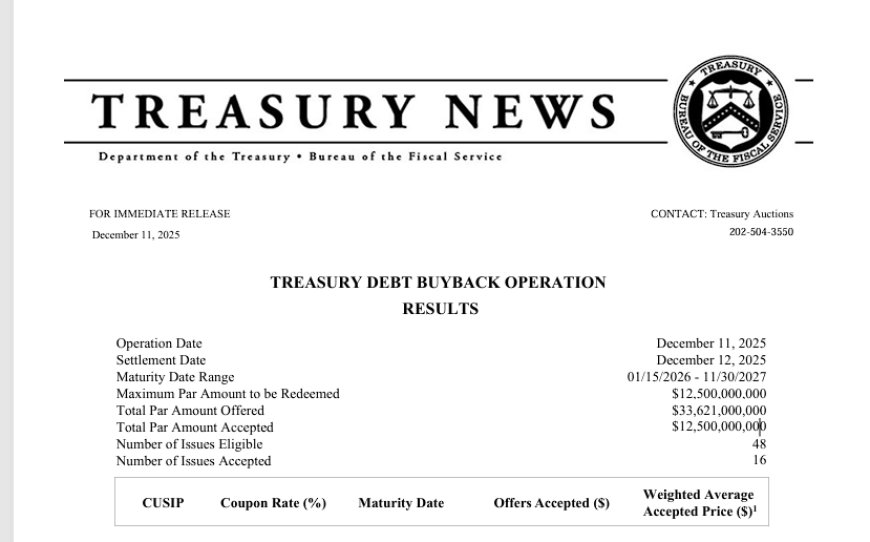
The U.S. Department of the Treasury has released the official Treasury Debt Buyback Operation Results for December 11, 2025. In a single operation, Treasury:
- Accepted the full authorized $12.5 billion in redemptions.
- Faced $33.621 billion in total offers from dealers and investors.
- Retired 16 individual issues out of 48 eligible.
- Targeted maturities between January 15, 2026 and November 30, 2027.
Mechanically, this is a debt-management tool. Functionally, it behaves as a fiscal-side QE-lite: it removes outstanding collateral, injects cash back into the private sector, and eases balance sheet constraints for dealers. It confirms what Pattern Nexus has been arguing for months: QT is not the lens anymore. We are already in a coordinated Treasury–Fed liquidity regime.
Official Buyback Results
Key parameters from the Treasury news release:
| Operation Date | December 11, 2025 |
|---|---|
| Settlement Date | December 12, 2025 |
| Maturity Date Range | January 15, 2026 – November 30, 2027 |
| Maximum Par Amount to be Redeemed | $12,500,000,000 |
| Total Par Amount Offered | $33,621,000,000 |
| Total Par Amount Accepted | $12,500,000,000 |
| Number of Issues Eligible | 48 |
| Number of Issues Accepted | 16 |
The fact that accepted par equals the maximum authorized par is the first tell: this was a full-size operation, not a tentative dip. Dealer demand to sell back older paper was nearly three times higher than what Treasury chose to take.
What This Operation Actually Does
On the surface, Treasury buybacks are a housekeeping tool. In practice, the mechanics matter for liquidity, collateral, and the yield curve:
- Fragmentation relief. By targeting a band of 2026–2027 maturities, Treasury reduces the clutter of off-the-run issues that trade with wider spreads and lower depth. Retiring this paper concentrates liquidity into the remaining benchmarks.
- Dealer balance sheet support. Dealers offered over $33 billion. By taking $12.5 billion off their books, Treasury frees up balance sheet capacity for primary auctions and repo intermediation.
- Cash back to the private sector. Holders receive cash in exchange for bonds. That cash can be recycled into new issuance, risk assets, or funding markets, depending on risk appetite and positioning.
- Curve and term-premium management. Systematically removing chunks of intermediate-maturity debt changes the supply–demand balance in that part of the curve and can dampen volatility in the 1- to 3-year window.
None of this is labelled as “quantitative easing,” but the balance-sheet reality is similar: fewer outstanding securities held by the public, more cash in private hands, and a cleaner collateral stack for the dealer system.
The Post-QT Liquidity Regime
QT is over. The relevant question is not whether the Fed is shrinking its balance sheet; the question is how the combined Treasury–Fed system manages liquidity, collateral, and volatility going forward.
The emerging architecture looks like this:
- Fed: Stabilizes front-end liquidity via bill reinvestments, standing repo facilities, and rate-targeting. It keeps the plumbing operational.
- Treasury: Actively manages curve structure through issuance, buybacks, and maturity-mix decisions. It removes cluttered collateral and supports market depth in stressed segments.
- Global dollar system: Anchors to this combined mechanism as the primary provider of safe, liquid collateral in both legacy and emerging tokenized rails.
The December 11 buyback is an early but very clear datapoint: Treasury is no longer just an issuer. It is now a recurring participant in secondary-market stabilization.
Pattern Nexus Lens
Through the Pattern Nexus framework, this operation slots directly into the Liquidity Cycle Reset narrative:
- A three-to-one ratio of offers to acceptances signals strong dealer and investor demand to convert aging collateral into cash. The system is asking for relief.
- Treasury’s willingness to hit the full $12.5 billion cap shows intent: this is not symbolic. It is targeted balance-sheet intervention.
- By focusing on the 2026–2027 window, Treasury is smoothing one of the key transition bands between the current tightening residue and the coming AI-industrial build-out funding cycle.
- Every buyback of this type nudges the system further away from a pure “central-bank-only QE” paradigm and toward a distributed liquidity machine where fiscal and monetary arms operate in tandem.
In other words, this is not a one-off event. It is how the next decade of U.S. dollar management is likely to look: frequent, data-driven, and executed through both Treasury operations and central-bank facilities.
Market and Policy Implications
For traders and investors, the December 11 buyback carries several practical signals:
- Collateral quality is being curated. Expect a gradual but persistent bias toward cleaner, more liquid benchmarks and fewer illiquid off-the-run pockets, especially in the 1- to 3-year segment.
- Volatility spikes may be met with operations, not just rhetoric. As buybacks normalize, the policy toolkit for dealing with stressed market conditions becomes more operational and less purely verbal.
- Dollar dominance is being engineered. A more resilient Treasury market with active buyback infrastructure is a core precondition for the next phase of tokenized reserves and digital dollar rails.
- Macro narratives must update.“QT” is no longer Running. The relevant framework is coordinated collateral and liquidity management across the entire public-sector balance sheet.
The headline number is $12.5 billion, but the real story is the architecture behind it. This is how the system quietly transitions from crisis-era QE and blunt-force QT into a more surgical, continuous liquidity regime.
Sources
- U.S. Department of the Treasury – Treasury Debt Buyback Operation Results, December 11, 2025 (news release PDF).
- U.S. Treasury buyback announcements and results archive: TreasuryDirect Buyback Results
Care este reacția ta?
 Îmi place
0
Îmi place
0
 Dezaprobat
0
Dezaprobat
0
 Iubire
0
Iubire
0
 Amuzant
0
Amuzant
0
 Wow
0
Wow
0
 Tristețe
0
Tristețe
0
 Înfuriați
0
Înfuriați
0

Founder of Pattern Nexus. I research markets, macro, geopolitics, AI, history, ancient systems, and the patterns most people overlook. I’m also building Market Radar, a trading scanner designed to read pressure, risk, confirmation, and setup quality before chasing a move. Pattern Nexus is where I connect the dots between data, history, technology, and the bigger system playing out around us.
















Comentarii (0)