
Warsh’s Fed and the Balance-Sheet War: Why “Rates Down” Can Still Mean “Liquidity Tight”
A Pattern Nexus systems read on the incoming Fed regime debate: floor vs corridor, repo backstops, Treasury supply, and why the balance sheet is the real rate.
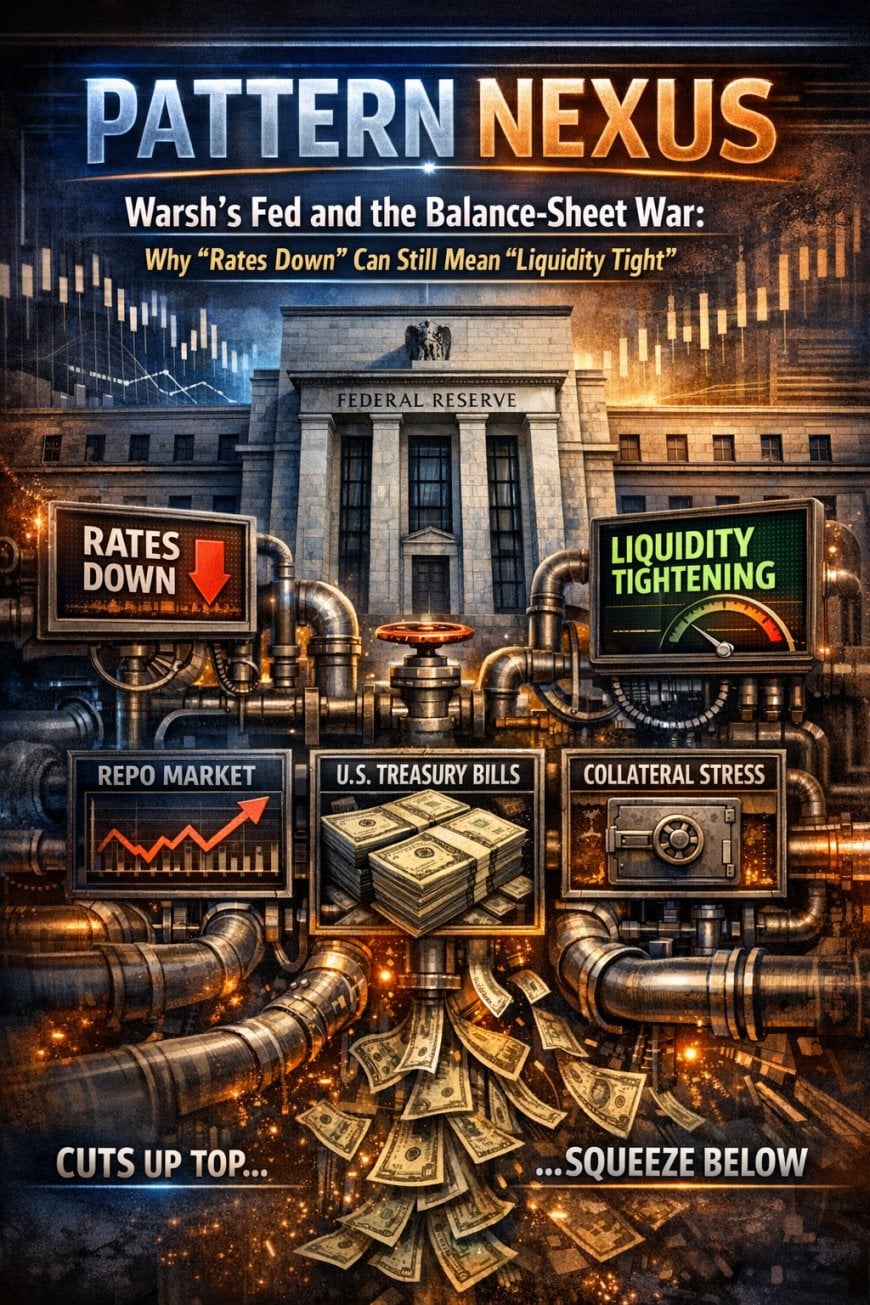


There’s a common misunderstanding in macro: “the Fed is easing” means “liquidity is loosening.” That was closer to true in a scarce-reserves corridor world. In a floor system, the balance sheet is the transmission mechanism, because reserve quantity and distribution determine funding conditions.
So you can cut policy rates and still tighten the real system if you drain reserves, increase collateral competition, or force balance-sheet constraints at the dealer layer. That tightening shows up first in repo, bill pricing, and credit spreads, not in the headline fed funds rate.
The political impulse to “shrink the Fed” and the market impulse to “price cuts” can coexist. That’s the trap. It produces mixed signals and violent repricings because the pipes decide what’s true.
This piece maps the mechanics, the stress points, and the tells. If you want to front-run the next liquidity wave, you track SOFR vs IORB, bill net issuance, settlement windows, and reserve management actions, not speeches.
Floor System Reality: The Balance Sheet Is the Rate
Pre-2008, you could talk about “the rate” like it was a single knob. The Fed ran a corridor framework with scarce reserves and a market-fed rate that actually reflected marginal funding. Post-crisis, the operating regime changed. Abundant reserves plus administered rates (IORB, ON RRP) became the anchor. In that world, the balance sheet is not a side issue. It’s how the system clears.
The key is not the total reserve number on a chart. It’s reserve distribution and the balance-sheet capacity of the dealers who intermediate collateral, repo, and risk. If reserves get trapped, or if dealer capacity gets pinched by regulation and volatility, the system tightens even if the headline “policy stance” looks easier.
The “Shrink It” Narrative Meets Treasury Supply
Every cycle produces the same political urge: “shrink the Fed,” “normalize,” “get back to markets.” That rhetoric can be sincere. It can also be messaging cover for a system that cannot function without reserve management. The constraint isn’t ideology. It’s financing. Treasury issuance schedules do not pause because a committee wants a smaller footprint.
This is why “rates down” does not automatically mean “liquidity up.” If the system is asked to absorb large net issuance while reserves are being drained, the first thing that breaks isn’t the funds rate. It’s the funding basis, repo specials, dealer balance sheets, and eventually credit spreads.
Where Stress Shows Up First: Repo, Bills, and the Ample-Reserves Edge
Funding markets are the early-warning system. When you’re near the “ample reserves” boundary, stress shows up as small but persistent dislocations: SOFR behaving oddly relative to administered rates, bill yields refusing to behave, repo rates spiking around known calendar events, or dealer inventories shrinking faster than the narrative admits.
- SOFR vs IORB: persistent tension is a plumbing tell, not “noise.”
- Bill supply and auction cadence: collateral competition tightens funding faster than most models capture.
- SRF usage and participation: it’s a backstop, but it’s also a signal that the system is tight enough to reach for the breaker.
What a “Warsh Pivot” Would Actually Look Like Operationally
If a more hawkish, “smaller Fed” philosophy takes over the messaging, don’t assume it means the system can go back to 2006. The modern apparatus exists because the modern machine requires it. The likely outcome is a narrative shift paired with a quiet operational continuity: more emphasis on rules, more emphasis on market functioning, and then reserve management purchases the moment funding stress turns systemic.
A practical “pivot” looks like this: public pressure to shrink, private willingness to intervene, and a growing reliance on facilities and tactical purchases that keep the floor system stable while avoiding the QE label. Call it whatever you want. The market will price the action, not the name.
How To Track the Plumbing in Real Time
If you want to trade or forecast liquidity, build a simple dashboard and stop listening to vibes. Track the administered anchors (IORB, ON RRP), the traded funding rate (SOFR), reserve level proxies, bill net issuance, and the calendar. The most important thing is timing: when auctions and settlements cluster, you get squeezes. When reserve management steps in, you get releases.
Pattern Nexus Lens
FAQ
Sources
- Federal Reserve: Interest on Reserve Balances (IORB) and reserve balances
- Federal Reserve: Standing Repo Facility / Standing Overnight Repo Operations
- New York Fed: SOFR and Treasury repo reference rates
- U.S. Treasury: Quarterly Refunding and financing updates
- New York Fed: Repo operations FAQs and mechanics
Care este reacția ta?
 Îmi place
0
Îmi place
0
 Dezaprobat
0
Dezaprobat
0
 Iubire
0
Iubire
0
 Amuzant
0
Amuzant
0
 Wow
0
Wow
0
 Tristețe
0
Tristețe
0
 Înfuriați
0
Înfuriați
0

Founder of Pattern Nexus. I research markets, macro, geopolitics, AI, history, ancient systems, and the patterns most people overlook. I’m also building Market Radar, a trading scanner designed to read pressure, risk, confirmation, and setup quality before chasing a move. Pattern Nexus is where I connect the dots between data, history, technology, and the bigger system playing out around us.

















Comentarii (0)