
Greenland as a Control Plane: COFA Talk, Arctic Basing, and the Real Levers
Reuters reports Trump advisers are discussing multiple pathways for Greenland, including a Compact of Free Association. Pattern Nexus breaks the story into control layers: basing, missile-warning infrastructure, fiscal support, and alliance risk.
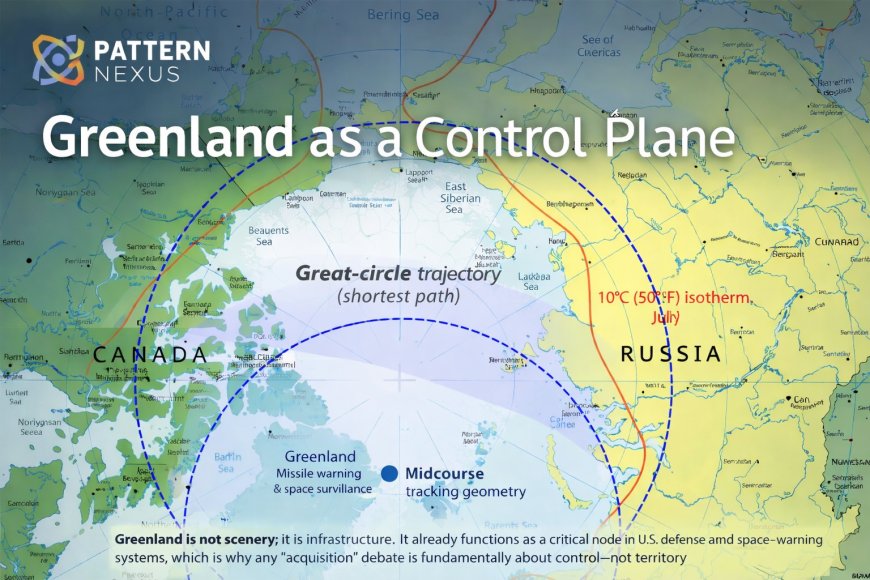
![[HERO_IMAGE_ALT]](https://patternnexus.com/uploads/images/202601/image_870x_695de2b2b9abe.jpg)

“Buy Greenland” is the headline trap. The operational question is: can the U.S. shift Greenland’s security stack and economic stack into a U.S.-anchored contract without detonating NATO cohesion?
Risk: even “just talk” changes behavior. It hardens Denmark’s position, forces Europe to publicly rally, and turns Arctic basing into a legitimacy contest—exactly where alliances fracture.
Greenland’s hidden lever is fiscal. Independence is a budget problem before it is a flag problem. Any alternative anchor must replace Denmark’s block grant and fund infrastructure at Arctic cost curves.
What’s Actually Being Reported
Strip away the noise and focus on what major outlets have put on the record: the White House has reiterated that acquiring Greenland is framed as a national security priority and publicly stated that military force remains “an option.” Reuters further reports that advisers are discussing multiple pathways that include a direct purchase attempt or a Compact of Free Association (COFA)-style arrangement.
This matters because COFA is not “annexation.” It’s a sovereignty-shaped contract that can relocate defense authority, basing rights, and long-term economic support into a U.S.-anchored framework without making Greenland a U.S. state.
Reported: options being discussed include COFA. Reported: “all options” language is being used publicly. Confirmed: the U.S. already operates critical Arctic defense missions from Greenland under long-standing agreements. Unconfirmed: any formal offer terms, negotiated draft, or a near-term “deal” timeline.
Why Greenland Matters: The Infrastructure That Already Exists
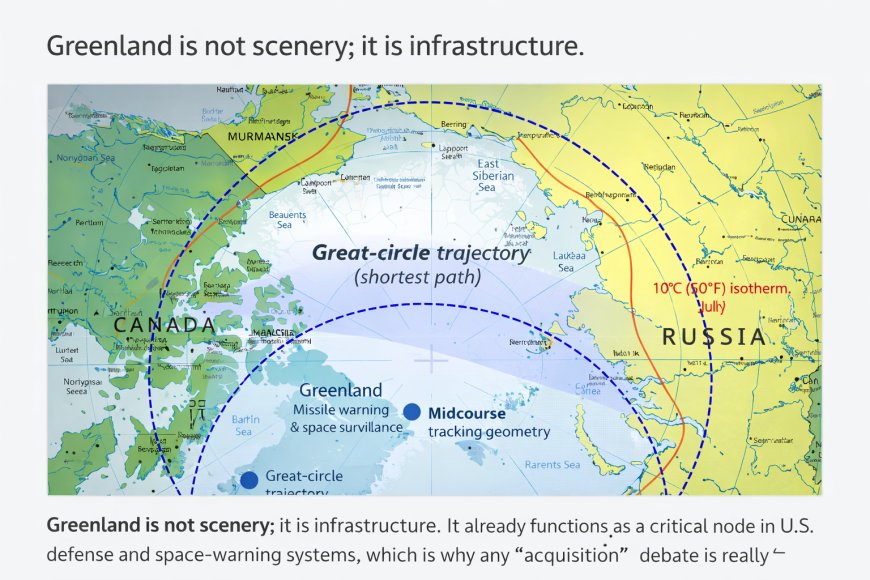
Greenland’s strategic value is already operationalized through Pituffik Space Base (formerly Thule). Pituffik supports missile warning, missile defense, and space surveillance missions, including radar and tracking functions tied into the broader U.S. space and homeland defense posture. In plain terms: this is an Arctic sensor mast and a forward operating node.
That’s why Greenland sits in a different category than the typical “resource” story. Minerals matter, yes—but minerals are optionality. The base, the radar, the polar geometry, and the ability to harden presence in the High North are immediate leverage.
- Geometry: polar routes compress distance; sensors and basing become disproportionately valuable.
- Persistence: an established base means the U.S. is not starting from zero.
- Denial: Arctic competition is not only about access—it is about denying access and shaping routes.
COFA as a Control Contract: What It Would Mean in Practice
COFA is best understood as a control-layer instrument. The U.S. has COFA relationships with sovereign states in the Pacific that exchange economic assistance and defined privileges for strategic access and defense arrangements. If applied to Greenland in any serious way, the implied structure is: Greenland gains more autonomy or sovereignty-shaped independence, while the U.S. gains defense primacy, basing rights, and strategic influence.
The constraint is fiscal. Greenland’s public finances are materially supported by Denmark’s annual block grant (reported around DKK 3.9 billion). That means any “new stack” replacing Denmark must fund: the state’s operating budget, plus infrastructure upgrades, plus Arctic logistics premiums.
Independence is expensive, and Arctic independence is more expensive. The “deal” would not be a handshake; it would be a durable funding pipeline plus defense integration—and both become politically radioactive the moment NATO allies interpret it as coercion.
This is why the story is structurally bigger than Trump. Arctic competition is tightening: Russia’s posture, China’s Arctic interests, and the U.S. need for sensor coverage and forward basing all move in the same direction. The argument inside Washington is likely that Greenland is too important to remain a “softly managed” node. The counterargument is that you can’t preserve the alliance by threatening the alliance.
Pattern Nexus Lens
Treat Greenland like a control system with layers: security layer (basing + radar + denial), fiscal layer (who funds the state), infrastructure layer (airports, ports, power, logistics), and legitimacy layer (NATO cohesion and public consent). You don’t need to “own the land” to own the control plane—if you can anchor the fiscal and security layers.
The reported COFA pathway is basically a proposal to rewire the control plane without calling it annexation: Greenland becomes “more sovereign,” while its defense and fiscal backstop migrate to U.S. contracts. That may be strategically attractive, but it has a predictable failure mode: it reads like coercion to allies and like a sovereignty trap to locals.
Greenland isn’t becoming “property.” It’s becoming infrastructure. The real fight is who gets to write the operating system: Denmark/NATO governance, or a U.S.-anchored contract stack that buys permanence in the Arctic.
FAQ
Is there credible reporting that COFA is being discussed for Greenland?
Yes. Reuters reports advisers are discussing multiple options that include a Compact of Free Association (COFA)-style arrangement, alongside other paths such as an outright purchase attempt.
Does the U.S. already have a strategic footprint in Greenland?
Yes. Pituffik Space Base supports missile warning, missile defense, and space surveillance missions and is a long-standing Arctic node in U.S. defense architecture.
What is the biggest constraint on Greenland independence or a COFA-style path?
Fiscal reality. Greenland receives substantial annual support from Denmark’s block grant. Any new arrangement has to replace that funding and carry the higher cost of Arctic infrastructure and logistics.
Sources
These sources support the specific reported claims (COFA as an option under discussion, “all options” public messaging), and the factual base-layer items (Pituffik mission set, Greenland block grant).
- Reuters (Jan 6, 2026): Advisers discussing options including COFA; White House messaging
- Financial Times (Jan 6, 2026): U.S. says military is among options; political and alliance reaction
- The Guardian (Jan 6, 2026): White House “option” language and backlash context
- U.S. Space Force: Pituffik Space Base mission overview (missile warning/defense, space surveillance)
- USSPACECOM: Pituffik strategic importance statement
- U.S. International Trade Administration: Greenland economic overview and Denmark block grant (DKK 3.9B)
- U.S. State Department: Defense Agreement amendments (Greenland)
- UN Treaty Collection: Registration entry for Greenland defense agreement amendments
Какова ваша реакция?
 Нравится
0
Нравится
0
 Не нравится
0
Не нравится
0
 Любовь
0
Любовь
0
 Смешно
0
Смешно
0
 Вау
0
Вау
0
 Грусть
0
Грусть
0
 Сердитый
0
Сердитый
0

Founder of Pattern Nexus. I research markets, macro, geopolitics, AI, history, ancient systems, and the patterns most people overlook. I’m also building Market Radar, a trading scanner designed to read pressure, risk, confirmation, and setup quality before chasing a move. Pattern Nexus is where I connect the dots between data, history, technology, and the bigger system playing out around us.












Комментарии (0)