
The End of the 40-Year Bond Supercycle: Why Rates Didn’t Rise — The Regime Changed
The U.S. 10-year yield didn’t “go up” — the 40-year bond bull ended. This analysis shows how 2020 broke the secular disinflation regime and launched a sovereign-credit repricing cycle mirroring the 1970s.
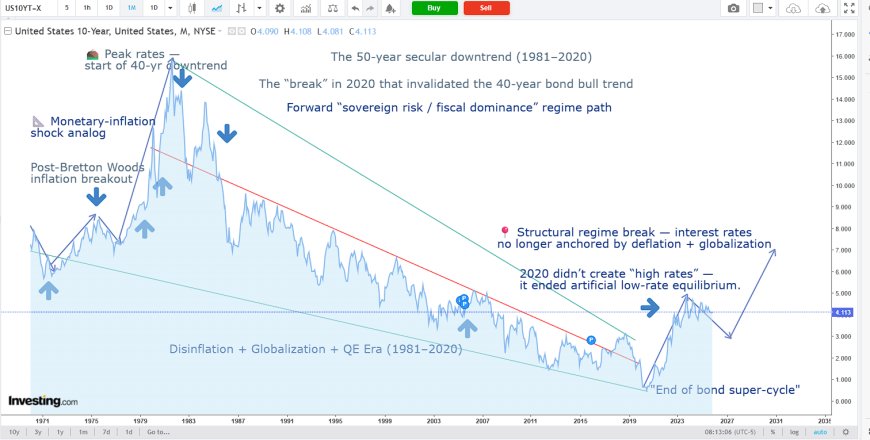
The End of the 40-Year Bond Super-Cycle
Interest rates didn’t “rise” — the regime changed.
The Next Super-Cycle: A 1970s Rhyme, Not a Repeat
Everyone wants the 2010s back — but that world is gone.
We are in a structural rate uptrend.
Not a straight line. Not endless hikes.
A cycle — like the 1970s, but with a modern constraint stack:
- Global debt saturation
- Sovereign rollover stress
- Fiscal dominance
- Industrial policy & strategic reshoring
- Energy & resource nationalism
- Demographic inversion
Here’s the pattern:
They will cut too soon → inflation will re-accelerate → rates will rise again.
Not because the Fed “fails.”
Because the system changed.
This is not a cycle to “beat.”
It’s a sovereign credit repricing era.
A multi-decade regime, not a central-bank mistake.
We will likely see:
- Volatile inflation returns
- Multiple tightening cycles
- Higher lows in yields
- Higher volatility floor
- Sovereign stress events
- Continued de-globalization & capital re-localization
This path doesn't compress in 12–24 months.
This arc likely runs into the 2040s.
The 1970s are the rhyme —
but this time, it's global sovereign debt, not just U.S. CPI.
We didn’t enter a high-rate era. We exited an artificial one.
For four decades, the global financial system operated under one dominant rule:
Every shock → lower rates → more debt → more liquidity.
That feedback loop died in 2020.
The Downtrend That Defined a World (1981-2020)
The 10-year yield’s 40-year secular decline wasn't “market wisdom” — it was a structural architecture:
- Disinflation
- Globalization + supply chain offshoring
- Demographics tailwind
- Technology deflation
- Financialization + QE
- Trust in the U.S. debt machine
Rates weren't naturally low — they were engineered down.
2020: The Break That Rewrote Monetary Physics
When fiscal and monetary merged, the bond super-cycle was over.
We moved into a world where interest rates are no longer anchored by:
- Global disinflation flow
- Cheap labor arbitrage
- QE-suppressed volatility
Instead, yields now respond to:
- Deficit scale
- Geopolitical fragmentation
- Reshoring + industrial policy
- Commodity and energy floor
- Sovereign risk repricing
Rates didn’t “overshoot” — they normalized to a new regime.
The 1974-1977 Fractal
History rhymes when monetary systems reboot:
- Currency transition shock (then Bretton Woods, now fiat-to-multipolar rails)
- Commodity repricing cycles
- Energy security stress
- Fiscal dominance
Two eras where the cost of capital stopped being optional.
What Comes Next
The path isn’t straight. But the regime is set:
- Volatility floor higher
- Rate floor higher
- Debt rollover stress persistent
- Fragile sovereign trust dynamics
This is not the return to 2010s finance. \ This is the sovereign-credit repricing era.
Vad är din reaktion?
 Gilla
0
Gilla
0
 Ogilla
0
Ogilla
0
 Kärlek
0
Kärlek
0
 Rolig
0
Rolig
0
 Wow
0
Wow
0
 Ledsen
0
Ledsen
0
 Arg
0
Arg
0

Founder of Pattern Nexus. I research markets, macro, geopolitics, AI, history, ancient systems, and the patterns most people overlook. I’m also building Market Radar, a trading scanner designed to read pressure, risk, confirmation, and setup quality before chasing a move. Pattern Nexus is where I connect the dots between data, history, technology, and the bigger system playing out around us.













Kommentarer (0)