
Tokenized Reserve Era: AI Industrial Dominance and the New Operating System of the World Economy (1980–2040)
IMF baselines through 2024 combined with S-curve tokenization, AI industrial concentration, demographic drag, and reserve plumbing reveal the most realistic map of global power through 2040 — a world where programmable dollars and compute-shielded AI industry become the new operating system of the global economy.
Tokenized Reserve Era — The Dollar’s Digital Rails, China’s Regional Sphere, and the AI Flywheel (1980–2040)
This is what the next 40 years look like when you stop measuring with the wrong ruler. IMF baselines to 2024. From 2025 forward: tokenized settlement rails and AI industrial concentration compound into a new operating system for the world economy.
Thesis
Every serious macro debate collapses into a single axis: liquidity vs. abstinence. Collapse narratives assume some future moment where central banks choose to sit on their hands and let systemic plumbing fail. But that has never happened in the modern era. The last 40 years are a relentless chain of liquidity events — LTCM, Dot-Com, GFC, Euro Crisis, COVID, UK Gilts, RRP drain — and the response has been identical every time: expand the balance sheet, stabilize collateral, keep the engine running.
But the deeper story is not the “if” of liquidity — it’s the rails the next liquidity regime will flow across. We are transitioning from an analog monetary system to a programmable one. Settlement itself becomes a competitive advantage: instant finality, transparent collateral, programmable constraints, automated compliance.
And this shift collides directly with the largest industrial buildout in modern history: the AI plant — data centers, GPUs, nuclear PPAs, cooling, grid capacity, and sovereign-scale compute. Compounding returns flow toward where the rails are cleanest and where the plant physically exists. The U.S. controls the rails; the U.S. hosts the plant. China’s advantage becomes regional, not global. Europe fragments into regulatory paralysis. Emerging markets increasingly import someone else’s AI and someone else’s money.
The divergence is not ideological — it’s mechanical. Rails + plant = structural power.
IMF Baseline Reality
Before layering tokenization or AI into the world model, we anchor to the one dataset that all sovereigns implicitly negotiate around: IMF nominal GDP. These numbers are not forecasts of creativity or innovation — they’re the map of where gravity already exists. Every future scenario sits on top of this distribution.
The IMF baseline shows a world that has already diverged structurally: the U.S. remains the anchor of global nominal GDP, China slows from blistering convergence to demographic drag, and Europe softens under aging, energy fragility, and institutional sclerosis. Asia ex-China rises, but with fragmentation. The Middle East gains share on hydrocarbons but not on manufacturing depth.
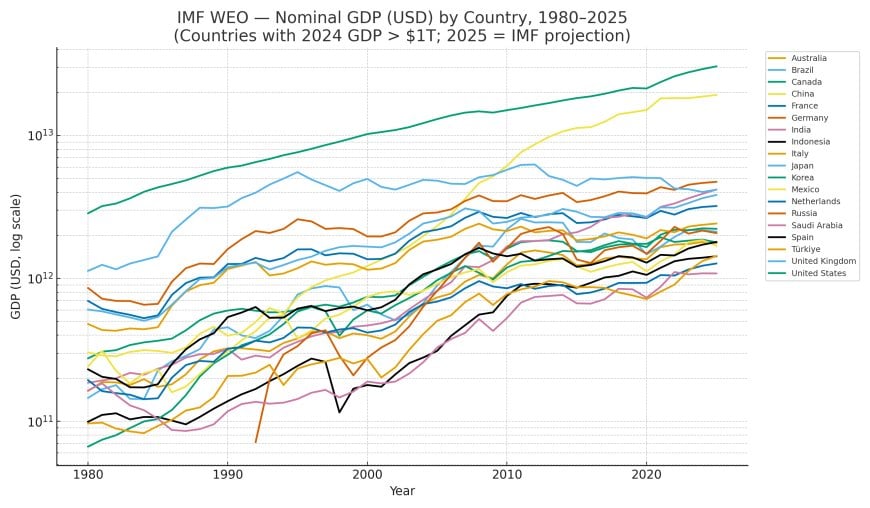
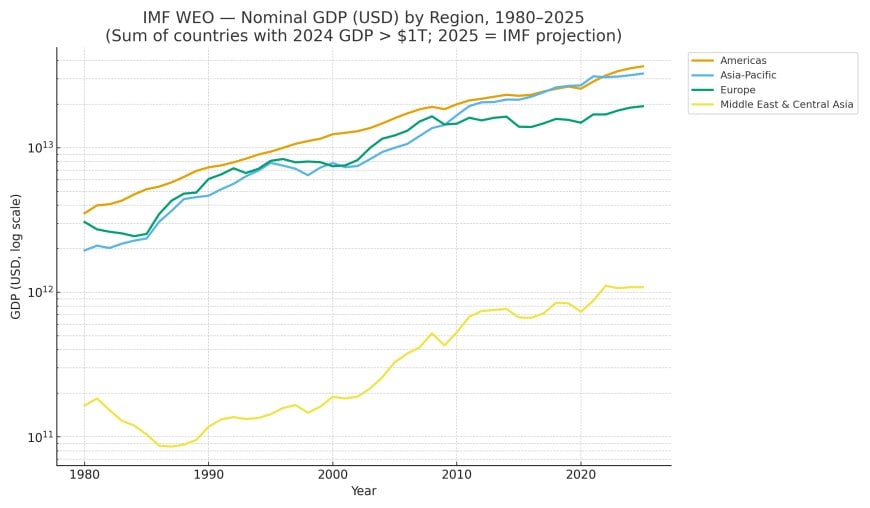
This is the ground truth. Tokenization does not replace the map — it bends the trajectories that sit on top of it.
Why S-Curves Matter
Most macro narratives assume linear change. But monetary technology and industrial platforms do not grow linearly — they follow S-curves. At first the system resists. Then the infrastructure unlock happens (GPU supply, regulatory framework, corporate adoption, settlement standards). Then adoption compounds until saturation.
Tokenization and AI both follow this pattern — and they reinforce each other. Tokenized rails accelerate capital movement; AI accelerates productivity and the returns on capital. Around the midpoint, these curves overlap and produce the most violent compounding period of the century: the early-to-mid 2030s.
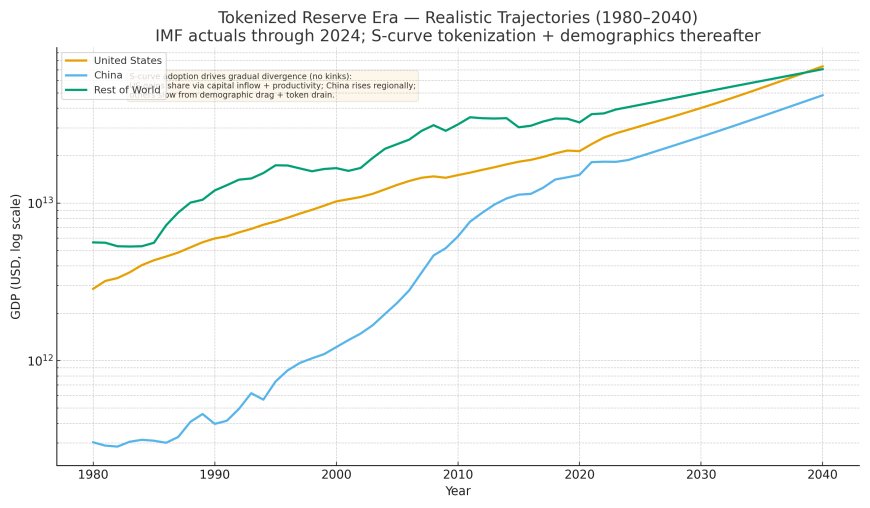
The result is systemic: growth becomes path-dependent. Whoever controls the rails and the plant during the midpoint controls the world that emerges after.
Model & Assumptions
The forward projection (2025–2040) uses three layers:
- IMF nominal GDP baseline — conservative, path-anchored.
- Tokenization modifier — a settlement utility premium for jurisdictions with compliant rails.
- AI modifier — a productivity + capital deepening premium for jurisdictions hosting the AI plant.
These are not “shock” assumptions. They are smooth logistic overlays built on the observed behavior of technological adoption.
- Tokenization (Strong): U.S. up to +1.2%/yr, China +0.6%/yr, Others −0.6%/yr (midpoint ≈ 2032).
- AI (Hybrid B–C): U.S. up to +2.5%/yr, China +1.0%/yr, Others −0.8%/yr (midpoint ≈ 2030).
- Demographics: IMF-assigned; no artificial boosts.
- Bounds: divergence, not runaway instability.
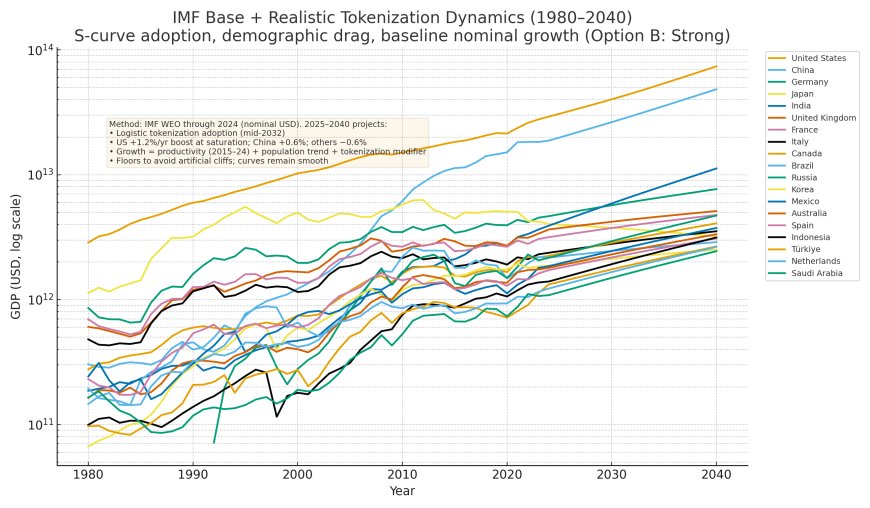
The shape is the point: compounding reallocates share even when absolute growth stays positive. This is how empires rise — and how they fade — quietly, mathematically, structurally.
Why Tokenization Rewires Power
Tokenization is not “crypto.” It is settlement physics. It turns money into software. And software behaves differently than paper:
- Instant finality eliminates counterparty latency.
- Atomic settlement reduces operational risk.
- Programmable compliance makes treasurers sleep at night.
- Transparent collateral reshapes repo and wholesale funding.
- 24/7 liquidity shifts global capital timing.
If you are a corporate treasurer, sovereign wealth fund, insurer, or global allocator, you follow the deepest dollar rails because the dollar is the cleanest collateral. Tokenization multiplies this advantage by baking U.S. regulatory architecture into the base layer. Every jurisdiction faces the same choice: do they build a compliant on-ramp, or do they watch capital flow around them?
This is why dollar tokenization is not “neutral.” It extends U.S. monetary reach into every smartphone on Earth.
- Digital Sovereignty & CBDCs
- Systemic Realignment
- The Dollar Isn’t Collapsing — It’s Evolving
- Reverse Repo Trap
- QE 2026
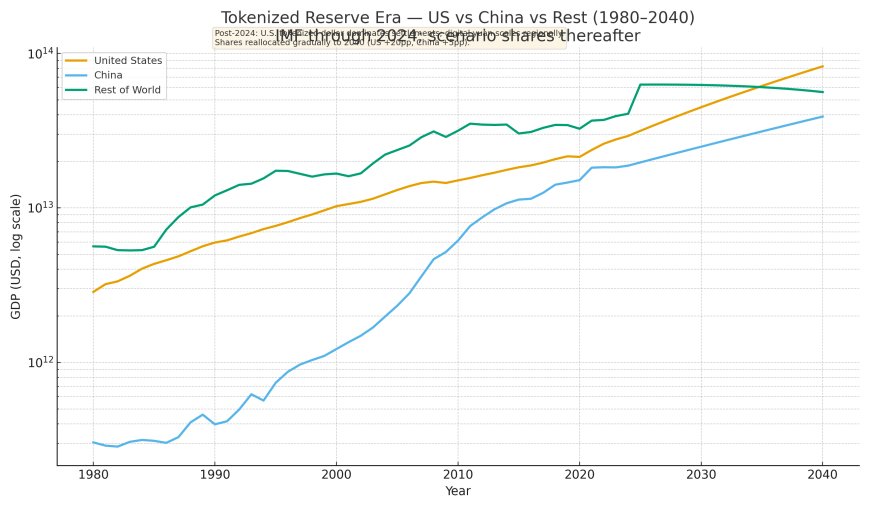
The result is a quiet but irreversible shift in global liquidity gravity: The U.S. becomes not just the issuer of the reserve currency, but the operator of the global operating system.
Scenario Ranges
This model uses a “Strong-leaning Dominant” configuration. Reduce these assumptions and the gap compresses; increase them (SMRs, sovereign GPU clusters, multi-gigawatt PPAs) and divergence widens. But directionally it does not reverse unless:
- the U.S. loses control of settlement,
- or China achieves unrestricted AI scale,
- or Europe unifies industrial policy,
—none of which are realistically on the table today.
Scenario inputs:
- Tokenization: U.S. +1.2%/yr, China +0.6%/yr, Others −0.6%/yr.
- AI (B–C hybrid): U.S. +2.5%/yr, China +1.0%/yr, Others −0.8%/yr.
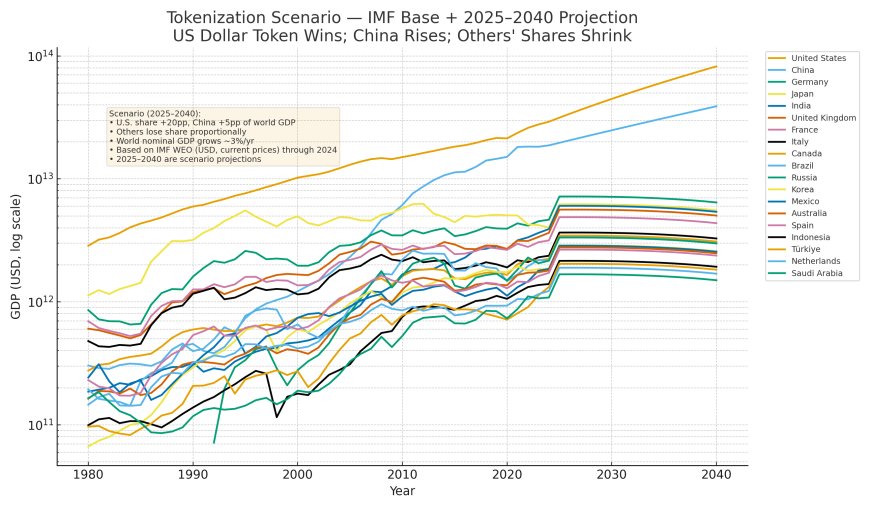
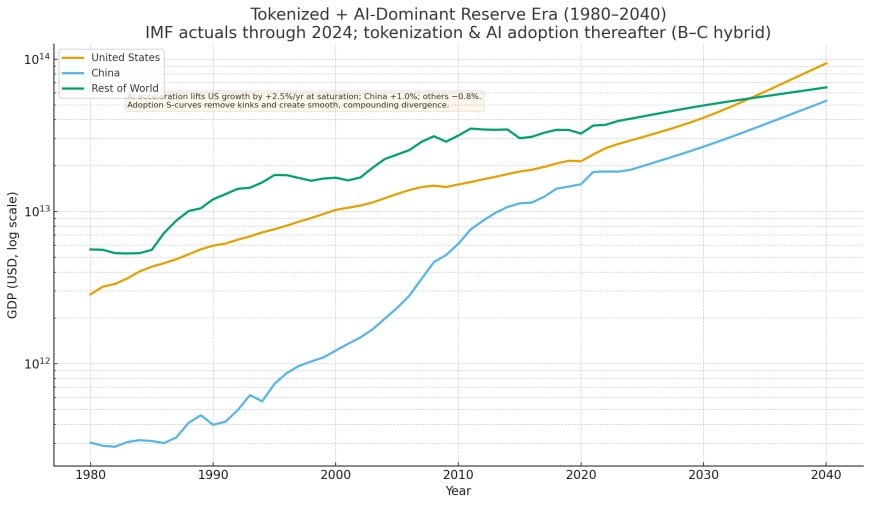
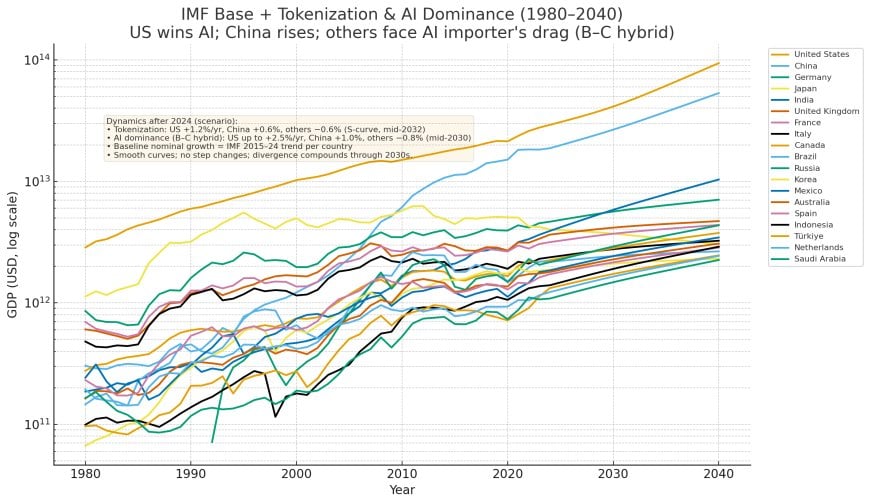
The world that emerges by 2040 is not multipolar — it is bimodal: U.S. dominance via tokenized rails + compute, and China’s regional bloc anchored by sovereign manufacturing scale. Everyone else becomes a liquidity importer and AI user, not a producer.
Signals I’m Watching
- Tokenized T-bill adoption — which jurisdictions integrate compliant rails fastest.
- Nuclear PPAs (10–20 yrs) — only serious AI players sign multi-decade baseload contracts.
- GPU export regimes — the real ceiling on China’s model scaling.
- Repo/RRP dynamics — collateral supply determines global liquidity rhythm.
- Reserve levels — QE-style liquidity events when reserves scrape bottom.
- Immigration policy — demographic leverage is a policy choice, not destiny.
These signals tell you not just where growth is going — but where power is going.
Positioning Ideas (Not Advice)
Not advice — but these are the buckets that matter if this map is right:
- AI infrastructure: GPUs, cooling, supply chain, nuclear-powered compute.
- Baseload power: SMRs, uprates, transmission, long-duration storage.
- Data-center land & REITs: whoever hosts the plant will host the returns.
- Tokenized cash: compliant wallets, T-bill rails, automated settlement.
- Selective real assets: energy, rare earths, copper, logistics.
- Long-dated optionality: space tech, asteroid mining, near-Earth industry.
Site Map
Browse categories for deeper context:
Macro & Markets • Systems & Patterns • Geopolitics • Wealth & Real Estate • Nexus Reports • Media & Visuals
Vad är din reaktion?
 Gilla
0
Gilla
0
 Ogilla
0
Ogilla
0
 Kärlek
0
Kärlek
0
 Rolig
0
Rolig
0
 Wow
0
Wow
0
 Ledsen
0
Ledsen
0
 Arg
0
Arg
0

Founder of Pattern Nexus. I research markets, macro, geopolitics, AI, history, ancient systems, and the patterns most people overlook. I’m also building Market Radar, a trading scanner designed to read pressure, risk, confirmation, and setup quality before chasing a move. Pattern Nexus is where I connect the dots between data, history, technology, and the bigger system playing out around us.














Kommentarer (0)