
BCRED Redemptions Spike: The Private Credit “Liquidity Mismatch” Goes Live
Blackstone’s BCRED saw redemption requests jump to 7.9% versus a typical 5% quarterly cap, forcing a higher repurchase capacity and a $400M sponsor backstop. This isn’t just a fund story—it’s the private-credit liquidity mismatch showing its teeth.

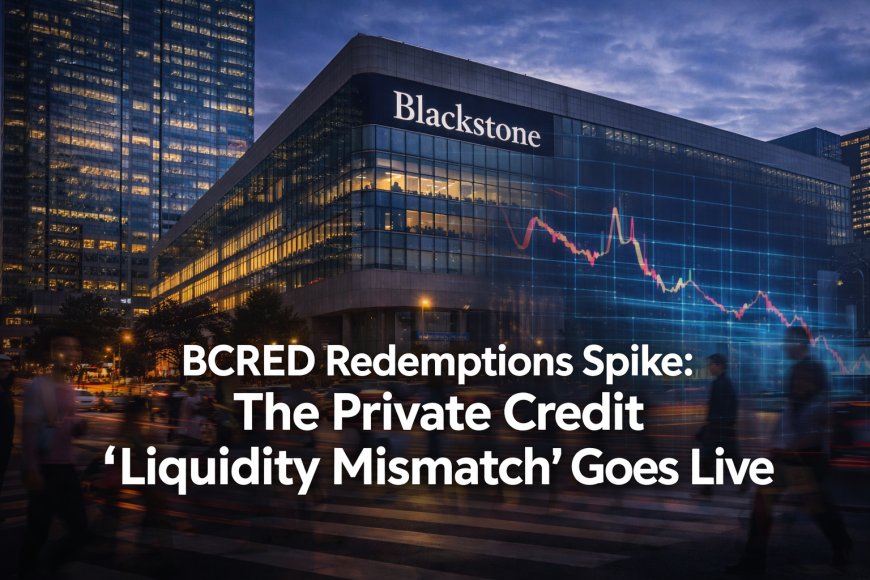

Blackstone’s BCRED just printed a clean stress datapoint: redemption requests climbed to 7.9% of fund assets versus the typical 5% quarterly repurchase cap, forcing Blackstone to expand repurchase capacity and inject $400M of firm/employee capital to satisfy all requests. This isn’t a “one fund” story. It’s the private-credit liquidity mismatch in motion: NAV-based pricing, capped exits, and confidence-sensitive flows colliding with a market that’s finally asking, “What happens when everyone wants out at the same time?”
“Semi-liquid” is a control valve, not a promise. When flows flip, the valve becomes the story.
The dangerous phase isn’t “defaults explode.” It’s “confidence breaks” and redemptions force suboptimal liquidity sourcing (sell the most liquid first, concentrate the rest).
Sponsor capital injections are damping functions. They buy time. They don’t remove the underlying mismatch.
The Print: What BCRED Just Told Us
The headline number is simple and brutal: BCRED’s redemption requests came in at 7.9% of the fund, above the typical quarterly repurchase limit that sits around 5% for these structures. In dollars, requests were about $3.7B, offset by roughly $2.0B of new inflows, leaving net outflows around $1.7B. Blackstone met the moment by increasing repurchase capacity to 7% and covering the remaining 0.9% with a $400M firm/employee investment so every request could be satisfied.
Requests: 7.9% of assets (~$3.7B) • New subscriptions: ~$2.0B • Net outflows: ~$1.7B • Repurchase capacity raised: 7% • Sponsor backstop: $400M to cover the remaining 0.9%
That “$400M internal bid” is the tell. It’s a conscious choice to preserve the product’s credibility. Blackstone is effectively saying: we’d rather damp volatility now than let a pro-rata haircut or an optics-driven gate accelerate the run dynamic.
Why This Is Happening: Confidence, Comparables, and “Semi-Liquid” Reality
The sector is dealing with a confidence problem that feeds on structure. These funds can look stable right up until they don’t, because pricing is NAV-based and exits are periodic and capped. When investors see peers alter liquidity terms, it forces a very rational question: “If the other guy changed the rules, why should I assume my door stays open?”
- Peer shock: Blue Owl’s OBDC II pivoted away from the standard quarterly redemption/tender dynamic and instead moved toward returning 30% of NAV to all investors within ~45 days, with the implication that the old “5% quarterly option” is no longer the core mechanism. Whether you label it “not halting liquidity” or “changing liquidity,” the market reads it as a structural stress flare.
- Valuation anxiety: Private credit has grown into a ~$2T ecosystem with limited real-time price discovery. When public comparables wobble or spreads widen, the question becomes whether NAV marks are lagging reality.
- New narrative catalyst: AI disruption is now being discussed as a credit impairment risk in parts of enterprise software. Even if you disagree with the magnitude, the narrative alone can accelerate allocator behavior.
This is why I keep coming back to the same frame: private credit isn’t only a loan book. It’s a behavior product. Confidence is the liquidity.
Failure Mode: Flow Turns the Portfolio Into a Worse Version of Itself
Here’s the mechanical failure mode most people miss: in a capped-redemption structure, the manager typically meets redemptions using the most liquid sources first. That sounds fine until you realize what it does to the remaining portfolio.
If the liquid sleeve gets used to satisfy exits, what’s left is a more concentrated, less liquid, harder-to-finance portfolio. The fund may still look “stable” on a marks basis, but the internal resilience declines. That’s how a mild outflow regime can become a nonlinear problem if it persists across quarters.
(1) Q2 request rate: does 7.9% become a new baseline? (2) Inflows vs outflows: does replacement capital dry up? (3) Liquidity sourcing: credit lines, asset sales, and cash buffers. (4) Peer actions: more “accelerated returns,” tender restructures, or gates elsewhere.
Blackstone chose to absorb the optics risk now (by writing a $400M internal check) rather than allow a pro-rata haircut to seed a bigger run. That’s a strong move. The question is not whether they can do it once. The question is whether the flow regime forces repeated interventions across the space.
Pattern Nexus Lens
This is a control-systems story. Semi-liquid private credit is engineered as a stable output product (steady income, smooth NAV, periodic liquidity) sitting on top of an illiquid input system (bilateral loans, limited secondary market depth, manager marks). That works when flows are stable and confidence is high. When flows flip, the system reveals its true governing rules: caps, queues, and sponsor discretion.
The next phase of private credit stress won’t announce itself as “defaults everywhere.” It will show up as structure friction: changing liquidity terms, sponsor backstops, widening trust gaps between NAV marks and market reality, and flow-driven portfolio degradation.
FAQ
Is this a liquidity crisis at BCRED?
Not proven as a “crisis,” and Blackstone explicitly framed it as a structural decision rather than a constraint. The real signal is that requests exceeded the typical cap, forcing an expanded repurchase and a sponsor/employee backstop to satisfy everyone. That’s stress behavior, even if it’s well-managed.
Why does the 5% cap matter?
Because it’s the control valve. Non-traded BDC/private credit funds generally run quarterly repurchases limited to about 5% of outstanding shares at quarter-end NAV. When requests exceed the cap, either investors get pro-rated, the manager adjusts terms, or the manager sources liquidity (including sponsor capital) to meet demand.
What’s the cleanest “watch item” from here?
The next quarter. If elevated requests persist and inflows don’t offset, managers start making portfolio-level choices that can quietly weaken future liquidity (selling liquid assets first, drawing lines, leaning on discretionary tools). That’s how a contained episode turns into a regime.
Sources
Primary reporting on BCRED Q1 outflows and the broader private-credit liquidity/valuation stress dynamic, plus official BCRED structure references and peer liquidity changes.
- Reuters (Mar 3, 2026): Blackstone’s $82B BCRED sees net outflows; requests 7.9%; $400M sponsor/employee backstop
- Financial Times (Mar 3, 2026): BCRED hit with wave of redemptions; implications for semi-liquid private credit
- BCRED (official): Offering terms and quarterly repurchase mechanics (cap and NAV-based repurchases)
- Reuters (Feb 19, 2026): Blue Owl OBDC II liquidity change; plan to return 30% of NAV within ~45 days
- Reuters (Feb 27, 2026): Goldman commentary on private credit redemptions and AI disruption risk framing
What's Your Reaction?
 Like
0
Like
0
 Dislike
0
Dislike
0
 Love
0
Love
0
 Funny
0
Funny
0
 Wow
0
Wow
0
 Sad
0
Sad
0
 Angry
0
Angry
0

Founder of Pattern Nexus. I research markets, macro, geopolitics, AI, history, ancient systems, and the patterns most people overlook. I’m also building Market Radar, a trading scanner designed to read pressure, risk, confirmation, and setup quality before chasing a move. Pattern Nexus is where I connect the dots between data, history, technology, and the bigger system playing out around us.













Comments (0)