
AI Compute and Power Infrastructure in 2025 — The New Industrial Backbone
A deep Pattern Nexus investigation into the 2025 AI industrial build-out — tracking every major compute deal, hyperscaler expansion, and the rebirth of nuclear power as the energy backbone for machine intelligence. Covers global capacity timelines, regional grid stress, economic spillovers, and the new “AI industrial complex” forming across tech and energy.
The AI Compute and Power Infrastructure Boom (2020–2025)
Framing the Power Constraint: A U.S. Grid Shortfall by 2028
The AI build-out is now paced by electrons. Multiple independent analyses signal that U.S. power supply and time-to-power constraints will collide with hyperscale data-center demand before decade’s end. In its latest assessment, Morgan Stanley warns of a shortfall of roughly 13–44 GW of capacity for data centers through 2028 (up to ~20% of what’s needed), even after applying “time-to-power” workarounds. Complementing that, the U.S. Department of Energy’s DOE/LBNL 2024 report finds data-center electricity use is likely to double to triple by 2028, rising to about 325–580 TWh and comprising roughly 6.7–12% of total U.S. electricity by that date (up from ~4.4% in 2023, per Berkeley Lab).
Why “Time-to-Power” Is the Bottleneck
The problem isn’t just generation—it’s the calendar. Interconnection queues and transmission buildouts take years. A DOE/LBNL review of queue performance shows the typical project built in 2022 took ~5 years from interconnection request to commercial operation (vs. ~3 years in 2015), underscoring how backlogs have lengthened as new load surges (DOE / LBNL interconnection analysis). Broader policy reviews echo the same timeline risk: transmission and interconnection reforms are now pacing items for large new loads like AI campuses (Council on Foreign Relations; Wood Mackenzie).
Where Pressure Will Hit First
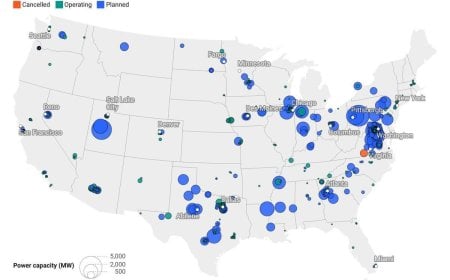
The load surge is geographically uneven. The biggest early pinch points are the existing hyperscale corridors and fast-growing metros (Northern Virginia, Phoenix, Dallas–Fort Worth, Atlanta, Reno, Columbus, Kansas City), where grid capacity and siting hurdles are tight. For example, Virginia’s power demand is projected to rise ~85% over 15 years, driven heavily by data-center growth (MAREC Action). Nationally, independent estimates suggest data centers could reach ~8–9% of U.S. electricity by 2030 (Goldman Sachs; EPRI via Reuters), implying further stress in already-constrained hubs without accelerated buildouts.
SMRs as Accelerants—But Timelines Still Matter
Dispatchable, 24/7 generation is the critical complement to variable renewables for AI-class loads. Small Modular Reactors (SMRs) are designed to be factory-built and sited closer to load, potentially compressing schedule risk versus gigawatt-scale plants. The U.S. has made regulatory progress—NRC approved an uprated NuScale design in 2025 after substantial DOE support—but execution remains the hurdle: the prior UAMPS CFPP was cancelled in 2023 amid cost and subscription challenges (Reuters; Clean Air Task Force). Even with improved standardization, most expert roadmaps still point to late-decade first-of-a-kind deployments and broad commercialization in the early-to-mid 2030s.
Policy Levers to Close the 13–44 GW Gap
- Fast-track “time-to-power” solutions: Prioritize brownfield interconnections (retired or under-utilized thermal sites), grid-adjacent behind-the-meter PPAs, and co-locating data centers with firm generation.
- Scale dispatchable clean power: Expand nuclear options in parallel—keep large-plant restarts/expansions moving while funding SMR design finalization, vendor qualification, and first-wave fleet orders (multi-unit buys to drive cost learning).
- Transmission + interconnection reform: Streamline permitting, set binding interconnection timelines, and fund high-capacity lines into known hyperscale corridors (CFR overview).
- Bridge capacity prudently: Where unavoidable, stage limited-duration gas peakers and demand-response while firm clean capacity comes online; avoid locking in long-lived emissions assets that complicate 2030s compliance trajectories.
Bottom line: On current trajectories, the U.S. risks a 13–44 GW data-center power gap by 2028. Accelerated SMR programs and targeted federal/state co-investment can bend the curve, but permitting and supply-chain realities mean time remains the critical variable. Near-term siting, queue reform, and co-located firm power will decide how fast AI compute can scale.
Historical Baseline (2020–2024)
From 2020 through 2024, global compute capacity and data center energy use were already on steep upward trends. Major supercomputers (e.g. Frontier, Fugaku, Aurora) and cloud GPU clusters (Nvidia A100/H100, Google TPUs) came online, pushing total AI/HPC compute to multi-exaflops. Data centers grew rapidly – U.S. data center power usage rose by ~12% per year, reaching about 415 TWh in 2024 (≈1.5% of global electricity). With AI training accelerators demand growing ~30% per year, global data center demand is projected to roughly double again by 2030. Major hyperscalers (Microsoft, Google, Amazon, Meta, Alibaba) announced multi-billion-dollar cloud and datacenter investments throughout 2022–2024 to meet AI workloads. Governments responded with “chips” and AI strategies (e.g. US CHIPS and Science Act of 2022, EU Chips Act), aiming to spur domestic chip fabs and HPC centers. Corporate strategy pivoted: Intel scaled up AI chip efforts, AMD regained competitiveness with MI300X GPUs, and private equity became active in AI infrastructure (e.g. Blackstone, BlackRock). Power infrastructure lagged behind: many regions saw tight grid capacity and DC vacancy falling to record lows (Northern Virginia <1%, Singapore ≈1%). By 2024, it was clear that AI compute growth was outpacing traditional infrastructure, prompting new investment plans in chips, datacenters, and power.
Major AI Deals in 2025
Throughout 2025, a flurry of high-profile deals – mergers, acquisitions, investments, and partnerships – underscored the AI infrastructure build-out. Notable transactions included:
- HPE acquires Juniper Networks ($16B): In 2025 HPE agreed to buy networking vendor Juniper for about $16 billion, strengthening HPE’s AI data center and networking portfolio.
- TPG takes private software firm Proficy ($600M): Private equity firm TPG bought AI-enabled software supplier Proficy for ~$600 million, aiming to integrate its generative AI tools into larger enterprises.
- CoreWeave buys Core Scientific ($9B): GPU cloud provider CoreWeave acquired bitcoin miner Core Scientific for roughly $9.0 billion. This deal sharply expanded CoreWeave’s supply of low-cost GPU hardware and bitcoin-mining power for AI workloads.
- BlackRock/GIP acquires Aligned Data Centers ($40B): A joint bid by BlackRock and Global Infrastructure Partners (GIP) for U.S. data center operator Aligned DC (~$40 billion) was announced, potentially closing by 2026. It’s the largest AI-era private equity deal yet, reflecting investor demand for AI-ready data centers.
- AMD–OpenAI compute partnership: In October 2025 AMD and OpenAI announced a multi-year strategic partnership. AMD will supply roughly 6 gigawatts worth of MI450X/MI350X/MI300X GPU power (generally starting in late 2026) to OpenAI, unlocking “tens of billions” in expected revenue for AMD.
- Nvidia-led U.S. manufacturing pledge ($500B): Nvidia, TSMC, Samsung, Intel and others announced an initiative to invest up to $500 billion over several years in U.S. chip and server manufacturing. This includes new fabs (TSMC, Samsung, Intel expansions) and server factories (Nvidia-AIMasters). It’s touted as the largest AI hardware push to date.
- Public-private AI infrastructure partnerships: Governments joined corporates in major deals. France, Italy, UK, Spain and other European states are co-investing with NVIDIA to build national AI “clusters” using Nvidia’s Blackwell GPUs (targeting thousands of exaflops of compute). Saudi Arabia’s Public Investment Fund (PIF) partnered with Google Cloud on a $10B AI/cloud hub to serve MENA (generating ~11,000 US tech jobs and \$35B US economic benefit). In the UAE, the Abu Dhabi “Stargate” AI Campus – a 5-gigawatt AI center – was announced, backed by UAE tech firm G42 and partners (OpenAI, Nvidia, Oracle, SoftBank). The first 200 MW of that campus is slated for 2026 operation.
- Hyperscaler cloud commitments: Among cloud-specific deals, OpenAI announced a 7-year, $38B commitment to Amazon Web Services for custom AI GPU infrastructure, securing hundreds of thousands of NVIDIA GB200/GB300 chips from AWS. Meta (Facebook) signed a $14.2B multi-year deal with GPU cloud provider CoreWeave for AI compute capacity. AMD also secured a GPU compute deal with OpenAI, and Oracle expanded its cloud contract with generative AI software firms (including a pledge to deploy over 130,000 AMD MI355X GPUs in 2025).
- Venture funding for AI startups: AI-focused companies continued raising record rounds. For example, EU’s data-center-infrastructure developer Nscale closed a €1.1B Series B (largest ever in Europe) to build high-performance AI data centers. U.S. startups like Crusoe Energy (gas-to-compute) raised \$1.4B (Series D), and robotaxis AI firm Avride got \$375M. In biotech, Fractal AI and Treeline Biosciences raised \$600M and \$600M respectively for AI-driven R&D. NVIDIA’s venture arm also backed AI solution firms: e.g. battery recycling company Redwood Materials raised \$350M (Series E) with NVIDIA Ventures as lead, and conversational AI firm Uniphore raised \$260M from investors including Nvidia and AMD.
These deals highlight the strategic trend: massive investment flows into AI compute and infrastructure, with deal values often in the tens of billions, involving hyperscalers, chipmakers, and global investors. The build-out is accelerating.
AI Infrastructure Expansions (Major Players)
Microsoft (Azure)
Microsoft accelerated Azure’s expansion for AI in 2025. It announced roughly 2 gigawatts of new data center power capacity and unveiled what it called “the world’s most powerful AI datacenter,” claiming ~10x the performance of the fastest 2024 supercomputer. Microsoft added new Azure regions and availability zones in Asia (e.g. launched new regions in Malaysia and Indonesia in 2025, with Taiwan North coming in 2026). Overall Azure now spans 70 regions (operational or announced) globally. Internal planning papers and industry reports put Microsoft’s AI-datacenter investment (2022–25) at on the order of \$80 billion. Microsoft’s infrastructure leverages NVIDIA and AMD GPUs (e.g. Azure NDv5 with H100 GPUs), along with custom CPUs for efficient data movement. The company’s close partnership with OpenAI (Azure OpenAI Service) means Azure is one of the largest single consumers of high-end GPUs, spurring these massive hardware deployments.
Google (Cloud & DeepMind)
Google Cloud poured tens of billions into AI infrastructure in 2025. It reaffirmed plans for an \$85B capital spend on data centers over 2025–26, including \$15B toward a new AI compute hub in southern India (reflecting partnership with TSMC). In October 2025 Google Cloud announced a \$10B deal with Saudi Arabia’s PIF to build out a global AI hub (increasing Google’s Middle East cloud regions). Google’s own AI lab (DeepMind) operates large TPU-based supercomputers, and Anthropic agreed to expand its use of Google Cloud TPUs by the millions. Reports indicate Anthropic is discussing multi-year GCP deals worth “tens of billions” to accelerate training on Google TPUs. Google also continued to roll out new cloud regions (e.g. Dubai, Zurich) and to upgrade network links (e.g. new undersea cables) to support AI traffic. Overall, Google’s 2025 cloud build-out combined traditional regions and specialized AI clusters (TPU v5/v6 pods, multi-TPU racks) to meet surging demand.
Meta (Facebook AI)
Meta took a dual approach of building its own mega-datacenters while leasing extra compute. Meta’s internal AI supercluster (codenamed Prometheus) is expected to reach 1 gigawatt of power by 2026, and in 2025 it announced plans for an additional 5 GW data center campus after that. To supplement in-house GPU supply, Meta signed a \$14.2B multi-year lease agreement with cloud provider CoreWeave for GPU servers. Meta’s 2025 capital budget was in the \$66–72B range, spurred by AI, and CFOs indicated a multi-year infrastructure build to follow. (Earlier reports said Meta had earmarked \$600B through 2028 for data centers and AI infrastructure.) Meta is installing advanced liquid-cooled racks (with Nvidia GH200 superchips, etc.) in new sites. Its Arizona, Texas, and Ohio campuses are being readied for these clusters. As a result, Meta’s compute footprint (in GPUs) will roughly double or triple by late 2026, funded by the CoreWeave contract and its own build-out.
Amazon Web Services (AWS)
AWS continued to invest heavily in AI servers and networking. Most prominently, in Oct 2025 AWS announced a \$38B, 7-year cloud partnership with OpenAI – committing hundreds of thousands of NVIDIA GB200/GB300 GPU instances to power ChatGPT-scale training. Separately, AWS and Anthropic launched “Project Rainier,” an AI supercomputer with ~500,000 Amazon Trainium2 chips (for Anthropic) now online and expected to exceed 1,000,000 chips by year-end. AWS branded this the largest AI training cluster in existence. On the connectivity side, AWS led construction of the 320 Tbps FastNet subsea cable (U.S.–Ireland, online ~2028) specifically to handle surges of cloud AI traffic. AWS also expanded its own cloud regions (e.g. Israel, UAE, Spain) in 2024–25. Its infrastructure now includes custom UltraServer racks (each with 64+ Trainium2 chips), Nitro chips, and planned higher-speed interconnects (AWS Fabric Cloud). The AWS AI expansion, anchored by its deals with OpenAI and Anthropic, has made AWS one of the largest single compute providers globally.
Oracle (Cloud Infra)
Oracle’s cloud unit (OCI) emerged as a key AI infrastructure player. In mid-2025, Oracle announced it would roll out roughly 131,072 AMD Instinct MI355X GPUs in a single cloud “AI Cluster,” one of the largest single deployments of accelerators. These GPUs (already sampling in cloud regions) will enable customers to run large transformer models. Oracle also deployed thousands of NVIDIA DGX SuperPOD systems for AI workloads. Oracle opened new cloud regions (Portugal, India) in 2025 to support European AI growth. To meet density needs, Oracle’s latest data halls use extensive liquid cooling (as noted by industry observers). Overall, Oracle’s strategy is to offer high-density GPU supercluster instances on-demand, challenging the hyperscalers by selling AI cloud to enterprises and governments (for example, Oracle is a partner in UAE’s Stargate AI project). Its record sales and stock performance in 2025 reflected this pivot.
NVIDIA
NVIDIA remains at the center of compute expansion. It announced a letter of intent to invest up to \$100B with OpenAI to deploy 10 gigawatts of NVIDIA-based data centers. Internally, NVIDIA also launched major partnerships to build “AI factories”: in October 2025 it teamed with Samsung and SK Group to build two separate AI development centers in South Korea, each housing over 50,000 NVIDIA GPUs (via GH200 and later chips) by 2027. On top of that, NVIDIA initiated a U.S.-based production effort with TSMC, Foxconn, and others, pledging to produce \$500B of AI servers in the U.S. (an estimate) over four years. NVIDIA also introduced its latest chip lineup (Grace Blackwell GH200 GPUs, Grace CPU, etc.), which industry reports indicate will double performance per rack over prior generations. Finally, NVIDIA continued to expand its own data centers and “NVL” cloud service – it will purchase any unsold capacity on partner clouds and has deals to share infrastructure. Overall, NVIDIA’s deployed capacity (GH200 and H200) worldwide probably reached on the order of 10–20 GW by late 2025, given the massive factory commitments and customer clusters.
OpenAI
OpenAI’s compute footprint grew through partnerships rather than building its own mega-datacenter. The AWS \$38B deal and AMD contract lock in vast GPU/AI-accelerator resources. OpenAI is also scaling up in Microsoft Azure (still a partner) but has relinquished MS first-right-of-refusal, preparing a possible IPO. CEO Sam Altman disclosed goals like 1 exaflop training clusters and up to 30 GW of compute (30M home equivalents) in coming years. OpenAI is reportedly exploring on-shore power solutions (like building data centers in power-rich US states) to handle this load. It also joined NVIDIA to co-design future chips for AI. In short, OpenAI’s strategy is to secure huge amounts of cloud/colocation compute (AWS, Azure, GCP) and gradually diversify into building custom data centers (e.g. an announced Texas AI campus for 2026); its compute resource grew by several exaflops in 2025 thanks to these deals.
Anthropic
Anthropic, the AI startup behind the Claude models, also massively expanded its compute. It signed multi-year commitments with AWS (reportedly \$8B+ over time) and began using Google TPUs en masse. In October 2025, Anthropic announced it would scale up to over 1 million Google TPU v5e chips across its projects, a deal worth “tens of billions.” Anthropic’s own press noted this TPU deployment (in addition to AWS’s Trainium2) will give it well over 1 GW of dedicated AI compute by 2026. It also announced a \$50B investment plan in U.S. AI infrastructure: new data center campuses in Texas and New York that will create ~800 permanent jobs plus 2,400 construction jobs. Like OpenAI, Anthropic remains largely cloud-based but is pre-purchasing or co-designing hardware. Its massively parallel infrastructure (spread across AWS, GCP, and colos) is projected to soon rival or exceed the largest single clusters at any one company.
Tesla (Dojo)
Tesla’s AI infrastructure efforts continue on a different path. In 2025 Tesla largely completed rollout of its first Dojo supercomputer (an on-prem facility at Giga Nevada with ~90,000 GPUs by mid-2024) and shifted focus. Tesla placed a \$16.5B order with Samsung for next-generation “AI6” training chips (with production slated for 2025–26). According to earnings calls, Tesla expects to have a second-generation Dojo cluster operating at scale by 2026, roughly equivalent to 100,000 Nvidia H100 GPUs. However, they have indicated that most inference/training will run on off-the-shelf GPUs and the new Tesla chips. Tesla’s 2025 capital expenditure is expected to be around \$5B on AI infrastructure, mostly for these GPUs. So far, Tesla’s build-out remains internal (no hyperscaler partnerships), but its AI hardware (D1 chips, AI6 chips) and on-site datacenter at Gigafactories are part of the broader compute ecosystem.
Global Compute Capacity in 2025
By late 2025, the world’s installed AI compute (including HPC and cloud GPU clusters) had grown to unprecedented scale. Analysis by research firm Epoch AI estimates the United States accounts for roughly 75% of total GPU-cluster compute performance globally, with China about 15% and the entire EU around 5%. This reflects the dominance of U.S. hyperscalers (OpenAI/Microsoft, AWS, Google, Meta, etc.) and chip design centers. Top supercomputers include multiple exascale machines: in the U.S. Frontier (Oak Ridge) and El Capitan (LLNL) each surpass 1.7 exaflops (FP64) of peak; Europe’s first exascale system (JUPITER in Germany) came online September 2025 at ~1.0 exaflop; China has several exa-scale-class systems (Tianhe-3 expected). High-end clusters in Japan, Canada, and others add hundreds of petaflops. In aggregate, global on-line HPC peak performance likely exceeds 10 exaflops by 2025, with plans (e.g. Aurora, Jupiter, Leão da Montanha) to push beyond 20 exaflops by 2028.
On the GPU side, Nvidia sold millions of H100 and GH200-class accelerators in 2024–25, and AMD shipped many MI300X GPUs. Google’s TPU deployments reached the millions, and custom fabrics (like Cerebras wafers) also contribute. Industry estimates suggest tens of millions of discrete AI chips (GPUs/TPUs/ASICs) are now under contract. Data center counts continue to rise: hundreds of hyperscale sites worldwide (50+ in US, 30 in China, 20 in EU/Asia-Pacific each) carry AI workloads, with another 100+ major sites planned by 2028. For example, Google is building a \$5B data center in Belgium (300 MW), Microsoft and Oracle each have dozens of large campuses, and new sites are sprouting from North America through Latin America, Africa, and Asia. In summary, global compute capacity in 2025 is heavily U.S.-centric (the Epoch data shows nearly 75% share:) but expanded globally via cloud networks. Total on-line FP32/FP16 performance (counting all AI-focused clusters) is on the order of 20–50 exaflops of effective throughput, with plans easily doubling that by 2030. Facilities span all geographies: in the Americas (US, Canada, Brazil), Europe (Germany, Finland, UK, France), Asia (China, Japan, South Korea, India, Singapore), and the Middle East (UAE, Saudi AI sites).
The AI compute boom is putting extraordinary pressure on electric grids. Morgan Stanley analysts warn that U.S. AI data centers alone could drive a 45-gigawatt electricity shortfall by 2028 – roughly equal to the power for 33 million homes. Projections indicate U.S. data center power demand rising to ~65 GW by 2028, far beyond existing generation in many regions. As a result, utilities are delaying coal-plant retirements and adding natural-gas capacity (Georgia regulators have even authorized ~10 GW more gas generators). Transmission upgrades are a bottleneck: building new high-capacity lines can take 4–10 years. To bridge the gap, firms are exploring rapid fixes like repurposing old Bitcoin-mining sites (which have ready grid connections) for AI use. In the medium term, natural gas and nuclear are being tapped as “bridge” solutions, as noted by industry surveys.
The nuclear power pipeline has expanded in response. Worldwide, about 70 nuclear reactors (~70 GW) are currently under construction across 15 countries, and roughly 110 more reactors (~110 GW) are planned. Much of this activity is in Asia: China alone has a dozen Hualong One and AP1000 units under construction or starting by 2028; India is building advanced (fast-breeder) and PHWR reactors; South Korea is completing APR1400 units; and Turkey and Bangladesh are bringing new Russian-designed reactors online. In the US, the long-delayed Plant Vogtle Units 3 & 4 in Georgia (2×1.1 GW AP1000) came online in 2023–24 – the first new U.S. nuclear in decades. The U.S. has two large reactors under construction (Vogtle 3/4) and is pursuing a suite of small modular reactors (SMRs). For example, the NuScale SMR design was certified in 2023, and the Utah-based UAMPS Carbon Free Power Project plans a 6-module (6×50 MW) NuScale plant at Idaho National Lab, with first power expected by 2029. DOE’s goal is to add 35 GW of nuclear by 2035 (15 GW/year by 2040) as part of tripling U.S. nuclear capacity by 2050.
Internationally, new gigawatt-class plants are rising: UK’s Hinkley Point C (2×1.6 GW EPRs) is nearly complete, France plans Flamanville 3/4, Finland’s OL3 (1.6 GW EPR) started up in 2023, and multiple reactors in UAE, Turkey (Akkuyu), and Pakistan are coming online. The push isn’t just reactors: companies like TerraPower, Rolls-Royce and others are racing to deploy advanced or SMR designs by 2030. In parallel, governments are improving grid coordination. For instance, in 2025 a consortium (Microsoft, Alphabet, U.S. DOE) began studying large-scale hydrogen power lines to carry off-peak nuclear power for datacenters (the “Green Hydrogen Underground” project). Still, securing transmission remains the toughest challenge. Industry reports note that “time to power” – the speed of connecting new projects to the grid – is becoming a critical competitive factor. In sum, the energy sector is rapidly mobilizing: utilities are extending grid lines, building peaker plants, and in some cases siting new nuclear specifically to serve data center campuses. These efforts create jobs and infrastructure: for example, Anthropic’s planned Texas/New York centers alone will add ~3,200 jobs (800 permanent, 2,400 construction), and Saudi-Google’s $10B hub will stimulate ~11,000 U.S. tech jobs by 2040.
The AI-infrastructure boom is a bonanza for many sectors. Semiconductor manufacturers are the primary beneficiaries: TSMC, Samsung, and Intel have each announced multi-billion-dollar fab expansions (e.g. TSMC’s \$40B Arizona 2nm plant, Samsung’s \$17B Texas fab, Intel’s \$20B Ohio effort) to meet AI chip demand. NVIDIA and AMD are realizing record GPU revenues (each shipping millions of new H100/MI300 chips). Semiconductor equipment makers (ASML, Applied Materials, KLA) are similarly seeing surging orders. Cloud and server hardware makers (Dell, HP Enterprise, Cisco, Lenovo) are booking out with AI-server orders. Network gear (Arista, Juniper) and optical providers (Ciena) are upgrading links for AI traffic. Contract manufacturers are bustling: Foxconn even announced building a new 242,000 sq ft plant in Houston to assemble NVIDIA AI systems. Electrical component makers have invested heavily – the U.S. National Electrical Manufacturers Assoc. notes \$185 billion was spent on wiring, cables, motors, transformers for data center expansion since 2018.
Construction and related labor markets are also booming. According to the Data Center Coalition and PwC, U.S. direct data-center employment grew 60% (from 2.9M to 4.7M) during 2017–2023{index=78}, with further gains expected. Many of these jobs are in construction trades (electricians, engineers, technicians). Infrastructure finance is also surging: JLL estimates \$170 billion of data-center development and refinancing needs will be deployed in 2025 alone. Governments and utilities are adding jobs in transmission and generation (for example, DOE programs to expand the transmission grid and AI-related power generation are ramping up). On a regional level, tech hubs tied to AI infrastructure are growing fast: Northern Virginia (D.C. metro) leads in data centers, Texas (Dallas/Austin/Houston) hosts hyperscalers and chip fabs, and communities near new plant sites (e.g. Columbus, OH; Mesa, AZ; Bremen, GA) see a construction surge. Internationally, investments are spurring local economies: India’s \$15B Google-Tata AI hub (Visakhapatnam) and $6.5B Tata 1GW data farm, Brazil’s Campinas tech zone (Google/Meta), and Singapore’s tightened grid are all yielding tech jobs. In short, hardware suppliers, chip foundries, construction contractors, logistics firms (transporting massive servers), and AI software startups alike stand to gain. The “AI value chain” index described by Bloomberg highlights this: it covers everything from GPU makers to cloud providers to power companies, reflecting that all layers – the ‘steelmakers’ and ‘elevator technicians’ of AI – are benefiting.
Sources
- Morgan Stanley (via MLQ.ai), Nov 2025 – report on U.S. power shortfall and AI demand.
- Ropes & Gray LLP, Q3 2025 AI and Emerging Tech Report – deals summary (Microsoft $80B, Meta $600B plans, HPE–Juniper, CoreWeave, etc.).
- Reuters, Sep 2025 – NVIDIA to invest up to $100B in OpenAI (10GW GPU deal).
- Reuters, Sep 2025 – OpenAI signs $38B, 7-year AWS cloud compute deal.
- Google Cloud Blog, Oct 2025 – Google–PIF $10B AI hub in Saudi Arabia.
- NVIDIA News, Jun 2025 – NVIDIA partners with Europe (Blackwell deployments).
- Oracle News, Jun 2025 – Oracle deploying 131,072 AMD GPUs in new AI cluster.
- Amazon (AWS) News Blog, Nov 2025 – “Project Rainier” AI supercluster (500k Trainium2 chips).
- Microsoft Press, Oct 2025 – Microsoft adds 2GW AI capacity, “world’s most powerful AI datacenter”.
- Microsoft Azure, 2025 – New regions (Malaysia, Indonesia).
- Anthropic News, Oct 2025 – Anthropic expands Google TPU usage (tens of billions, large-scale TPU capacity).
- TechCrunch, Jul 2025 – Tesla $16.5B Samsung AI6 chip deal; Dojo timeline.
- Epoch AI, Jun 2025 – U.S. ~75% of global GPU compute share (China ~15%).
- International Energy Agency, Apr 2025 – “Energy and AI” (data center energy ~415 TWh in 2024; ~945 TWh by 2030).
- Nuclear Business Platform, 2025 – Global nuclear capacity and new reactors (approx. 85 plants, ~80 GW planned).
- NuScale Power, 2023 – NRC-certified SMR; UAMPS project (6×50 MW by 2029).
- U.S. DOE, Aug 2023 – U.S. goal: 35 GW new nuclear by 2035 (15 GW/yr by 2040).
- JLL, 2025 – Data Center Outlook: $170B financing needs; SMR momentum.
- Manufacturing Dive, Oct 2025 – AI/data center jobs (2.9M → 4.7M) and industry impact.
- Bloomberg Professional (BISL), Nov 2025 – “The AI value chain” (ecosystem beneficiaries).
Tepkiniz Nedir?
 Beğen
0
Beğen
0
 Beğenmiyorum
0
Beğenmiyorum
0
 Aşk
0
Aşk
0
 Komik
0
Komik
0
 Vay
0
Vay
0
 Üzgün
0
Üzgün
0
 Öfkeli
0
Öfkeli
0

Founder of Pattern Nexus. I research markets, macro, geopolitics, AI, history, ancient systems, and the patterns most people overlook. I’m also building Market Radar, a trading scanner designed to read pressure, risk, confirmation, and setup quality before chasing a move. Pattern Nexus is where I connect the dots between data, history, technology, and the bigger system playing out around us.











Yorumlar (0)