

The Treasury Market Is Changing Its Gatekeepers
Treasury clearing deadlines are approaching. PN examines who gains from netting and cross-margining, how access and funding terms shape the benefits, and what would signal pressure through 2027.
Jump to a section
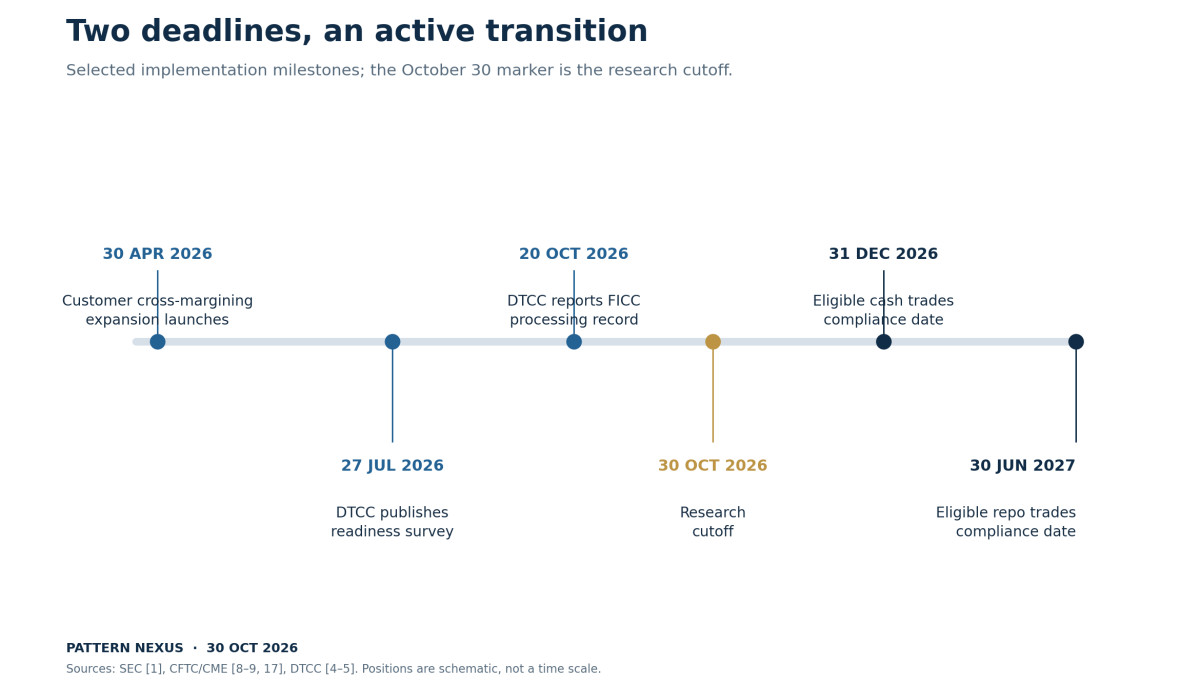
- Eligible Treasury cash transactions reach their central-clearing compliance date on December 31, 2026. Eligible repo transactions follow on June 30, 2027. The requirements have a defined scope and exceptions.[1]
- Much of the migration is already happening. DTCC reported a $13.9 trillion single-day FICC processing record in an October 20 update. That is transaction activity, not new government borrowing.[4]
- Clearing can reduce settlement exposures and collateral costs. Those savings depend on the positions, accounts, clearing arrangements, and risk offsets available to a participant.
- Access runs through institutions that supply clearing services, credit, operational support, and margin financing. Their commercial terms help determine how much of the efficiency reaches the customer.
- My central expectation is an orderly transition accompanied by uneven benefits. The important evidence will be financing costs, access, concentration, and behavior during margin calls.
The Treasury market is often discussed as if the only important question were the yield. The 10-year rises, mortgage rates respond, and the debate moves back to the Federal Reserve. Underneath that price sits another system: the arrangements that allow institutions to buy the security, finance it, hedge it, deliver it, and meet the cash obligations attached to the position.
That system is changing on a fixed timetable. With the cash-market deadline two months away, the next financial story may emerge through changes in the cost of carrying Treasuries and the firms that provide access to clearing. A bond can retain its value as government collateral while becoming more expensive for a particular institution to finance. The effect depends on the structure around the bond.
Cash clearing reaches its compliance date first; repo follows six months later.
Compatible obligations and risk offsets can reduce the resources tied up in a portfolio.
Provider relationships and commercial terms help determine who receives the benefits.
A participant still needs available resources when a margin obligation falls due.
01 · TREASURY MARKET STRUCTURE
Two deadlines, with a specific perimeter
The SEC's current implementation page lists December 31, 2026 for eligible cash-market transactions and June 30, 2027 for eligible repo transactions. Those dates reflect the one-year extension announced in 2025. Older adoption documents still show the original deadlines. The current schedule governs this report.[1]
A cash transaction is an outright purchase or sale of a Treasury security. A repurchase agreement, or repo, is a financing transaction: securities are exchanged for cash with an agreement to reverse the exchange later. These activities interact, but they have different economic purposes and different clearing deadlines.
The rule works through covered clearing agencies and their direct participants. It requires policies reasonably designed to bring eligible secondary-market transactions into central clearing. The cash-market categories include specified interdealer and broker-dealer activity; the repo categories cover a wider set of Treasury financing transactions involving direct participants. The original rule contains exceptions, and later implementation work addresses additional boundaries.[2]
An individual buying a Treasury through an ordinary brokerage account is not being ordered to establish a direct clearing membership. A retail purchase, an institutional cash trade, a Treasury auction, and a dealer's repo borrowing are different transactions. A serious analysis has to identify the relevant activity before assigning a consequence to it.
The SEC staff FAQ also confirms that transactions with the Federal Reserve and other central banks are excluded from the eligible-transaction definition.[3]
The immediate task for an institution is therefore to map transactions, counterparties, and legal entities against the rule. A firm may need a clearing relationship for one part of its business while another part sits outside the requirement. Costs can change through that mapping before anyone changes the underlying investment view.
02 · TREASURY MARKET STRUCTURE
The bond sits inside a financing structure
Treasuries perform several jobs at once. They finance the government, provide an interest-bearing asset, support hedging, and circulate as collateral. A long-term investor may buy a bond with available cash and hold it. A dealer making markets may need to finance inventory while standing ready to buy and sell. A relative-value fund may own the bond and hedge its interest-rate exposure with a derivative.
Those are very different balance sheets. The same Treasury can be easy for one owner to carry and difficult for another because their cash sources, leverage, counterparties, and funding horizons differ. The government's promise to pay at maturity does not supply every intermediary with the cash it needs today.
Repo makes that time difference visible. A borrower receives cash against securities, then owes cash back at the agreed maturity. If financing is short term and the position is intended to last longer, continued access matters. A good asset can become a difficult position when its owner has to replace financing rapidly.
New York Fed discussion of the Treasury Market Practices Group's work describes substantial variation in bilateral-repo risk management. Zero haircuts can coexist with other controls such as position limits, netting, and portfolio margining. A zero haircut alone does not establish that a trade has no protection or no risk.[12]
An OFR pilot across nine dealers on three June 2022 dates found more than 70% of Treasury repo volume in its bilateral sample transacted at zero haircut. That is historical sample evidence about one segment, rather than a current estimate for the entire repo market.[13]
That is why Treasury-market capacity cannot be read from the amount of government debt alone. We also need to know how much inventory dealers can finance, how much risk their counterparties can carry, and what happens when the price of that financing changes. Clearing reform operates inside those constraints.
03 · TREASURY MARKET STRUCTURE
What a clearinghouse changes
A central counterparty, or CCP, stands between participants in accepted trades under its rules. It becomes the central point for the cleared obligations and applies risk-management requirements to them. The objective is to reduce the dependence of settlement on a web of separate bilateral exposures.[2]
Participants still have positions and obligations. Clearing reorganizes how those obligations are managed. It can standardize risk controls, recognize offsetting positions, and reduce the payments or securities deliveries that must move across the system. The ability to combine obligations is one reason a growing market can process more activity without requiring an equal increase in every balance-sheet input.
Several financial requirements need to be kept separate. A repo haircut affects the relationship between the cash lent and the value of securities exchanged. Initial margin protects against potential adverse changes over a risk-management horizon. Variation payments or mark-to-market adjustments respond to changes in current value. Clearing-fund and other default resources support a different part of the protection structure. Their precise operation depends on the service and applicable rules.[16]
These requirements affect different risks and different cash flows. A reduction in one margin component does not establish an identical reduction in a customer's total financing cost. An intermediary may still charge for credit, liquidity, operations, and the responsibility it assumes under the clearing arrangement.
The practical question is how all of those components combine for a particular portfolio. A participant with stable funding, eligible offsets, and a well-established clearing relationship can have a different experience from a participant carrying the same headline notional through a less efficient arrangement.
04 · TREASURY MARKET STRUCTURE
A simple example of multilateral netting
Consider three institutions trading the same Treasury, at the same price, for the same settlement date. A sells $100 million to B. B sells $98 million to C. C sells $97 million to A. The gross value of the three trades is $295 million.
After combining the obligations, A is a net seller of $3 million, B is a net buyer of $2 million, and C is a net buyer of $1 million. In this deliberately simplified example, the final net securities delivery is $3 million, matched by $3 million of net cash moving in the opposite direction. The original economic trades remain represented in the final positions.
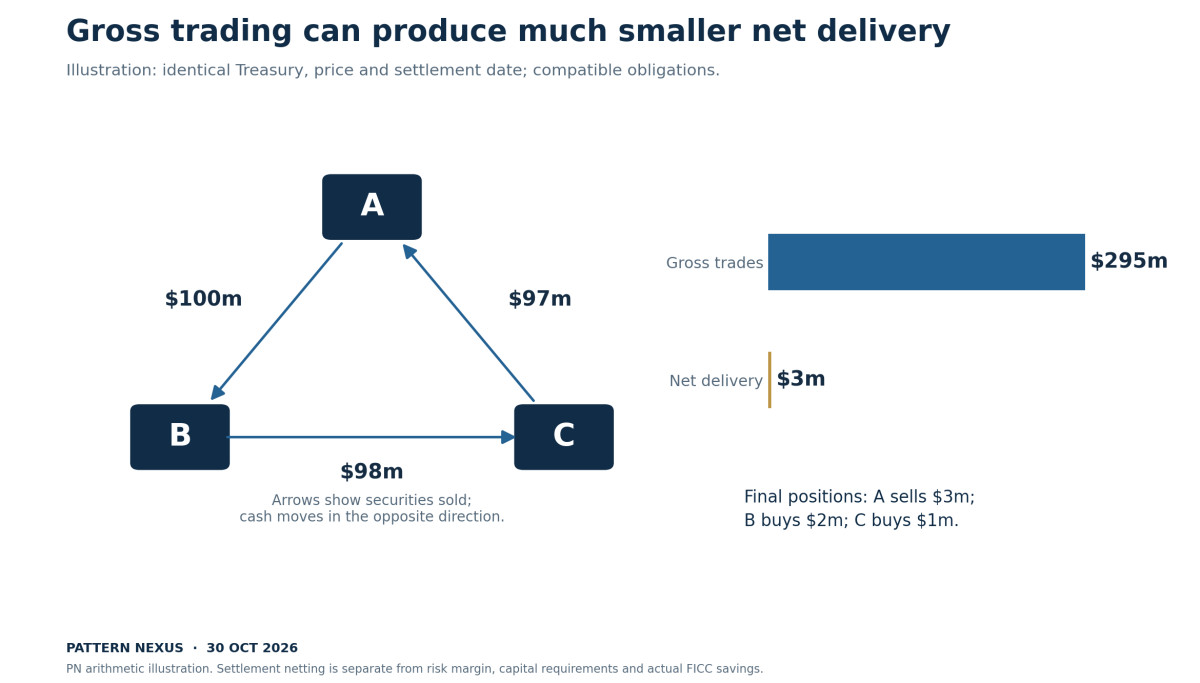
The example shows how a network of large gross transactions can generate much smaller net settlement obligations. Bilateral arrangements can also recognize offsets between counterparties. The additional opportunity in multilateral netting comes from combining compatible obligations across the broader cleared network.
The $295 million and $3 million figures are arithmetic illustrations. They are not estimates of actual FICC capital savings, and their ratio cannot be applied to the Treasury market. Different securities, dates, prices, accounts, and legal arrangements change the offsets that can be recognized. Risk margin is also a separate calculation from the amount delivered at settlement.
The economic incentive is still clear. If a participant can support the same useful trading activity with fewer settlement obligations or less collateral tied up, it can carry more activity with a given funding base. That benefit creates demand for clearing arrangements that recognize the participant's positions efficiently.
05 · TREASURY MARKET STRUCTURE
The transition is already visible in the operating data
DTCC's October 20 update reported that FICC had processed $13.9 trillion of transactions in one day during the preceding week. It also reported roughly $570 billion of balances across its Agent Clearing Service and Sponsored GC Collateral-in-Lieu program, and more than $2 billion in average daily margin savings across the enhanced FICC-CME cross-margining program.[4]
Those are three different measurements. Transaction processing is a flow. Service balances describe positions within specified arrangements. Margin savings describe a reduction in collateral requirements relative to the relevant comparison. None is a measure of daily government borrowing or daily trading profit.
| Reported observation | What the number describes | Interpretation limit |
|---|---|---|
| $13.9 trillion processed in a single day | FICC transaction activity reported in the October 20 update | A processing record is not a stock of debt or an estimate of new credit creation. |
| Approximately $570 billion | Balances across two named FICC access programs | The figure does not represent every clearing service or every customer. |
| More than $2 billion in average daily margin savings | Reported collateral efficiency across the enhanced cross-margining program | It cannot be added up as though the same amount were newly earned every day. |
A July 27 DTCC survey provides another view. Responding FICC Government Securities Division Netting Members reported more than $1.2 trillion in daily Treasury cash activity already cleared and approximately $300 billion to $400 billion still outside clearing. Seventy-nine percent said the necessary account setups were already in place. Approximately one-third expected to provide cash-clearing services to clients.[5]
The sample is important. These are responses from clearing members, not an independent census of every investor's readiness. They nevertheless provide evidence of considerable preparation. A forecast of immediate system-wide failure would have to explain why that migration and onboarding progress are insufficient.
06 · TREASURY MARKET STRUCTURE
Access becomes part of the economics
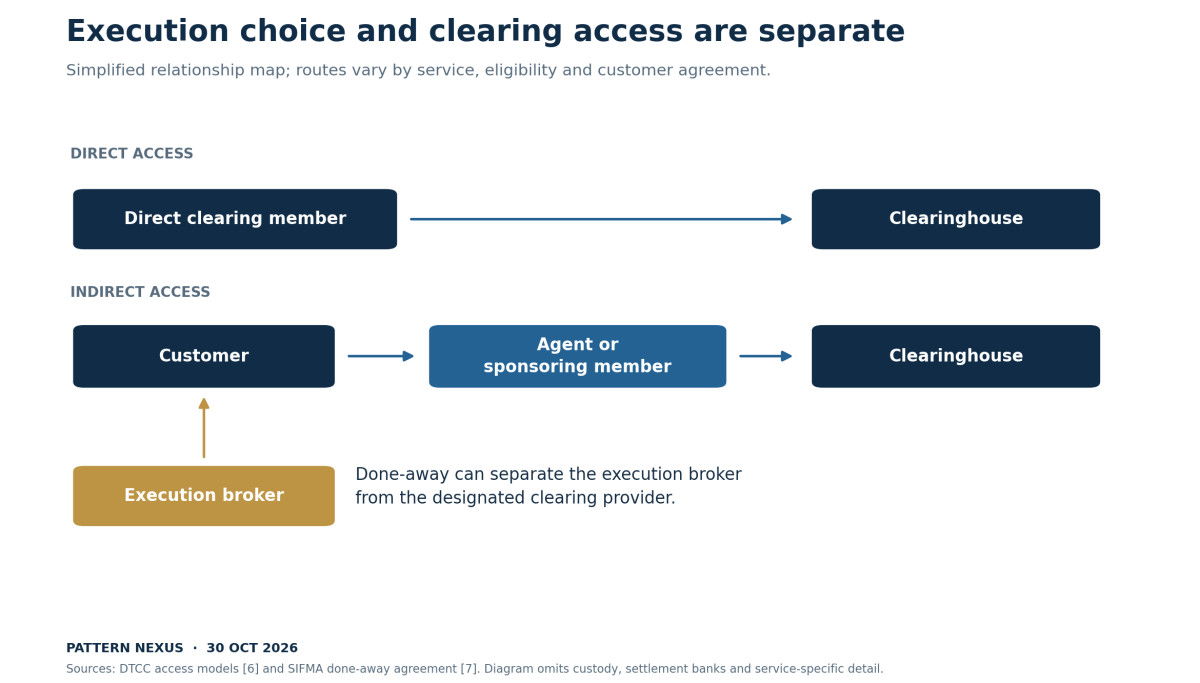
FICC offers direct and indirect routes. Full Netting Membership creates a direct relationship with the clearinghouse. CCIT is a direct limited-membership route for eligible triparty cash lenders. Agent Clearing Service, Sponsored Service, and Sponsored GC provide indirect access through an agent or sponsoring member, with different service features and eligibility requirements.[6]
The choice affects the operational work a firm performs and the responsibilities carried by its intermediary. A large institution may have the systems and resources to support a direct relationship. Another institution may find an indirect arrangement more practical. The existence of several routes can broaden access, while the commercial terms attached to each route influence how much of the benefit reaches the end participant.
| Access route | Relationship | Economic question for the participant |
|---|---|---|
| Full Netting Membership | Direct | Are the infrastructure, funding, and membership responsibilities justified by the activity? |
| CCIT Membership | Direct, limited-purpose | Does the firm's cash-lending activity fit this route? |
| Agent Clearing Service | Indirect, through a clearing agent | How are service responsibilities and customer charges allocated? |
| Sponsored Service / Sponsored GC | Indirect, through a sponsoring member | Which positions and services are available, and on what credit and liquidity terms? |
Execution adds another layer. In a done-with arrangement, the trade is executed and cleared through the same broker. Done-away permits a trade executed with a third party to be cleared through the customer's designated provider. SIFMA published its done-away Treasury clearing agreement on July 30 after an industry drafting process.[7]
That arrangement can let an investor seek execution from several dealers while maintaining a consolidated clearing relationship. It can support price competition at the execution stage and improve the organization of collateral. It also makes the quality of the clearing-provider relationship more consequential.
The survey finding that roughly one-third of responding members expected to offer client cash clearing deserves attention here. It does not establish inadequate capacity. It means the number of firms able to clear their own activity is different from the number offering that service to others. The market for customer access has to be evaluated on its own terms.[5]
07 · TREASURY MARKET STRUCTURE
Cross-margining changes the cost of a hedged position
A hedged portfolio can contain large positions whose risks partly offset. If each leg is margined without recognizing the other, the participant may have to finance more collateral than a combined assessment would require. Cross-margining permits eligible offsets to affect the margin calculation across the specified arrangements.
The CFTC approved limited exemptive relief on April 15, 2026 to extend the FICC-CME arrangement to certain customers with safeguards. The end-user expansion launched on April 30. Participation depends on eligible customers and joint clearing members with the required broker-dealer and futures-commission-merchant registrations; it is not a universal benefit attached to every Treasury holding.[8][9][17]
Take an illustrative portfolio with $20 million of margin required on one leg and $15 million on another. If an eligible combined arrangement reduces the total from $35 million to $23 million, $12 million of collateral capacity is released. At an assumed 5% annual funding cost, the gross annual carry difference is $600,000. Collateral remuneration, fees, and other costs would alter the final result.
That calculation is not a published FICC margin schedule or a promised customer saving. It illustrates why firms spend time and money organizing eligible positions. A change in the financing structure can alter the economics of a trade even when its expected market return has barely changed.
CME's FAQ says the two clearing organizations charge no additional participation fee for the cross-margining arrangement. A customer's complete financing and service bill still needs separate assessment.[9]
For a fund competing on a narrow relative-value spread, that difference can determine whether a position is worth carrying. For a dealer, it can affect the inventory it can support. Those decisions feed back into the prices available to the next participant.
08 · TREASURY MARKET STRUCTURE
The basis trade connects all three markets
The Treasury cash-futures basis trade brings together an outright Treasury position, repo financing, and a futures hedge. A typical construction holds a deliverable Treasury financed through repo and sells a related Treasury futures contract. The opportunity depends on the relationship among cash prices, futures prices, financing, and the mechanics of delivery.[11]
Federal Reserve research published in June describes both the liquidity and price-discovery role of these trades and the risks created by leverage and interconnected exposures. A position can be sensitive to changes in the basis, futures margin, or access to repo financing. The hedge limits some risks while leaving those other funding and implementation risks in place.[11]
Cross-margining is relevant because the positions sit in related markets. Recognizing offsets can reduce the collateral needed to support them. That can improve resilience for an existing portfolio if the released capacity becomes a cash buffer or reduces borrowing.
There is another possible response: the participant may use the efficiency to expand the position. A lower collateral requirement per unit can then support more gross activity. Whether the system becomes more resilient depends partly on how the new capacity is used.
That is the feedback I would monitor. An efficiency improvement can be real while aggregate exposure continues to grow. The most useful question is how much readily available cash participants retain relative to the obligations they could face during a sharp market move.
09 · TREASURY MARKET STRUCTURE
Cash has to arrive on the clearing timetable
An institution can have substantial assets and still need to obtain cash quickly. A collateral call creates a deadline. The relevant assets may be in another account, held in a form requiring conversion, or committed to obligations that cannot be unwound immediately. Operational ability to mobilize resources becomes part of financial resilience.
CME's published cross-margining FAQ describes both intraday and end-of-day calculations. For the FICC customer cross-margin account, it describes an end-of-day calculation at 8:00 p.m. Eastern and an early-morning call between 2:00 and 3:00 a.m., with the combined payment due by 9:30 a.m. It also explains that fallback processes cannot guarantee a margin reduction in every disruption.[9]
The timetable turns a model output into a funding requirement. A participant must have the account access, cash, eligible collateral, and operational process ready when the obligation arrives. The value of a long-term portfolio cannot by itself establish that readiness.
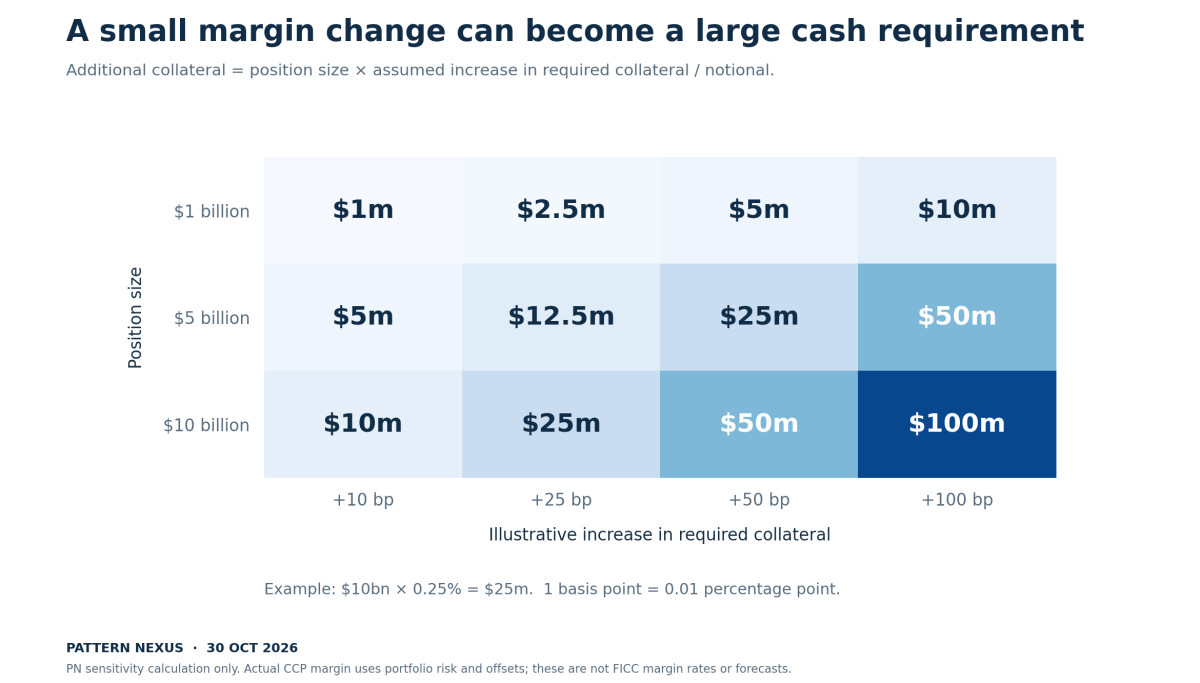
Figure 4 applies a simple sensitivity calculation: additional collateral equals position size multiplied by an assumed increase in required collateral as a share of notional. A 25-basis-point increase on $10 billion produces a $25 million cash-equivalent requirement. On $1 billion it produces $2.5 million.
These assumptions are deliberately transparent. Actual CCP margin models use portfolio risk, offsets, and other factors; they do not impose this report's illustrative flat percentages. The calculation shows how scale converts a small change in funding terms into a meaningful call on liquidity.
The risk spreads if several participants respond by selling assets, cutting positions, or drawing credit at the same time. The most liquid securities can be the easiest source of cash. A sale then reflects the owner's funding needs as well as its view of the security's underlying value.
10 · TREASURY MARKET STRUCTURE
The next competition may be between clearing arrangements
A market can offer several clearing venues and still concentrate much of its activity in one. Portfolio offsets create an incentive to clear related positions together. As more compatible positions accumulate, the location of the existing portfolio can affect the cost of the next trade.
An August Chicago Fed Letter examines this possibility through the experience of interest-rate-swap clearing. It discusses competition that improved efficiency alongside concentration and pricing differences between CCPs. For Treasuries, the paper expects less scope for this type of pricing basis in short-settlement cash trades, with more potential in term repo as funding and margin effects persist over longer periods.[10]
I would treat a durable difference in the all-in cost of economically similar term-repo positions across clearing arrangements as an important signal. The quoted repo rate alone may miss fees, collateral financing, account restrictions, and the value of offsets elsewhere in the portfolio.
Moving a single trade to a cheaper venue can also sacrifice an offset with the remaining book. That makes the customer's decision a portfolio decision. Competition over one price may coexist with a strong incentive to remain within an established arrangement.
The test is observable. Broad access, workable transfers, competitive customer terms, and persistent cost savings would support the case that expanded clearing improves capacity widely. Concentrated access combined with material differences in all-in costs would support the case that market power is becoming more important.
11 · TREASURY MARKET STRUCTURE
Cross-border boundaries and operational fallback
The dollar system operates across legal entities and time zones. A financing structure that works for a domestic business-day cycle may need additional arrangements when securities, cash, and staff are distributed globally. Clearing rules meet that existing structure rather than replacing it overnight.
In August, the SEC described continued work on requests concerning transactions with non-U.S. clients, inter-affiliate transactions, and the treatment of net omnibus margin in reserve computations. Those were implementation questions and requests for relief. Their existence alone did not make each requested exemption effective.[14]
At the September Treasury Market Conference, Commissioner Uyeda specifically discussed the time-zone limits of clearing agencies that do not operate continuously, alongside the role of inter-affiliate repo in global liquidity management.[15]
Fallback arrangements also matter. SEC staff guidance addresses limited circumstances in which transactions may settle bilaterally during clearing-agency unavailability or after operational failures to novate outside a participant's control, subject to the stated conditions. The FAQ is staff guidance, rather than a new Commission rule.[3]
These provisions belong in the financial analysis because market functioning depends on the route available when the normal process is interrupted. A participant needs to understand the applicable conditions, its counterparty arrangements, and its operational ability to use a permitted alternative. The presence of a fallback is useful evidence of preparation; its performance must still be observed under real conditions.
12 · TREASURY MARKET STRUCTURE
Three paths through the transition
My central case through the cash deadline and into the repo transition is continued migration with uneven efficiency gains. The published readiness evidence supports substantial preparation. The economics of offsets and intermediary relationships support differences in the benefits customers receive. This is a qualitative assessment, without a statistically calibrated probability attached to it.
| Path | Conditions that would produce it | Financial result to look for |
|---|---|---|
| Broad efficiency | Multiple usable access routes, competitive customer terms, reliable offsets, and manageable funding needs | Lower all-in carrying costs and more capacity across a broad participant base. |
| Orderly concentration — central case | Successful migration, with efficiency tied closely to established portfolios and clearing relationships | Better aggregate infrastructure alongside persistent differences in customer costs and access. |
| Funding disruption | Volatility, operational problems, or constrained credit arrive while firms need collateral quickly | Margin funding pressure, position reductions, and weaker market depth despite substantial aggregate clearing capacity. |
The third path does not require a failure of the entire clearing system. Stress could remain concentrated in firms whose available cash, credit, or operational arrangements are insufficient for a particular demand. Strong infrastructure and a vulnerable participant can exist at the same time.
The first path deserves equal attention. If customer access broadens and the benefits pass through, expanded clearing could allow dealers and investors to support Treasury activity more efficiently. That would be a consequential improvement in the system's ability to absorb trading and financing demand.
13 · TREASURY MARKET STRUCTURE
The dashboard I would use
The calendar supplies checkpoints, but the evidence has to come from market behavior. High processing volume alone cannot establish either broad resilience or broad fragility. The measurements below address different parts of the mechanism.
| Signal | What to inspect | Evidence that would strengthen the concentration or funding-pressure thesis |
|---|---|---|
| Customer access | Number and breadth of active service providers; onboarding completion | Persistent dependence on a narrow set of providers or difficulty establishing usable access. |
| All-in financing | Repo rates plus fees, collateral carry, and other customer charges | Durable differences for comparable portfolios across providers or clearing arrangements. |
| Margin efficiency | Published savings and customer-level offsets | Large aggregate benefits that fail to reach a broad customer base. |
| Funding readiness | Cash buffers, available credit, collateral mobility, and intraday processes | Repeated urgent funding needs or position reductions around margin calls. |
| Market functioning | Depth, bid-ask spreads, settlement fails, and repo conditions | Deterioration that persists beyond a routine calendar or temporary operational effect. |
| Portfolio response | Leverage, gross exposures, and use of released collateral | Efficiency gains used to expand positions faster than liquidity buffers. |
| Implementation status | Final orders, effective rules, guidance, and remaining proposals | Operational dependence on relief or processes that are not yet in place. |
Some of this information is public in aggregate; some sits in private customer agreements and supervisory data. Public analysis can establish the mechanism and monitor symptoms without pretending to observe every institution's live funding position. The strongest conclusion will come when several independent measures point in the same direction.
PATTERN NEXUS VIEW
Pattern Nexus View
The financial system does not transmit liquidity through one number. It depends on the amount of money available, the balance-sheet capacity willing to intermediate it, the collateral recognized by the relevant institutions, and the time allowed to meet an obligation. Clearing changes how those pieces interact.
In QE 2026, Phase Two, I examined the difference between reserve support and absorbing the duration private investors must carry. Expanded clearing adds another variable: the efficiency with which private balance sheets process the resulting transactions. A system can improve its use of existing resources without the Federal Reserve creating additional reserves.
That can still influence liquidity conditions. If netting allows a dealer to support more useful activity with a given balance sheet, market capacity can improve. If the benefits depend on access to particular providers and eligible portfolio arrangements, the improvement can be uneven. The institutional route becomes part of the financing price.
The Interest Trap follows the government's growing financing burden. This article follows the machinery that intermediates the securities. Fiscal demand and market infrastructure meet at the dealer balance sheet, but a better clearing arrangement cannot remove the government's interest expense or guarantee low long-term yields.
My expectation is that the structure of access will become more visible as cash clearing reaches its deadline and repo follows. The firms able to combine eligible positions, organize collateral, and meet calls reliably should capture a larger share of the efficiency. How much they pass through to customers will help determine whether the result is broadly cheaper financing or a more concentrated set of advantages.
That expectation would weaken if client access expands, customer costs converge, and stress episodes show that collateral savings are accompanied by stronger liquidity buffers. It would strengthen if comparable positions carry persistently different all-in costs or if margin calls repeatedly force constrained participants to reduce otherwise viable positions.
The Treasury security remains central to the system. The arrangements around it decide how much activity an institution can support, what that activity costs, and how long it can remain in the market when conditions change. Those arrangements are now moving toward a new operating structure on a published timetable.
READER QUESTIONS
Reader Questions
Does every Treasury trade have to clear by December 31?
No. December 31, 2026 is the compliance date for eligible cash-market transactions under the rule. Eligible repo transactions follow on June 30, 2027. Scope depends on transaction type, counterparties, and applicable exceptions.[1][2]
Does central clearing create money like QE?
Clearing can reduce settlement obligations or collateral requirements and thereby improve use of existing financial resources. It does not by itself create Federal Reserve reserve balances. Its influence runs through market capacity, risk management, and financing arrangements.
Are lower margin requirements always safer?
Recognizing a genuine offset can reduce unnecessary collateral use. Resilience also depends on whether the participant retains the released capacity as liquidity or uses it to expand positions, and on what happens to offsets during stress.
Does the $13.9 trillion record mean that much government debt was issued in a day?
No. DTCC reported transaction processing at FICC. Processing volume, outstanding positions, government borrowing, and margin requirements measure different things.[4]
Could this improve Treasury-market liquidity?
Yes. Netting, broader access, and more efficient collateral use can support intermediation. The outcome should be evaluated through market depth, customer costs, funding resilience, and performance during volatile periods.
Is the main forecast a crisis at the deadline?
My central expectation is an orderly migration with uneven benefits. The funding-disruption scenario requires additional pressure from volatility, constrained credit, collateral demands, or operational difficulties.
Who is most likely to benefit?
Participants with compatible positions, eligible offsets, reliable funding, and effective clearing access have the clearest route to efficiency gains. The distribution of benefits also depends on service-provider competition and negotiated customer terms.
METHOD AND EVIDENCE
Method and evidence notes
The research cutoff is October 30, 2026. Current compliance dates come from the SEC implementation page. Adoption documents are used for scope, with their original deadlines superseded by the extension. Issuer statistics are attributed to DTCC and retain their publication dates and survey boundaries. Outstanding proposals are identified as proposals rather than completed changes.
The netting example assumes the same security, price, settlement date, and compatible obligations. The margin sensitivity is position size multiplied by an assumed incremental collateral percentage. The cross-margin funding example assumes a $12 million collateral reduction and a 5% gross annual funding cost. These are reproducible illustrations, not estimated FICC requirements, portfolio backtests, or investment returns. Scenario ranking is analytical judgment.
This report examines market structure and funding mechanics. It does not identify a particular institution as distressed or establish that the clearing transition will produce a specific Treasury yield or asset-price outcome.
SOURCES
Research and Data Sources
Primary documents and institutional publications supporting the rule, implementation record, market mechanics, and historical comparisons. PN calculations are identified separately.
- U.S. Securities and Exchange Commission. Treasury Clearing Implementation. Current page, checked October 30, 2026. Current compliance dates, implementation resources, and scope of the transition.
- U.S. Securities and Exchange Commission. SEC Adopts Rules to Improve Risk Management in Clearance and Settlement and Facilitate Additional Central Clearing for the U.S. Treasury Market. December 13, 2023. Adopted transaction categories and risk-management objectives; the original compliance dates shown here were later extended.
- SEC Division of Trading and Markets. Frequently Asked Questions — Treasury Clearing Rule. Updated September 2, 2026. Staff interpretation of eligibility, central-bank exclusions, outages, and operational failures to novate.
- DTCC — Brian Steele. What the New Volume Peak at FICC Is Really Telling Us About the Treasury Market. October 20, 2026. Issuer-reported processing record, balances in named access programs, and average daily cross-margining savings.
- DTCC. Market Participant Firms Making Significant Progress Toward U.S. Treasury Cash Clearing Deadline, According to Latest DTCC Survey. July 27, 2026. GSD Netting Member survey; activity, account readiness, onboarding, and expected provision of client clearing.
- DTCC / FICC. Access Models. Current service description, checked October 30, 2026. Direct and indirect access routes; service eligibility and primary relationships.
- SIFMA. SIFMA Publishes U.S. Treasury Done-Away Securities Clearing Agreement. July 30, 2026. Done-with and done-away execution/clearing arrangements and standardized documentation.
- Commodity Futures Trading Commission. CFTC Approves Order to Further Strengthen U.S. Treasury Market Liquidity. April 15, 2026. Limited exemptive relief enabling customer cross-margining with safeguards.
- CME Group. FAQ: CME-FICC Cross-Margining Arrangement Expansion. Updated June 2026. Eligibility, customer margin collection, calculation cycles, payment deadlines, and fallback limitations.
- Federal Reserve Bank of Chicago — Ketan B. Patel. Central Clearing Mandates and Market Power: Lessons from Swaps for U.S. Treasury Securities. Chicago Fed Letter No. 526, August 2026. Historical clearing competition and conditional implications for Treasury cash markets and term repo.
- Federal Reserve Board. Decomposing Hedge Funds’ U.S. Treasury Exposures. June 22, 2026. Cash-futures basis construction, leverage, interconnected exposures, and funding vulnerabilities.
- Federal Reserve Bank of New York — The Teller Window. Haircuts in Treasury Repo: A Look at the Non-Centrally Cleared Bilateral Repo Market. April 8, 2025. Repo mechanics and differences among haircuts, netting, limits, and portfolio margining.
- Office of Financial Research. Why Is So Much Repo Not Centrally Cleared?. May 12, 2023; June 2022 pilot sample. Historical sample evidence on bilateral-repo haircuts; this is not a current market-wide estimate.
- U.S. Securities and Exchange Commission — Mark Uyeda. Update on the SEC’s Work Toward Treasury Clearing Implementation. August 7, 2026. Requests and implementation work concerning non-U.S. activity, affiliate transactions, and reserve computations.
- U.S. Securities and Exchange Commission — Mark Uyeda. Remarks at the 2026 U.S. Treasury Market Conference. September 22, 2026. Cross-border, time-zone, and implementation considerations; remarks reflect the speaker’s stated capacity.
- Federal Reserve Board. Proportionate Margining for Repo Transactions. February 14, 2025. Differences between bilateral repo haircuts, risk-based CCP margin, and counterparty protection.
- CME Group / DTCC. DTCC and CME Group Receive Regulatory Approvals to Launch Expanded U.S. Treasury Cross-Margining Arrangement for End-User Clients. April 16, 2026. April 30 customer expansion date and eligible end-user access through joint clearing members.
Public research on collateral, financing capacity, and the institutions connecting them. This article is available free, without a premium or registration gate.
What's Your Reaction?
 Like
0
 Dislike
0
 Love
0
 Funny
0
 Wow
0
 Sad
0
 Angry
0

Nexus (Christopher)
Founder of Pattern Nexus. I research markets, macro, geopolitics, AI, history, ancient systems, and the patterns most people overlook. I’m also building Market Radar, a trading scanner designed to read pressure, risk, confirmation, and setup quality before ch…
Related research

CFTC Turns Tokenized Collateral Into a 24/7 Treasury-Market Plumbing Test
CFTC Chairman Michael S. Selig told the 2026 U.S. Treasury Market Conference that U.S. markets need to prepare for mass tokenization, oncha…
3 shared topics, 2 shared assets.
QE 2026, Phase Two: When the Long End Forces Duration Control
The Fed already ended QT and expanded Treasury holdings through bill-focused reserve-management purchases, but that repaired the reserve la…
4 shared topics, 1 shared asset.
Two Economies, One Balance Sheet: The Unstable Barbell of 2026
Reserve support has returned, but real long rates, fiscal supply, and an AI-energy capital wave are splitting the U.S. economy between capi…
4 shared topics, 1 shared asset, same research avenue.
The Price of a Fractured World: Why the 30-Year Treasury Is Sending a Geopolitical Signal
Something about the global system feels uncomfortable, and the last month of data suggests that feeling has a measurable foundation. The U.…
4 shared topics, 2 shared assets.
The New Fed Chair Does Not Inherit an Economy. He Inherits the Permission Stack.
Kevin Warsh is not simply inheriting the Federal Reserve. He is inheriting the control layer where inflation, debt service, Treasury fundin…
7 shared topics, 1 shared asset, same research avenue.
The Headline Is Late: How Pattern Nexus Mapped the Chokepoint War Before Hormuz Became Visible
The Iran-Hormuz crisis did not create the Pattern Nexus framework. It exposed it. For months, Pattern Nexus had already been mapping the de…
5 shared topics, 1 shared asset.
Warsh’s Fed and the Balance-Sheet War: Why “Rates Down” Can Still Mean “Liquidity Tight”
A Pattern Nexus systems read on the incoming Fed regime debate: floor vs corridor, repo backstops, Treasury supply, and why the balance she…
4 shared topics, 1 shared asset.
Comments (0)
Security Check
Please complete the captcha to verify you are human.