

Who Actually Gets the Tariff Refund?
Tariff refunds can pass through importers to claim buyers, vendors, and employees. PN follows the cash and accounting in three company disclosures to test how much new operating relief the refund cyc…
Jump to a section
Designer Brands received $36.8 million from Customs in its second quarter and remitted $18.3 million to an investor that had bought refund rights before the Supreme Court ruling. Academy Sports also disclosed a substantial payment to a claim buyer. Williams-Sonoma recorded reimbursements for vendors and a contribution for employees.[1][3][4]
The financial story runs through several balance sheets. The company receiving the government payment, the party that financed the claim, and the people who absorbed the original tariff can be different. My working view is that refund ownership and prior financing will explain more of the near-term variation between companies than the headline size of their refund announcements.
The administrative recipient identifies where the government payment begins.
Claim sales and credit terms can attach obligations before cash arrives.
Vendor reimbursements and employee allocations can distribute the recovery.
Remaining cash, borrowing capacity, and subsequent spending determine the financial effect.
01 · REFUNDS AND FINANCING
The money had a history before Customs paid it
Before the Supreme Court's February 20 ruling, Designer Brands had sold rights to $18.3 million of potential tariff refunds for $2.2 million in cash. The eventual government payment therefore arrived with an existing private claim attached.[1]
That transaction is a useful place to begin because it forces a question that an aggregate refund total cannot answer: how much of the incoming payment remains available to the business receiving it?
A retailer could use an earlier advance to meet payroll, buy inventory, or reduce expensive borrowing. When Customs later pays the refund, some of the financing benefit has already happened. Counting the whole payment as another fresh injection into that retailer's spending capacity would count the same economic support twice.
The reverse mistake is to treat the later payment as irrelevant. It closes a financing transaction, transfers risk out of the claim, and gives the investor cash that can be deployed again. The immediate recipient and the next use of the money have changed. The money has not disappeared.
This is where the article's central hypothesis begins. The refund cycle could produce strong cash receipts, conspicuous earnings benefits, and uneven operating relief at the same time. Whether that hypothesis holds depends on the contracts and subsequent uses of cash, which can be tested in filings.
02 · REFUNDS AND FINANCING
Designer Brands: trace the two interest payments
For the quarter ended August 1, Designer Brands reported $35.5 million of tariff recoveries and $1.3 million of government interest, totaling $36.8 million received. It remitted $18.3 million to the investor. The repayment comprised $2.2 million of principal and $16.1 million of financing interest expense.[1]
The government interest and the financing interest move in opposite directions. The first compensates the company for money held by the government. The second belongs to the earlier claim-financing arrangement. Combining them into a single interest figure would obscure the transaction.
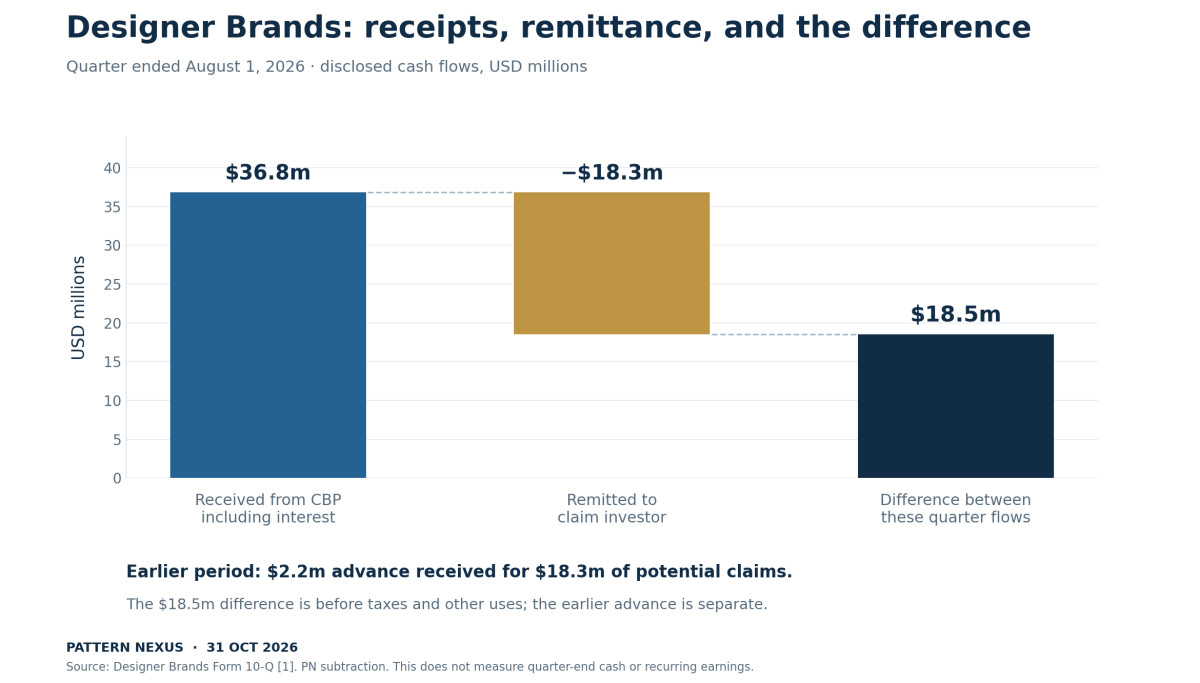
PN's cash reconciliation is $36.8 million received minus $18.3 million remitted, leaving $18.5 million from those quarter-specific flows, before taxes and other uses. The earlier $2.2 million advance belongs to a different period. Including it produces $20.7 million across the two stages, rather than another $2.2 million of second-quarter cash.
The original purchase price was approximately 12% of the stated claim amount. The eventual gross payment to the buyer was about 8.3 times the advance. These are transaction arithmetic, not an annualized return or the investor's net profit. The filing does not provide everything needed to calculate either.
Hindsight makes the discount look easy to judge. At the time of purchase, the legal result, payment timing, and collectability were uncertain. The seller bought certainty and earlier cash; the buyer accepted contingent exposure. Assessing the bargain would require the alternatives available to the seller at that time, including the cost of waiting.
The earnings presentation adds another layer. The company's release identifies the tariff recovery in cost of sales and separates the related financing effect in its results reconciliation.[2] A reader looking only at gross margin can therefore miss a substantial expense elsewhere in the income statement.
For analysis, I would reconcile the entire transaction before treating a margin improvement as evidence of stronger merchandise economics. That means following the recovery, the associated financing charge, and the cash settlement together. It also means resisting a false calculation: subtracting a pretax refund benefit from after-tax net income does not produce a valid measure of underlying earnings.
03 · REFUNDS AND FINANCING
Academy provides a second completed cash example
Academy Sports and Outdoors disclosed a participation agreement entered during 2025 to sell part of its potential tariff-relief rights, accounted for under the debt guidance. In its second quarter ended August 1, 2026, it received $83.7 million of refunds excluding interest and paid $72.2 million to the buyer. It also recognized $10.5 million of earlier sale proceeds that had been recorded as a liability.[3]
The refund less the buyer payment is $11.5 million. That is a reconciliation of the disclosed flows, excluding interest, taxes, and other cash movements. Recognition of the earlier $10.5 million changes the income statement; it does not establish a fresh receipt of that amount in this quarter.
| Disclosed second-quarter flows | Designer Brands | Academy Sports |
|---|---|---|
| Government receipts | $36.8m, including interest | $83.7m, excluding interest |
| Payment to claim buyer | $18.3m | $72.2m |
| Difference between those flows | $18.5m | $11.5m |
The cases demonstrate that an announced refund can have a substantial onward payment attached. They are a selected pair, with different interest coverage, rather than a representative sample. Their proportions cannot establish how much of the national refund pool belongs to investors. Academy's note also does not establish a claim-face amount directly comparable with the Designer Brands transaction.
That limitation leaves a useful research agenda. An investor can search filings for participation agreements, refund-right sales, financing liabilities, and payments to buyers, then reconcile those disclosures with the cash-flow statement. A growing sample could establish how common the mechanism is. Two examples establish its existence.
04 · REFUNDS AND FINANCING
Four questions determine where a refund lands
The word “recipient” can conceal several different relationships. For a financial model, I would separate four questions before forecasting the effect of a refund.
| Question | What it helps identify | Evidence to seek |
|---|---|---|
| Who receives the government payment? | The administrative payment route | Customs records and company receipt disclosures |
| Who already has a contractual interest? | Claim buyers, lenders, vendors, or other counterparties | Participation agreements, credit terms, and commitments |
| Who absorbed the original cost? | The economic burden across the supply chain | Pricing, concessions, margins, and purchasing terms |
| Who can use the remaining cash? | The next spending or financing decision | Cash restrictions, debt repayment, investment, and distributions |
These questions overlap without producing identical answers. A company may have paid Customs, negotiated lower supplier prices, raised retail prices, and sold part of its potential recovery. One government payment then interacts with several earlier bargains.
CBP's original CAPE deployment notice describes consolidated refunds to the importer of record or designated recipient and allows offsets for outstanding CBP bills.[8] That administrative route helps explain where a payment starts. The private agreements determine additional obligations after receipt.
The strongest financial analysis therefore needs both a payment map and a contract map. A large receivable says something about an expected asset. It says less about how much unrestricted cash will remain after settlement, and still less about how management will use that cash.
05 · REFUNDS AND FINANCING
Williams-Sonoma shows another route through the supply chain
Williams-Sonoma's quarter ended August 2 provides a broader distribution example. It recorded $167.8 million as a reduction in cost of goods sold and $6.3 million of related interest income. Against that, it recorded a $47.5 million provision to reimburse certain merchandise vendors for earlier tariff concessions and a $10 million employee recognition cost through a discretionary 401(k) contribution.[4]
Those four disclosed items produce a $116.6 million pretax accounting contribution by PN arithmetic. Separately, $29.3 million of refund income reduced inventory and was expected to reach cost of goods sold in the third quarter. The company collected $200.2 million of refund cash including interest during the second quarter.[4][5]
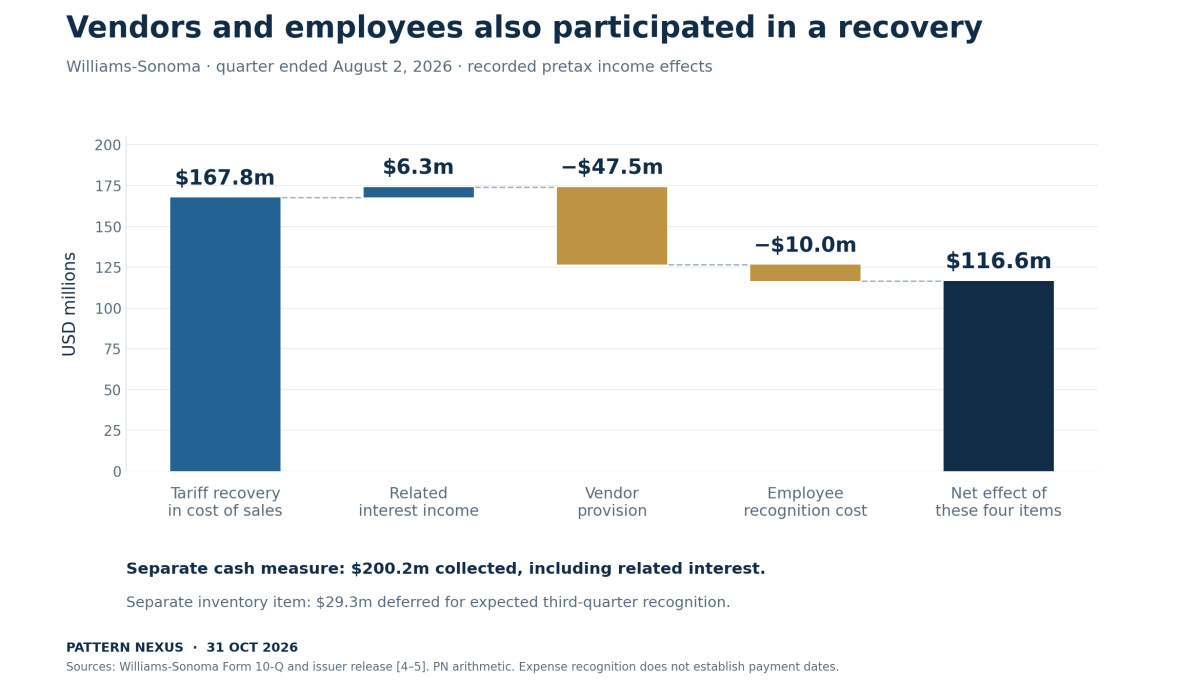
The bridge in Figure 2 measures recorded income effects. The vendor provision and employee cost do not, by themselves, establish the dates on which matching cash payments occurred. Subtracting those expenses from the $200.2 million receipt would not establish cash retained at quarter-end.
The disclosure gives the original tariff negotiation a financial afterlife. A vendor that had accepted less revenue to help its customer bear the tariff could receive reimbursement when the tariff was recovered. Workers were included through an employer retirement contribution. Both outcomes need to be measured on their own terms.
This changes the distributional question. It is too narrow to ask only whether an importer or an outside investor benefits. The possibilities also include supplier restoration, employee compensation, and a later inventory-related earnings benefit. Each route has different timing and different implications for the next quarter.
I would treat this as evidence for a more detailed model of transmission. The national total sets the scale. Company arrangements help determine which balance sheets improve and when the improvement becomes available for another decision.
06 · REFUNDS AND FINANCING
Claims became a way to finance waiting
Selling a contingent recovery brings future uncertainty into a present financing decision. The seller receives an advance. The buyer receives an interest in an uncertain payment. If the government eventually pays, the contract allocates the proceeds.
Deloitte's accounting analysis explains why arrangements involving proceeds from the sale of refund rights can be treated as financing, with the original receipt and eventual settlement requiring separate consideration.[16] That accounting framework is consistent with the financing characteristics visible in the company examples; the classification of a particular agreement still depends on its terms.
The discount can reflect more than the probability of winning a lawsuit. Expected waiting time, documentation quality, disputes over entitlement, investor funding costs, and the seller's need for cash can all affect a negotiated price. The realized outcome does not reveal the weight each factor carried when the agreement was signed.
This opens a less obvious financial angle: legal uncertainty can become a source of financing demand. Businesses facing similar legal prospects may accept different terms because their liquidity positions differ. The claim can be economically valuable while still being difficult for its owner to carry until payment.
That is a hypothesis about bargaining conditions, rather than a finding that any named company was forced into its agreement. Establishing it would require transaction dates, comparable offers, borrowing alternatives, and information about available cash at the time.
The evidence that would strengthen the hypothesis is specific: larger discounts associated with weaker liquidity, longer expected payment delays, or more difficult documentation, after controlling for differences in the claims themselves. Evidence of competitive pricing and ample seller financing alternatives would weaken an interpretation centered on financing constraints.
07 · REFUNDS AND FINANCING
Three clocks can tell three different stories
The same refund can appear in national accounts, corporate earnings, and government cash records in different periods.
BEA estimated the obligation at approximately $166 billion excluding interest and classified it as a capital transfer accrued in the first quarter of 2026. The $664 billion figure in annual-rate presentation is the same quarterly amount annualized. It is not an additional cash payment.[6]
Corporate recognition follows the company's accounting model and facts. Academy disclosed recognition as payments were received; Williams-Sonoma recorded a receivable under a loss-recovery model.[3][4] Treasury cash reporting follows actual receipts and refunds. A comparison that ignores these dates can make one transaction look like several separate events.
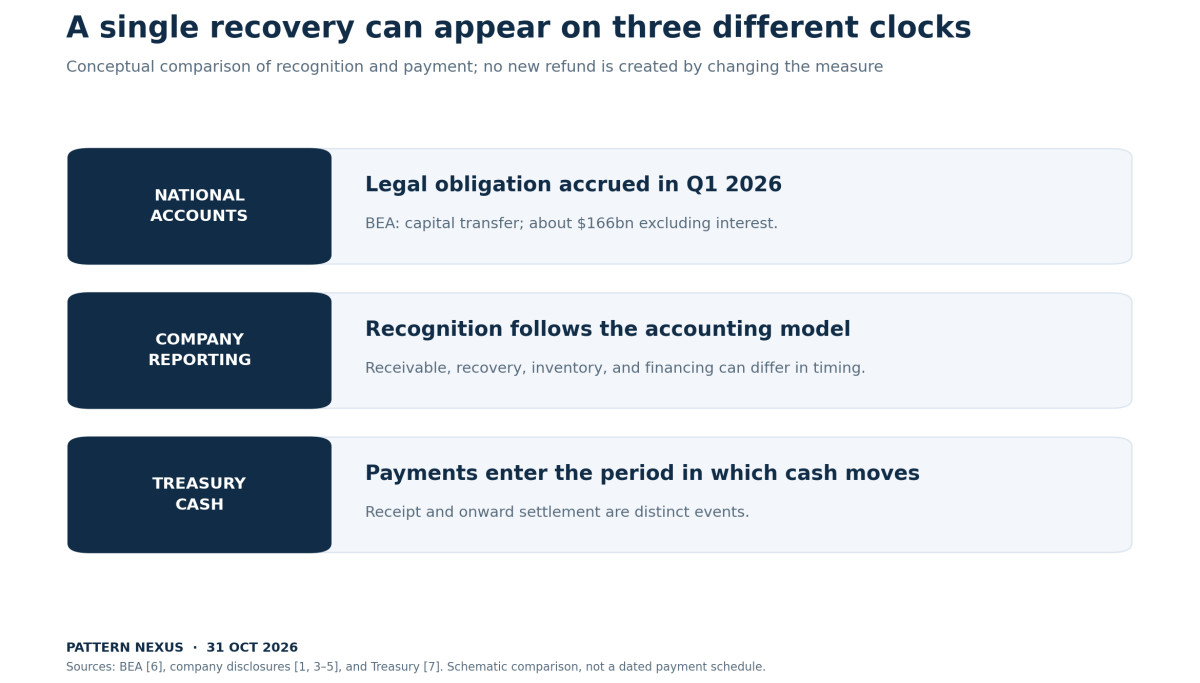
BEA explains that the capital transfer itself does not enter GDP or corporate profits from current production; refund interest is treated separately as property income.[6] A cost-of-sales recovery in a company's accounts can still improve its reported earnings. The measures answer different questions.
For an earnings model, the recognition policy and inventory treatment help determine the quarter containing the benefit. For a liquidity model, payment and onward-settlement dates matter. For a national-accounts comparison, the accrual classification matters.
This also affects the next comparison period. A company can report a large recovery this year and face a difficult year-over-year earnings comparison next year even if its ongoing business holds steady. Analysts should identify the reversal of that comparison effect before describing a later decline as a sudden deterioration in demand.
The transfer's exclusion from current production does not prevent a later economic effect. A supplier receiving reimbursement may place an order; a borrower may reduce debt; management may approve an investment. Those subsequent decisions are separate events and require separate evidence.
08 · REFUNDS AND FINANCING
The Treasury statement already shows the fiscal reversal
Treasury's September Monthly Treasury Statement reports fiscal-year 2026 customs duties of approximately $317.8 billion gross, $144.6 billion in refunds, and $173.2 billion net. These are all-customs categories, covering more than a narrowly defined IEEPA-only refund series.[7]
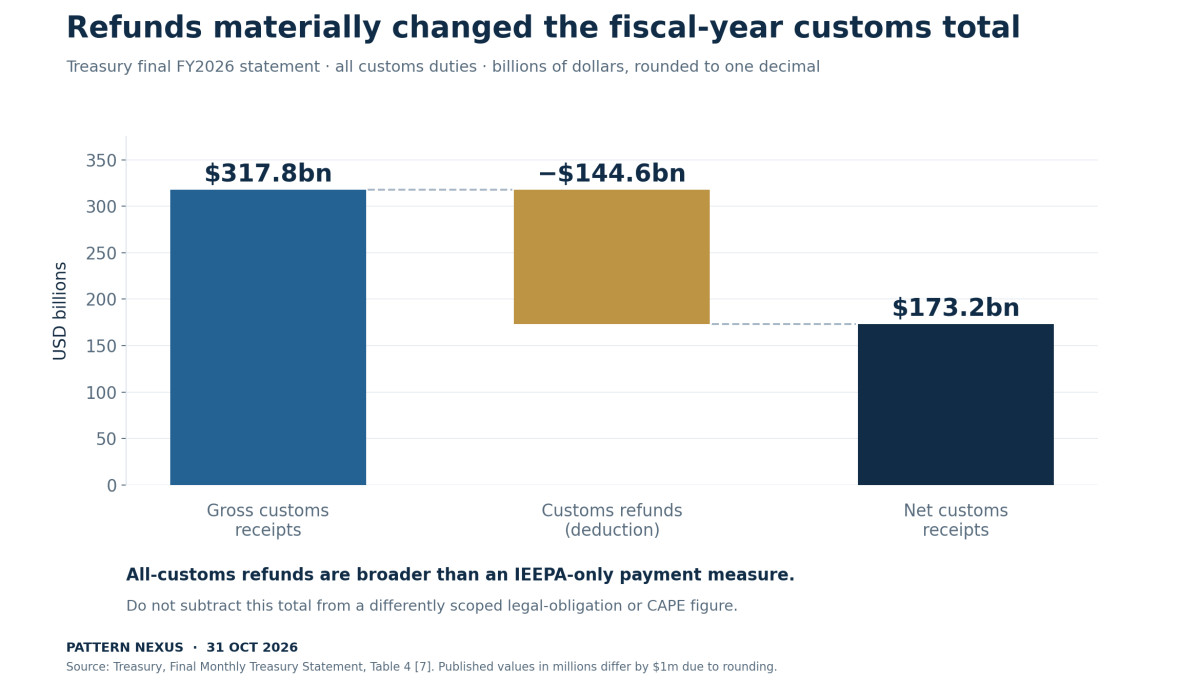
In The Interest Trap, PN examined the difference between gross customs collections and the amount remaining in the fiscal accounts.[15] Following refund ownership adds the next step: a fiscal outflow can pass through the named importer before settling an earlier private obligation.
The scope boundaries are consequential. A BEA estimate of the legal obligation, a CAPE processing figure, and Treasury's all-customs refunds are not interchangeable. They can differ in date, interest treatment, coverage, and stage of settlement. Subtracting one from another does not produce a reliable estimate of refunds still to come.
Nor does a large government payment establish an equal increase in future retail sales. The effect depends on who receives usable cash and what that party does next. A creditor can repay its own funding; a retailer can rebuild inventory; a vendor can restore its working capital. Aggregate fiscal arithmetic cannot select between those paths.
09 · REFUNDS AND FINANCING
Processing is a financial variable
The Court of International Trade's October 8 opinion described $136.6 billion accepted for CAPE processing as of October 2. Its discussion also identified approximately $126 billion certified and sent to Treasury for disbursement.[10] The latter is a processing milestone; it should not be treated as an independently verified total of cash credited to every ultimate beneficiary.
CBP's May monitoring notice had already distinguished progress through CAPE and ACE reporting from the eventual Treasury ACH payment.[9] An accepted declaration, an authorized refund, and settled cash occupy different positions in the sequence.
Procedures also continued to change in late October. MLex reported on October 30 that an order expanded access to refunds involving protests and finally liquidated entries.[14] That report concerns access to the process; it does not establish that every affected payment had settled. This article does not use the initial CAPE Phase III limits as a statement of current eligibility.
A delay has a financing cost even when ultimate recovery remains likely. An importer may keep borrowing while it waits. A claim buyer may have capital tied up longer than expected. A vendor may wait for reimbursement from its customer after the customer waits for Customs.
The timing can therefore propagate through a chain of counterparties. Faster processing can release financing capacity before it generates observable new spending. Slower processing can leave a valuable receivable alongside a cash shortage.
For a company-level forecast, I would want the receivable's age, the stage of approval, and the obligations triggered by payment. A national headline announcing progress is useful context. It does not replace those inputs.
10 · REFUNDS AND FINANCING
The consumer's burden and the importer's claim are different questions
The New York Fed's October research finds that tariff increases pass into consumer goods prices with delays and through both imported and domestically produced goods.[11] Those effects help explain the economic burden. They do not identify the owner of a particular refund claim.
A household could have paid a higher retail price while the government refund flows through an importer and then to a financing counterparty. A supplier could have accepted a concession that later becomes the subject of reimbursement. The original burden and the refund payment route must be traced separately.
Refunding a past charge also does not mechanically set the price of the next unit sold. Future pricing depends on replacement costs, current trade measures, competition, inventories, and demand. The payment restores an asset to some party; it is not itself an instruction to change a retail price.
My inference is that the distribution of the recovery can remain uneven even when the original tariff burden was broad. Testing the consumer outcome requires subsequent price data and any disclosed rebates or credits. A company's refund announcement alone cannot establish that households were compensated.
This is also why the article does not assume that every customer has an automatic claim against every supplier. Contract language, promises, and the facts of the transaction would have to support that conclusion. Economic incidence is a starting point for analysis, rather than a substitute for those documents.
11 · REFUNDS AND FINANCING
A second round of credit questions may follow
The financing chain can matter even when no refund rights were sold. Sidley's analysis identifies issues involving lenders, borrowers, and claim purchasers, including the interaction of refund arrangements with existing credit documents.[12] Depending on those documents, a recovery could affect repayment obligations or the assets available to support borrowing.
Donald F. Clarke, writing for the Secured Finance Network in October, raised another possible issue: customer claims and offsets where tariff charges had been passed through. He presented this as a due-diligence concern for asset-based lenders.[13] It is an attributed risk assessment, not a court finding that all customers are entitled to a rebate.
The potential mechanism is straightforward. A borrower expects a refund to improve cash. A customer asserts a credit against an invoice. A lender then examines whether that invoice still supports the same borrowing availability. The relevant change would be in the collectability of the receivable, not merely the gross refund received.
This is one of the less visible places to watch. A favorable recovery can coexist with a dispute about who should benefit from it. That dispute could delay the use of funds or affect collateral calculations.
The hypothesis should remain conditional until evidence appears. Useful evidence would include disclosed customer credits, material disputes, changed reserves, borrowing-base adjustments, or amendments to credit agreements. Without it, a possible channel should remain a scenario rather than an asserted developing crisis.
12 · REFUNDS AND FINANCING
Three paths for the next financial effect
The following paths are analytical scenarios. They are not probability estimates or forecasts of the entire refund pool.
| Path | What happens after settlement | Evidence that would support it |
|---|---|---|
| Operating relief | Usable cash supports inventory, suppliers, employees, or investment | Lower funding pressure followed by disclosed operating uses |
| Financing settlement | Cash repays claim buyers or other financing obligations | Substantial onward payments, lower debt, or reduced interest expense |
| Delayed or disputed allocation | Approval delays or competing claims postpone usable cash | Aging receivables, legal disclosures, reserves, or collateral adjustments |
The same company can move through more than one path. Paying down a revolving facility now may create room to finance inventory later. Vendor reimbursement may improve the supplier's operations before any benefit becomes visible at the retailer. A claim investor can recycle settlement proceeds into another investment.
This prevents a narrow reading of “retained cash.” A payment that goes to a creditor can still improve future capacity by reducing interest or restoring borrowing room. Those benefits should be measured where they arise, without assuming the original receipt becomes an immediate spending increase.
The strongest operating-relief case would combine unrestricted cash, a genuine financing constraint that has eased, and evidence of a subsequent business decision. The strongest financing-settlement case would show large gross receipts accompanied by matching repayments and only limited additional operating uses.
The delayed-allocation case would become more persuasive if expected cash repeatedly slipped into later periods or disputes began to affect reported assets and credit availability. A large legal entitlement by itself would not settle which scenario is unfolding.
13 · REFUNDS AND FINANCING
The filing checklist that can test the thesis
I would track a small set of reconciliations across the next reporting cycle, using the same definitions for each company over time.
| Disclosure | Question it answers | Common reading error |
|---|---|---|
| Refund cash and related interest | What actually arrived during the period? | Treating a receivable as collected cash |
| Payments to claim buyers | How much of the receipt settled an earlier bargain? | Counting the full refund as newly available cash |
| Prior advances and financing liabilities | When did the business first receive support? | Counting earlier proceeds again when income is recognized |
| Cost-of-sales and inventory treatment | Which quarter contains the earnings benefit? | Extrapolating a recovery into recurring margins |
| Vendor, employee, or customer allocations | Who else participates in the recovery? | Treating an expense provision as proof of same-period cash payment |
| Debt balances and interest expense | Did financing capacity improve? | Equating debt repayment with no economic benefit |
| Receivable aging and disputes | What remains uncertain after recognition? | Treating approval, certification, and settlement as identical |
The thesis would weaken if a broader sample showed that most companies kept most refund cash without significant prior financing or onward commitments, and then documented meaningful incremental operating uses. That would support a more direct business-liquidity interpretation.
It would strengthen if gross refund announcements regularly exceeded the additional cash available to their named recipients, with the difference explained by prior advances, repayments, or contractual sharing. The size and prevalence of that gap need measurement. They should not be inferred from the most striking individual example.
There is also a timing test. If financing settlements dominate initially but operating investment improves later, the transmission may be delayed rather than absent. Following multiple quarters is necessary to distinguish those outcomes.
PATTERN NEXUS VIEW
The Pattern Nexus view
I think the overlooked financial story is the sequence of ownership around the payment. The legal ruling establishes a government obligation. Processing turns that obligation into cash. Earlier agreements and later management decisions distribute the effect across balance sheets.
The filings already show enough variation to challenge a uniform refund-boom narrative. Some proceeds settle a claim-financing transaction. Some restore value to vendors. Some reach employees through compensation arrangements. Some affect earnings in a different quarter from the cash receipt.
The next useful question is therefore specific: whose financing constraint has eased, by how much, and for how long? That question can be answered through cash reconciliation, contract disclosure, and subsequent behavior. It is more demanding than collecting refund headlines, but it is also more informative.
The broader PN connection is the distribution of liquidity. An aggregate can rise while the improvement reaches particular institutions on particular terms. Understanding those terms is how we move from a large number to a financial mechanism that can be tested.
READER QUESTIONS
Reader questions
Does the company receiving the refund keep all of it?
That depends on its agreements and other obligations. The company examples show onward payments to claim buyers and allocations involving vendors and employees. The payment announcement should be reconciled with the associated commitments.
Was the Designer Brands buyer's return really 8.3 times its money?
The disclosed $18.3 million payment divided by the $2.2 million advance is about 8.3. That is a gross payment multiple. It is not an annualized return, a measure of net profit, or evidence that the original investment was risk-free.
Does a tariff refund automatically improve recurring profit margins?
A recovery can improve reported earnings in the recognition period. Recurring margins require analysis of ongoing sales, replacement costs, expenses, and the company's accounting adjustments. Inventory treatment can also move part of the benefit into a later quarter.
Does a refund guarantee lower prices for consumers?
No. A payment concerning a past charge does not determine the price of future merchandise. Subsequent prices and any actual customer credits must be examined separately.
Is the $664 billion BEA figure another refund program?
No. It is the annual-rate presentation of a $166 billion quarterly amount: $166 billion multiplied by four. It must not be added to that quarterly amount or treated as an additional cash disbursement.[6]
Does paying a creditor mean the refund has no economic effect?
Debt repayment can reduce interest, restore borrowing capacity, or improve resilience. Those are financial effects even when the money does not immediately fund additional purchases. Their size and timing need to be observed.
What would be the strongest follow-up article?
A larger filing sample reconciling gross receipts, buyer payments, supplier and employee allocations, and subsequent debt or investment changes. It would test how widespread these mechanisms are instead of extrapolating from a handful of companies.
METHOD AND EVIDENCE
Method and evidence boundaries
Research cutoff: October 31, 2026. Company observations retain their own reporting periods; they are not presented as October cash balances. The legal discussion provides context for financial timing and does not supply filing instructions or deadlines.
Reported amounts come from the documents listed below. Figures 1, 2, and 4 contain PN arithmetic or presentation of those disclosures. Figure 3 compares accounting and payment timing conceptually. The Academy comparison excludes government interest; the Designer Brands and Williams-Sonoma cash receipts include it.
Dollar amounts are rounded. Treasury publishes the underlying customs figures in millions; independently rounded gross receipts less refunds differ from the published net by $1 million. The chart uses billions to one decimal, and the data audit preserves all three published values and the rounding difference.
The selected companies do not establish market-wide participation, discounts, investor returns, or the distribution of the national refund pool. No buyer identity is inferred. The supplier, employee, and inventory items at Williams-Sonoma are accounting disclosures, not a reconstruction of its same-quarter cash disbursements.
The financing-constraint hypothesis, possible credit effects, and future operating paths are PN analysis. They remain open to the tests described above. No probability, price target, investment recommendation, or estimated spending multiplier is assigned.
SOURCES
Research and Data Sources
Company filings and issuer releases provide the observed examples. Official government publications establish accounting and processing context. Specialist interpretations, late-October reporting, and PN analysis are identified separately.
- Designer Brands / SEC. Form 10-Q, quarter ended August 1, 2026. Filed September 10, 2026. Refund-right sale, government receipts, remittance, and financing-interest accounting.
- Designer Brands. Designer Brands Inc. Reports Second Quarter of 2026 Financial Results. September 10, 2026. Issuer earnings presentation and adjustments for the tariff-financing transaction.
- Academy Sports and Outdoors / SEC. Form 10-Q, Commitments and Contingencies note. Quarter ended August 1, 2026. Participation agreement, refunds excluding interest, payment to buyer, and recognition of prior proceeds.
- Williams-Sonoma / SEC. Form 10-Q, quarter ended August 2, 2026. Fiscal second quarter 2026. Refund recognition, vendor provision, employee contribution, inventory deferral, and collected cash.
- Williams-Sonoma. Williams-Sonoma, Inc. announces strong second quarter 2026 results. August 2026. Issuer confirmation of the disclosed tariff-related income effects and cash collection.
- U.S. Bureau of Economic Analysis. How are the International Emergency Economic Powers Act tariff refunds reflected in BEA’s National Economic Accounts?. April 30, 2026; modified June 25, 2026. Capital-transfer classification, estimated obligation, accrual timing, annualization, and separate interest treatment.
- U.S. Treasury / Bureau of the Fiscal Service. Final Monthly Treasury Statement, fiscal year 2026 through September 30, 2026, Table 4. Final FY2026 statement. All-customs gross receipts, refunds, and net receipts; values independently rounded to millions.
- U.S. Customs and Border Protection. CSMS #68340863 — CAPE deployment notice. April 20, 2026. Original consolidated payment route, process components, and possible offsets for unpaid CBP bills; not a current eligibility guide.
- U.S. Customs and Border Protection. CSMS #68536553 — Monitoring CAPE refunds in ACE reports. May 4, 2026. Distinguishes processing status and reports from Treasury ACH payment.
- U.S. Court of International Trade. Freestyle World, Inc. v. United States, Slip Opinion 26-123. October 8, 2026; Court No. 26-01088. As-of-October-2 processing totals and description of certification and Treasury disbursement; historical procedural context.
- Federal Reserve Bank of New York — Mary Amiti, Sebastian Heise, and David E. Weinstein. How Fast Do Tariffs Pass Through into Consumer Prices?. October 6, 2026. Research on delayed direct and indirect transmission into consumer goods prices; does not establish refund entitlement.
- Sidley Austin. International Emergency Economic Powers Act Tariff Refund Claims: Key Considerations for Lenders, Borrowers, and Claims Purchasers. April 30, 2026. Attributed legal analysis of credit-document interaction and competing interests; not a blanket rule.
- Donald F. Clarke / Secured Finance Network. The Contra Nobody Is Watching: Tariff Refunds Through an ABL Due Diligence Lens. October 13, 2026. Author’s assessment of potential customer offsets and collateral issues; not a judicial determination.
- MLex. US trade court says all importers with protests eligible for IEEPA refunds. October 30, 2026, 16:06 GMT. Attributed late-October reporting of an order concerning protests and finally liquidated entries. The attached order was not independently retrieved.
- Pattern Nexus. The Interest Trap. October 2026. Related PN analysis of fiscal accounts and gross versus net customs receipts.
- Deloitte DART. Accounting Considerations Related to the Supreme Court’s Ruling on Tariffs. February 27, 2026; updated June 30, 2026. Accounting interpretation of refund recognition and monetization, financing, and separate cash-flow presentation.
Public research on financing, liquidity, and the agreements that distribute them. This article is available free, without a premium or registration gate.
Article overview
Tariff refunds can pass through importers to claim buyers, vendors, and employees. PN follows the cash and accounting in three company disclosures to test how much new operating relief the refund cycle creates.
What's Your Reaction?
 Like
0
 Dislike
0
 Love
0
 Funny
0
 Wow
0
 Sad
0
 Angry
0

Nexus (Christopher)
Founder of Pattern Nexus. I research markets, macro, geopolitics, AI, history, ancient systems, and the patterns most people overlook. I’m also building Market Radar, a trading scanner designed to read pressure, risk, confirmation, and setup quality before ch…
Related research
The End of the 40-Year Bond Supercycle: Why Rates Didn’t Rise — The Regime Changed
The U.S. 10-year yield didn’t “go up” — the 40-year bond bull ended. This analysis shows how 2020 broke the secular disinflation regime and…
5 shared topics.
August CPI Just Activated the Fed’s One-Hike Option—and Deepened the Long-End Trap
August CPI rose 0.4% on the month and 3.4% from a year earlier, while core CPI rose a hotter-than-expected 0.3% even as its annual rate eas…
3 shared topics, same research avenue.
Two Economies, One Balance Sheet: The Unstable Barbell of 2026
Reserve support has returned, but real long rates, fiscal supply, and an AI-energy capital wave are splitting the U.S. economy between capi…
3 shared topics, same research avenue.
The New Fed Chair Does Not Inherit an Economy. He Inherits the Permission Stack.
Kevin Warsh is not simply inheriting the Federal Reserve. He is inheriting the control layer where inflation, debt service, Treasury fundin…
3 shared topics, same research avenue.
Interest Rates, Recession, and the Current Environment
A Pattern Nexus deep research analysis on interest rates, recession risk, energy-led inflation, commercial real estate stress, private cred…
3 shared topics, same research avenue.Japan's Market Resurgence: Beyond the Bubble—The AI-Industrial Yen Boom
Japan's Nikkei has reclaimed bubble-era highs thanks to decent growth, cheap valuations, corporate reform and a weak yen. We unpack the dri…
3 shared topics, same research avenue.
Comments (0)
Security Check
Please complete the captcha to verify you are human.