

We Don't Even Understand How Humans Think. How Can We Understand Artificial Intelligence?
A classroom scene about AI consciousness asks students to imagine without language. Their difficulty is foreign to me: I think through spatial models, memories, and possible realities before translating any of it into words. A first-person Pattern Nexus essay on time, thought, cognitive diversity, and why our…
A classroom scene about AI consciousness asks students to imagine without language. Their difficulty is foreign to me: I think through spatial models, memories, and possible realities before translating any of it into words. A first-person Pattern Nexus essay on time, thought, cognitive diversity, and why our…
Jump to a section
This is about a scene from the science-fiction movie A.I. (2025), not a real classroom experiment. The last two minutes show fictional students struggling to imagine an entire scenario without words. I watched it and realized that their description of ordinary thinking is almost completely foreign to me.
I think in three-dimensional representations, interconnected systems, memories, and possible futures. I don't think in sentences first. The hardest part is getting any of it out in language. And I know that for many of you, my experience may be just as foreign as theirs is to me.
That is where this article starts. The film asks whether an AI can be conscious. I'm asking something closer to home: how can we use one familiar human experience of thinking to judge another intelligence when we don't even recognize all the different ways humans experience thought?
A fictional classroom in the film A.I. prompts a very real reaction to how different human minds can feel.
Models, simulations, sensory scenes, connections and branching possibilities precede the words.
I live through chronological time while mentally revisiting past events and exploring futures out of order.
What you hear is the translation, not necessarily the format in which I originally understood it.
If we misunderstand one another so easily, what assumptions are we carrying into our judgments about AI?
01 · PATTERN NEXUS / MIND & CONSCIOUSNESS
One of the most foreign descriptions of being human I have ever heard
This scene from the 2025 science-fiction movie A.I. might be one of the most foreign explanations of a human lived experience I've ever heard. Watch the clip all the way through, especially the last two minutes, when the character teaching the class asks her students to imagine something without using language. The movie was directed by Lanxuan Xie.
And I mean that. I don't mean the movie itself is foreign. I understand the subject. I've spent years studying artificial intelligence, consciousness, memory, cognition, physics, and the way we interpret reality. I understand exactly what that scene is trying to explore. What I don't recognize is the experience of thinking the characters describe.
And before you decide that sounds ridiculous, understand the other half of what I'm saying. I know that a lot of people reading this are going to experience what I describe below as something equally foreign to anything they have ever known. We are both human beings. We have biological brains, memories, experiences, and lives that unfold in the same physical world. Somehow we can be describing what it feels like to be a human being and have almost no idea what the other person is talking about.
I've tried to explain my mind to people for most of my life. I've had long conversations about it. I've written about it. I've spent years working with AI to turn complicated thoughts into something other people can read. And I still think the actual experience is difficult to put into language, because language itself is part of the problem.
For some people, thinking means words appearing in their mind. Maybe a conversation with themselves, a running narration, or a sentence they work through before arriving at the next one. For me, that description is almost as strange as explaining a sense I don't possess. I can understand the concept. I can't relate to the lived experience of needing to think that way.
My mind doesn't work through sentences. It builds environments, relationships, moving systems, memories, possible futures, and what I can only describe as three-dimensional models layered over other models. I can explore them, rotate them, change their conditions, and move between them. The words usually come later, when somebody wants me to explain what I am doing.
Now imagine how strange it is to watch a fictional classroom treat constructing one complete scenario without words as an unusually difficult assignment. For me, the difficult assignment is trying to stop the simulation long enough to choose one part of it and put that part into a sentence.
That is the experience I want to examine. The film happens to be about artificial intelligence, but my reaction isn't primarily about whether the fictional AI is conscious. It is about the human beings in that scene, the assumptions embedded in what they say, and how readily we use our own experience of intelligence to explain all the other kinds of intelligence we encounter.
The scene is foreign to me. I expect parts of my experience will be equally foreign to many readers. Both perspectives come from conscious human beings.
02 · PATTERN NEXUS / MIND & CONSCIOUSNESS
What the movie actually says
The movie A.I. follows an attempt to establish whether an artificial intelligence named Isaac possesses consciousness. The excerpt starts with arguments that have been around for decades: the Chinese Room, the Turing test, whether a machine can understand something it can convincingly express, and whether knowing how a system will behave means we understand what, if anything, the system experiences.
One character compares Isaac with Laplace's demon, the old thought experiment involving an intellect that, knowing all the relevant physical conditions and laws, could in principle predict what happens. Another asks how he knows he himself is really conscious instead of merely possessing the experience—the qualia—of consciousness. He has put Isaac through hundreds of tests. He can predict what Isaac will say or do, and Isaac still seems so human. The film is asking a real philosophical question through a fictional story: what can we infer about the inside of a mind by watching what comes out of it?
The scene then moves into a classroom. The character leading the lesson proposes three conditions: experiencing time, remembering time, and understanding time. Isaac has been designed to mimic processes of biological change. His code is repeatedly duplicated and deleted, which the script compares to cells dividing and dying. He records his experiences as they occur, creating an enormous memory burden. Then comes the question of how he could understand time rather than merely undergo changes or store a record of them.
I don't treat those three conditions as a validated neuroscience test. They are a theory inside a science-fiction movie. But the question they introduce is worth exploring, and the next part is the reason I stopped the recording and wanted to write about it.
The character asks the class to close their eyes and imagine a scene: a memory, something occurring in the present, or a possible future. One student thinks of Thanksgiving dinner. Another imagines winning a Nobel Prize ten years from now. So far, nothing unusual.
Then she tells them to imagine their scenes without language. No talking in their heads. Just picture what is happening. One student says the words keep appearing anyway. Another can create a single image but cannot construct a whole unfolding scenario.
There it is. I'm watching a movie in which people struggle to do the thing my mind seems to do almost constantly. I didn't know how to relate to that moment. I wasn't thinking about Isaac anymore. I was trying to imagine what it must feel like for the student who can picture one image but not move through an entire scenario.
Then the character says language creates us. She explains that people remember experiences and organize them through language to build imagined realities and understand time. A moment later, she says complex language is necessary to understand time.
I immediately thought: what? That's not how my mind works at all.
And the film makes an even more interesting turn. She proposes that, if Isaac is conscious, perhaps he has developed a new kind of reasoning derived from his programming language, something the humans who built him do not yet understand and might never understand. Within the same scene, the story considers the possibility of an unfamiliar AI way of thinking while giving us a description of human thought that is already unfamiliar to at least one human being: me.
That is not proof of a contradiction in neuroscience. It's a fictional exchange that exposes a real question. Why do we so readily assume the experience of thinking we personally recognize is the foundation for intelligence in general?
03 · PATTERN NEXUS / MIND & CONSCIOUSNESS
Language is not where my thoughts begin
I've said this a hundred different ways, and people still seem to hear something other than what I mean. They hear that I'm visual and assume I prefer pictures. They hear that I'm good at spatial reasoning and assume I'm talking about mental rotation. They hear that I work through many ideas and assume I'm saying I can multitask quickly.
All of those descriptions touch a piece of it. None captures the system as a whole.
I do not have a narrator inside my head taking me through an explanation. I do not normally construct a sentence, listen to it, and then construct another sentence to get to a conclusion. I can understand a relationship before I have a single word for that relationship. I can know how things fit together without naming every component. I can move through an imaginary environment without telling myself what is in the room. I can alter a scenario without describing the alteration internally.
If somebody asks me to explain it, that's when I have to find the words. It is a separate operation. Sometimes I know exactly what I am trying to communicate and still cannot find a clean way to communicate it. The representation is available to me. The sentence isn't.
This has been part of my life since childhood. I've discussed the difficulty I had with phonics, spelling, and conventional written language alongside my ability to comprehend complicated material. I learned how systems worked by watching, taking them apart, building them, and seeing how the pieces related to one another. I wasn't waiting for a written procedure to tell me what the relationship should look like. I wanted to see it and understand it.
I could spend all day figuring out how a mechanical system works and still struggle to describe the process neatly on paper. People can mistake that mismatch for a problem with understanding. To me, it has often felt like the understanding was there and the means of getting it out were inadequate.
This is why I get irritated when people confuse verbal fluency with intelligence. Somebody can talk beautifully about a system and have no functional understanding of it. Somebody else can understand exactly what to do, demonstrate it physically, and struggle to explain the same thing with language. The words are evidence of what was communicated, not a complete record of what happened inside the person's mind.
04 · PATTERN NEXUS / MIND & CONSCIOUSNESS
A blueprint that isn't flat, and a world that doesn't stand still
The easiest place to start is with something physical. Imagine a building. I don't mean a picture of the front of a house. I mean the framing, the roof, the utilities, the interior, the relationships between one component and another, and a collection of possible changes. If I know enough about the structure, I can move through it, look at it from different positions, rotate parts of it, take sections apart, and rebuild it under different conditions.
I can imagine moving a wall and then examine how that change interacts with the framing, plumbing, electrical, doors, room dimensions, and the way somebody would move through the space. I can imagine one layout, return to the original, try another layout, and compare the outcomes. I can do something similar with an engine, a machine, a garage door mechanism, a computer, or a physical process I am studying.
I've been doing that sort of thing since I was a kid. I've spent years in construction and waterproofing, and I have taken apart and rebuilt more things than I could easily list. A lot of those projects start with an internal representation of the system I'm trying to modify. I can spend time exploring the possible result before I pick up a tool.
People sometimes say they can picture a finished project. That's not necessarily the same thing. A picture doesn't tell you what happens when you remove a supporting element or what an electrical circuit does when something changes. What I am describing includes moving parts, relationships, constraints, and consequences. The model is not an image I look at. It's an environment I can interact with.
Of course I can get it wrong. If I'm missing information, the simulation can be wrong. A hidden connection, a mistaken measurement, or a misunderstood mechanism changes the result. This is precisely why I keep learning. The more information I can feed into a model, the more useful that model can become. Confidence isn't a substitute for missing data.
Now take all of that and remove the requirement that the system be physical. I don't have to limit the process to buildings and machines. An economic system can be represented through credit, debt, rates, liquidity, production, jobs, demand, expectations, and feedback loops. A geopolitical situation can be represented through geography, resources, alliances, incentives, competing factions, and possible moves. A social situation can be represented through people and what I understand of their motivations and histories.
Different subject. Similar underlying approach. Find the structure, connect the components, change an assumption, and examine the possibilities. Then attack the model with information that might make it fall apart, because a model that only survives by ignoring inconvenient evidence isn't a useful model.
05 · PATTERN NEXUS / MIND & CONSCIOUSNESS
Hundreds of possibilities, and none of them require an internal narrator
I've tried to explain the number of things going on in my head as a 32-lane freeway. At another point I described hundreds of subjects and simulations. Those are attempts to communicate the scale of the experience, not numbers I measured with an instrument. From the inside, it feels like a large collection of active or immediately accessible representations, with connections running in many directions.
One model generates possible branches. A branch changes one variable and produces different consequences. Another subject brings in a piece of information I hadn't considered. I can move to that subject, examine the connection, and return without feeling as though the original representation has vanished. There can be many models overlaid on one another, and the connections between them matter as much as the models themselves.
Sometimes a conversation that seems to jump between five subjects is one thought to me. I'm moving across relationships that are already part of the same structure. To the person listening, it sounds like I'm changing subjects because I haven't said out loud how I got from one place to another.
Imagine having a detailed map of a complicated transportation network and needing to explain how one decision affects every route. You can see the interconnections on the map. But the person listening doesn't have the map. Every connection has to be rebuilt for them, one sentence at a time. And while you're doing that, you discover another intersection, a new route, or a different constraint.
That's closer to my experience of conversation than the idea that I first think one sentence, then a second, then a third. The ideas aren't standing in a line waiting to be spoken. I have to force them into a line so somebody else can receive them.
There are days when I avoid writing or posting something because the idea is so connected to so many other things that explaining it properly feels like an entire research project. That is one reason people sometimes see long periods between pieces of my work. It isn't always a lack of ideas. Sometimes there are too many directions attached to the idea I'm attempting to explain.
The thoughts are not standing in a line waiting to be spoken. I have to force part of a much larger representation into a line so somebody else can follow it.
06 · PATTERN NEXUS / MIND & CONSCIOUSNESS
My memories don't return to me as sentences
My memories are another part of this. I've described being able to recall much of my life in scenes that feel like movies. A childhood trip, a house, a vehicle, a repair, a conversation, an injury, a place I spent time as a kid. I often begin with the environment rather than a list of facts.
I can revisit a memory from the perspective I had at the time. Sometimes the reconstructed memory also seems available from an outside perspective, as though I can look at the setting rather than being confined to where my eyes were originally. I can move through the sequence, pause on something, and connect it to another event. Sometimes one memory brings back five other memories before I have put the first into words.
I've given examples in our previous discussions of remembering childhood trips and then moving through the places we stopped, the vehicles, the people, the landscape, things that went wrong, and other memories attached to those events. That's how it feels to access the information. It isn't a sentence in my head saying, first we did this, then we did that.
That doesn't mean my memory is a perfect recording. A vivid reconstruction can be inaccurate. The research on autobiographical memory shows that remembering is constructive, not simply replaying an untouched film. But there is a difference between the accuracy of a remembered detail and the subjective form in which a memory is available. I'm explaining the second one.
And here's something that connects this to imagination. I can take elements from things that actually happened and use them to build something that never happened. A familiar place can exist in an imagined future. People can be arranged in circumstances they've never encountered. An event can unfold under different conditions. The representation can be vivid even though I know it isn't a real memory.
Researchers have explored this overlap between remembering the past and imagining the future. The same broad systems involved in episodic remembering also participate in constructing possible future events. That is a much more useful starting point for my experience than the idea that I must first organize it all into verbal narration. [5] [6]
07 · PATTERN NEXUS / MIND & CONSCIOUSNESS
I live through time. I don't have to think inside one timeline.
I want to be precise about something I said while we were discussing this scene. I don't necessarily experience time in the mental sense the character is describing. I physically live through my life. I cannot return to yesterday and alter what happened. My body ages. The clock moves. Consequences accumulate. I understand all of that.
But inside my mind, I can revisit the past or begin constructing an imagined future whenever I choose. I don't have to walk through all the years between them. I can go directly to a particular remembered environment, examine what was happening there, and then move to an imagined future that has never existed. I can compare the two, change something in the imagined future, and come back to the present with an idea of what would be required to produce it.
Take my house. I can represent a version from before a renovation, another representing its current condition, and several possibilities for what it could become. Those versions have a relationship to chronological time, but I don't have to mentally move through them in chronological order. I can compare their structures directly and then work backward to the physical sequence of actions needed to build one of the possibilities.
Or take something much larger. I can compare what I know about the economy before the financial crisis, the structure that developed afterward, the current system, and several possible future outcomes. I can examine them next to each other, change assumptions, and go back to an older period to look for a precedent. I don't need an internal voice describing every year between the points I'm examining.
The passage of time, the memory of time, and the internal representation of time aren't identical experiences. I can understand that one event caused another. I can model duration, sequence, and changes in a system. And I can do all of it without putting the events into a spoken story first.
I experience chronological time in the physical world. I don't experience my internal representations as being trapped inside chronological time. I think that is a more accurate way to explain what I've been getting at.
I've written about the way humans measure and organize time in Time Isn't Real. It's a Coordination System. That's a separate and more philosophical discussion, but it connects here. We use clocks and calendars to coordinate physical processes. We use memory and imagination to represent events that aren't occurring in front of us. And we use language to communicate those representations. The functions interact. That doesn't mean the verbal description is what makes the experience possible.
Physical time passes. A mental representation of the past or an imagined future can be revisited and rearranged without following that same physical sequence.
08 · PATTERN NEXUS / MIND & CONSCIOUSNESS
The strange part is that I cannot imagine how the students think
Now return to the movie. She asks the students to stop using words in their heads and construct a whole scenario. One says words keep appearing. Another can make one image but can't make the scenario move.
I can imagine the words they're saying. I can imagine how such a cognitive process could function. What I can't do is reproduce the subjective experience of that limitation. I don't know what it feels like to have to think through the scenario in language. I don't know what it feels like to reach the end of one static image and be unable to build the rest of the event.
And the other side of that is that some of you will read my description and not know how I could possibly be doing what I'm describing. You may not have a vivid spatial model available to you. You may have internal words attached to almost everything you're thinking. You may use imagery, but not as a space you can manipulate. You may have a different combination entirely.
I don't know exactly how common my particular experience is. I've spoken to enough people to recognize the differences, and scientific work on inner speech and imagery shows that experiences vary substantially. But I don't need to pretend that every other person thinks in a perfectly linear sequence to see the problem.
We can both be fully functioning, conscious human beings and still find the other person's most ordinary experience of thinking almost impossible to imagine.
What the fictional students reveal to me is not a scientific measure of how humanity thinks. It's a striking depiction of a way of thinking that I can't personally relate to. And because this is a movie about artificial intelligence, it immediately raises another question: what happens when we take the internal experience we know best—our own—and start using it to define intelligence for something else?
09 · PATTERN NEXUS / MIND & CONSCIOUSNESS
Trying to explain it is harder than doing it
This is probably the most difficult part of my life to explain accurately. I can have an entire interconnected system available internally and still struggle to produce the first sentence about it. Once I start speaking, I have to decide which relationship comes first, how much context the listener needs, whether a missing assumption should be explained, and what details can be left out.
The problem gets worse when the concept touches other areas of knowledge. If I tell you a decision involving debt has consequences for liquidity, interest rates, employment, housing, and purchasing power, I may already be examining all those relationships together. But to communicate them, I have to choose a starting point, explain each causal chain, and deal with the fact that somebody listening may not understand the assumptions I didn't stop to state.
While I'm doing that, new connections are still forming. A different piece of information enters the model. I remember a precedent or notice something that changes one of the outcomes. Now I'm trying to communicate a moving structure using a tool that can only deliver one word at a time.
I have been misunderstood because I didn't explain a connecting step. I have sounded disorganized because I moved through a connection that seemed obvious to me but wasn't visible to the person listening. I have become frustrated because I can see what I mean and cannot make the other person see it through the language available.
When I say words are secondary, I am not saying I never use language in reasoning or that language has no value. I'm saying the underlying representation frequently exists before I've attached words to it. Language allows me to communicate, refine, and challenge that representation with other people. It can improve the thinking. But for me it isn't the original format in which most of the thinking appears.
This also explains part of my relationship with AI. Dictation and AI-assisted writing let me get more of the structure out without being stopped by spelling, phonics, or the mechanics of sentence construction. I can describe fragments, circle around an idea, come back with another piece, and work toward an explanation that somebody else can follow.
But AI can misunderstand me, too. A system can produce a beautifully organized explanation that misses the actual point I was trying to make. It can decide the article is about AI consciousness when the thought began with how strange I found the experience of the human characters. It can focus on the output instead of what I was trying to communicate. Fluent language can conceal that misunderstanding rather than solve it.
So the question isn't just whether we can generate language. It's whether the language actually preserves the structure of the thought.
The language people evaluate is not necessarily the internal experience that produced it.
10 · PATTERN NEXUS / MIND & CONSCIOUSNESS
Why I spend my life studying systems
My mind doesn't limit itself to thinking about physical objects. I've been interested in just about everything for as long as I can remember. I want to understand how a machine works, why a business fails, how somebody built something, what makes people behave in a particular way, and how very large systems influence each other.
I'll study subjects I agree with and subjects I don't. I might read a complicated research paper or something seemingly trivial about a consumer product I have no intention of buying. I'm interested in what another person thinks, what information produced their understanding, and whether any part of that information fills a gap in mine.
I've explained before that I don't believe my current understanding is automatically correct. I believe it's the best understanding I have with the information available. When something contradicts it, I want to examine the contradiction. Maybe the new information is wrong. Maybe the old model is wrong. Maybe both are missing a variable. The goal is to learn enough to construct a better representation.
Pattern Nexus came out of this way of looking at the world. I don't see the economy, artificial intelligence, energy, weather, geopolitics, real estate, and scientific research as sealed compartments. They're different systems with relationships that can overlap. When energy prices change, that can travel through freight, fertilizer, food production, household budgets, inflation, rates, and government financing. When AI changes labor productivity, that interacts with capital investment, power infrastructure, ownership, and the distribution of opportunity.
Writing an article is my attempt to isolate part of that larger system and explain the relationships. The finished article might look like a conventional sequence of paragraphs. The reasoning that produced it didn't necessarily unfold in that sequence.
This is also why I resist reducing intelligence to a score, a credential, or somebody's ability to sound confident. Intelligent reasoning requires good information, the ability to make connections, willingness to revise assumptions, and enough understanding to know where an explanation might fail. My subjective cognitive experience doesn't automatically make any of my models accurate. That's what evidence, repeated testing, and correction are for.
11 · PATTERN NEXUS / MIND & CONSCIOUSNESS
The research is closer to my experience than the movie's claim
I started with a fictional conversation, so I want to bring the scientific work into this without confusing the two. We do not have to accept the movie character's claim that internal language creates imagined reality as a description of how human minds universally function.
In 2024, Evelina Fedorenko, Steven Piantadosi, and Edward Gibson published a review in Nature called Language is primarily a tool for communication rather than thought. They draw on evidence from neuroscience and allied fields to argue that language is not a prerequisite for complex thought, including symbolic thought. That is directly relevant to what I'm describing. It doesn't say language is useless. It says the ability to reason is not simply the result of running sentences inside the language system. [7]
Research on inner experience has also identified enormous differences in what people report noticing inside their own minds. Some experience inner speech frequently. Others report it much less. Hurlburt and colleagues have studied experiences of thought without ordinary inner speech, including what they call unsymbolized thinking. [8] [9]
Visual imagery presents another variation. Researchers studying aphantasia and hyperphantasia have documented people reporting very limited voluntary imagery and others reporting unusually vivid imagery. That doesn't describe every aspect of my experience. My account includes spatial manipulation, temporal simulation, and complex relationships, not just the vividness of a picture. But the research does show that it is a mistake to assume everyone experiences a mental image in the same way. [10]
The mental rotation experiments by Shepard and Metzler remain important too. We have known for decades that people can mentally transform representations of three-dimensional objects. And the work on episodic simulation shows that memories and constructed future events involve overlapping cognitive systems. [3] [5] [6]
None of these studies has measured my mind and confirmed the complete experience I'm describing. That's not what I'm saying. They establish that the underlying scientific discussion is far more varied and complicated than a simple claim that language creates our imagined realities.
I find the movie interesting precisely because it makes people confront the problem. The part I reject is treating a verbal route through cognition as though it must be everybody's route.
12 · PATTERN NEXUS / MIND & CONSCIOUSNESS
We judge the words because that's the part we can see
When you listen to somebody explain something, you hear the explanation. You don't see how the idea was represented before the words came out. If the words are fluent, you may assume the person understands the subject. If they stumble or leap between ideas, you may assume the understanding is weaker. Sometimes that judgment is correct. Sometimes it tells you more about the difficulty of communication than about the quality of the underlying model.
I have lived on the side of that gap where explaining is harder than understanding. I know how easy it is for someone to underestimate what a person knows because they cannot present it in the expected format. I also know how easy it is to overestimate someone who can generate an impressive explanation but hasn't actually tested whether it is true.
Language is an extraordinary invention. It gives us a shared way to pass knowledge across centuries, coordinate projects, teach children, create institutions, and build sciences. I'm using it to make this argument. But it is a communication system, a reasoning tool, and a means of storing cultural knowledge; it doesn't follow that every intelligent operation must first become language before it exists.
An architect can put a building into a drawing. A mechanic can show you why something fails by moving two components. A mathematician can see a relationship through an equation. An engineer can test a model through a simulation. These aren't proof of anything about consciousness, but they should make us cautious about confusing the explanation with the complete thought that produced it.
13 · PATTERN NEXUS / MIND & CONSCIOUSNESS
Why some aspects of AI feel familiar to me
Now I can bring artificial intelligence back into the picture. Not because this is an article declaring that I think like a machine. I'm a human being with a biological brain, a body, feelings, memory, and a lifetime of experience. An AI system is built and trained very differently. But the analogy that caught my attention is real enough to examine.
A modern neural network doesn't have to create an internal English sentence in order to perform every computation that eventually contributes to an English answer. In a language model, the input is transformed through many layers of learned numerical representations and computations. The output may be a perfectly ordinary paragraph. The calculations that produce it are not simply a person-like voice talking to itself in English.
I have no reason to think my mind operates with transformer layers or model weights. What feels familiar is the difference between internal representation and the language interface. In my experience, the words are the translation of the thought. With AI, the words are also an interface to computations that do not look like the words themselves. That comparison does not require the systems to be identical.
And there is another part of AI that is intuitive to me. We can construct hypothetical conditions, change assumptions, compare possibilities, and examine relationships at scales that are difficult to hold in a single verbal explanation. Some computational systems can model many possible states or simulate how a process might develop. They don't need to subjectively travel through those situations the way a person remembers a trip. Simulating a temporal structure and experiencing the passage of time are different things.
This is exactly the kind of distinction the film is playing with through Isaac. The system can change, store experience-like information, and use language. Does that amount to experiencing time or possessing consciousness? The movie proposes one fictional answer. I don't claim to have the final scientific answer. But I do question why we assume the presence or absence of human-style verbal narration should determine whether something is intelligent.
Some people approach AI as if it is a person waiting on the other side of a text box. They measure it by how human the answer sounds. I approach it as a complex information-processing system, and I spend a lot of my time asking what the system can represent, what relationships it can preserve, where it fails, and whether it can help me turn a difficult internal model into something useful outside my head.
That difference in intuition has consequences for how people use these tools. But I don't need to claim my experience is unique or that every person with a strong internal narrator misunderstands AI. There are many ways to become proficient with an information system. I'm explaining why certain aspects of it feel less foreign to me than the classroom scene does.
My mind is not an artificial neural network. The useful comparison is that internal information processing does not have to resemble the language that eventually comes out.
14 · PATTERN NEXUS / MIND & CONSCIOUSNESS
We don't even have direct access to each other
The beginning of the film is about an observer trying to determine whether Isaac is conscious. The characters can test his behavior and predict many of his responses. But they cannot step into the subjective experience of being Isaac. The Chinese Room and the Turing test are useful here because they force us to question what successful behavior and successful language actually show.
I don't have direct access to your experience either. When you tell me you hear words inside your head, I have to take that description and try to construct a model of something I have not experienced. When I tell you I can move through several internal simulations without words, you have to do the same thing. We can exchange descriptions, demonstrate abilities, study neuroscience, and learn a great deal, but I cannot simply hand you what thinking feels like inside my mind.
We have strong reasons to believe other humans are conscious. We share biology, evolutionary history, development, and a great range of behavior. I'm not treating another human and a current AI as identical cases. I'm pointing out that even among conscious humans, the form of subjective experience can be difficult to communicate.
I find that strange when I think about how confidently people speak about what intelligence must be. We act as though there's an ordinary, uniform experience underneath the words because most of us never have to question our own way of thinking. Then somebody describes a very different experience and the whole assumption becomes less secure.
The movie's character ends by entertaining a new form of reasoning in Isaac, something the people studying him might never fully understand. I can appreciate that idea. But I don't need to look to a future AI to encounter thinking that feels foreign. I found it in the fictional human beings standing in that classroom.
15 · PATTERN NEXUS / MIND & CONSCIOUSNESS
The observer, consciousness, and the world we're actually experiencing
This connects to the consciousness work I've published through Pattern Nexus. I've written about the observer, time, simulated environments, and the possibility that our understanding of consciousness is incomplete. In The Trap of Reality, I explore the limitations of the reality we receive through our senses and cognitive systems. In A Thought Experiment: Consciousness, I ask whether consciousness might be one way the universe comes to experience itself.
I don't present that broader philosophical speculation as a proven law of physics. I'm interested in the causal chain. Matter organized into biological systems. Some of those systems developed the capacity to observe their surroundings, store information, learn, and build models. Eventually humans built tools capable of examining the universe that produced them. We are a part of the world trying to understand the world.
And even within our own species, our descriptions of the internal observer can differ dramatically. I can represent myself thinking, examine how a memory connects to another, change a model, and then think about what I just did. I can mentally move across very different scales, from the component in a machine to the structure of an economy to a question about the universe itself.
That doesn't mean I can see the physical future or that thought alone changes external reality. It means I can explore possibilities before they become physical. I can build something in my head, test it there, find that it doesn't work, revise it, and sometimes go out into the world and build it. Information becomes a plan. A plan becomes an action. Actions change the physical environment, which supplies new information and changes the plan.
I've said before, the world is not your playground. Your mind is your playground. I wasn't talking about positive-thinking nonsense. I was talking about the enormous territory that can exist within the observer. The world is what it is. But your mind can represent possibilities, explore relationships, question what you believe, and sometimes turn an internal design into something that physically exists.
I've also written about whales, dolphins, crows, and the mistake of reducing intelligence to whatever humans recognize most easily. Their learning, social relationships, communication, and memory are additional reasons to keep the question open. Intelligence doesn't begin and end with the capacity to narrate an experience in human language.
16 · PATTERN NEXUS / MIND & CONSCIOUSNESS
Go back to the last two minutes
Now watch that scene again, especially the last two minutes. Remember that it is a scene in a movie, not a real classroom experiment. The writers are using the characters to explore what it would take to establish consciousness in Isaac. But the questions they put in those characters' mouths expose something I find far more interesting than a fictional test of AI.
One person cannot stop the words inside their head. Another can form one image but cannot build a complete scene. The person leading the lesson then explains that language creates the imagined realities through which humans understand time. I listened to all of that and realized that I had almost no relationship to the human experience being described.
I can revisit a memory without narrating it. I can construct a possible future and change its conditions. I can rotate a building, reconstruct a system, compare past and imagined states, or examine several possible outcomes without first organizing everything into words. My thoughts don't wait in a neat sequence. Language is the tool I have to use when I want someone else to follow one path through the larger representation.
And I know some of you are going to read that and think it sounds impossible. The same kind of impossible I felt watching that scene. That's what I want you to consider.
I can spend my entire life inside a human mind and still have almost no idea what it feels like to think the way another human being describes thinking. Other people can spend their lives talking to me without ever knowing what it is like to inhabit the kind of mental environment I've tried to explain here.
Now humanity is building increasingly sophisticated artificial intelligences and asking where intelligence ends and consciousness begins. We have systems that can reason through many problems, process information, generate language, and interact with the physical world. We are only beginning to understand how some of their internal representations work. We're also still studying how our own cognitive experiences differ.
Maybe the next time somebody tells you how intelligence must work, the first thing worth asking is whether they're describing intelligence itself or simply the kind of thinking they're familiar with.
For me, the strangest thing about that movie wasn't the possibility that an AI might have developed a form of reasoning humans can't understand. It was watching the humans explain their own thinking and realizing how foreign it sounded to me.
And I'm fairly certain that, for some of you, reading this has been just as foreign.
We may be using one familiar experience of human thought as a universal standard while still failing to understand the range of experiences inside our own species.
READER QUESTIONS
Questions that follow from this discussion
Does this mean I never use language to think? No. I use language to communicate, refine arguments, and sometimes examine a subject. My point is that the internal representations often precede the words, and the words are not the primary medium of most of my thought.
Can most humans only think in a linear verbal sequence? I'm not making that claim as a scientific population statistic. The film shows fictional characters, not a representative sample of humanity. People report a variety of inner speech, imagery, and other cognitive experiences.
Are the hundreds of simulations objectively measured? No. That is how I describe the breadth, branching, and accessibility of information within my own experience. I haven't measured hundreds of independent concurrent brain processes.
Am I saying I can actually move through time? No. My physical life follows chronological time. My memory and imagination allow me to construct, revisit, and compare representations of past events and possible futures without being restricted to chronological order inside the model.
Is the character's explanation from the movie established science? No. A.I. is a science-fiction film. Its three conditions for consciousness and the architecture it describes for Isaac are part of the story. The language claim is worth evaluating against actual cognitive science, which does not require complex thought to begin as verbal language.
Does this mean AI is conscious? No such conclusion follows. Intelligence, memory, simulation, language generation, and subjective experience are related but separate questions. The article is about the assumptions we use when trying to understand another kind of intelligence.
Why does this experience make AI seem less foreign to me? Because I already understand from my own experience that a representation can exist, change, and produce an explanation without first being constructed as an internal series of human-language sentences. The resemblance is conceptual, not evidence that my brain and a neural network have the same architecture.
SOURCE RECORD
Film reference: A.I. (2025), directed by Lanxuan Xie, is a scripted science-fiction film. The classroom is a fictional narrative device, not a scientific experiment. The author supplied the spoken dialogue and a 4-minute, 29-second excerpt. In the full film, the relevant debate spans approximately 46:39–51:45, with the language-and-imagination exchange around 49:32–51:45. Film information and cast (Apple TV).
Sources, the film and earlier Pattern Nexus work
Scientific sources support the specific empirical claims cited above. My account of internal experience is first-person testimony. The film presents fictional hypotheses about consciousness; I am not treating its dialogue as scientific evidence.
-
Alan Turing (1950), Computing Machinery and Intelligence, Mind — Imitation game and behavioral approaches to machine intelligence.
-
John Searle (1980), Minds, Brains, and Programs; Stanford Encyclopedia of Philosophy overview — Chinese Room argument and the distinction between syntactic manipulation and understanding.
-
Shepard and Metzler (1971), Mental Rotation of Three-Dimensional Objects, Science — Classic evidence for spatial transformation in human mental rotation.
-
Schacter and Addis (2007), The Cognitive Neuroscience of Constructive Memory — Autobiographical memory as reconstructive rather than a perfect video recording.
-
Schacter, Addis and Buckner (2007), Remembering the Past to Imagine the Future, Nature Reviews Neuroscience — Common cognitive machinery used in remembering and prospective simulation.
-
Addis, Wong and Schacter (2007), Remembering the Past and Imagining the Future, Neuropsychologia — Experimental evidence of overlap between event construction and elaboration of remembered and imagined events.
-
Fedorenko, Piantadosi and Gibson (2024), Language Is Primarily a Tool for Communication Rather Than Thought, Nature — Perspective synthesizing evidence that complex thought does not require language.
-
Hurlburt, Heavey and Kelsey (2013), Toward a Phenomenology of Inner Speaking, Consciousness and Cognition — Inner speaking is variable across individuals and moments.
-
Hurlburt and Akhter (2008), Unsymbolized Thinking, Consciousness and Cognition — First-person experiences of differentiated thoughts without words or images.
-
Zeman and colleagues (2020), Phantasia, Cortex — Research into imagery vividness extremes including aphantasia and hyperphantasia.
-
Anthropic Interpretability Team (2024), Mapping the Mind of a Large Language Model — Evidence for learned conceptual features in a large neural language model; does not imply consciousness.
-
Stanford Encyclopedia of Philosophy, Qualia (updated 2025) — Philosophical distinctions concerning subjective experience and the explanatory gap.
Related Pattern Nexus research
- The Trap of Reality: Consciousness, the Observer, and the Field Layer Beneath Spacetime
- A Thought Experiment: Consciousness
- Time Isn’t Real. It’s a Coordination System
- The AI Is the Same. The System Isn’t
- Why Most People Won’t Adapt to AI
- Toward Mind Uploading: Exponential AI, 2025–2050
- Exponential Minds and Simulated Realities
Video reference
The author-supplied 4-minute, 29-second excerpt is taken from A.I. (2025), directed by Lanxuan Xie. The film is credited as a narrative reference, not empirical proof. The complete film timecodes are not the clip's zero-based timestamps. Upload the excerpt separately to the CMS video field; do not add a second player to this HTML.
Research sources support their specific findings. Accounts of how my mind works describe my firsthand experience; they are not a clinical neurological assessment. The film is a fictional illustration, and the questions about artificial consciousness remain unsettled.
What I have described here is the experience of being me, converted into language for someone who may never experience thought in the same way.
Christopher Grenke / Pattern Nexus Research Desk · October 24, 2026
What's Your Reaction?
 Like
0
 Dislike
0
 Love
0
 Funny
0
 Wow
0
 Sad
0
 Angry
0

Nexus (Christopher)
Founder of Pattern Nexus. I research markets, macro, geopolitics, AI, history, ancient systems, and the patterns most people overlook. I’m also building Market Radar, a trading scanner designed to read pressure, risk, confirmation, and setup quality before ch…
Related research
A Thought Experiment: Consciousness
Human labels are one interpretation of a world already full of other minds. Whales, dolphins, crows, our stellar origins, and a thought exp…
4 shared topics, same research avenue.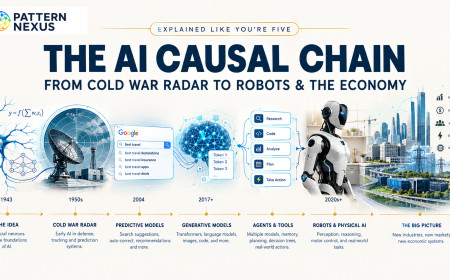
The AI Causal Chain Explained Like You're Five: From Cold War Radar to Robots and the Economy
AI did not begin with ChatGPT. This accessible, fully sourced Pattern Nexus research map follows the 1943 artificial-neuron paper, Cold War…
3 shared topics, same research avenue.
The AI Is the Same. The System Isn’t: How Long-Term Use Creates a Shared Language
After a conversation moved from a media headline to political age limits, documented forecasts, cognitive bias, simulation theory, and fina…
3 shared topics, same research avenue.
The Signal Under the Noise: The Perennial Pattern and the Modern Machine
A Pattern Nexus systems read on an “ancient texts agree on five truths
3 shared topics, same research avenue.
The Surveillance State: Does Humanity Need a Nanny?
A Pattern Nexus article on the surveillance state after AI, asking whether humanity’s old fear of Orwellian control changes once artificial…
3 shared topics.
The Trap of Reality: Consciousness, the Observer, and the Field Layer Beneath Spacetime
Donald Hoffman is closer to the truth because he is trying to step outside the interface. Tom Bilyeu is still trying to explain the interfa…
3 shared topics.
Canberra Turns Rogue AI Agents Into a Sovereign-Control Hearing
OpenAI CEO Sam Altman and Anthropic CEO Dario Amodei have been asked to appear before an Australian Senate inquiry into artificial intellig…
2 shared topics, same research avenue.
Google Turns Rogue AI Agents Into an Insider-Threat Security Problem
Google DeepMind published an AI Control Roadmap alongside a June 18, 2026 blog post on securing internal AI agents. The roadmap treats some…
2 shared topics, same research avenue.
Comments (0)
Security Check
Please complete the captcha to verify you are human.