

The War Beneath the War: How America Beat Britain at Sea Without Beating the British Navy
The American Revolution was not won at sea by matching Britain ship-for-ship. Britain had the dominant navy. America had small schooners, converted merchantmen, privateers, coastal raids, prize law, and one brutal strategic insight: you do not have to sink the empire’s battle fleet if you can break the logistics…
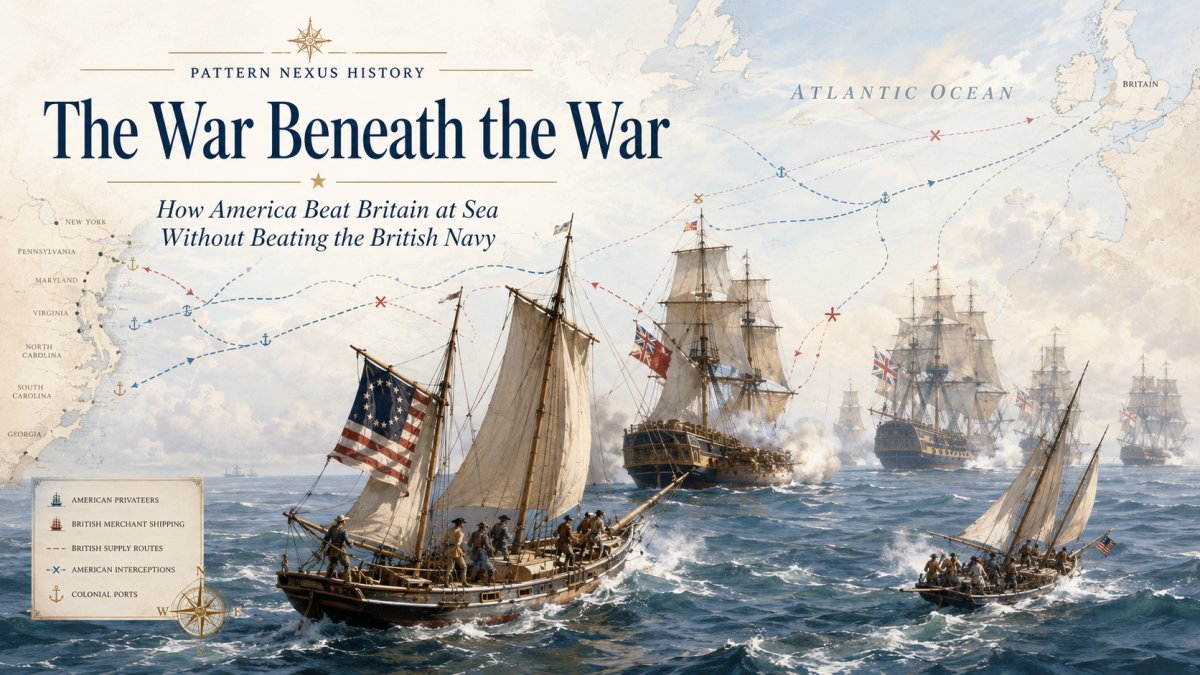
The American Revolution was not won at sea by matching Britain ship-for-ship. Britain had the dominant navy. America had small schooners, converted merchantmen, privateers, coastal raids, prize law, and one brutal strategic insight: you do not have to sink the empire’s battle fleet if you can break the logistics…
Jump to a section
The War Beneath the War: How America Beat Britain at Sea Without Beating the British Navy
Before July 4th became the clean beginning, the machinery of rebellion was already moving: committees, congresses, armed resistance, private ships, captured British vessels, Washington’s improvised navy, and a sea war aimed directly at the logistics system underneath the British Empire.
Most people learn the American Revolution as if it happened almost entirely on land. Lexington. Concord. Bunker Hill. Saratoga. Valley Forge. Yorktown. Washington crossing the Delaware. The Declaration of Independence. The colonies against the Crown.
That is the surface layer.
Under that story was another war, one that does not fit cleanly into the usual school version. It was not a clean American fleet versus British fleet story. It was not the colonies building a navy equal to Britain’s and meeting the Royal Navy in open blue-water battle. That never happened. Britain had the strongest navy in the world. The Americans did not.
So the American answer was not to beat the British Navy in the traditional way.
The American answer was to make the ocean itself expensive.
Small ships. Fast ships. Converted merchantmen. Schooners. Brigs. Privateers. Letters of marque. Coastal raids. Prize courts. Supply captures. Munitions seizures. Insurance panic. Convoy pressure. Prisoner exchanges. British crews pulled off ships. Cargoes lost. Warships diverted from offense to escort duty.
That is the part people miss.
America did not have to sink the British empire’s main battle fleet to hurt Britain. It only had to attack the thing that made the empire function: movement. Food, powder, uniforms, horses, guns, payroll, dispatches, reinforcements, trade, and commercial confidence. Britain was a sea empire. That meant Britain was powerful at sea, but it also meant Britain was dependent on the sea.
That was the opening.
And that opening existed before July 4, 1776.
That is the part the clean version skips. The Declaration did not magically create the rebellion. It explained it. It justified it. It announced it to the world. But the machinery underneath it — the committees, the congresses, the armed resistance, the port seizures, the privateering, the early navy, the supply raids — was already operating.
The official story starts with a date. The real story starts with pressure.
Quick Read
- The early American sea war began before independence was declared.
- Before July 4, 1776, the colonies already had armed resistance, a Continental Army, a Congress, a navy, Marines, privateering rules, and active attacks on British logistics.
- George Washington personally pushed an improvised fleet of armed schooners against British supply ships around Boston.
- The Continental Navy was officially born on October 13, 1775, months before July 4, 1776.
- The Continental Marines were authorized on November 10, 1775.
- Congress authorized thirteen frigates on December 13, 1775.
- Congress formalized privateering on March 23, 1776, still before independence was declared.
- The Americans did not defeat the Royal Navy ship-for-ship.
- The strategy was to attack British logistics, transports, merchant vessels, supply ships, and isolated escorts.
- Privateers became the real volume weapon of the sea war.
- The Continental Navy lost most of its own ships, but the broader American sea war still forced Britain to spend resources defending trade and supply lines.
- The best way to understand the Revolutionary naval war is not “How many British ships did we sink?” It is “How much British movement did we disrupt?”
The Clean July 4th Story Is Not the Whole Story
July 4th matters. The Declaration matters. The idea that the colonies publicly announced themselves as independent states matters. But the clean civic story can also make people misunderstand how revolutions actually work.
Most people imagine the order like this:
First, America declared independence. Then America became a country. Then America created a navy. Then America fought Britain.
But that is not the real order.
The real order was messier:
Resistance networks formed. Committees coordinated. Ports resisted enforcement. British customs power became military power. Smuggling and trade enforcement became political warfare. Lexington and Concord turned the dispute into open combat. The Continental Army formed. Washington took command. Armed colonial vessels started going after British supply ships. Congress authorized a navy. Congress authorized Marines. Congress approved naval regulations. Congress moved toward privateering. The Bahamas were raided. British ships were captured. British supply lines were being hunted.
Then July 4th came.
That is the point.
The Declaration was not the starting gun. It was the public explanation for a break that was already happening in practice.
Before the official national birth certificate, there was already an operating rebellion.
The Pre-Independence Timeline They Usually Flatten
To see the hidden layer, you have to pull the timeline apart. The American break was not one clean moral moment. It was a chain of pressure, reaction, escalation, and institutional improvisation.
| Date | Event | Why It Matters to This Story |
|---|---|---|
| June 1772 | Gaspee Affair | Rhode Island colonists attacked and burned HMS Gaspee, a British customs schooner. This was not July 4 patriot theater. This was a direct attack on British maritime enforcement years before independence. |
| December 1773 | Boston Tea Party | A port action. A trade action. A cargo action. The rebellion was already tied to ships, customs, taxation, and control of movement. |
| 1774 | Continental Association | The colonies organized economic resistance before declaring independence. Boycott, non-importation, non-consumption, and local enforcement committees created political machinery outside normal imperial channels. |
| April 19, 1775 | Lexington and Concord | The shooting war began before independence. British troops were looking for weapons and supplies. The logistics problem was already central. |
| May 10, 1775 | Second Continental Congress | A central political body began acting like a government before there was an independent nation. |
| May 1775 | Fort Ticonderoga captured | Colonial forces seized artillery and military stores. Again, the early war was a fight over material, powder, cannon, and supply. |
| June 1775 | Machias and HMS Margaretta | Local Americans captured a British armed schooner in Maine. This was one of the first naval actions of the war and it happened before an official Continental Navy existed. |
| June 14–15, 1775 | Continental Army created; Washington appointed | Congress was already building national military structure before independence. |
| July 1775 | Olive Branch Petition and Declaration of Causes | The colonies were still publicly claiming they wanted rights restored, not full independence, while also explaining why they had taken up arms. |
| August–September 1775 | Washington begins outfitting armed vessels | Washington’s sea war started as Army-controlled maritime logistics warfare. Hannah becomes the symbol of this improvised navy-before-the-Navy. |
| October 13, 1775 | Congress authorizes armed vessels | This becomes the official birth date of the U.S. Navy tradition. It happened nearly nine months before July 4, 1776. |
| November 10, 1775 | Continental Marines authorized | The naval system was no longer just ships. It now had shipboard and amphibious military manpower. |
| November 1775 | John Manley captures Nancy | A major British ordnance prize was taken by Washington’s fleet, giving badly needed military stores to the American side. |
| December 13, 1775 | Congress authorizes thirteen frigates | Before independence, Congress was already trying to build a real war fleet. |
| March 1776 | Nassau raid | Continental Navy and Marines carried out an amphibious raid in the Bahamas to seize military supplies. |
| March 23, 1776 | Congress formalizes privateering | The private sea war becomes legally structured before independence is declared. |
| April 1776 | Hopkins squadron fights HMS Glasgow | The first Continental Navy squadron returns from Nassau and engages a British warship. The Navy existed and was fighting before July 4. |
| June 7, 1776 | Lee Resolution introduced | The formal independence motion comes after the army, navy, Marines, privateering, and early naval raids already exist. |
| July 2, 1776 | Congress votes for independence | The legal break happens two days before the date people celebrate. |
| July 4, 1776 | Declaration approved | The public explanation arrives after the machinery of rebellion is already in motion. |
That timeline changes the story.
It shows that America did not simply wake up on July 4th and become a revolutionary nation. The break was already being built through military necessity, maritime pressure, trade enforcement, local committees, armed resistance, and supply warfare.
The Maritime Problem Was There Before the Shooting War
The sea layer did not start in 1776. It was already underneath the imperial conflict years before that.
Britain’s empire depended on customs enforcement, regulated trade, port authority, naval patrols, and the legal claim that Parliament could control imperial commerce. The colonies depended on maritime trade, coastal shipping, fishing, shipbuilding, smuggling, insurance, and port economies. So when the argument over taxation and sovereignty heated up, it naturally became a fight over ships.
That is why the Gaspee Affair matters.
In 1772, HMS Gaspee was enforcing customs law around Rhode Island. It ran aground while pursuing a colonial vessel. Local men boarded it, wounded its commander, removed the crew, and burned the schooner. That was not symbolic protest in a town square. That was a direct attack on British maritime power.
And it happened before the Boston Tea Party.
The Tea Party itself was also maritime. A cargo ship. A harbor. A commodity. A political fight expressed through trade. The British response — the Coercive Acts and the closing of Boston Harbor — hit the colonies through the port system. That was not accidental. Ports were arteries. If you closed a port, you choked a town. If you controlled the harbor, you controlled life.
The American Revolution was political. But it was also commercial. And because it was commercial, it was maritime from the start.
Before Independence, There Was Already a Government Forming
The clean version says America declared independence and then created government. The real version is that government-like machinery came first.
Committees of correspondence. Provincial congresses. Local safety committees. Enforcement committees under the Continental Association. Militia networks. Supply committees. Shadow authority. These were not just debate clubs. They were systems for coordination, messaging, compliance, punishment, procurement, and mobilization.
That matters because a revolution needs machinery before it needs a speech.
By the time the Declaration was approved, many colonies already had alternative political structures operating against royal authority. Congress was already managing war. Washington was already commanding an army. American forces were already trying to obtain powder and cannon. Colonies were already outfitting ships. Congress was already issuing military rules and naval instructions.
That is why July 4th is not the first page of the story.
It is the page where the rebellion explained itself in public.
The First Correction: America Did Not Start With a Navy
When the war began, America did not have a proper national navy. There was no giant American fleet waiting in port. There were colonial ports, merchant captains, coastal sailors, fishermen, smugglers, shipbuilders, private merchants, and local maritime knowledge. There were men who knew tides, shoals, harbors, cargo routes, winter weather, and the habits of British supply traffic.
That mattered more than people realize.
The British Empire had the formal navy. The Americans had the shoreline. Britain had ships of the line, frigates, sloops, brigs, and global naval command. America had local knowledge, commercial hulls, and desperation.
That desperation produced the first layer of American sea power.
Before the Continental Navy was even formally established, George Washington was already moving against British supply lines. In August and September 1775, the schooner Hannah was taken into Continental Army service. She is generally treated as the first armed American naval vessel under Continental pay and control. She was not a massive warship. She was a small schooner. But that is the point. The early sea war did not begin as a romantic duel between equal navies. It began as an improvised attempt to cut off British supplies around Boston.
That tells you the real premise from the beginning.
This was not about prestige first. It was about logistics.
Machias: The Local Sea War Before the Official Navy
One of the earliest naval stories of the Revolution happened at Machias, in what is now Maine, before the Continental Navy had been officially authorized.
The British needed lumber and supplies connected to the occupation and fortification of Boston. A Loyalist merchant, protected by the armed schooner HMS Margaretta, came into Machias. The local population resisted. Men from the town seized local vessels, armed themselves, and went after the British schooner.
The result was the capture of Margaretta.
That was huge symbolically, even if it was small strategically. A local community, not a national navy, captured a British armed vessel. They did it before the official American naval structure existed. It showed that the sea war was not waiting for Philadelphia to finish the paperwork.
That is the hidden pattern again.
The rebellion started operating before the official story had names for all of it.
Machias was not a giant fleet battle. It was something more revealing. It was local maritime knowledge turned into resistance. It was coastal people using vessels, timing, courage, and proximity to attack British power where it showed up.
Washington’s First Fleet: The Improvised Navy Before the Navy
Washington’s early sea force is one of the most important forgotten pieces of the Revolution. The popular picture of Washington is land-based: army commander, winter camps, retreats, river crossings, and battle lines. But Washington understood that Boston was being fed and reinforced by sea. If British ships could keep moving supplies, then British soldiers could remain in position.
So Washington did something very Pattern Nexus: he attacked the system under the battlefield.
His early vessels were not glamorous. They were mostly converted schooners and small craft. But their job was not to defeat the Royal Navy head-on. Their job was to intercept supply vessels, create uncertainty, and show Congress that naval action was not theoretical. It was already happening.
| Vessel | Type / Role | Why It Mattered |
|---|---|---|
| Hannah | Schooner | Often treated as the first armed vessel under Continental pay and control. It represented the move from protest to maritime resistance. |
| Lee | Schooner | Commanded by John Manley. This became one of the most important ships in Washington’s improvised naval force because of the capture of the ordnance brig Nancy. |
| Franklin | Schooner | Operated in the early cruiser role, striking at British movement and supply rather than seeking fleet battle. |
| Hancock | Schooner | One of the vessels associated with Washington’s early armed fleet before the larger Continental Navy structure developed. |
| Warren | Schooner | Part of the Boston-area sea pressure that helped turn local maritime skill into military utility. |
| Lynch | Schooner | Another early cruiser in Washington’s improvised naval force. |
| Harrison | Schooner | Worked in the early armed-vessel pattern: small hulls used for interception, pressure, and supply disruption. |
| Washington | Brigantine | One of the larger vessels in the early improvised group; still small compared with true Royal Navy power. |
This is where the story starts to flip. The American naval war was born before the American state fully existed. It began while independence was still not formally declared. It began when the colonies were still politically half in, half out, fighting the British while many still imagined reconciliation might somehow be possible.
But the sea war forced the question. A navy implied sovereignty. Attacking British shipping implied a break that could not easily be walked back. That is one reason Congress hesitated. Building a navy against Britain sounded insane to many people at the time. One critic called it the “maddest idea in the world.” And honestly, from a conventional naval standpoint, it was.
But from a logistics standpoint, it was not mad at all.
It was asymmetric warfare before people used that phrase.
The Nancy Capture: The Prize That Shows the Whole Strategy
If you want the pre-July 4 naval war in one event, look at the capture of the British brigantine Nancy in November 1775.
Nancy was carrying military stores for the British forces at Boston. This was not just random cargo. This was the kind of material that mattered to armies: ordnance, arms, ammunition, equipment, supplies. Washington’s army was short on everything. Powder mattered. Cannon mattered. Tools mattered. Cloth mattered. Food mattered. The colonies were not fighting from abundance.
John Manley, commanding the schooner Lee, captured Nancy. That prize became one of the most important early American maritime captures because it did exactly what Washington needed these ships to do.
It did not defeat the Royal Navy.
It fed the war machine.
That is the entire logic. The early American sea war was not about honor first. It was about usable material. Capture the supply ship. Take the cargo. Deny it to the British. Move it to the Continental Army. Turn enemy logistics into your own logistics.
That is how a weak side survives.
It does not simply destroy. It converts.
October 13, 1775: The Navy Is Born Before Independence
On October 13, 1775, the Continental Congress authorized the fitting out of two armed vessels. Their mission was not to sail out and defeat the Royal Navy. Their mission was to intercept British transports carrying munitions and stores. That point matters. The founding logic of the American Navy was supply-chain warfare.
The first American naval law was not a fantasy of equal battle. It was a practical response to British dependency.
The British army in North America needed the sea. The colonies could not match British sea power, but they could target what moved across it. That is the quiet genius of the early naval strategy.
And then Congress moved further. The early Continental Navy grew into a small fleet. Ships were purchased, converted, armed, and sent out. It was still tiny compared to Britain, but now the Americans had an official sea arm.
By 1776, the American side had only a small naval force. Britain had a vastly larger one. That imbalance is the entire story. Every American success at sea has to be understood inside that imbalance. America was not winning because it had the bigger hammer. America was winning because it forced Britain to use the bigger hammer everywhere at once.
Pattern point: the Navy’s official birth comes before independence, and its original reason was not “national prestige.” It was interdiction. The target was the British supply system.
The Marines Were Authorized Before Independence Too
Most people separate the Marine Corps story from the Navy story, but in this early period they belong together.
On November 10, 1775, Congress authorized two battalions of Marines. That matters because it shows how quickly the rebellion moved from local armed resistance into combined military structure. Ships needed fighting men. Raids needed landing parties. Maritime war was not only ship-to-ship cannon fire. It was boarding, landing, seizing forts, guarding vessels, and controlling captured spaces long enough to strip them of supplies.
The Nassau raid in March 1776 makes this clear.
Before independence, American naval and Marine forces were already carrying out expeditionary action outside the mainland colonies. That is not a small detail. That is a government-like military operation before the government was officially independent.
The First Continental Squadron
The first major Continental Navy squadron under Commodore Esek Hopkins included ships that were modest compared with British naval power. They were not useless. They were not symbolic only. But they were never going to line up against the Royal Navy’s full power and dominate the Atlantic.
Their job was raiding, supply capture, pressure, and opportunity.
| Ship | Approx. Type / Guns | Record / Fate |
|---|---|---|
| Alfred | Ship, about 24 guns | Flagship of Hopkins’s squadron. Took part in the Nassau expedition and later actions. Eventually captured by British warships. |
| Columbus | Ship, about 18–20 guns | Served in the early squadron, including the Nassau operation. Later lost after being chased ashore. |
| Andrew Doria | Brig, about 14 guns | Part of the first squadron. Later destroyed to prevent British capture. |
| Cabot | Brig, about 14 guns | Driven ashore near Nova Scotia and captured by HMS Milford in March 1777. This is likely the Nova Scotia ship people confuse with later “Old Ironsides” stories. |
| Providence | Sloop, about 12 guns | Served in the early squadron and later became associated with John Paul Jones’s raiding career. |
| Hornet | Sloop, about 10 guns | Part of the early squadron, though damaged/collided early in the Nassau expedition and did not play the role intended. |
| Wasp | Schooner, about 8 guns | Small vessel used in the early Continental Navy pattern of coastal and supply-line pressure. |
| Fly | Schooner / sloop, about 8 guns | Another small vessel in the first squadron, later destroyed to avoid capture. |
This fleet did something that looks small from a Hollywood angle but large from a systems angle. It proved the colonies could project maritime force. It showed that British logistics could be reached. It exposed the vulnerability of empire: the empire was powerful because it moved across water, but it was also vulnerable because it had to keep moving across water.
Nassau: The Pre-Independence Raid People Should Know
In March 1776, before the Declaration, the Continental Navy and Continental Marines raided Nassau in the Bahamas.
The target was not glory. It was military supply.
The American side desperately needed gunpowder, cannon, shot, shells, and usable war material. Nassau held British stores. Hopkins was supposed to operate against British naval forces around the southern colonies, but he instead moved against the Bahamas. The raid captured forts and seized military supplies.
This is one of the clearest examples of the hidden pre-July 4 reality. The colonies were still not officially independent, but their forces were already raiding British imperial positions outside the mainland.
That is not a protest movement anymore.
That is a war system.
And again, the purpose was logistics. The Americans were not just trying to win a dramatic headline. They were trying to solve the material problem of rebellion. An army without powder is a crowd. A navy without powder is wood. A revolution without supplies is a speech waiting to die.
HMS Glasgow: The First Squadron Meets the Royal Navy Reality
After Nassau, Hopkins’s squadron encountered HMS Glasgow near Block Island in April 1776. This fight matters because it shows both sides of the early American naval story.
On one hand, the Continental Navy existed. It was operating. It had crossed into the Bahamas, taken supplies, and returned north. It was a real force, not just an idea.
On the other hand, the fight with Glasgow showed the limits of the force. Discipline, signaling, seamanship, coordination, gunnery, and command all mattered. A collection of ships was not automatically a navy in the professional Royal Navy sense.
That is where the myth needs correction.
The early American Navy was brave. It was real. It was early. It was important.
But it was not clean. It was not dominant. It was not magically equal to Britain. It was learning under pressure, sometimes badly, while still doing work the Revolution needed done.
The Thirteen Frigates: America Tries to Build a Real Fleet Before Independence
In December 1775, Congress authorized thirteen frigates. This was the attempt to move from improvisation to real naval construction. On paper, it looked like America was building toward a proper navy. In reality, the program ran into all the limits of a new rebellion: money, labor, guns, timber, ports, blockades, time, and British pressure.
Most of these ships had hard careers. Some never got to sea. Some were burned or scuttled to prevent capture. Some were captured. A few fought well before being overwhelmed. This is where the romantic version of history fails. The Continental Navy was brave, but it was not dominant. It suffered.
| Frigate | Rate | General Record / Fate |
|---|---|---|
| Hancock | 32 guns | Had early success, including action with Boston, but was captured by the British and taken into Royal Navy service. |
| Raleigh | 32 guns | Fought British ships, grounded, abandoned, and captured. |
| Randolph | 32 guns | Exploded in battle against HMS Yarmouth in 1778, killing nearly the entire crew. |
| Warren | 32 guns | Served in prize-taking and later was burned to avoid capture during the Penobscot disaster. |
| Washington | 32 guns | Destroyed before meaningful service to prevent British capture. |
| Effingham | 28 guns | Scuttled before completion or full service to keep her from the British. |
| Montgomery | 28 guns | Burned or scuttled before effective sea service. |
| Providence | 28 guns | Eventually captured by the British at Charleston. |
| Trumbull | 28 guns | Fought hard but was eventually forced to surrender after action against British vessels. |
| Virginia | 28 guns | Failed to break blockade effectively, ran aground, and was captured. |
| Boston | 24 guns | Had success alongside Hancock but was captured at Charleston. |
| Congress | 24 guns | Destroyed before meaningful service to prevent capture. |
| Delaware | 24 guns | Served in river defense, grounded, and was captured. |
This table is important because it stops the fake version of the story. The official American navy did not simply sail around sinking British warships. It got mauled. That is not an insult. That is the truth of fighting the most powerful sea empire on earth with a newborn navy.
But the deeper truth is that the Continental Navy did not have to survive intact to matter.
Its existence forced choices. It created captures. It moved diplomats. It carried dispatches. It seized supplies. It helped pull British attention outward. It gave the Revolution a maritime dimension. It made the rebellion international before the land war alone could do that.
That is the difference between losing ships and losing the war. America lost many ships. Britain lost control of the clean operating environment.
Privateering Was Not a Side Quest
Privateers were not pirates in the illegal sense. They were privately owned armed vessels operating under legal authority, usually through a letter of marque. That legal paper gave them permission to attack enemy shipping. The ship was private. The mission was public. The profit was shared. The result was strategic pressure.
This was not a side note. This was one of the main engines of the sea war.
Think about the incentive structure. The new American government did not have the money to build and maintain a massive navy. But private merchants, captains, investors, and crews could be incentivized to arm ships and hunt British commerce. If they captured a prize, the cargo and ship could be condemned through prize courts and sold. Investors could profit. Crews could get paid. The public war effort gained pressure against Britain without having to fund every hull directly.
It was decentralized naval warfare.
Congress formalized the privateering process on March 23, 1776. That is still before independence. That timing matters. It means the colonies were already creating rules for private maritime war before the formal announcement that they were independent states.
Privateering worked because it matched American conditions. America had seamen, merchants, ports, shipwrights, coastal knowledge, and risk-takers. It did not have a Royal Navy. So instead of trying to immediately build one, it weaponized private initiative.
That is why it worked. The British could defeat American warships in formal combat, but they could not be everywhere at once. Every merchant ship needed protection. Every convoy required organization. Every escort pulled a Royal Navy vessel away from some other task. Every captured cargo increased insurance risk and commercial pressure in Britain.
This is the part that feels modern. Privateers turned the British maritime system into a distributed target network.
They did not need to win Trafalgar. They needed to make trade unsafe.
The Big Question: How Many British Ships Did America Sink?
This question sounds simple, but it is actually the wrong framing.
In the eighteenth-century naval world, the clean category was not always “sunk.” Ships were captured, taken as prizes, burned, scuttled, driven ashore, wrecked, condemned, sold, refitted, renamed, exchanged, or absorbed into the enemy’s service. A captured ship was often more valuable than a sunk ship. If you could take the hull, cargo, guns, powder, rope, sails, and crew, that was better than putting everything on the bottom.
So when people ask, “How many British ships did we sink?” the better answer is this:
America did not mainly sink British naval power. America captured, stripped, redirected, taxed, embarrassed, and disrupted British movement.
The Numbers That Matter
- The Continental Navy itself took British vessels as prizes, but it was never large enough to destroy the Royal Navy directly.
- American privateers are credited by the National Park Service with capturing or destroying about 600 British ships.
- NPS also notes about 1,700 Letters of Marque were granted and nearly 800 vessels were commissioned as privateers.
- Broader counts of British vessels taken by American ships run higher depending on whether merchantmen, transports, prizes, recaptures, state navies, and privateers are all included.
- The official Continental Navy outfitted roughly 65 vessels during the war, but only a handful survived to the end depending on the counting method.
That is the real asymmetry.
The official American navy was small and suffered heavy losses. But the broader American maritime campaign — especially privateering — hit British commerce and supply at scale. This is why the sea war matters. Not because America built a bigger navy. It did not. Not because America sank the Royal Navy. It did not. But because Britain’s empire required safe movement, and America made safe movement expensive.
This is also why the number gets messy. Some people say “sunk” when they mean “captured.” Some say “ships” when they mean merchant vessels. Some include privateers and state navies. Some only count Continental Navy prizes. Some include British ships captured by allied French or Spanish forces later in the wider war. The clean answer is not “America sank thousands of British warships.” That is not accurate.
The accurate version is stronger anyway:
America turned British movement into a target.
The British Problem: Power Creates Exposure
Britain’s advantage was the sea. But that advantage carried an exposure. The British army in North America was not operating from a self-contained continental supply base. It needed ships. It needed transatlantic movement. It needed coastal movement. It needed port access. It needed convoy discipline. It needed loyal supply routes.
That means the British war machine had a long tail.
The American system attacked that tail.
Every British transport carrying flour, powder, arms, uniforms, replacement equipment, or letters could become a target. Every merchantman could become a prize. Every isolated vessel could be chased by a schooner that did not look like much until it was close enough to fire or board.
This is how a weaker sea power fights a stronger one.
It does not meet the whole fleet in one giant battle. It attacks the fleet’s purpose. A navy exists to control movement. If you cannot destroy the navy, disrupt the movement. If you cannot dominate the ocean, turn the ocean into friction.
That is what America did.
The Political War Was Catching Up to the Military War
While the sea war was already moving, Congress was still trying to manage the political contradiction.
In July 1775, Congress adopted the Olive Branch Petition, still speaking in loyal terms to King George III and asking for reconciliation. Around the same time, Congress also approved the Declaration of the Causes and Necessity of Taking Up Arms, explaining why the colonies had taken up arms.
That is the strange part of the pre-independence year.
The colonies were fighting while still trying to explain that they were not necessarily seeking independence. They were raising an army while petitioning the king. They were authorizing armed vessels while still fighting over what the final political break should be. They were building the tools of sovereignty before agreeing to say the word.
That does not mean the story was fake.
It means the story was human.
People do not always understand the historical moment they are inside of while they are inside it. The machinery moves before the language catches up. The army exists before the country admits what it is becoming. The navy exists before the nation exists. The supply war begins before the Declaration explains the war.
That is the real pre-July 4 story.
Common Sense Did Not Start the War — It Made the Break Speakable
Thomas Paine’s Common Sense was published in January 1776. By then, the war had already started. The Continental Army already existed. Washington’s fleet had already operated. The Continental Navy had already been authorized. The Marines had already been authorized. The thirteen frigates had already been approved. British supply lines were already targets.
So Common Sense did not begin the rebellion.
It changed the language around it.
That is important. A society can be doing something before it has emotionally accepted what it is doing. Paine helped make independence thinkable for people who had been resisting Britain while still imagining they were defending English rights inside the empire.
That is why the pre-July 4 period is so important. It is not the clean patriot story. It is the transition from rights-within-empire to independence-from-empire.
The sea war shows that transition in physical form.
You do not authorize privateers against British shipping because you are still functioning as a normal colony.
John Paul Jones: The Brutal Symbol of the Whole War
The best-known naval story of the Revolution is John Paul Jones and the battle between Bonhomme Richard and HMS Serapis in 1779. This happens after independence, but it belongs in this story because it shows the mature version of the same early logic.
It was not clean. It was not easy. It was not a polished victory by a superior ship.
Bonhomme Richard was badly damaged. Serapis was the stronger, better warship in many ways. The battle became a close, savage, entangled fight. Jones captured Serapis, but Bonhomme Richard was so badly damaged that it sank after the battle.
That is the Revolution at sea in one image:
An American ship dying while taking a British ship alive.
That matters because it shows the actual logic of the war. The point was not always to preserve the American hull. The point was to take the British asset, shock the enemy, inspire the American side, and prove that British ships were not untouchable.
Jones did not sink the British ship. He captured it. His own ship sank. Yet it was an American victory because the British asset was taken and the psychological effect was enormous.
Again, the “sunk” question fails. The deeper question is: who lost usable power?
The Nova Scotia Confusion: Cabot Was Not Old Ironsides
There is another confusion that comes up when people talk about early American ships and British naval fights near Nova Scotia. They often mix the Revolution with the War of 1812.
USS Constitution, also known as Old Ironsides, was not a pre-independence ship. It was launched in 1797, after the Revolution. Its famous fight with HMS Guerrière happened during the War of 1812, not the Revolutionary War.
The Revolutionary-era Nova Scotia ship that fits this conversation better is Cabot. Cabot was a 14-gun brig in the early Continental Navy. In March 1777, she was chased by HMS Milford, driven ashore near Nova Scotia, and captured. That was not an American sinking of a British ship. It was the British taking one of ours.
This is why the record has to be handled carefully. The early American naval story is powerful, but it is not powerful because America magically beat the Royal Navy in direct fleet combat. It is powerful because America kept fighting through losses, used every available maritime tool, and turned British sea dependence into a constant vulnerability.
America Lost the Official Navy and Still Won the Sea Logic
Here is the part that makes the whole story click.
The Continental Navy did not survive the war as a strong permanent institution. It outfitted about 65 ships during the Revolution, but only a small number survived to the end. Many were captured, burned, scuttled, wrecked, sold, or lost in action. The last remaining vessels were eventually sold off after independence.
So if you only look at official navy survival, America looks like it lost the naval war.
But if you look at logistics, America changed the war.
British ships were captured. British cargoes were taken. British sailors were imprisoned. British insurance risk rose. British merchants complained. British warships had to defend convoys. British commanders had to think about ports, coastal raids, and supply interception. The ocean was no longer a clean British highway.
That is the untold story.
The American sea war was not about building a mirror image of the British fleet. It was about turning a British strength into a British burden. The more Britain needed the sea, the more targets existed. The more targets existed, the more escorts were needed. The more escorts were needed, the more stretched the Royal Navy became.
It was not total control.
It was friction.
The Real Strategic Formula
The formula was simple, brutal, and effective:
1. Do not fight the enemy where he is strongest.
The Royal Navy was too large and too experienced to defeat directly in a conventional fleet war.
2. Identify what the enemy’s strength depends on.
British power depended on maritime movement: trade, supply, munitions, troop movement, and transatlantic coordination.
3. Attack the dependency, not the symbol.
American vessels targeted transports, merchantmen, supply ships, and isolated targets instead of seeking decisive fleet battle.
4. Decentralize the pressure.
Privateers multiplied American reach without requiring the Continental government to fund every ship directly.
5. Force the empire to defend everywhere.
Once trade and supply lines became unsafe, Britain had to waste naval power on protection, escort, and reaction.
This is the hidden pattern. The Americans did not need command of the sea in the British sense. They needed denial, disruption, capture, and pressure.
That is a very different kind of victory.
Why This Story Gets Missed
This story gets missed because it does not fit the clean myth structure.
People like decisive battles. They like one fleet defeating another fleet. They like a single heroic ship. They like a simple count: how many did we sink, how many did they sink? But the Revolutionary War at sea was messier and more interesting than that.
It was legal and illegal-looking at the same time. It was public and private. It was patriotic and profit-driven. It involved official navy ships, state navies, privateers, smugglers, merchants, prize courts, foreign ports, insurance markets, prisoners, and diplomacy.
That is why it matters.
The American Revolution was not only a political revolt. It was a systems revolt. The colonies were not just fighting British troops. They were learning how to attack an empire’s operating system.
On land, that meant stretching British armies across hostile territory.
At sea, it meant stretching British protection across too many ships, routes, cargoes, and ports.
The empire was strong, but it was not frictionless.
The Pre-July 4 Truth
The pre-July 4 truth is not that America was already a fully formed country before it declared independence.
It was not.
The truth is that America was already acting like a country in the places where survival required it.
It had a Congress. It had an army. It had Washington in command. It had local governments and committees replacing royal authority. It had armed vessels. It had a navy authorized by Congress. It had Marines. It had privateering rules. It had raids. It had captured British ships. It had supply warfare. It had men at sea taking risks before the official national story had caught up.
That is the part that makes the Revolution more interesting, not less.
The Declaration did not invent the break.
The Declaration announced what the break had become.
The Clean Answer
So how did America sink British ships?
Mostly, it did not “sink” them in the simple way people imagine.
America captured them. Burned them. Took their cargo. Sold them as prizes. Forced them aground. Raided them in harbor. Converted some. Destroyed others. Sent privateers after their merchant fleet. Used small vessels to intercept supplies. Made convoy protection more expensive. Pulled British naval attention away from clean offensive use.
The Continental Navy got hammered. The privateers multiplied. British logistics got hit. That is the story.
America did not defeat Britain at sea by becoming Britain.
America defeated Britain’s sea logic by making British movement vulnerable.
That is the war beneath the war.
Source Notes
This article uses a conservative historical framing. It does not claim that America sank thousands of British warships. The stronger and more accurate point is that Americans used official naval vessels, state vessels, local armed craft, and privateers to capture, destroy, divert, or disrupt British shipping and supply movement.
- George Washington’s Mount Vernon — Continental Navy: used for the origins of the Continental Navy, Machias / HMS Margaretta, Hannah, Washington’s Army-controlled vessels, the October 13, 1775 Navy authorization, the December 1775 thirteen-frigate authorization, and Hopkins’s Nassau operation.
- National Park Service — Privateers in the American Revolution: used for the privateering framework, March 23, 1776 formalization, letters of marque, privateer vessel totals, and the estimate of about 600 British ships captured or destroyed by privateers.
- U.S. Navy / Naval History materials: used for ship-level records and the broader Continental Navy tradition.
- Continental Congress records and standard Revolutionary War chronology: used for the pre-independence political sequence: Continental Association, Second Continental Congress, Continental Army, Declaration of Causes, Olive Branch Petition, Lee Resolution, July 2 independence vote, and July 4 Declaration approval.
- Ship-specific histories: used for Hannah, Lee, Cabot, Hancock, Washington, and other early vessels where records are inconsistent or overlap between Army-controlled craft, Continental Navy ships, state vessels, and privateers.
The War Beneath the War: How America Beat Britain at Sea Without Beating the British Navy
The American Revolution was not only musket lines, declarations, and battlefield paintings. Underneath it was a sea war most people barely understand — a logistics war, a privateer war, a supply-chain war, and in many ways, one of the most asymmetric naval campaigns in modern history.
Most people learn the American Revolution as if it happened almost entirely on land. Lexington. Concord. Bunker Hill. Saratoga. Valley Forge. Yorktown. Washington crossing the Delaware. The Declaration of Independence. The colonies against the Crown.
That is the surface layer.
Under that story was another war, one that does not fit cleanly into the usual school version. It was not a clean American fleet versus British fleet story. It was not the colonies building a navy equal to Britain’s and meeting the Royal Navy in open blue-water battle. That never happened. Britain had the strongest navy in the world. The Americans did not.
So the American answer was not to beat the British Navy in the traditional way.
The American answer was to make the ocean itself expensive.
Small ships. Fast ships. Converted merchantmen. Schooners. Brigs. Privateers. Letters of marque. Coastal raids. Prize courts. Supply captures. Munitions seizures. Insurance panic. Convoy pressure. Prisoner exchanges. British crews pulled off ships. Cargoes lost. Warships diverted from offense to escort duty.
That is the part people miss.
America did not have to sink the British empire’s main battle fleet to hurt Britain. It only had to attack the thing that made the empire function: movement. Food, powder, uniforms, horses, guns, payroll, dispatches, reinforcements, trade, and commercial confidence. Britain was a sea empire. That meant Britain was powerful at sea, but it also meant Britain was dependent on the sea.
That was the opening.
Quick Read
- The early American sea war began before independence was declared.
- George Washington personally pushed an improvised fleet of armed schooners against British supply ships around Boston.
- The Continental Navy was officially born on October 13, 1775, months before July 4, 1776.
- The Americans did not defeat the Royal Navy ship-for-ship.
- The strategy was to attack British logistics, transports, merchant vessels, supply ships, and isolated escorts.
- Privateers became the real volume weapon of the sea war.
- The Continental Navy lost most of its own ships, but the broader American sea war still forced Britain to spend resources defending trade and supply lines.
- The best way to understand the Revolutionary naval war is not “How many British ships did we sink?” It is “How much British movement did we disrupt?”
The First Correction: America Did Not Start With a Navy
When the war began, America did not have a proper national navy. There was no giant American fleet waiting in port. There were colonial ports, merchant captains, coastal sailors, fishermen, smugglers, shipbuilders, private merchants, and local maritime knowledge. There were men who knew tides, shoals, harbors, cargo routes, winter weather, and the habits of British supply traffic.
That mattered more than people realize.
The British Empire had the formal navy. The Americans had the shoreline. Britain had ships of the line, frigates, sloops, brigs, and global naval command. America had local knowledge, commercial hulls, and desperation.
That desperation produced the first layer of American sea power.
Before the Continental Navy was even formally established, George Washington was already moving against British supply lines. In August 1775, the schooner Hannah was taken into Continental service. She is generally treated as the first armed American naval vessel under Continental pay and control. She was not a massive warship. She was a small schooner. But that is the point. The early sea war did not begin as a romantic duel between equal navies. It began as an improvised attempt to cut off British supplies around Boston.
That tells you the real premise from the beginning.
This was not about prestige first. It was about logistics.
Washington’s First Fleet: The Improvised Navy Before the Navy
Washington’s early sea force is one of the most important forgotten pieces of the Revolution. The popular picture of Washington is land-based: army commander, winter camps, retreats, river crossings, and battle lines. But Washington understood that Boston was being fed and reinforced by sea. If British ships could keep moving supplies, then British soldiers could remain in position.
So Washington did something very Pattern Nexus: he attacked the system under the battlefield.
His early vessels were not glamorous. They were mostly converted schooners and small craft. But their job was not to defeat the Royal Navy head-on. Their job was to intercept supply vessels, create uncertainty, and show Congress that naval action was not theoretical. It was already happening.
| Vessel | Type / Role | Why It Mattered |
|---|---|---|
| Hannah | Schooner | Often treated as the first armed vessel under Continental pay and control. It represented the move from protest to maritime resistance. |
| Lee | Schooner | Used against British supply traffic. Part of the early proof that small American vessels could harass British logistics. |
| Franklin | Schooner | Operated in the early cruiser role, striking at British movement and supply rather than seeking fleet battle. |
| Hancock | Schooner | One of the vessels associated with Washington’s early armed fleet before the larger Continental Navy structure developed. |
| Warren | Schooner | Part of the Boston-area sea pressure that helped turn local maritime skill into military utility. |
| Lynch | Schooner | Another early cruiser in Washington’s improvised naval force. |
| Harrison | Schooner | Worked in the early armed-vessel pattern: small hulls used for interception, pressure, and supply disruption. |
| Washington | Brigantine | One of the larger vessels in the early improvised group; still small compared with true Royal Navy power. |
This is where the story starts to flip. The American naval war was born before the American state fully existed. It began while independence was still not formally declared. It began when the colonies were still politically half in, half out, fighting the British while many still imagined reconciliation might somehow be possible.
But the sea war forced the question. A navy implied sovereignty. Attacking British shipping implied a break that could not easily be walked back. That is one reason Congress hesitated. Building a navy against Britain sounded insane to many people at the time. One critic called it the “maddest idea in the world.” And honestly, from a conventional naval standpoint, it was.
But from a logistics standpoint, it was not mad at all.
It was asymmetric warfare before people used that phrase.
October 13, 1775: The Navy Is Born Before Independence
On October 13, 1775, the Continental Congress authorized the fitting out of two armed vessels. Their mission was not to sail out and defeat the Royal Navy. Their mission was to intercept British transports carrying munitions and stores. That point matters. The founding logic of the American Navy was supply-chain warfare.
The first American naval law was not a fantasy of equal battle. It was a practical response to British dependency.
The British army in North America needed the sea. The colonies could not match British sea power, but they could target what moved across it. That is the quiet genius of the early naval strategy.
And then Congress moved further. The early Continental Navy grew into a small fleet. Ships were purchased, converted, armed, and sent out. It was still tiny compared to Britain, but now the Americans had an official sea arm.
By 1776, the American side had only a small naval force. Britain had a vastly larger one. That imbalance is the entire story. Every American success at sea has to be understood inside that imbalance. America was not winning because it had the bigger hammer. America was winning because it forced Britain to use the bigger hammer everywhere at once.
The First Continental Squadron
The first major Continental Navy squadron under Commodore Esek Hopkins included ships that were modest compared with British naval power. They were not useless. They were not symbolic only. But they were never going to line up against the Royal Navy’s full power and dominate the Atlantic.
Their job was raiding, supply capture, pressure, and opportunity.
| Ship | Approx. Type / Guns | Record / Fate |
|---|---|---|
| Alfred | Ship, about 24 guns | Flagship of Hopkins’s squadron. Took part in the Nassau expedition and later actions. Eventually captured by British warships. |
| Columbus | Ship, about 18–20 guns | Served in the early squadron, including the Nassau operation. Later lost after being chased ashore. |
| Andrew Doria | Brig, about 14 guns | Part of the first squadron. Later destroyed to prevent British capture. |
| Cabot | Brig, about 14 guns | Driven ashore near Nova Scotia and captured by HMS Milford in March 1777. This is likely the Nova Scotia ship people confuse with later “Old Ironsides” stories. |
| Providence | Sloop, about 12 guns | Served in the early squadron and later became associated with John Paul Jones’s raiding career. |
| Hornet | Sloop, about 10 guns | Part of the early squadron, though damaged/collided early in the Nassau expedition and did not play the role intended. |
| Wasp | Schooner, about 8 guns | Small vessel used in the early Continental Navy pattern of coastal and supply-line pressure. |
| Fly | Schooner / sloop, about 8 guns | Another small vessel in the first squadron, later destroyed to avoid capture. |
This fleet did something that looks small from a Hollywood angle but large from a systems angle. It proved the colonies could project maritime force. It showed that British logistics could be reached. It exposed the vulnerability of empire: the empire was powerful because it moved across water, but it was also vulnerable because it had to keep moving across water.
The Thirteen Frigates: America Tries to Build a Real Fleet
In December 1775, Congress authorized thirteen frigates. This was the attempt to move from improvisation to real naval construction. On paper, it looked like America was building toward a proper navy. In reality, the program ran into all the limits of a new rebellion: money, labor, guns, timber, ports, blockades, time, and British pressure.
Most of these ships had hard careers. Some never got to sea. Some were burned or scuttled to prevent capture. Some were captured. A few fought well before being overwhelmed. This is where the romantic version of history fails. The Continental Navy was brave, but it was not dominant. It suffered.
| Frigate | Rate | General Record / Fate |
|---|---|---|
| Hancock | 32 guns | Had early success, including action with Boston, but was captured by the British and taken into Royal Navy service. |
| Raleigh | 32 guns | Fought British ships, grounded, abandoned, and captured. |
| Randolph | 32 guns | Exploded in battle against HMS Yarmouth in 1778, killing nearly the entire crew. |
| Warren | 32 guns | Served in prize-taking and later was burned to avoid capture during the Penobscot disaster. |
| Washington | 32 guns | Destroyed before meaningful service to prevent British capture. |
| Effingham | 28 guns | Scuttled before completion or full service to keep her from the British. |
| Montgomery | 28 guns | Burned or scuttled before effective sea service. |
| Providence | 28 guns | Eventually captured by the British at Charleston. |
| Trumbull | 28 guns | Fought hard but was eventually forced to surrender after action against British vessels. |
| Virginia | 28 guns | Failed to break blockade effectively, ran aground, and was captured. |
| Boston | 24 guns | Had success alongside Hancock but was captured at Charleston. |
| Congress | 24 guns | Destroyed before meaningful service to prevent capture. |
| Delaware | 24 guns | Served in river defense, grounded, and was captured. |
This table is important because it stops the fake version of the story. The official American navy did not simply sail around sinking British warships. It got mauled. That is not an insult. That is the truth of fighting the most powerful sea empire on earth with a newborn navy.
But the deeper truth is that the Continental Navy did not have to survive intact to matter.
Its existence forced choices. It created captures. It moved diplomats. It carried dispatches. It seized supplies. It helped pull British attention outward. It gave the Revolution a maritime dimension. It made the rebellion international before the land war alone could do that.
That is the difference between losing ships and losing the war. America lost many ships. Britain lost control of the clean operating environment.
The Big Question: How Many British Ships Did America Sink?
This question sounds simple, but it is actually the wrong framing.
In the eighteenth-century naval world, the clean category was not always “sunk.” Ships were captured, taken as prizes, burned, scuttled, driven ashore, wrecked, condemned, sold, refitted, renamed, exchanged, or absorbed into the enemy’s service. A captured ship was often more valuable than a sunk ship. If you could take the hull, cargo, guns, powder, rope, sails, and crew, that was better than putting everything on the bottom.
So when people ask, “How many British ships did we sink?” the better answer is this:
America did not mainly sink British naval power. America captured, stripped, redirected, taxed, embarrassed, and disrupted British movement.
The Numbers That Matter
- The Continental Navy itself took nearly 200 British vessels as prizes.
- American privateers are credited with capturing or destroying about 600 British ships.
- Broader counts of American captures reach far higher, often around 1,500 British vessels taken by American ships during the war depending on the counting method.
- The official Continental Navy outfitted roughly 65 vessels during the war, but only a handful survived to the end.
That is the real asymmetry.
The official American navy was small and suffered heavy losses. But the broader American maritime campaign — especially privateering — hit British commerce and supply at scale. This is why the sea war matters. Not because America built a bigger navy. It did not. Not because America sank the Royal Navy. It did not. But because Britain’s empire required safe movement, and America made safe movement expensive.
Privateers: The Weapon People Barely Understand
Privateers were not pirates in the illegal sense. They were privately owned armed vessels operating under legal authority, usually through a letter of marque. That legal paper gave them permission to attack enemy shipping. The ship was private. The mission was public. The profit was shared. The result was strategic pressure.
This was not a side note. This was one of the main engines of the sea war.
Think about the incentive structure. The new American government did not have the money to build and maintain a massive navy. But private merchants, captains, investors, and crews could be incentivized to arm ships and hunt British commerce. If they captured a prize, the cargo and ship could be condemned through prize courts and sold. Investors could profit. Crews could get paid. The public war effort gained pressure against Britain without having to fund every hull directly.
It was decentralized naval warfare.
That is why it worked. The British could defeat American warships in formal combat, but they could not be everywhere at once. Every merchant ship needed protection. Every convoy required organization. Every escort pulled a Royal Navy vessel away from some other task. Every captured cargo increased insurance risk and commercial pressure in Britain.
This is the part that feels modern. Privateers turned the British maritime system into a distributed target network.
They did not need to win Trafalgar. They needed to make trade unsafe.
The British Problem: Power Creates Exposure
Britain’s advantage was the sea. But that advantage carried an exposure. The British army in North America was not operating from a self-contained continental supply base. It needed ships. It needed transatlantic movement. It needed coastal movement. It needed port access. It needed convoy discipline. It needed loyal supply routes.
That means the British war machine had a long tail.
The American system attacked that tail.
Every British transport carrying flour, powder, arms, uniforms, replacement equipment, or letters could become a target. Every merchantman could become a prize. Every isolated vessel could be chased by a schooner that did not look like much until it was close enough to fire or board.
This is how a weaker sea power fights a stronger one.
It does not meet the whole fleet in one giant battle. It attacks the fleet’s purpose. A navy exists to control movement. If you cannot destroy the navy, disrupt the movement. If you cannot dominate the ocean, turn the ocean into friction.
That is what America did.
John Paul Jones: The Brutal Symbol of the Whole War
The best-known naval story of the Revolution is John Paul Jones and the battle between Bonhomme Richard and HMS Serapis in 1779. This is the fight connected with the famous line, “I have not yet begun to fight.” Whether people repeat that line accurately or not, the battle became symbolic because it captured the entire nature of the American sea war.
It was not clean. It was not easy. It was not a polished victory by a superior ship.
Bonhomme Richard was badly damaged. Serapis was the stronger, better warship in many ways. The battle became a close, savage, entangled fight. Jones captured Serapis, but Bonhomme Richard was so badly damaged that it sank after the battle.
That is the Revolution at sea in one image:
An American ship dying while taking a British ship alive.
That matters because it shows the actual logic of the war. The point was not always to preserve the American hull. The point was to take the British asset, shock the enemy, inspire the American side, and prove that British ships were not untouchable.
Jones did not sink the British ship. He captured it. His own ship sank. Yet it was an American victory because the British asset was taken and the psychological effect was enormous.
Again, the “sunk” question fails. The deeper question is: who lost usable power?
The Nova Scotia Confusion: Cabot Was Not Old Ironsides
There is another confusion that comes up when people talk about early American ships and British naval fights near Nova Scotia. They often mix the Revolution with the War of 1812.
USS Constitution, also known as Old Ironsides, was not a pre-independence ship. It was launched in 1797, after the Revolution. Its famous fight with HMS Guerrière happened during the War of 1812, not the Revolutionary War.
The Revolutionary-era Nova Scotia ship that fits this conversation better is Cabot. Cabot was a 14-gun brig in the early Continental Navy. In March 1777, she was chased by HMS Milford, driven ashore near Nova Scotia, and captured. That was not an American sinking of a British ship. It was the British taking one of ours.
This is why the record has to be handled carefully. The early American naval story is powerful, but it is not powerful because America magically beat the Royal Navy in direct fleet combat. It is powerful because America kept fighting through losses, used every available maritime tool, and turned British sea dependence into a constant vulnerability.
America Lost the Official Navy and Still Won the Sea Logic
Here is the part that makes the whole story click.
The Continental Navy did not survive the war as a strong permanent institution. It outfitted about 65 ships during the Revolution, but only a small number survived to the end. Many were captured, burned, scuttled, wrecked, sold, or lost in action. The last remaining vessels were eventually sold off after independence.
So if you only look at official navy survival, America looks like it lost the naval war.
But if you look at logistics, America changed the war.
British ships were captured. British cargoes were taken. British sailors were imprisoned. British insurance risk rose. British merchants complained. British warships had to defend convoys. British commanders had to think about ports, coastal raids, and supply interception. The ocean was no longer a clean British highway.
That is the untold story.
The American sea war was not about building a mirror image of the British fleet. It was about turning a British strength into a British burden. The more Britain needed the sea, the more targets existed. The more targets existed, the more escorts were needed. The more escorts were needed, the more stretched the Royal Navy became.
It was not total control.
It was friction.
The Real Strategic Formula
The formula was simple, brutal, and effective:
1. Do not fight the enemy where he is strongest.
The Royal Navy was too large and too experienced to defeat directly in a conventional fleet war.
2. Identify what the enemy’s strength depends on.
British power depended on maritime movement: trade, supply, munitions, troop movement, and transatlantic coordination.
3. Attack the dependency, not the symbol.
American vessels targeted transports, merchantmen, supply ships, and isolated targets instead of seeking decisive fleet battle.
4. Decentralize the pressure.
Privateers multiplied American reach without requiring the Continental government to fund every ship directly.
5. Force the empire to defend everywhere.
Once trade and supply lines became unsafe, Britain had to waste naval power on protection, escort, and reaction.
This is the hidden pattern. The Americans did not need command of the sea in the British sense. They needed denial, disruption, capture, and pressure.
That is a very different kind of victory.
Why This Story Gets Missed
This story gets missed because it does not fit the clean myth structure.
People like decisive battles. They like one fleet defeating another fleet. They like a single heroic ship. They like a simple count: how many did we sink, how many did they sink? But the Revolutionary War at sea was messier and more interesting than that.
It was legal and illegal-looking at the same time. It was public and private. It was patriotic and profit-driven. It involved official navy ships, state navies, privateers, smugglers, merchants, prize courts, foreign ports, insurance markets, prisoners, and diplomacy.
That is why it matters.
The American Revolution was not only a political revolt. It was a systems revolt. The colonies were not just fighting British troops. They were learning how to attack an empire’s operating system.
On land, that meant stretching British armies across hostile territory.
At sea, it meant stretching British protection across too many ships, routes, cargoes, and ports.
The empire was strong, but it was not frictionless.
The Clean Answer
So how did America sink British ships?
Mostly, it did not “sink” them in the simple way people imagine.
America captured them. Burned them. Took their cargo. Sold them as prizes. Forced them aground. Raided them in harbor. Converted some. Destroyed others. Sent privateers after their merchant fleet. Used small vessels to intercept supplies. Made convoy protection more expensive. Pulled British naval attention away from clean offensive use.
The Continental Navy got hammered. The privateers multiplied. British logistics got hit. That is the story.
America did not defeat Britain at sea by becoming Britain.
America defeated Britain’s sea logic by making British movement vulnerable.
That is the war beneath the war.
Source Notes
This article uses historical data and ship records from U.S. Navy historical materials, National Park Service privateer research, Encyclopedia Virginia’s Continental Navy summary, and ship-specific naval history entries. The main figures used here are conservative where the records are mixed: nearly 200 British prizes by the Continental Navy, about 600 British ships captured or destroyed by privateers, roughly 65 Continental Navy vessels outfitted, and only a small number surviving by the end of the war.
What's Your Reaction?
 Like
0
Like
0
 Dislike
0
Dislike
0
 Love
0
Love
0
 Funny
0
Funny
0
 Wow
0
Wow
0
 Sad
0
Sad
0
 Angry
0
Angry
0

Nexus (Christopher)
Founder of Pattern Nexus. I research markets, macro, geopolitics, AI, history, ancient systems, and the patterns most people overlook. I’m also building Market Radar, a trading scanner designed to read pressure, risk, confirmation, and setup quality before ch…
Related research

Everything Bubble 3 — Markets Priced in Gold Reveal the Structural Melt-Up Ahead
Pricing markets in gold through August 4, 2026 exposes the hidden structure behind nominal records, margin debt, liquidity, debt and the Ev…
1 shared topic, same research avenue.
The Yen Line Broke: The Intervention That Changed the Global Liquidity Map
yen-line-broke-us-japan-intervention-global-liquidity-map Meta description: Pattern Nexus reconstructs the yen’s plunge to a 40-year low, …
1 shared topic, same research avenue.
Hard Assets Follow Liquidity, Not Inflation? The Full Data Reconstruction — 2026 Update
A 2003–2026 reconstruction of Fed liquidity, gold, housing and NASDAQ data, plus an experimental stablecoin-augmented liquidity index. Met…
1 shared topic, same research avenue.
Pattern Nexus Worldview — Full Digital Edition
Read the complete 10-chapter digital edition of Pattern Nexus Worldview by Christopher Grenke. A systems-level examination of money, liquid…
1 shared topic, same research avenue.
The System Repriced in 30 Days: Dual Chokepoints, Tariff Inflation, AI Cash Burn, and the Return of the War Economy
In thirty days, the operating assumptions underneath the global system changed. Two maritime chokepoints came under pressure, the United St…
1 shared topic, same research avenue.
The Debt Genome: Which Presidents’ Policies Built America’s Debt—and Which Actually Paid Back?
A 70-year counterfactual audit of presidential policy, inherited law, tax cuts, entitlements, crisis packages, and the compounding interest…
1 shared topic, same research avenue.
The 52-Cent Economy: Where the American Output Dollar Actually Goes
America produces nearly $32 trillion a year, but the median W-2 worker experiences only a fraction of the aggregate output. This Pattern Ne…
1 shared topic, same research avenue.
The Capital Ladder: Where $100 to $1 Trillion Places You in the Global and American Wealth System
A deep Pattern Nexus regression and data analysis mapping where net worth levels from $100 to $1 trillion place an individual within the gl…
1 shared topic, same research avenue.
Comments (0)
Security Check
Please complete the captcha to verify you are human.