

The Female Logic Gate: How Coherent Societies Checked Male Power
A Pattern Nexus research article on the forgotten civilizational structure behind stable societies: male executive power often existed beside a female legitimacy layer. Across Haudenosaunee, Palau, Asante, Igbo, Yoruba, Cherokee, Chaco, Minangkabau, Kush, Egypt, Rome, Sparta, Neolithic China, and Iron Age Britain, the…
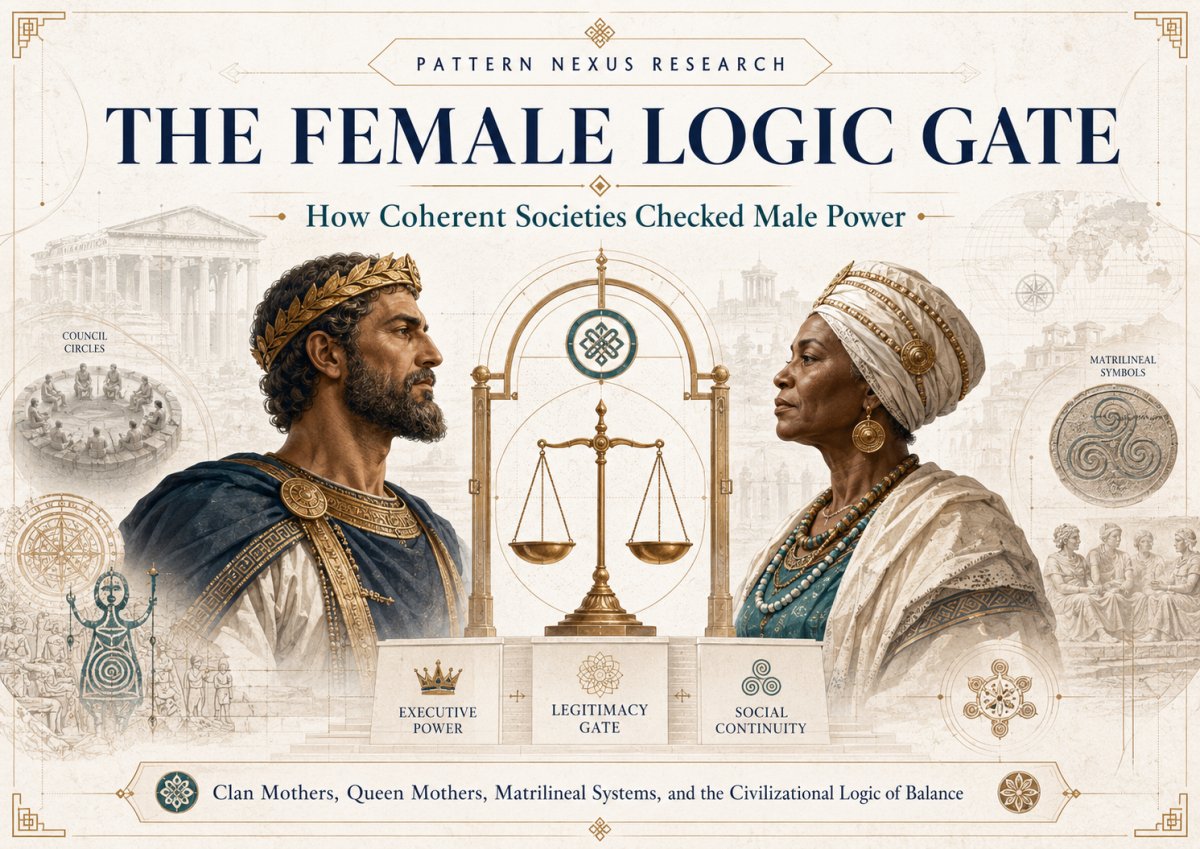
A Pattern Nexus research article on the forgotten civilizational structure behind stable societies: male executive power often existed beside a female legitimacy layer. Across Haudenosaunee, Palau, Asante, Igbo, Yoruba, Cherokee, Chaco, Minangkabau, Kush, Egypt, Rome, Sparta, Neolithic China, and Iron Age Britain, the…
Jump to a section
The Female Logic Gate: How Coherent Societies Checked Male Power
This is not an argument that women secretly ruled everything. It is not a modern gender-war article either. The deeper pattern is simpler and much older: many coherent societies let men hold the visible executive role, but placed that power inside a female legitimacy system.
I started this thought from a rant, and I am not going to pretend otherwise.
I was watching an interview with Priyanka Chopra Jonas, and I made the mistake of going into the comments section. What I saw was not debate. It was not disagreement. It was not even criticism of the ideas being discussed. It was just the same low-level male reaction pattern: objectification, insult, sex-based stupidity, and complete detachment from the actual content.
And that is where this article starts.
Not because one comments section matters that much by itself. It does not. But because it is a microcosm of a much larger civilizational issue. We have taken the male-female relationship, stripped it down to objectification, algorithmic bait, ego-response, biochemical reaction, and status performance, and then we act confused when families stop forming, relationships collapse, communities weaken, and people lose the ability to build anything coherent across generations.
So I started looking backward.
Not to romanticize the past. Not to pretend ancient societies were perfect. Not to pretend women were always treated fairly. They were not. But to look for something structural. Something societies used to understand that modern society seems to be losing.
The pattern that keeps showing up is this:
The claim
The claim is not that women ruled over men in some clean modern ideological sense. That is not the point. The point is that coherent societies often built male authority inside a female-check structure.
Men could be chiefs, kings, war leaders, public speakers, judges, diplomats, or military commanders. But in many societies, the deeper system that made that male authority legitimate was controlled or heavily shaped by women: clan mothers, queen mothers, mothers of the ruler, female councils, market women, priestesses, landholding women, maternal inheritance lines, ritual offices, and household continuity systems.
In other words, the male side handled projection.
War. Law. Public office. External diplomacy. Executive command. Visible authority.
The female side often handled continuity.
Clan. Land. Inheritance. Family structure. Ritual legitimacy. Market order. Children. Household economics. Social memory. Future generations.
That balance matters because a society cannot survive on male projection alone. Male power without a feminine legitimacy gate turns into conquest, ego, appetite, status display, hierarchy, extraction, and eventually collapse. But a society also cannot survive on internal continuity alone. It still needs executive action, defense, law, discipline, and public decision-making.
The stable pattern was not domination. It was balance.
Why the modern framing gets this wrong
Modern people tend to force every historical society into one of two boxes: patriarchy or matriarchy. That framing is too flat.
A society can be male-led in public office and still have female control over land. A society can send men to war and still trace legitimacy through mothers. A society can have male chiefs and still let women select or remove those chiefs. A society can have kings and still require queen mothers, priestesses, or female ritual offices to stabilize the throne.
So when people ask, “Was this society patriarchal or matriarchal?” they are often asking the wrong question. The better question is:
Who controlled succession? Who controlled land? Who controlled the household? Who controlled clan identity? Who controlled the market? Who controlled ritual continuity? Who could shame, remove, veto, nominate, or delegitimize a bad male leader?
That is where the real structure shows up.
Haudenosaunee: when the Clan Mothers could remove the chief
The Haudenosaunee, often called the Iroquois Confederacy, are one of the strongest examples of this pattern. Their system had male chiefs, but those chiefs did not just own authority as private male power. Clan Mothers selected the Hoyane, or chief, to represent the clan in council. If he failed to represent the people, the Clan Mother had authority to remove him after warnings.
That is not symbolic influence. That is institutional power.
The male chief was the public speaker, but the female clan line held the legitimacy mechanism. He could speak for the clan only because the Clan Mother allowed him to speak. If he stopped serving the people, she could take that authority away.
This is one of the purest examples of the female logic gate.
The man held visible public authority. The woman controlled whether that authority remained valid.
This is not anti-male. It is anti-runaway-male-power. It is a system that understands that male leadership can be useful, but only when it remains attached to the people, the families, the land, the children, and the clan structure that produced it.
Palau: men ruled as chiefs, women chose the chiefs
Palau gives almost the exact structure this article is talking about.
Traditional Palauan society was matrilineal. Men ruled as chiefs, but women chose the chiefs and could rescind chiefly status. Women also held clan money and played central roles in land, lineage, and continuity.
That is the whole argument in one society.
The male held the outward office. The female line held the social gate around that office.
This prevents leadership from becoming merely a male dominance contest. A man could be strong, visible, forceful, or politically skilled, but he still had to remain acceptable to the women who understood clan lines, household realities, land relationships, and intergenerational continuity.
In modern language, Palau shows a governance split between executive role and legitimacy source.
That is the missing piece in modern society. We confuse visibility with authority. We assume the person speaking from the throne is the entire system. But in many societies, the visible man was only one layer. The women behind land, clan, property, and succession were another layer.
Asante and Akan societies: the Queen Mother and the stool
In Asante and broader Akan political systems, the queen mother was not just “the king’s mother” in a private domestic sense. She was a public authority connected to succession, legitimacy, dispute resolution, lineage, and governance.
Asante authority was organized around stools, which functioned as political and spiritual symbols of office. The chief had a stool. The queen mother had a stool. This matters because it means authority was not just male. The political system carried a dual-gender logic.
The queen mother could nominate or strongly shape the selection of a chief. She was a public female leader in a society that traced descent through the female line. She did not necessarily act alone to remove every ruler, and that should not be overstated. But she was part of the legitimacy engine around male authority.
This is the difference between real history and lazy internet history.
The claim is not “women secretly ran everything.” The claim is that male rule was often embedded inside a maternal-line legitimacy system. The ruler’s authority had to connect back to the lineage. The lineage ran through women.
That alone changes the structure of power.
Igbo society: dual-sex political systems
Precolonial Igbo societies are another major example because they often used what scholars describe as a dual-sex political system. That does not mean men and women did the same thing. It means men and women had parallel structures of authority.
Men had their institutions. Women had theirs.
In many Igbo communities, women had councils, market authority, women’s courts, and organizations that protected women’s social and economic interests. The Omu, sometimes described as the “mother of society,” could be a major female authority.
This is a very important model because it shows that female power did not always need to be hidden inside the palace. It could exist as a parallel public system.
Men could make decisions in male spaces. Women could make decisions in female spaces. And society worked through the interaction of both.
Colonial rule damaged this structure by often recognizing male intermediaries while ignoring female institutions. That matters. Colonialism did not simply replace one ruler with another. It often flattened native social complexity into male-only administrative channels, which broke the older balance.
Yoruba and Egba: Iyalode, market women, and political pressure
Yoruba societies give another version of the female check through the Iyalode and through market women’s power. The Iyalode was a high-ranking female title, often described as a representative of women in political and economic affairs. Her views could matter in the council of chiefs.
This is important because market power is political power.
Modern people often separate economics from social authority, but many older societies did not. If women controlled or organized major parts of the market, they controlled a pressure point inside the society. They could coordinate, punish, withhold, shame, protest, or redirect economic life.
The Abeokuta Women’s Revolt shows that in a more modern colonial context. Women organized through the Abeokuta Women’s Union against taxation and political exclusion. They protested the Alake of Abeokuta, challenged the taxation system, and forced major concessions, including the Alake’s temporary abdication in 1949.
That is not ancient, but it is one of the clearest examples of organized women overriding a male ruler operating inside a colonial-backed power system.
The lesson is not that women should always overthrow men. The lesson is that when women have organized legitimacy, male political authority cannot treat the population as a passive object.
Dahomey: the Kpojito, the king’s female reign-mate
Dahomey gives a state-level version of this structure through the office of the Kpojito.
The Kpojito was a female reign-mate to the kings of Dahomey. She was not merely decoration around the king. Scholarship describes the office as central to legitimacy, especially in the eighteenth century, when Dahomey was expanding and kings needed both spiritual and political grounding.
This is a key point: expansion creates stress.
When a kingdom expands, the male executive layer becomes more aggressive. Territory, warfare, hierarchy, extraction, competition, and command become more important. That is exactly when a legitimacy structure matters.
The Kpojito functioned as a female counterpart inside kingship. The king was not just a man with command. His rule was paired with a female office that helped stabilize legitimacy.
Again, the pattern is not male versus female. It is male projection paired with female legitimacy.
Benin: the Iyoba and the political mother of the kingdom
The Benin Kingdom had the office of the Iyoba, or queen mother. Queen Idia is the famous example. She was politically powerful, spiritually significant, and connected to the success and legitimacy of her son’s reign.
The Metropolitan Museum describes the queen mother’s political status within the Benin court as equal to that of a senior chief. That is not a soft cultural footnote. That is court-level authority.
This shows another version of the pattern: the ruler’s mother is not just emotionally important. She can become politically and ritually important because she connects the ruler to origin, lineage, legitimacy, and the continuity of the kingdom.
The king may embody present authority. The queen mother embodies the root system that produced him.
Cherokee: women, land, clans, and peace authority
Cherokee society was traditionally matrilineal. Clan identity, property relationships, and social belonging passed through women. The role of the Beloved Woman, including figures like Nanyehi, also shows how women could carry peace authority, moral authority, and diplomatic weight.
The 1817 Cherokee women’s petition is important because it shows women speaking as guardians of land continuity. They were not merely private household figures. They understood land as inheritance, identity, and survival.
This directly ties into the broader Pattern Nexus point.
A society is not just a government.
A society is land, children, homes, food, ritual, kinship, memory, and continuity. If women hold the continuity layer, then women are not outside politics. They are sitting under politics, holding the base structure that politics rests on.
When that layer is ignored, politics becomes floating male performance with no roots.
Navajo and Hopi: women as continuity anchors
Not every example has to be a council removing a chief.
Sometimes the female check is not a veto vote. Sometimes it is control over the thing the entire society depends on: property, livestock, clan identity, children, food, land, and house.
Traditional Navajo society is matrilineal, with descent and inheritance through the mother. Navajo women traditionally owned major resources such as livestock, and in separation women retained property and children.
Hopi society also carries matrilineal clan structure, where women’s roles are deeply tied to family, clan, village, ritual, and household continuity.
These examples matter because they show that female authority does not always look like modern politics. It is not always a podium. It is not always a title. It is not always a law code.
Sometimes the most important power is being the structure that everything has to return to.
Chaco Canyon: an elite matriline lasting about 330 years
The deep-time evidence gets even more interesting.
A Nature Communications study on Pueblo Bonito at Chaco Canyon found evidence for an elite matrilineal descent group that persisted for about 330 years. The study found identical mitochondrial genomes among high-status burials and nuclear DNA evidence of mother-daughter and grandmother-grandson relationships.
That is a major data point.
It means maternal-line continuity was not just a small village custom or a modern political interpretation. It existed inside a major ancient ceremonial and political center in North America.
Chaco is important because it shows the female continuity layer in architecture, burial, elite identity, and social memory. The society built monumental structures, ceremonial systems, and regional influence while preserving elite descent through the maternal line.
That is exactly the kind of evidence that should change how people think about power.
Power is not only who gives orders. Power is also whose line survives inside the structure.
Neolithic China: Fujia and the two-clanned matrilineal community
In 2025, Nature published genomic evidence from the Fujia site in eastern China, dating to roughly 2750–2500 BCE. The study found evidence of a two-clanned matrilineal community.
This does not mean there was a women’s council overriding an emperor. There was no emperor in that context. This is Neolithic China, not imperial China.
But that is what makes it important.
It pushes maternal-line social organization deep into early complex communities before later state systems hardened around more male-line imperial models.
This is where the article has to be careful. The claim is not that China was secretly ruled by women. The claim is that maternal-line community organization existed in ancient China before later political forms replaced, absorbed, or buried it.
That matters because it means the female legitimacy layer is not a modern invention. It is old. Very old.
Iron Age Britain: maternal-line communities before Rome
Another major 2025 Nature study looked at Late Iron Age Durotrigian burials in southern Britain. Researchers found an extended kin group centered around a single maternal lineage, while unrelated incoming burials were mostly male.
That suggests a matrilocal pattern: women stayed, men moved in.
This is important because Roman writers already commented on the unusual empowerment of Celtic women. Ancient writers can exaggerate, misunderstand, or distort what they see. But now the genetic evidence gives independent support to the idea that women were central to the structure of some Iron Age British communities.
Again, this is not a cartoon matriarchy. It is more interesting than that.
It suggests land, kinship, residence, and continuity may have been organized around women, while men entered those communities through marriage and likely participated in warfare, labor, exchange, and public life.
That is the tension system again.
Female continuity. Male participation. Social coherence through both.
Minangkabau: the world’s largest matrilineal society and male public leadership
The Minangkabau of West Sumatra are one of the best living examples of the pattern.
They are widely described as the world’s largest matrilineal society. Property and lineage pass through women. But public clan leadership often operates through male chiefs, or penghulu.
That is exactly the structure this article is talking about.
Women hold the continuity system. Men hold visible public office inside that system.
A man can speak as a chief, but he does not stand outside the maternal-line society. He is operating inside it. The land, inheritance, household, and family continuity do not simply become his private domain.
This is why “patriarchy versus matriarchy” is often too simple.
Minangkabau society can be matrilineal and still have male public leadership. That does not contradict the argument. It proves it.
Khasi and Nair: matrilineal systems with male authority still present
Khasi society in Meghalaya is matrilineal, with inheritance and clan identity passing through women. But researchers also point out that Khasi matriliny does not automatically erase male authority or patriarchal social pressure.
That nuance helps the argument.
The claim is not that matrilineal societies are automatically utopias. They are not. The claim is that they preserve a structural female role in continuity, property, and identity.
The Nair marumakkathayam system in Kerala gives a similar but different example. Descent and inheritance operated through the female line, while formal household authority was often held by the male karanavan, the senior maternal uncle.
Again, there is no clean modern ideology here.
Female line. Male management. Maternal inheritance. Male household office.
It is not domination. It is a divided structure.
And divided structures are often more stable than unchecked ones.
Marshall Islands and Trobriand Islands: land through the maternal line
In the Marshall Islands, land rights are traditionally tied to matrilineal inheritance. Women’s traditional rights and responsibilities around land are central enough that modern reports still focus on the matrilineal factor in land and governance conflict.
The Trobriand Islands also show matrilineal property structures, where land and important inherited property move through the maternal line, often to a man’s sister’s son rather than his own son.
That detail is more important than it looks.
If power passes through your sister’s children, not your own sons, then male authority is forced to remain connected to the maternal clan. It blocks the simple father-to-son dynastic capture model.
In a modern political system, we call this a check and balance.
In older kinship systems, it was often built directly into family structure.
Kush: Kandakes and queen mothers
The Kingdom of Kush gives another state-level example.
The Kandake, often rendered as Candace, could refer to queen mothers and ruling women in the Kushite world. Some ruled directly. Others served as queen mothers, regents, or major royal women tied to legitimacy and power.
This is important because Kush was not a tiny isolated village system. It was a kingdom operating in the Nile world, beside and against Egypt, with its own royal ideology, military power, religion, and state structure.
Here again, the mother of the ruler is not simply biological background. She can become a legitimizing force inside kingship. The ruler is not just male power floating in space. He is connected to a sacred maternal-political structure.
That shows how deep this pattern goes.
Egypt: God’s Wife of Amun and the sacred female office
Ancient Egypt gives a different version of the female check through sacred office.
The God’s Wife of Amun was not just a religious title. The office became a power center in its own right and controlled vast economic resources tied to the Temple of Amun at Thebes.
This is the ritual gate.
The king may rule politically, but sacred legitimacy, temple economics, and divine order are not separate from the state. In a religious civilization, controlling ritual office and temple resources is political.
This matters because many modern people only recognize power when it looks like a president, king, or general. Older societies often placed enormous authority in ritual offices, temples, priesthoods, and symbolic continuity.
A female sacred office with economic resources is not background decoration. It is a stabilizing layer inside the civilization.
Rome: Vestal Virgins and the feminine hearth of the state
Rome was not an egalitarian society. It was deeply patriarchal.
But even Rome preserved a sacred female institution at the center of the state: the Vestal Virgins. They guarded the sacred fire of Vesta, which symbolized the hearth and continuity of Rome itself.
Vestals had unusual legal privileges compared with most Roman women. They could own property, make wills, give testimony, and hold sacrosanct status.
This is not the same as Clan Mothers selecting chiefs. It is a different kind of feminine check.
Rome placed women at the sacred continuity point of the city.
That should not be ignored.
Even in a hard male republic and empire built around soldiers, fathers, senators, magistrates, and emperors, the symbolic hearth of the state was female.
Rome could be patriarchal and still understand that civic continuity required a sacred feminine anchor.
Sparta: male war-state, female property power
Sparta is useful because it breaks lazy assumptions.
Sparta was one of the most male-coded military societies in history. The entire civic system was built around male soldiers, discipline, warfare, and the production of fighting men.
Yet Spartan women had unusual property and economic rights compared with many other Greek women. They could inherit property, own land, make business transactions, and were better educated than women in many other Greek city-states. Some research says Spartan women reportedly owned a very large share of agricultural land.
So even in a male war-state, women held part of the material base.
That is the point.
Male soldiers are not a civilization by themselves. They need land, households, children, inheritance, food systems, legitimacy, and reproduction of the citizen body.
Sparta made men into soldiers. But Spartan women helped hold the property and biological-civic continuity system that produced those soldiers.
The Maya correction: powerful women, but do not overclaim the council
This is where I need to correct the starting assumption.
There is evidence for powerful Maya queens, rulers, and regents. Lady Yohl Ik’nal ruled Palenque. Lady Six Sky was a major dynastic figure at Naranjo. Other royal women appear in Maya political history.
But I am not comfortable claiming the Maya had a confirmed standing “council of women” that could override an emperor. That may exist in a specific tradition or claim somewhere, but the evidence I found does not support making that a core statement in this article.
That does not weaken the article.
It strengthens it.
Because the real claim is bigger than one civilization. The evidence is spread across North America, West Africa, Micronesia, South Asia, Southeast Asia, ancient Egypt, Kush, Rome, Sparta, Neolithic China, and Iron Age Britain.
The pattern does not need the Maya council claim to survive.
The deeper mechanism: two gates instead of one
When you put all these examples together, the pattern becomes obvious.
Strong societies often did not let one sex hold every layer of power.
Men might hold public-facing authority, but women held the deeper continuity layer. Men might make decisions, but women could shape succession. Men might go to war, but women held land and children. Men might sit in council, but women could remove the council speaker. Men might rule the kingdom, but queen mothers or priestesses could legitimate the throne. Men might manage the household, but the household line passed through women.
That is the system.
Two gates.
Male executive action.
Female continuity check.
Modern society has tried to destroy both and replace them with performance.
Men are not trained into disciplined protectors, builders, fathers, or rational actors. They are triggered into appetite, reaction, loneliness, porn-brain, status anxiety, aggression, and comment-section stupidity.
Women are not presented as intelligence, sophistication, lineage, continuity, wisdom, culture, household formation, or civic legitimacy. They are pushed through beauty algorithms, sexualization loops, influencer filters, bot incentives, and objectification markets.
Then society acts shocked when the male-female bond breaks.
But of course it breaks.
You destroyed the gates.
What the female check actually checked
The female legitimacy layer checked five major failure modes.
1. It checked male ego
A chief who knows the Clan Mother can remove him cannot fully confuse himself with the office. He is not the power. He is the carrier of the power.
2. It checked dynastic capture
Matrilineal succession can block the simple father-to-son handoff that turns society into a private male bloodline machine. When inheritance or office passes through the mother’s line, power has to route through a wider kinship structure.
3. It checked extraction
Women tied to land, markets, children, food, household survival, and community continuity are often closer to the lived consequences of policy. That does not make them perfect. It makes them structurally necessary.
4. It checked social detachment
Male authority without a female continuity layer can become abstract. It turns into conquest, status, and command. The female layer keeps authority attached to family, land, and future generations.
5. It checked civilizational stupidity
A society that only rewards male dominance and female objectification will eventually produce emotionally reactive men, socially distrustful women, weak families, low birth rates, broken communities, and a culture that cannot reproduce itself.
The modern collapse: objectification replaced legitimacy
This is where the ancient structure connects back to the rant.
A man watching a woman discuss archaeology and ancient history, then running into the comments to say something sexist, is not just being individually stupid. He is acting out a deeper social programming problem.
He is not seeing intelligence. He is not seeing inquiry. He is not seeing content. He is not seeing another human being participating in the civilizational conversation.
He is seeing the female as an object.
And that is exactly what the modern system has trained him to do.
But the same system then turns around and shames him for responding to the objectification machine that it built. It triggers the chemical response, promotes the sexualized content, rewards the algorithmic bait, floods the culture with artificial beauty markets, and then points at the damaged male response as if that response emerged from nowhere.
That does not excuse him.
He still has responsibility.
That is where the logic gate comes in.
A functioning man has to be able to run the emotional impulse through the logical gate. If it should not pass, you close the gate.
But society has trained an enormous number of men to stop using the gate.
At the same time, society has trained an enormous number of women to understand that the only value promoted for them is beauty, sexual value, performance, and algorithmic visibility.
So both sides degrade.
The man becomes appetite without discipline.
The woman becomes image without recognized authority.
The relationship collapses.
The family collapses.
The community collapses.
Then the birth rate collapses.
Then everyone acts surprised.
The older societies understood something we forgot
Older societies were not perfect. I am not making a childish “ancient people were better” argument. Some were violent. Some were hierarchical. Some were brutal. Some treated women badly in ways that should not be excused. Some treated men as disposable in ways that should not be excused either.
But many of them still understood one thing modern society seems determined to forget:
Men project power outward.
Women stabilize continuity inward.
That does not mean every individual man or woman fits that role perfectly. It does not mean women cannot lead armies or men cannot raise children. History has examples of both.
This is not about forcing individuals into cartoons.
It is about understanding the civilizational architecture.
If society destroys the feminine legitimacy layer, male power becomes unmoored.
If society destroys disciplined male executive function, female continuity becomes unprotected and unsupported.
If society destroys both, you get what we have now: objectification, distrust, loneliness, broken relationships, collapsing family formation, status theater, low meaning, and a population increasingly unable to build local communities.
The Pattern Nexus read
The Pattern Nexus read is that this is not a gender issue in isolation.
It is a systems issue.
The male-female relationship is one of the base-layer operating systems of civilization. It creates children, households, inheritance, continuity, cooperation, emotional regulation, property transfer, social trust, and the local family structures that scale into community.
Break that relationship, and you break the society below the political layer.
That is what people miss.
Politics is downstream from family structure.
Economics is downstream from household formation.
Culture is downstream from male-female trust.
The state can print money. It can write laws. It can build agencies. It can manipulate markets. It can regulate speech. It can subsidize behavior. It can run endless social programming campaigns.
But it cannot easily replace the civilizational function of men and women trusting each other enough to form households, raise children, transmit values, and build coherent local communities.
That is the base layer.
And that is the layer modern society is degrading.
Conclusion: restore the gate
The point of this article is not to say we should copy any ancient society directly. We should not.
The point is to understand the structure they preserved.
Male authority needs a logic gate.
Female authority needs to be recognized as more than beauty, sex, image, or emotional labor.
Men need discipline, self-reflection, and the ability to close the gate when the emotional response should not pass.
Women need to be seen again as carriers of intelligence, continuity, legitimacy, land, culture, family, and civilization.
And society needs to stop pretending that the algorithmic objectification of both sexes has no consequences.
The old systems were not perfect.
But they understood something:
Not because women should dominate men.
Because power without continuity becomes predatory.
Continuity without action becomes fragile.
Civilization requires both.
And when that relationship breaks, everything downstream starts breaking with it.
Research sources
- Onondaga Nation — Clan Mothers
- Library of Congress — Haudenosaunee Confederacy and the Constitution
- PBS — Palau: Legends and Traditional Structure
- Beverly Stoeltje — Asante Queenmothers
- JSTOR Daily — Women Leaders in Africa: The Igbo
- Oxford Scholarship — Igbo Women’s Governing Councils
- JENdA — The Yoruba Iyalode
- History Workshop — Abeokuta Women’s Revolt
- Yale eHRAF — Belief, Legitimacy and the Kpojito
- The Met — Idia, First Queen Mother of Benin
- Bill of Rights Institute — Cherokee Women Address Their Nation
- Indian Health Service — Navajo Nation
- Crow Canyon — A Woman’s Role in Hopi Society
- Nature Communications — Chaco Canyon Matrilineal Dynasty
- Nature — Fujia Matrilineal Community in Neolithic China
- Nature — Matrilocality in Iron Age Britain
- Archipel — Minangkabau Women
- EBSCO — Minangkabau People
- Journal of International Women’s Studies — Khasi Matriliny
- IJCRT — Nair Tharavad System
- Republic of the Marshall Islands Courts — Land and Women
- Yale eHRAF — Trobriands Summary
- World History Encyclopedia — The Candaces of Meroe
- Institute for the Study of Ancient Cultures — God’s Wives of Amun
- National Geographic — Vestal Virgins
- World History Encyclopedia — Spartan Women
- Penn Museum — Maya Queens
What's Your Reaction?
 Like
0
Like
0
 Dislike
0
Dislike
0
 Love
0
Love
0
 Funny
0
Funny
0
 Wow
0
Wow
0
 Sad
0
Sad
0
 Angry
0
Angry
0

Nexus (Christopher)
Founder of Pattern Nexus. I research markets, macro, geopolitics, AI, history, ancient systems, and the patterns most people overlook. I’m also building Market Radar, a trading scanner designed to read pressure, risk, confirmation, and setup quality before ch…
Related research

The Fantasy of Reality: Human Constructs, Control Structures, and the World We Pretend Is Natural
A Pattern Nexus essay on how human beings mistake constructed systems for base reality, why media romanticizes worlds that never existed, a…
4 shared topics, same research avenue.
Peak Insanity: Pure Speculation on a World That No Longer Organizes Itself
This is not a prediction article. It is not a clean thesis. It is a speculative Pattern Nexus thought-run through the pressure stack buildi…
3 shared topics, same research avenue.
The Sixes Are Never Good: Q3, October Surprises, and the Pattern Window Opening in 2026
The number is not the mechanism. The window is. Across 1976, 1987, 1996, 2006, and 2016, major shocks kept clustering around Q3 and October…
3 shared topics, same research avenue.
Mouse Utopia in the Age of Gen Z: When Abundance Kills Purpose
John Calhoun’s “mouse utopia” wasn’t about starvation. It was a controlled-collapse of meaning and social roles under abundance. This Patte…
3 shared topics, same research avenue.
They Found the Dead at Göbekli Tepe. Now the Story Is Changing.
New research published September 22, 2026 documents the first two preserved burial contexts at Göbekli Tepe, containing at least four indiv…
2 shared topics, same research avenue.
The Internet Was Wild: From AOL to AI, How 25 Years Built the Digital Control Layer
In 1999 the internet was something we logged into. Twenty-seven years later, phones, cars, cameras, satellites, databases, artificial intel…
2 shared topics, same research avenue.
No One Who Wants Power Should Have It: The 90-Day State
Elections reward the people best adapted to campaigning, fundraising, party advancement and self-promotion—not necessarily the people best …
2 shared topics, same research avenue.
Why Artificial Intelligence needs an ethical approach.
Originally written by Christopher Grenke in 2022, this paper examines artificial intelligence, trust, ethics, human values, algorithmic bia…
2 shared topics, same research avenue.
Comments (0)
Security Check
Please complete the captcha to verify you are human.