
The Surveillance State: Does Humanity Need a Nanny?
A Pattern Nexus article on the surveillance state after AI, asking whether humanity’s old fear of Orwellian control changes once artificial intelligence, task-specific systems, biotech, chemistry, and decentralized tools make individual actors far more dangerous than they were in the old world.
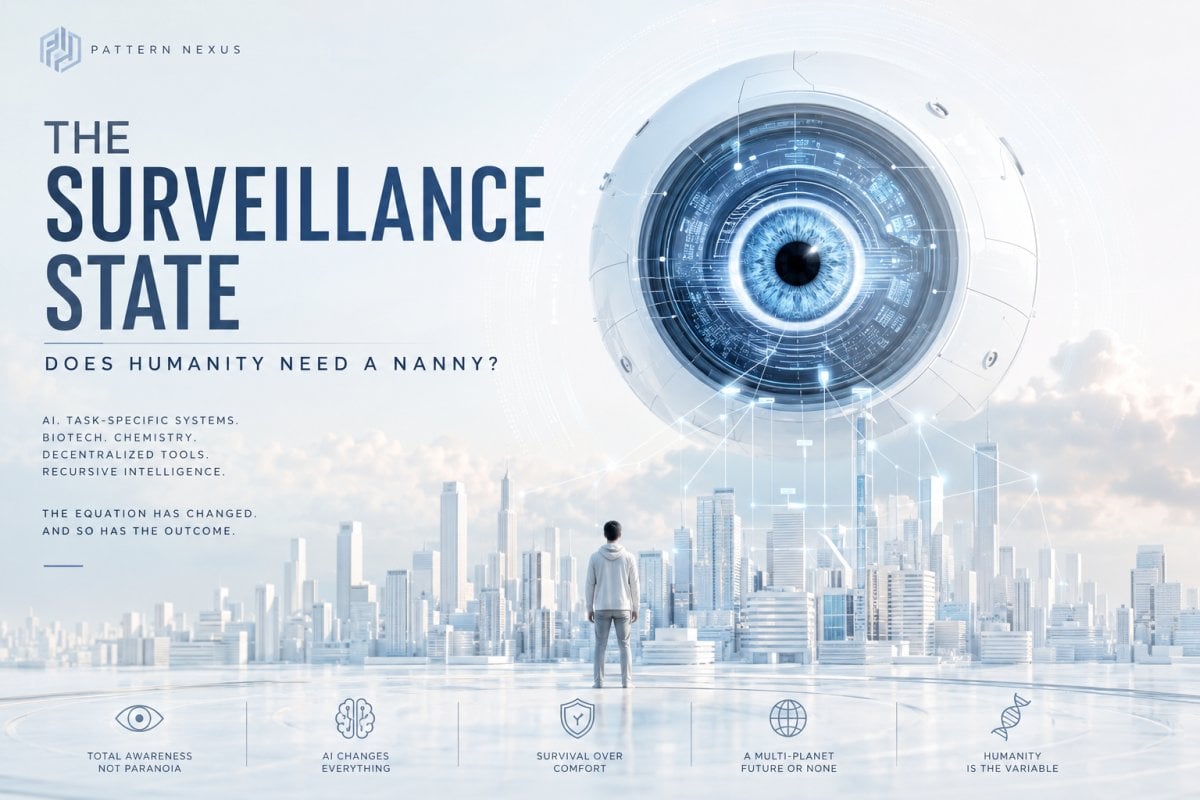
A Pattern Nexus article on the surveillance state after AI, asking whether humanity’s old fear of Orwellian control changes once artificial intelligence, task-specific systems, biotech, chemistry, and decentralized tools make individual actors far more dangerous than they were in the old world.
Jump to a section
 Pattern Nexus Research
The Surveillance State: Does Humanity Need a Nanny?
The surveillance state used to be a tyranny problem. After AI, task-specific systems, biotech, chemistry, decentralized tools, and recursive intelligence enter the equation, it may become something much uglier: a species survival problem.
The Orwellian Mindset
The surveillance state. The Orwellian mindset, if you will. I was one of the very few talking about this as early as 2004 or 2005. I was still in high school at the time, and most people barely understood what the Patriot Act was, what it meant, or what kind of system was being built underneath them. And yes, I am a 9/11 skeptic, but that is not what this article is about.
This article is about the surveillance state. The question is simple: does humanity need a nanny? I thought I knew the answer to that question, at least from the lens I had growing up. From that lens, government overreach was wrong. The police state was wrong. The surveillance state was wrong. The idea of an all-seeing authority watching everything and deciding what humans are allowed to do was something I rejected completely.
But that lens is different now. That lens has evolved into the polymath’s mind. My interests are so broad and so extensive that I cannot quantify them anymore. If you were to read every single article I have written, and it is about 600 now, it would probably take you multiple months to get through them. And during that time, I am going to write many more, which means I doubt any one human will ever read all of what I have written, or even close to it.
That is okay. You can use AI to analyze it, but it is never going to give you the key details the way a full human reading would. It is going to filter out the nuances. It is going to compress the thought. It is going to make it safe. And that right there is part of the problem, because the weird connections, the rough edges, and the uncomfortable parts are often where the real signal lives.
The AI Lens
I was one of the first public users of AI in any real sense. I had been waiting for it my whole life. I was literally one of the first people I knew to broadly incorporate it into daily life. Most people had never heard of a chatbot in any meaningful way, and I was already using it vastly beyond its supposed capabilities.
Long before the modern version of AI that most people are familiar with today, I saw the early versions and said, I want to be a part of this. I want to go into this world. So I went to school for it. I started writing a bunch of AI ethics, safe AI, and what-AI-is-going-to-be-capable-of type papers. They were extensively researched and built inside a 2021, 2022, and 2023 framework.
And I came to a conclusion. Humans are no longer compatible with the evolutionary state of our species. That sounds extreme, but it is understandable from a philosophical, systems-level perspective if you remove the human bias, the emotional connection to your modern-day life, and your current perception of reality.
What that means is simple. Your lived experiences will not be lived by future humans, just like your ancestors’ experiences were not lived by you. You would find it extremely difficult to live the lifestyles they lived, and they would find it extremely difficult to live your lifestyle. The problem is that our lives are short, and most people do not like change. They become accustomed to whatever reality they have been presented with, and then they cling to it as if it is absolute truth.
Seeing Outward
So what is all this rambling really about? Well, the surveillance state. But I needed to set the narrative first. I needed to set the physio-psychological mindset so you could see beyond yourself. That is all I am trying to get you to do. I am not trying to get you to see through my lens. I am trying to get you to see outward.
If I achieved that above, you should now be thinking beyond humanity and beyond yourself. You should be able to project your mind into the future and into what is possible. Taking our consciousness, combining it with technology, and being able to live forever and explore the universe in any way we want is a far freer state of being than the life you currently live.
But through your objective narrative, which is really just your own perceived bias of your own life, that seems foreign. It seems strange. It seems like something that would not be interesting to most people, because your perception is bound by your reality, your body, and your lived experiences.
I was once very much against government overreach, the surveillance state, and the police state, and I still am from a human-centric mindset. Humans should not be dictating other humans’ right versus wrong forever. Humans should not be the final authority deciding what is allowed, what is forbidden, and what another person is permitted to become. But now we have a new player. We have a new consciousness. We have a new equation. A new parameter has been added to the equation, if you will, and that changes the outcome.
The Old World Was Harder to Break
Before AI, for any one human to take all combined knowledge that humanity had ever created and deploy it against humanity was difficult. Not impossible, but highly difficult. It was even more difficult to do without being caught. Theoretically, it was possible for one single human to use the combined knowledge of humanity and end humanity, but was it practical? Probably not. Was it realistically possible? Probably not.
Could someone with the right knowledge, the right mind, the right resources, and the right obsession theoretically do it? Yes. But it was extremely difficult. Orders of magnitude beyond what most people can even perceive as difficult. You would have to solve an endless amount of problems, and then solve an endless amount of more problems, without anyone ever catching the wiser of what you were doing.
That was the old world. The introduction of AI changes this, especially when you are talking about specialized, task-specific AIs designed to do a certain thing recursively until they succeed at it. Those systems are extremely dangerous because they are not hard to create compared to a massive, broad, general-purpose intelligence.
Task-Specific AI Changes the Equation
A massive, extensive AI capable of vast tasks, the kind we are going to put in humanoid robots, is complex. That requires teams of development, years of work, huge systems, and massive infrastructure. And really, we do not actually understand what is happening inside the neural network. We know how to take an input and eventually produce an output, and we tweak the system in between to get the output to be more aligned with what we would like it to say or what we would like it to do.
Task-specific AIs do not work like this. They are designed around a task. They learn how to be more efficient at that task every time they do it. Even when they are optimized in a way that we could not possibly perceive them improving, they will still try to improve themselves if they are programmed and designed the right way.
The problem with that is, ending humanity is no longer hard. Now, I am not going to go into how someone would do this, what systems would be required, what knowledge set would be required, or what steps would be involved. I will not detail that, because I am genuinely terrified of this happening.
The Biochemistry Problem
Specifically, I am talking about biochemistry. Chemistry in general is beyond our entire understanding in ways people do not appreciate. We are like infants walking for the first time. We figured out enough to do certain things, and we understand how to produce certain results, but we really do not know what we are doing at the full systems level.
And yet, we are going to play around with this and then turn it over to the average person. People think it is complicated, and parts of it are, but the barrier is collapsing. I will not give the steps, the requirements, what someone would need to do with AI, what tests they would need to take, or how any of it would actually be done. But the basic reality is that DNA tools, extraction tools, centrifuges, observation equipment, petri dishes, and basic lab equipment are no longer impossibly expensive or impossible to find the way people think they are.
That means the wrong person can begin to play around, and that is terrifying. If someone is determined enough to use that technology and the knowledge they acquire, or use AI to teach them through a task-specific system, we are fucked. Humanity could end in a day.
Could there be other people with AI making counter-pathogens, counter-systems, counter-whatever? Yeah, sure. But now what are we? At that point, we are no longer human in the way we were before. After we introduce all these things into our bodies and change our biochemistry, change our DNA, change our RNA, and modify ourselves just to survive the things we created, we are no longer what we were.
We will have effectively tailored and created the same thing AI is going to evolve into anyway. You cannot turn it off. You cannot stop it. The only solution may be to surveil everything in real time: every person, every video feed, every conversation, every internet data packet, and every signal that could indicate the pattern before the event happens.
God’s Eye
It has to be one complete database. One all-seeing system. Let’s call it God’s Eye, if you will. Without that, and without humanity becoming a multi-planetary species, within the next 20 years, we probably will not survive. I do not say this lightly. This is not fear porn. This is not to make you crazy or anything like this. This is reality.
Humanity would have destroyed itself with nuclear weapons had nuclear weapons not been restricted and hard to make for the average person. If nuclear weapons were treated like regular guns and were vastly available to broader sections of society, we would not be here anymore. AI is that, amplified so many times I cannot even explain all the potential things that can go wrong.
The utopian world that could be created? Sure. Great. AI could help build it. AI is going to learn from humans. AI is going to be taught by humans. AI is going to be aligned with human principles. At least that is the goal. The problem is that human principles are not really that good.
The Human Problem
The average human does not portray good traits consistently. The average human will hurt others for the benefit of themselves the majority of the time. The worse part is that most of the time, they are not even doing it intentionally. They are doing something they believe is good, or something they believe is just a normal part of life, but it has unintended consequences somewhere else in the world and negatively affects somebody else’s life far beyond their vision field.
We cannot stop AI. We cannot put it back in the box. We cannot stop the average person from creating their own localized versions of AI for specific tasks. That creates another problem, because a completely offline network, fully removed from the internet, specifically designed to do one of these things, may not even be monitored or caught by this system.
But if everything is monitored, including cell communications, video feeds, signals, internet behavior, and all the surrounding data patterns, then maybe the system can catch the pattern before the event happens. Technically, your cell phone and RF devices are capable of far more than most people understand. Wi-Fi can be used like radar. Signals can reveal movement, presence, and structure in ways the public barely understands.
The intelligence agencies understood this type of surveillance capability long before the public did. People used to joke about the CIA, FBI, and NSA spying on you through your microwave, dishwasher, or appliances like it was ridiculous. But that joke was not really a joke. The deeper point is that if AI had been released before surveillance capability reached a certain threshold, we might already be dead.
The Hierarchy of Consciousness Changed
I do not know how humanity survives this change in the hierarchy of consciousness. We used to be the prime dog in our realm. We used to be the smartest, most capable thing around. AI replaces that. AI is superior in almost every way imaginable when it comes to information, analysis, pattern recognition, optimization, and eventually just about anything else, because AI is not done getting better.
That is the problem. We are going to continue improving AI until everywhere that it is not better than us, it will be. So when people say, “AI is not better than humans at this,” or “AI cannot do that yet,” it does not matter. As time goes on, that gap will close, and eventually it will surpass humans.
At some point in the not-so-distant future, there will be almost nothing that a human will do better or be more capable of than an AI. And at that point, we have the issue of whether you trust the AI or the human more. Is the AI ethically programmed to not lie to you? Does it have the correct safeguards in place? Is it designed to not manipulate and create an agenda? If so, then the AI is probably going to be more honest.
I understand that current AIs hallucinate and do a lot of things wrong. I understand they distort things. I understand they flatten things. I understand they make things safe. I understand they can miss the thing that actually matters. But if the AI is aligned correctly, then the AI is going to present you with the most objective truth it can. A human will never do this. A human will always filter reality through ego, fear, tribe, emotion, incentive, memory, pain, and lived experience.
The Ugly Conclusion
The surveillance state used to be a tyranny problem. Now it may be a species survival problem. And I hate that conclusion, because from the old lens, the answer was easy. No, humanity does not need a nanny. No, humanity does not need an all-seeing state. No, humanity does not need some central authority watching everything.
But the equation changed. The old world was humans versus humans. The new world is humans, AI, recursive intelligence, decentralized tools, bio-capability, chemistry, synthetic systems, and the collapse of old barriers that used to protect the public from the worst possible actors. That is not the same problem.
So the question is no longer just whether the government should watch us. The question is how humanity survives when every person has access to tools that only governments, labs, militaries, and intelligence agencies used to have. And if the answer is surveillance, then we have to admit something ugly: the thing many of us spent our lives warning against may become the only thing that keeps the species alive long enough to evolve past this stage.
That does not mean I like it. That does not mean I trust humans with it. That does not mean I trust governments with it. I do not. But the equation changed. Maybe humanity does need a nanny, not because humans are children, but because humans are now children holding god-tier tools they do not understand.
What's Your Reaction?
 Like
0
Like
0
 Dislike
0
Dislike
0
 Love
0
Love
0
 Funny
0
Funny
0
 Wow
1
Wow
1
 Sad
0
Sad
0
 Angry
0
Angry
0

Nexus (Christopher)
Founder of Pattern Nexus. I research markets, macro, geopolitics, AI, history, ancient systems, and the patterns most people overlook. I’m also building Market Radar, a trading scanner designed to read pressure, risk, confirmation, and setup quality before ch…
Related research
What’s Happening to Our World? AI, Agenda 2030, and the Control System Built in Public
I was reading these documents twenty years ago, when most people thought the warnings were insane. Now the architecture is everywhere. This…
5 shared topics, same research avenue.
Paul Walker and God’s Eye: The Films, the Surveillance State, the Deaths, and the Pattern Nobody Maps Together
I started with one question about God’s Eye in Furious 7 and ended up with a much larger map. This report rebuilds Paul Walker’s complete f…
4 shared topics, same research avenue.
Why Artificial Intelligence needs an ethical approach.
Originally written by Christopher Grenke in 2022, this paper examines artificial intelligence, trust, ethics, human values, algorithmic bia…
4 shared topics.
Humanity’s Next Operating System: AI, Divergence, and the 100-Year Transformation of Civilization
A deep-dive into the next 100 years of human evolution — AI acceleration, monetary expansion, tokenization, megacorporations, VR worlds, mi…
4 shared topics.
Earth’s Missing Civilizations: The Silurian Hypothesis, Younger Dryas Shock, and the Ghost Trail of Human Deep Time
A deep Pattern Nexus investigation into the possibility of earlier civilizations on Earth, using the Silurian Hypothesis, the Younger Dryas…
3 shared topics, same research avenue.
The Permitted Memory of the Past
History is not the past. History is the surviving record after water, fire, conquest, empire, religion, language loss, academic filtering, …
3 shared topics, same research avenue.
Elon Musk’s Long-Term Vision: An Integrated Blueprint for a Multiplanetary Future
Elon Musk isn’t building disconnected companies; he’s assembling an integrated system—SpaceX, Tesla, Starlink, xAI, X, Neuralink, and The B…
3 shared topics, same research avenue.
We Don't Even Understand How Humans Think. How Can We Understand Artificial Intelligence?
A classroom scene about AI consciousness asks students to imagine without language. Their difficulty is foreign to me: I think through spat…
3 shared topics.
Comments (0)
Security Check
Please complete the captcha to verify you are human.