

The Ancient Geometry of the Universe? Roman Dodecahedra, Cosmic Topology and Quantum Gravity
A mysterious Roman bronze object, Plato’s geometry of the cosmos, a modern model of a finite universe and a new AI-assisted quantum-gravity paper. I walk through the striking geometric resemblance, w…
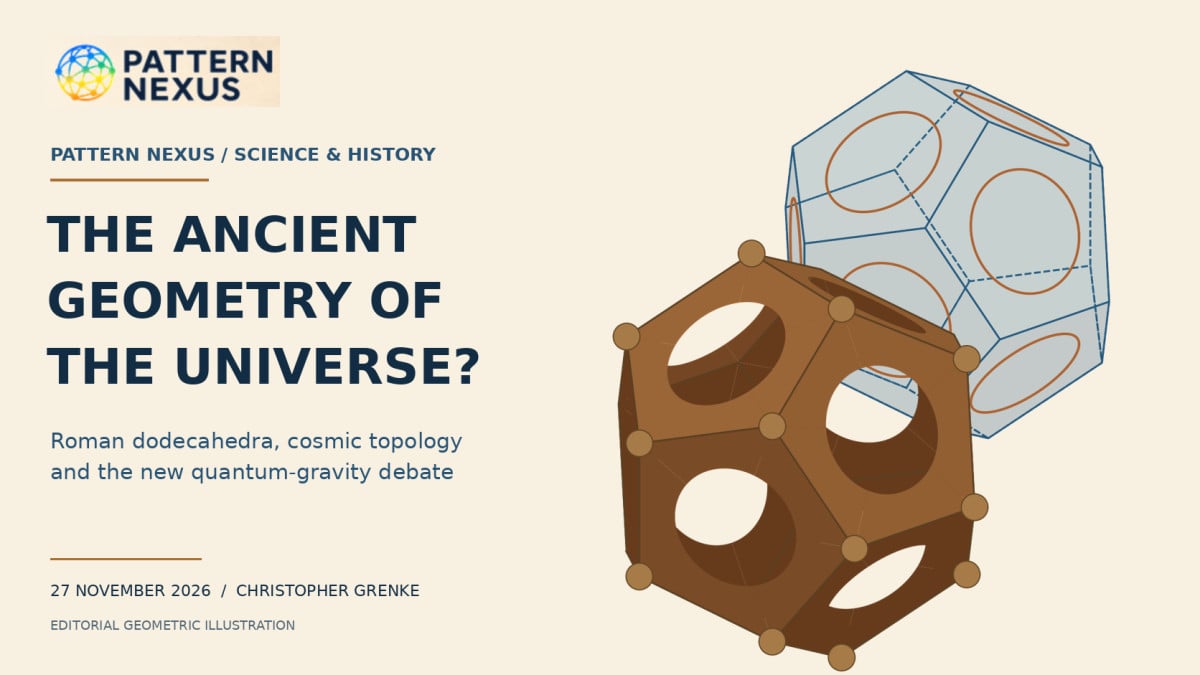
A mysterious ancient bronze object resembles a modern mathematical diagram of a universe that wraps back into itself. The resemblance is striking — and the ancient cosmological connection is real enough to investigate. I will explain the object, Plato, the geometry, the causal diamond and the new quantum-gravity research without assuming you have studied physics.
The key is to separate what we know from what we are trying to find out: ancient geometry is documented, cosmic topology remains a hypothesis, and the November 25 quantum-gravity paper is a preliminary theoretical result.
A physical Roman bronze object of unresolved purpose.
A twelve-faced solid associated with the ancient cosmos.
A quotient-space model that changes how causal boundaries behave.
A striking resemblance is a starting point for investigation, not proof of shared knowledge.
01 · GEOMETRY AND COSMOLOGY
Two images I couldn’t get out of my head
The amount of new research coming out every day right now is unbelievable. I spend a good deal of time following physics, mathematics and the development of AI, and even I am having a hard time keeping up. On November 27, I was looking into the discussion surrounding a new paper attempting to connect gravity with quantum mechanics in four-dimensional spacetime.
Then I came across the diagram you are going to see below. The first thing I noticed wasn’t the graph or even the equations. It was the shape. I had seen something remarkably similar before, except the other object was made of bronze nearly two thousand years ago.
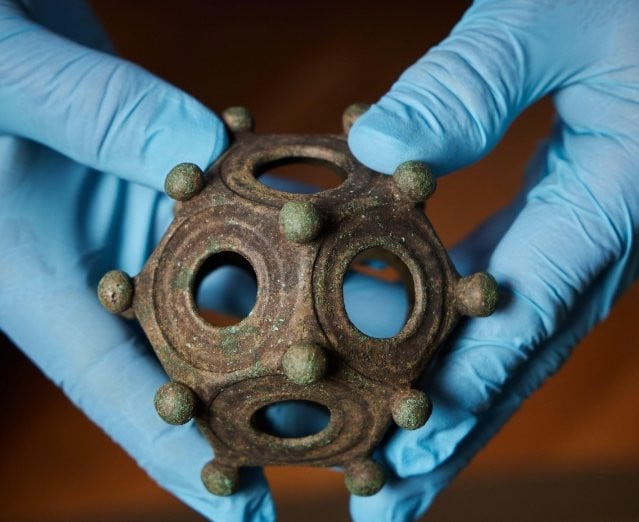
My immediate reaction was: how in the hell did the ancients know? But before we get there, I need to explain what we are actually looking at, because otherwise the significance of the comparison is going to get lost. And there is an important distinction here: the image shows a Roman-type artifact, not an established Egyptian artifact. I initially associated it with ancient Egyptian geometry, but the documented objects of this design belong to the Gallo-Roman archaeological record.[3][5]
I am not claiming that the Romans had quantum mechanics. I am asking why this particular geometry keeps turning up in radically different attempts to describe reality, and what we can actually establish about it.
02 · GEOMETRY AND COSMOLOGY
What did the Romans build?
A dodecahedron is a solid made of twelve pentagonal faces. A regular one has thirty edges and twenty corners. The objects found in the Roman world are hollow copper-alloy versions, with circular holes through their faces and small knobs at their vertices.[3]
The exact purpose of these objects remains unsettled. The Norton Disney archaeological group excavated a particularly complete example in Lincolnshire in June 2023. The local authority dates it approximately to the third or fourth century AD. It is around eight centimeters tall and weighs 245 grams. The group reports roughly 130 known examples across the Roman world.[5][6]
They are not all identical. Hole sizes differ, and the relationship between opposite openings varies among specimens. That is important because if this geometry served a particular mathematical or physical function, we would want to know what was standardized and what was allowed to vary.
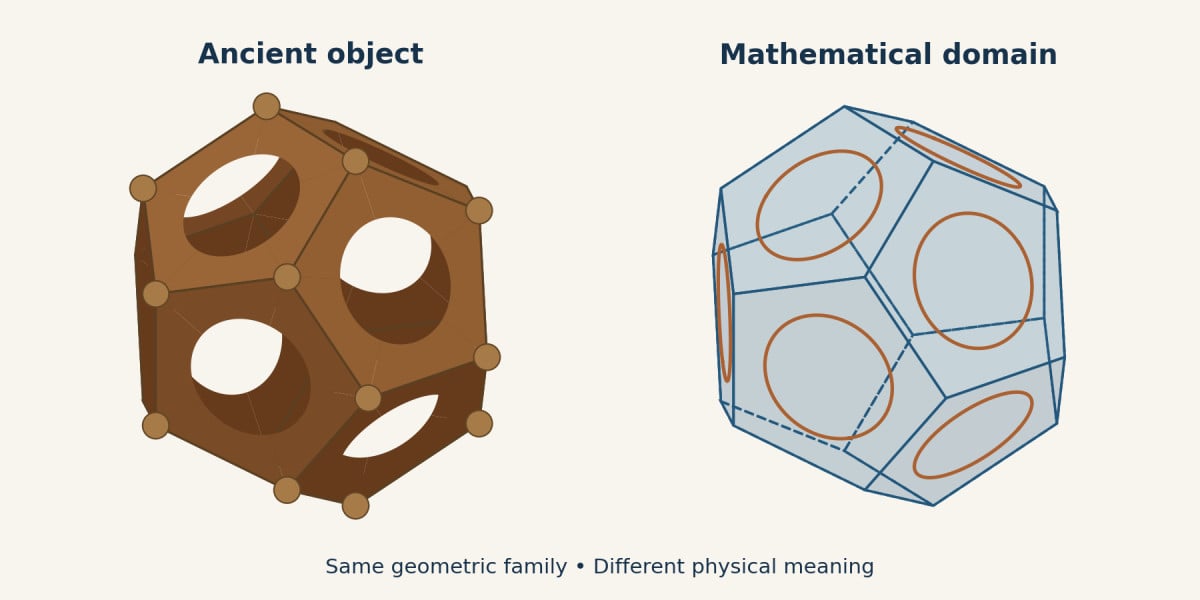
The physical artifact has metal faces and real holes. The mathematical shape has identified surfaces and intersections of wavefronts with those surfaces. Those are fundamentally different things, even though the pictures look similar.
03 · GEOMETRY AND COSMOLOGY
Plato associated this exact geometry with the cosmos
Here is the part that made me want to look into it further. Around 360 BC, Plato described five regular solids in the Timaeus. He associated four of them with the elements as they were understood in Greek philosophy. The remaining solid was associated with the universe as a whole.[4]
| Solid | Faces | Ancient association |
|---|---|---|
| Tetrahedron | 4 triangles | Fire |
| Cube | 6 squares | Earth |
| Octahedron | 8 triangles | Air |
| Icosahedron | 20 triangles | Water |
| Dodecahedron | 12 pentagons | The cosmos as a whole |
That does not mean Plato was writing a modern physics textbook. He was describing a philosophical cosmology. But it does establish that this shape already had a special cosmological significance long before the bronze artifacts were manufactured.
In November 2025, Michael Guggenberger and Stephen Leach published a paper in The Antiquaries Journal examining whether Gallo-Roman dodecahedra were inspired by Platonic and Pythagorean traditions. They explored ancient texts and the geographical distribution of the finds, including possible religious and divinatory associations.[3]
So the possible connection between the objects and ancient cosmology is not something I am simply inventing based on a photograph. Archaeologists have investigated it. What they have not established is that the objects modeled a specific modern theory of space.
04 · GEOMETRY AND COSMOLOGY
Imagine a universe that has no edge but is not infinite
Most of us picture space as something you could travel through forever in a straight line. But being finite does not necessarily mean that something has an edge. Consider the surface of Earth. You can travel around it continuously without falling off an edge, yet its surface has a finite area.
Now imagine a video game where you leave the right side of the screen and reappear on the left. You did not teleport in the physical sense; the game defines those two edges as the same location. If you also connect the top and bottom edges, you have a simple example of periodic space.
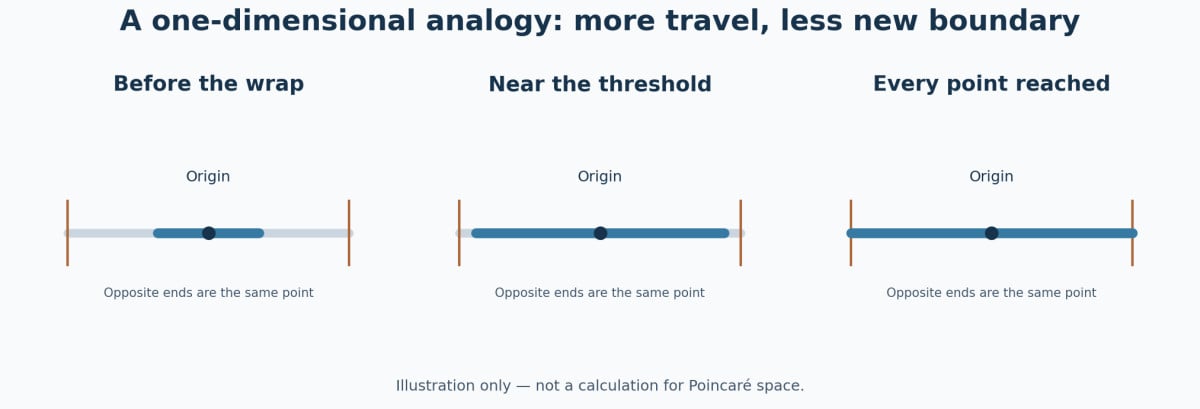
The mathematical model I am discussing takes the idea much further. Poincaré dodecahedral space is a positively curved three-dimensional space formed from a three-sphere, S³, by identifying points under a symmetry group called the binary icosahedral group, I*. One can represent it using a spherical dodecahedron whose opposite faces are identified with a 36-degree twist.[7][8]
Do not picture a giant bronze object floating somewhere outside the universe. The dodecahedron is a way to describe which locations are equivalent. Its faces are not walls; the geometry continues across them. And S³ is not the ordinary two-dimensional surface of a ball. It is a three-dimensional curved space.
This is the difference between geometry, which describes distances and curvature, and topology, which describes how the space is connected. Two universes could look locally similar and have very different global connections.
05 · GEOMETRY AND COSMOLOGY
What is a causal diamond?
Imagine you turn on a flashlight at a particular moment, event p. Then imagine that at some later moment, event q, you receive a signal back. There is a limit to how far anything could have traveled during that interval, because information cannot outrun light.
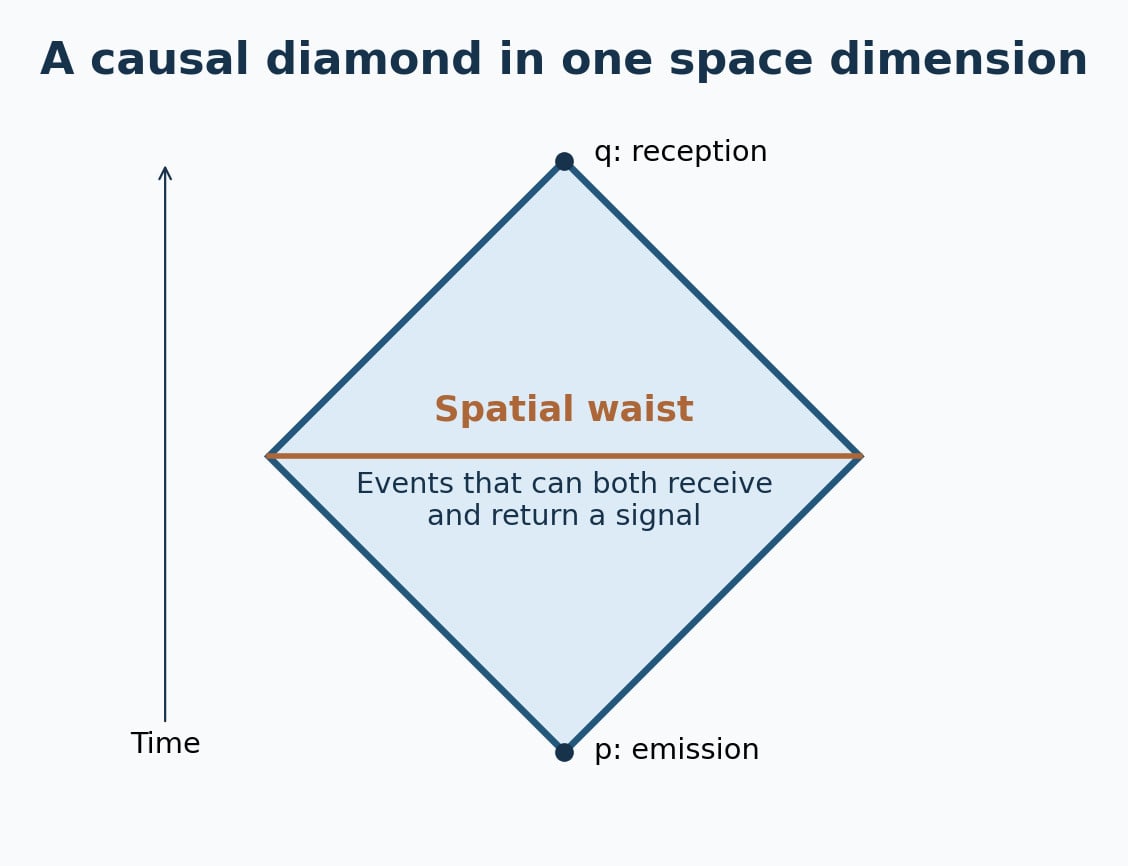
The upward cone describes events your original signal could reach. The downward cone describes events that could send information back to you before the deadline. Where those cones overlap, you have a causal diamond. It is a region of spacetime, not a physical crystal.
A familiar diagram only shows one spatial direction and time. In our everyday universe there are three spatial directions plus time. At the middle of a simple symmetric diamond, the accessible spatial region is three-dimensional, and the surface that bounds it is two-dimensional. That surface is what the diagram calls its waist.
When we talk about four dimensions here, we are talking about three spatial dimensions and one time dimension. That is not a claim that the Romans could see a fourth spatial dimension.
06 · GEOMETRY AND COSMOLOGY
Now look at the original diagram again
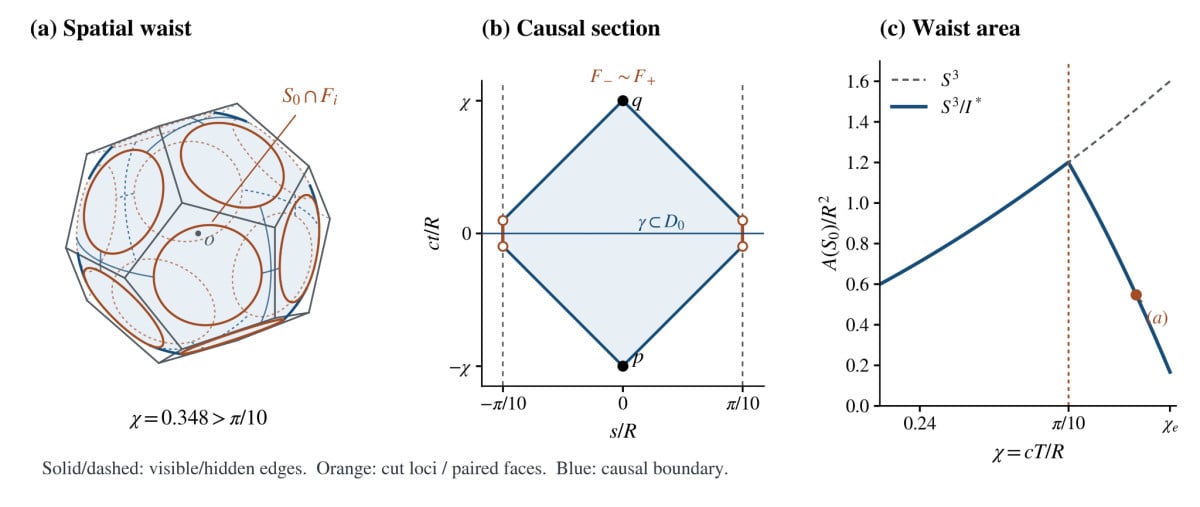
The left panel shows the spatial boundary intersecting faces of a dodecahedral domain. The middle panel is a slice through a causal diamond, with opposite spatial faces identified. And the right panel plots the normalized boundary area against the dimensionless parameter χ = cT/R.
Here c is the speed of light, T is the one-way time scale shown in the diagram, and R is the spatial curvature radius. If the endpoints sit at times −T and +T, the entire interval lasts 2T. The transition is marked at χ = π/10, or approximately 0.314. In this particular spherical quotient, that is the injectivity radius in units of R: roughly the point at which shortest routes begin encountering the global identification.
Before that threshold, the boundary behaves like a sphere in the covering space. After it, parts of the expanding boundary cease to enclose newly reachable locations. The available region can continue to grow while its boundary area decreases.
Notice that the blue curve drops while the dashed curve keeps climbing over the range displayed. That is what caught my attention physically. It is not evidence of matter collapsing, gravity reversing or energy being created. It is what a change in global connectivity can do to a boundary defined by the shortest paths.
The orange circles in the left panel represent intersections associated with the paired faces or cut loci. They are not holes drilled in a metal object. And the graph is a mathematical model, not a measurement of the universe.
A small technical point for readers who want the mathematics: in a round three-sphere of curvature radius R, a geodesic sphere at distance Rχ has area A = 4πR² sin²χ before the relevant identifications. At χ = π/10, this gives A/R² ≈ 1.20, consistent with the plotted peak. Beyond the threshold, the quotient boundary must account for the identified regions; the ordinary spherical expression alone is no longer sufficient.
I have not established the authorship of this three-panel figure. It is labeled in accordance with what can be read directly from the image, not presented as a figure from the new Stanford paper.
07 · GEOMETRY AND COSMOLOGY
Physicists have actually proposed this as a model of our universe
In October 2003, Jean-Pierre Luminet and four coauthors published a paper in Nature proposing Poincaré dodecahedral space as a possible explanation for features of the cosmic microwave background, the radiation remaining from the early universe.[7]
If space wraps around, we could in principle see the same distant region in more than one direction. The model predicts pairs of circles in the microwave sky with correlated temperature patterns. The specific pattern and detectability depend on the cosmological geometry and size.[8]
That turns the idea into something we can investigate with observations. The Planck 2013 topology analysis placed a strong lower limit on the dodecahedral domain size in the models it tested. Subsequent Planck work also found no convincing evidence of the repeated patterns expected from sufficiently small detectable multi-connected topologies.[9][10]
So we do not have a discovery that the universe is dodecahedral. We have an existing, mathematically defined cosmological hypothesis that makes predictions, with observations constraining the versions tested. There can still be topology beyond the scale we can observe.
08 · GEOMETRY AND COSMOLOGY
Why the geometry of a boundary matters to quantum gravity
General relativity describes gravity through the geometry of spacetime. Quantum mechanics describes physical systems through quantum states, probabilities and observables. Both work extraordinarily well in their respective domains, but a complete theory that consistently describes quantum gravitational effects is still an open problem.
One of the most interesting clues is black-hole entropy. In the usual units the Bekenstein–Hawking relationship is:
S = kB c³ A / (4Gℏ)
| Symbol | Meaning |
|---|---|
| S | Entropy |
| A | Black-hole horizon area |
| G | Gravitational constant |
| ℏ | Reduced Planck constant |
| c | Speed of light |
| kB | Boltzmann constant |
Think about what is in that one equation: gravity, quantum mechanics, relativity, thermodynamics and the area of a geometric surface. Black-hole entropy scales with horizon area, not directly with interior volume. That makes the relationship between geometric boundaries and information worth examining.[11][12]
But that does not mean every surface has black-hole entropy, or that the decreasing blue curve in the original figure proves an entropy law. A causal boundary, a black-hole horizon and a physical bronze face are different entities. The connection here is a research question about geometry and information, not an equation that equates all three.
09 · GEOMETRY AND COSMOLOGY
What the November 25 quantum-gravity paper actually proposes
Venkatesa Chandrasekaran at Stanford submitted An Algebraic Quantization of Gravity from the Null Cone to arXiv on November 25, 2026. It proposes a quantum description of vacuum general relativity in four-dimensional spacetime using intersecting lightlike boundaries, rather than prescribing a fixed background geometry.[1][2]
The reported results include a construction of a quantum state space for the gravitational variables, convergence of intermediate-state sums in the proposed amplitudes, a finite-dimensional state space for a bounded macroscopic causal diamond, recovery of black-hole entropy and its one-loop correction, and a low-energy recovery of semiclassical Einstein equations. The full paper also treats an area operator and spatial topology.[1][2]
The important part is not just writing a new equation. Any proposed quantum theory of gravity must reproduce the gravitational physics we already know in the regime where that physics works. It must also survive independent mathematical checks.
This is a preprint. The results are the author’s claims, not an independently established solution to quantum gravity. Early reactions have included serious objections as well as interest in the method.[13]
And I want to be clear again: the connection I am drawing between this paper and the ancient dodecahedron is my comparison of geometric ideas. The preprint is not an archaeological study and I have not verified the supplied figure as one of its illustrations.
10 · GEOMETRY AND COSMOLOGY
There is another part of this story: the speed of AI research
The acknowledgements of the paper are almost as interesting to me as the paper itself. Chandrasekaran reports months of collaboration with GPT-6 Astra on some of the calculations and proofs, totaling approximately 400 million tokens. OpenAI provided the computing resources.[2]
This is the kind of thing I have been trying to get people to understand about AI. I am not talking about asking a chatbot to write an article or answer a question. I am talking about a person working through complex mathematical structures with a system capable of exploring, calculating and revising them repeatedly.
That is a substantial acceleration in the amount of material researchers can explore. It does not guarantee that the answer is right. In fact, if the rate of producing new research accelerates faster than the rate at which people can verify it, we are going to have a real problem distinguishing the breakthroughs from the errors.
Four hundred million tokens is a measure of the amount of interaction, not a measure of how correct a theory is. We need to keep those two things separate.
11 · GEOMETRY AND COSMOLOGY
So what could the ancients actually have known?
The ancients clearly understood the shape. We also have direct evidence that Greek philosophers associated it with the cosmos. We have physical artifacts constructed centuries later. What I want to know is whether their design tells us anything more specific.
I would start by assembling a dataset of surviving objects with verified archaeological context, photographs, three-dimensional scans, measurements of every opening and records of repairs or corrosion. Then I would compare the ratios across the entire collection instead of looking at one object that happens to resemble a modern diagram.
| What to examine | What it could test |
|---|---|
| Opposite-hole diameter ratios | Whether repeated pair relationships exceed manufacturing variation. |
| Face angles and alignment | Whether the openings were intended to align along specific axes. |
| Knob dimensions and wear | Whether knobs served handling, support or a functional role. |
| Orientation and find context | Whether archaeological settings favor ritual, craft or another use. |
| Optical and geometric replicas | Whether proposed uses make repeatable predictions that distinguish them from competing explanations. |
The comparison would need null models and uncertainty estimates. If the holes were chosen for practical sizing, ritual convention or simply visual preference, those explanations need to be tested too. If a proposed geometric rule predicts the sizes only after we fit a separate parameter for every object, it is not much of a prediction.
The stronger claim — that an object represents a specific topology — would require independent evidence of face pairing, rotational mapping or an equivalent mathematical instruction. The fact that two things share a pentagonal dodecahedron is insufficient.
12 · GEOMETRY AND COSMOLOGY
Where I land on this
What interests me most is not trying to manufacture a conclusion about lost technology. It is that geometry is something humans were studying thousands of years ago, and some of those same shapes continue to appear in our attempts to describe nature.
The bronze object is real. The ancient cosmological association is documented. The modern mathematical model exists. The quantum-gravity preprint exists. The relationship between all of them beyond the shared geometry is the part we do not know.
I do not think we give ancient people enough credit for their capacity to think abstractly, build physical models and explore mathematics. Nor do I think we should give ourselves permission to fill every gap in the historical record with whatever modern theory looks similar.
How did they arrive at this geometry, and why did they consider it important enough to build? That is a question worth asking. If we ever establish a deeper connection, it should come from the evidence, not from how badly we want the connection to be true.
13 · GEOMETRY AND COSMOLOGY
Reader questions
Were these objects Egyptian?
The photograph appears to show a Roman-type dodecahedron. The documented class is Gallo-Roman; this exact specimen has not been identified.
Do we know what they were for?
No definitive function has been established. Cosmological or ritual interpretations are among the possibilities.
Did Plato say the universe was dodecahedral?
He gave the fifth regular solid a special cosmological role in Timaeus 55c. That is not the same as specifying the modern quotient space.
Is the universe shaped like a dodecahedron?
It is a proposed topology, not an established observation. The dodecahedron is a fundamental domain, not an outer shell.
Does a shrinking waist area mean gravity is reversing?
No. In the supplied model, global identification changes the boundary of the accessible region.
Has the new paper solved quantum gravity?
It proposes a framework and reports theoretical results. Independent validation and empirical tests are still necessary.
Is the technical figure from that paper?
Its original source has not been confirmed. The image is analyzed separately from the verified preprint.
SOURCES
Research and Data Sources
- Chandrasekaran, V. (2026). An algebraic quantization of gravity from the null cone. arXiv:2611.34924. Submitted November 25, 2026.
- Chandrasekaran, V. Full text, sections 4–6 and acknowledgements (v1).
- Guggenberger, M. & Leach, S. (2025). The Gallo-Roman Dodecahedron and the Receptacle of All Becoming. The Antiquaries Journal 105, 31–54.
- Stanford Encyclopedia of Philosophy. Plato’s Timaeus; discussion of 55c and the regular solids.
- Norton Disney History and Archaeology Group. The Norton Disney Dodecahedron; excavated in June 2023.
- Lincolnshire County Council (2024). Mysterious Roman dodecahedron found in Norton Disney.
- Luminet, J.-P. et al. (2003). Dodecahedral space topology as an explanation for weak wide-angle temperature correlations in the cosmic microwave background. Nature 425, 593–595.
- Luminet, J.-P. (2016). The Status of Cosmic Topology after Planck Data. Universe 2, 1.
- Planck Collaboration (2014). Planck 2013 results XXVI: Background geometry and topology of the Universe.
- Planck Collaboration (2016). Planck 2015 results XVIII: Background geometry and topology of the Universe.
- Bekenstein, J. D. (2008). Bekenstein–Hawking entropy. Scholarpedia 3(10):7375.
- Bekenstein, J. D. (1973). Black Holes and Entropy. Physical Review D 7, 2333.
- Business Insider (November 27, 2026). What smart people are saying about an AI-assisted theory of quantum gravity.
- Wikimedia Commons. Bronze dodecahedron.jpg (Eamonn O’Mahony); see file page for license and attribution. Alternative artifact photograph if needed.
Public research connecting geometry, history, physics and emerging AI-assisted science.
Article overview
A mysterious Roman bronze object, Plato’s geometry of the cosmos, a modern model of a finite universe and a new AI-assisted quantum-gravity paper. I walk through the striking geometric resemblance, what the physics means, and the questions the archaeological record still leaves unanswered.
What's Your Reaction?
 Like
0
 Dislike
0
 Love
0
 Funny
0
 Wow
0
 Sad
0
 Angry
0

Nexus (Christopher)
Founder of Pattern Nexus. I research markets, macro, geopolitics, AI, history, ancient systems, and the patterns most people overlook. I’m also building Market Radar, a trading scanner designed to read pressure, risk, confirmation, and setup quality before ch…
Related research
CERN Just Put ESFD in a Testable Place: Higgs Decay, Off-Shell Z Bosons, and the Field Beneath the Particle
CERN’s ATLAS and CMS experiments have found strong evidence for entanglement in the spin structure of Higgs → ZZ* → 4ℓ decays. The result i…
3 shared topics, same research avenue.
The Vacuum Program: Zero-Point Energy, UAP Disclosure, and the Physics Hiding in Plain Sight
NASA studied quantum-vacuum propulsion. DIA commissioned papers on vacuum-energy extraction, negative energy, wormholes, and spacetime engi…
3 shared topics, same research avenue.
Sunset on Mars: The Blue Hour That Shows What Happened to a World
A sunset on Mars is not just a beautiful image from another planet. It is a physics lesson, an atmospheric fossil, and a reminder that Mars…
3 shared topics, same research avenue.
Mapping the Invisible: JWST’s Cosmic Web Shows Dark Matter as the Universe’s Control Grid
A January 2026 JWST survey mapped more than 800,000 galaxies and revealed dark matter filaments twice as sharply as before, showing how the…
3 shared topics, same research avenue.
A Battle Above the Arctic: El Niño, a Rebuilding Polar Vortex, and the November 29 Atmosphere
Eight November 25–29 GFS atmospheric maps reveal contrasting structures from 10 hPa to the surface. The November polar-vortex reversal is …
2 shared topics, same research avenue.
The Polar Vortex Reversal Is Confirmed: Fourteen Records, the October Wave Transition, and the Thanksgiving Forecast Conflict
NASA now confirms fourteen consecutive date-matched Arctic 10-hPa wind lows and an early-November reversal, following five September high-w…
2 shared topics, same research avenue.
The Million-Dollar Economy: When Everybody Has More Dollars but the Dollar Buys Less
The U.S. money supply has expanded nearly fifteenfold since 1980, while consumer prices have quadrupled. Household wealth, wages, housing, …
2 shared topics, same research avenue.
The Polar Vortex Is Approaching a November Record: From September Extremes to an Early Reversal Forecast
Five September wind records have given way to an exceptionally weak Arctic circulation. PN checks 47 NASA autumns, the 1952 and 1968 warmin…
2 shared topics, same research avenue.
Comments (0)
Security Check
Please complete the captcha to verify you are human.