
Did Life on Earth Begin on Mars? Sample 25, Viking, and the Evidence We Left Behind
Perseverance sealed the strongest potential Martian biosignature yet inside Sample 25. Viking's 1976 results are being re-litigated. NASA's return architecture lost funding as the evidence strengthened. This report reconstructs the science, the institutional bottleneck, the 2028 propulsion test, and the larger possibility that Mars sits upstream of Earth's biology.
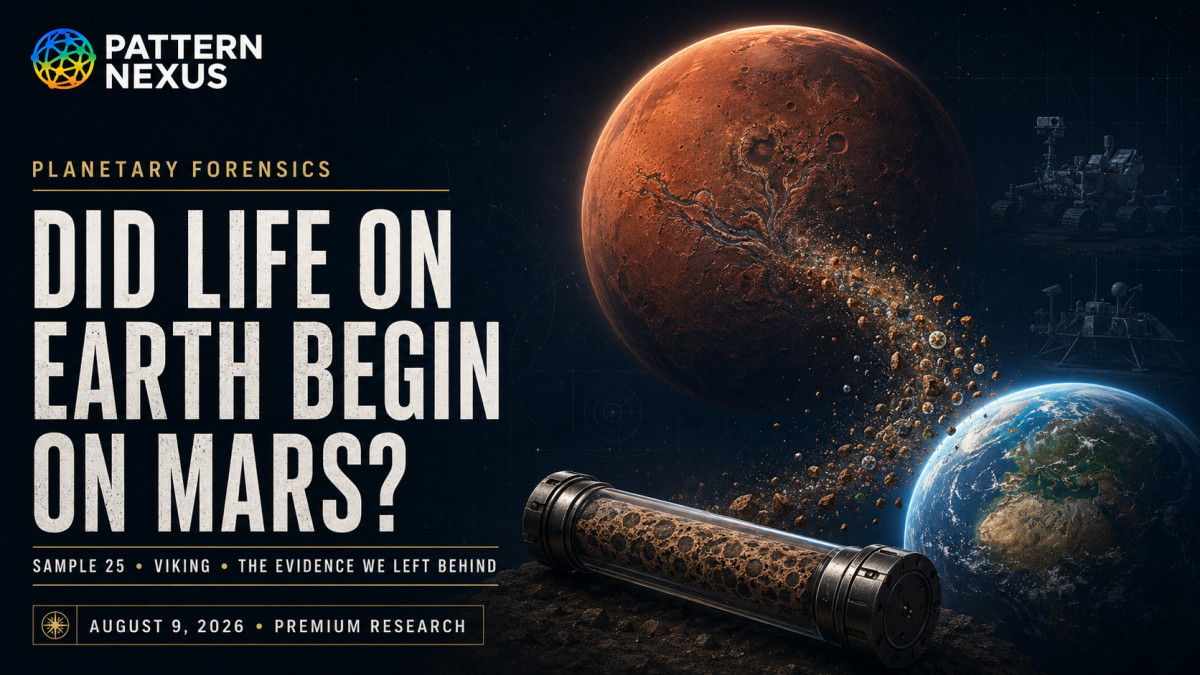
Mars is no longer a dead-world story. It is an evidence-return problem.
- Sample 25 is real, sealed and still on Mars. Perseverance collected the 6.2-centimeter Sapphire Canyon core from the vein-filled rock Cheyava Falls on July 21, 2024. It is the mission's 25th overall sample and remains inside the rover.[2]
- The rock contains a potential biosignature—not proof of life. Its fine-grained mudstone holds organic carbon, sulfur, phosphorus and iron-bearing reaction fronts. The leopard-spot minerals are consistent with redox reactions that microbes can exploit, but nonbiological pathways have not been eliminated.[3]
- The 2026 update strengthened the preservation case. Researchers reported spatially distributed complex organic matter in the same Bright Angel formation. Curiosity separately found the most chemically diverse set of Martian organics yet, including seven carbon-bearing molecules never previously detected on Mars.[4][5]
- Viking is not settled in the simple way most people were taught. A 2025 reassessment showed how perchlorate chemistry and radiation-generated oxidants can reproduce key responses without life. A 2026 counter-analysis argued that one carbon-assimilation result still resists that closure. The experiments remain historically important and scientifically disputed; they did not prove life.[14][15]
- Mars-to-Earth transfer is physically plausible. Martian meteorites prove that rocks cross between the planets. Models and meteorite-temperature studies show that shielded microbes could survive some ejection and transit conditions. That establishes a route, not an origin story.[18][19]
- My view: the most important live hypothesis is no longer only that Mars once hosted life. It is that early Mars may have been a biological upstream node and Earth the world where that biology found continuity. The timeline allows the idea. It does not yet prove it.
- The institutional contradiction is the center of the story. NASA's own current page now describes Mars Sample Return as a plan that was proposed. Fiscal 2026 appropriations did not fund it. The highest-value sample is therefore scientifically compelling but logistically stranded.[6][8]
- China is building a different return rail. Tianwen-3 is planned for launch around 2028 and return around 2030–31. It would collect at its own landing site—not retrieve Perseverance's Sample 25.[9]
- NASA really is testing a new Mars transport architecture in 2028, but it is not a 45-day crew flight. Space Reactor-1 Freedom is a nuclear-electric demonstration scheduled for late 2028, with a first Mars flyby in 2029 and delivery of three SkyFall helicopters in 2030. It is an efficiency, cargo, power and continuity rail.[10][11]
- The wider pattern extends beyond Mars. Europa, Enceladus and Titan each preserve different pieces of the habitability stack. Venus remains a chemistry and climate question. None is confirmed to host life. All make a life-only-on-Earth assumption harder to defend as a default.
- Planets are normal. NASA's exoplanet archive listed 6,336 confirmed worlds on August 6, 2026, and Kepler established that planets outnumber stars in the Milky Way. Common planets do not prove common life, but they transform the prior probability problem.[29][30]
This report does not treat Sample 25, Viking, subsurface water, propulsion, Mars Sample Return, Tianwen-3, Rosalind Franklin, Europa, Enceladus, Titan, Venus and exoplanets as disconnected headlines. It maps the full operating system: evidence, alternative explanations, sample custody, mission power, mobility, communications, budgets, national competition and the threshold required to move from “interesting” to “life.”
The primer video correctly locates the institutional failure: the sample became more important as the architecture to retrieve it weakened. Pattern Nexus extends that frame backward to Viking, forward to the 2028–2034 mission stack, and outward to the larger question of whether life emerged repeatedly—or moved between worlds.
The evidence stack is strengthening faster than the return rail
The public question is usually asked too early: did NASA find life on Mars? The correct first question is what layer of evidence we actually possess. Perseverance found ancient sediment, organics, redox-active minerals and small-scale textures arranged in a context that could preserve microbial activity. That is more than a strange spot and less than a cell.
The second question is whether the strongest nonbiological explanations survive laboratory testing. That requires the sample. The instruments on Perseverance are extraordinary, but they are not terrestrial synchrotrons, isotope laboratories, electron microscopes or clean-room biology facilities. Sample 25 was collected precisely because the decision-quality analysis happens on Earth.
The third question is structural: can the sample cross the rail? Mars Sample Return became a cost, schedule and architecture failure just as Cheyava Falls moved to the center of the astrobiology case. NASA did not lose the science. It lost the funded chain linking rover, sample retrieval, launch from Mars, orbital capture, Earth return and secure laboratory custody.
That is the Pattern Nexus signal. Discovery is not only measurement. Discovery is measurement plus retrieval, power, mobility, communications, custody, capital and institutional continuity. When any one of those rails breaks, the evidence can exist without becoming knowledge.
Mars may have been ready first. Earth may simply have lasted.
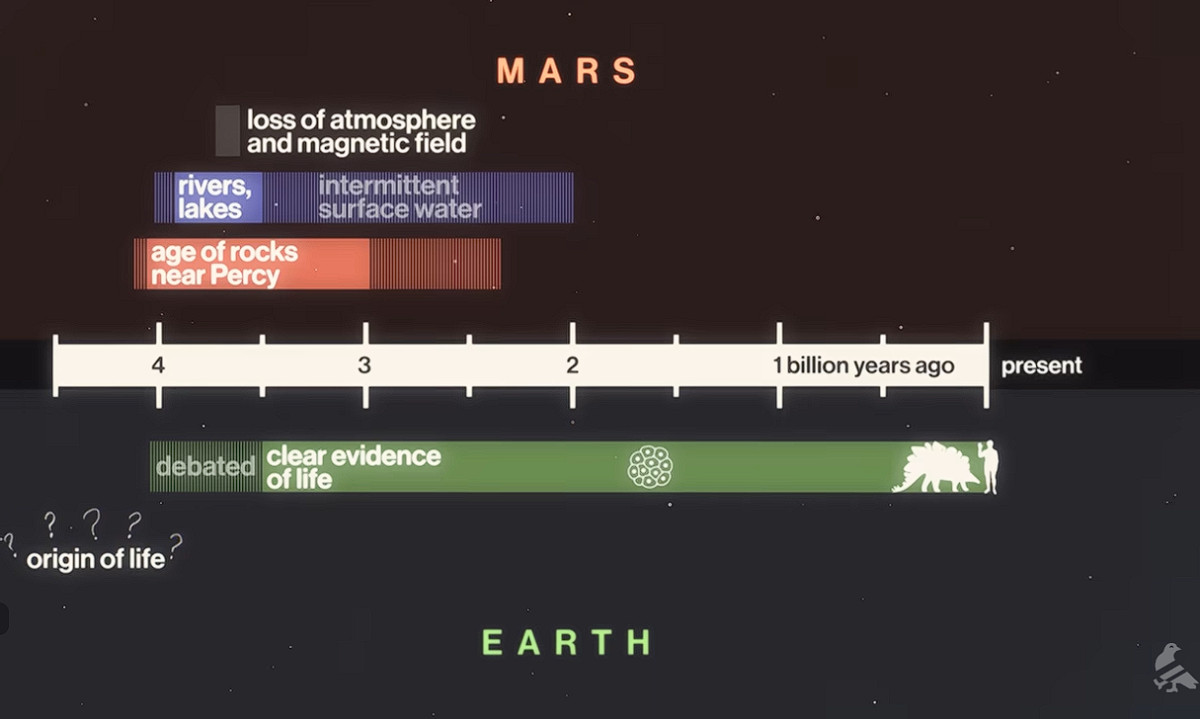
The supplied image compresses two planetary histories onto the same four-billion-year line. Above the line, early Mars has rivers and lakes, then intermittent surface water, while its global magnetic field and thick atmosphere disappear. The age band for rocks around Perseverance occupies that ancient wet interval. Below the line, Earth's first evidence of life emerges in the same deep-time neighborhood and then expands toward the complex biosphere we know.
The visual creates a legitimate question: if Mars had stable surface water, chemical energy and habitable environments early—possibly before Earth settled after its violent formation—could biology have emerged there first? Impacts routinely eject Martian rock into space. Some of that rock reaches Earth. The transport rail existed before humans built one.
But the chart can also seduce. Its bars are broad reconstructions, not exact appointments on a calendar. The oldest terrestrial biosignatures remain debated, crustal preservation is uneven, and “habitable” does not mean “inhabited.” A temporal overlap shows opportunity. It does not show ancestry or direction.
Mars as source world
Life begins during an early wet interval, then rides impact-ejected rock to Earth before the Martian surface collapses.
Earth as source world
Life begins here and reaches Mars through the reverse transfer channel, which models generally find less frequent but not impossible.
Independent origins
Both planets generate life separately. This would be the strongest evidence that biology is a common planetary outcome.
No Martian biology
Mars remains a geochemical false-positive laboratory: habitable in places, chemically rich, but never alive.
My own weighting is that the Mars-upstream hypothesis deserves more attention than it receives—not because the evidence has crossed into proof, but because the timing, transfer physics and preservation asymmetry form a coherent testable pattern. Mars may have started first and failed. Earth may have inherited something and retained the operating conditions required for complexity.
A biosignature is a claim about exclusion, not excitement
Space coverage fails in two directions. Institutional language can become so cautious that the public misses the significance. Media language can become so excited that a potential biosignature becomes “aliens” before the chemistry is finished. Both destroy the evidence hierarchy.
| Layer | What we have | What it means |
|---|---|---|
| Observation | Ancient delta and river deposits, clay-rich mudstone, organics, sulfur, phosphorus, iron minerals, reaction fronts and textures. | These are measured features and geological context. |
| Interpretation | Some features resemble products of microbial redox metabolism and preservation on Earth. | Biology is one plausible cause. |
| Alternative | Abiotic reactions involving heat, acidic fluids or catalytic organics may create overlapping mineral patterns. | The null hypothesis remains alive even if the obvious heat and acid signatures are absent. |
| Confirmation | Correlated isotope fractionation, unambiguous cellular structures, molecular handedness, repeating biological polymers or multiple independent biosignatures in context. | This is the decision layer that likely requires returned samples. |
The primer video makes the correct systems point: Sample 25 is not a conclusion that ran out of publicity. It is a question that ran into an institutional and financial boundary. The science now waits behind the logistics.
Cheyava Falls is the strongest case because the clues are organized
Perseverance encountered Cheyava Falls in the Bright Angel formation of Neretva Vallis, an ancient river valley that once carried water into Jezero crater. The rover abraded the rock, analyzed it with multiple instruments and extracted a core named Sapphire Canyon. NASA lists it as Sample 25, sealed on mission sol 1,215—July 21, 2024—and still carried inside Perseverance.[2]
The numbering causes confusion. Sapphire Canyon was the rover's 22nd rock core but the 25th overall sample because the campaign also includes regolith, atmospheric and witness tubes. “Sample 25” is therefore not a ranking and not a secret designation. It is the sample inventory number.
What matters is the arrangement. The host rock is fine-grained sediment capable of preserving chemical gradients. It contains organic carbon alongside sulfur, oxidized iron and phosphorus. White calcium-sulfate veins record water movement. Millimeter-scale “poppy seed” and larger “leopard spot” features show reaction fronts rimmed with iron-bearing phases. The leading mineral identifications include vivianite, an iron phosphate, and greigite, an iron sulfide.[3]
On Earth, microbes can drive reactions that reduce sulfate and transform iron, producing spatially linked mineral and organic patterns. That is why NASA uses the phrase potential biosignature. The pattern is not merely that organics exist. Meteorites, hydrothermal systems and atmospheric chemistry can make organics. The importance is that energy-bearing chemistry, sedimentary preservation and micro-scale organization converge in one ancient environment.
The alternative pathways remain serious. High temperature, strongly acidic fluids or reactions catalyzed by organic compounds can generate some of the same minerals without life. The published team did not find evidence that this rock experienced the required high heat or acid, which weakens those versions of the null. It does not eliminate every abiotic route. Absence of a known sterilizing pathway is not the same as presence of biology.
There is another implication. Bright Angel appears younger than some of the older crater-floor units where scientists first expected to find the best habitable record. If the interpretation holds, Mars may have retained local habitable environments later than the simplest global-death timeline suggests. Planetary collapse may have been a long retreat through refuges, not a single switch.
Perseverance and Curiosity are seeing a richer carbon record
In June 2026, the Bright Angel science moved beyond a single striking rock. A Science Advances study reported heterogeneous, spatially distributed complex organic matter across ancient mudstones in Neretva Vallis. That result does not identify a biological source. It strengthens the claim that ancient Martian sediments can preserve chemically complex carbon in the same formation that contains Cheyava Falls.[4]
Curiosity added a separate line of evidence in Gale crater. In April 2026, NASA reported 21 carbon-containing molecules from the Mary Anning 3 drill sample, including seven never previously detected on Mars. The set included a nitrogen-bearing ring compound from a chemical family relevant to nucleic-acid precursors and benzothiophene, a sulfur-containing aromatic molecule. The origin can be biological or geological. The importance is molecular diversity and preservation.[5]
This builds on Curiosity's 2025 detection of decane, undecane and dodecane—the largest organic molecules then identified on Mars. Longer and more varied molecules mean the destructive Martian surface environment has not erased every ancient carbon system. The record is degraded, not empty.
Perseverance
Maps organics and mineral reaction fronts in a former river valley, then caches the physical core for Earth laboratories.
Curiosity
Heats drilled samples and identifies an increasingly diverse inventory of preserved carbon chemistry in Gale crater.
Rosalind Franklin
Planned to drill as deep as two meters, below the most radiation-damaged layer, and analyze samples with its MOMA laboratory after a 2028 launch.[28]
The convergence is not “three missions found life.” It is more disciplined: multiple sites, instruments and mineral settings now show that Mars carried and preserved complex organic chemistry. That raises the expected value of going deeper and bringing material home.
Mars did not begin dead. It lost the rails that kept water stable.
The old picture of Mars as an eternally dry desert is gone. Valleys, deltas, lakebeds and minerals formed in liquid water show that ancient Mars supported rivers and standing bodies of water. The modern question is not whether water once moved across the surface. It is how long the habitable intervals lasted, how connected they were and whether the subsurface kept them after the surface failed.
Mars's smaller size made the system fragile. Its interior cooled, the global magnetic dynamo shut down, and the atmosphere became exposed to the solar wind. MAVEN measured the modern escape processes and in 2025 made the first direct observation at Mars of atmospheric sputtering—energetic particles knocking atmospheric atoms away. Over deep time, the pressure fell until stable surface liquid water became difficult.[21]
The blue Martian sunset covered earlier by Pattern Nexus is a visible remnant of that collapse. Fine dust scatters light differently from Earth's thick atmosphere, concentrating blue light near the Sun while the wider sky appears red. The beauty is forensic. We are watching light pass through what remains of a failed atmospheric operating layer.
Water may not have left the planet entirely. An interpretation of InSight seismic data placed liquid water in fractured mid-crust roughly 10–20 kilometers below the lander, with a possible global-equivalent volume of one to two kilometers if the layer is representative. A later analysis showed that dry rock properties can also fit the seismic observations. The correct status is a debated geophysical inference—not a discovered global ocean.[22][23]
This distinction matters because the best present-day refuge would likely be underground, protected from radiation and extreme temperature swings. But a potentially wet crust is not an accessible biosphere. We still lack direct sampling at those depths.
Mars is therefore a planetary systems lesson. Habitability is not one resource. It is water, pressure, temperature, magnetic shielding, geochemical cycling and time. Lose enough of those rails and a world can move from open surface habitability to scattered refuges, then possibly to memory.
The 1976 experiment may have asked the right question with the wrong chemistry model
Viking carried the only dedicated in-situ life-detection package ever operated on Mars. Its Labeled Release experiment added radioactive nutrients to soil and detected rapid gas release. Gas Exchange looked for gases produced or consumed after wetting. Pyrolytic Release—also called Carbon Assimilation—tested whether soil incorporated labeled carbon. A gas chromatograph-mass spectrometer searched for organics.
The result was a split screen. The Labeled Release response looked metabolically suggestive and changed after heat sterilization. The other biology experiments were ambiguous or negative, and the GC-MS did not detect the expected organics. The institutional conclusion became that reactive soil chemistry, not biology, caused the signal.
Then Phoenix discovered perchlorate in Martian soil. That mattered because Viking's thermal analysis heated samples. Laboratory work later showed that heating perchlorate-bearing Atacama soil can destroy native organics while producing chloromethane and dichloromethane—the same class of compounds Viking treated as contamination. The absence of organics was no longer as clean as it first appeared.[16]
A 2025 Icarus reassessment by Christopher McKay, Richard Quinn and Carol Stoker used the post-Viking chemistry to build a stronger abiotic model. Perchlorate itself is not reactive enough at cold surface temperatures, but radiation can create hypochlorite and other oxidants. Those compounds can react quickly with nutrients and reproduce important features of the Viking responses. Their conclusion did not require life.[14]
A 2026 Astrobiology paper led by Steven Benner pushed back. It argued that the standard consensus still lacks a full quantitative explanation for the Carbon Assimilation result and proposed a BARSOOM biological model involving dormant autotrophic organisms, stored oxygen and brief access to brines or ice fog. That is a hypothesis. It has not displaced the abiotic interpretation or demonstrated Martian organisms.[15]
| Viking claim | Best current reading |
|---|---|
| “Viking proved life.” | Too strong. No independent biological signature closed the case, and oxidant chemistry can explain substantial parts of the response. |
| “Viking proved Mars sterile.” | Also too strong. The instrument chemistry, heating protocol, tiny samples and unknown perchlorate environment limited the negative inference. |
| “The old data are irrelevant.” | False. New environmental discoveries change how legacy measurements should be interpreted and how future experiments should be designed. |
Gilbert Levin, who led Labeled Release, argued for decades that Viking detected life. His argument remains part of the record, not the consensus.[17] The durable lesson is more valuable than either slogan: an experiment can be technically successful and scientifically underdetermined when the environment contains chemistry the designers did not know existed.
Could life on Earth have come from Mars?
There is a version of panspermia that requires no spacecraft, no intelligent intervention and no exotic physics. A large impact hits early Mars. Rock is accelerated beyond Martian escape velocity. Microbes or prebiotic systems survive inside shielded pores. A fraction of the ejecta intersects Earth. A tiny fraction lands without being sterilized. If the cargo finds a compatible environment, the biological lineage continues here.
Every link in that chain has some physical support. We possess Martian meteorites. Shock experiments and orbital models show that material can escape Mars and reach Earth. Modeling by Mileikowsky and colleagues found viable Mars-to-Earth transfer possible under a range of shielding, transit-time and survival assumptions. Study of the Martian meteorite ALH84001 found portions that apparently never exceeded about 40°C since leaving Mars, demonstrating that ejection and arrival do not automatically sterilize the entire rock.[18][19]
Early Mars may also have offered useful origin-of-life settings while Earth was still being reworked by giant impacts. A 2021 review argued that Mars had many of the needed ingredients and environments and may, in some respects, have offered an earlier or better-preserved window for prebiotic chemistry.[20]
None of this establishes that the transfer happened. Feasibility is not history. A Martian microbe would have to survive ejection shock, radiation, vacuum, transit and atmospheric entry. The arrival rate of viable material is uncertain, and the oldest Earth record is incomplete. Most importantly, if Earth and Mars life shared the same basic molecular system, common ancestry would not by itself reveal which planet was the birthplace.
The most scientifically disruptive outcome may not be shared ancestry. It may be a second genesis. If Mars life used different informational polymers, different molecular handedness or a biochemical architecture unrelated to terrestrial life, the sample would show that life emerged twice in one small planetary system. That would make a populated universe far more likely.
We built the vault before we funded the door
Perseverance was not designed only to inspect Mars. It was designed to begin a chain. The rover would select, document, core and seal samples. A later lander would retrieve them, launch them from Mars, transfer the container in orbit and return it to a secure Earth facility. Each tube is therefore part science instrument and part custody object.
The chain became overloaded by cost and complexity. NASA's inspector general documented estimates that moved from an early $2.5–$3 billion concept toward a $7.4 billion internal estimate, with independent reviews warning of costs approaching $11 billion and return slipping toward 2040 under the prior architecture.[7] NASA sought commercial and alternative designs, but the 2026 fiscal structure did not rescue the campaign.
The agency's current mission page now uses the past tense: Mars Sample Return “was a plan” and “was a proposed multi-mission campaign.” The administration's FY2026 budget request called the program financially unsustainable, and NASA's April 2026 report states that final FY2026 appropriations did not include funding for it.[6][8]
That does not mean the samples were thrown away. Perseverance carries the primary set, including Sample 25, and previously deposited a backup cache at Three Forks. It means the retrieval, ascent, rendezvous and Earth-return chain does not presently have an approved funded path.
This is the exact opposite of the way the headline is usually framed. We did not run out of evidence. We ran out of architecture. The constraint is no longer whether a rover can find an important rock. The constraint is whether institutions can maintain a multi-decade program across cost growth, changing administrations, planetary-protection rules, contractor boundaries and competing exploration priorities.
China's Tianwen-3 changes the clock—but not Sample 25's custody
China plans to launch Tianwen-3 around 2028, use two launches, collect at least 500 grams with surface scooping and a drill reaching roughly two meters, and return material around 2030–31. Public descriptions also include a drone for site investigation. The mission's primary scientific goal is the search for signs of life.[9]
Tianwen-3 is strategically important because the first successful Mars sample return will set laboratory, planetary-protection and public-narrative precedents. But it is not currently designed to collect Perseverance's tubes. A sample from China's landing site could transform Mars science while Cheyava Falls remains inside an American rover.
| Program | Sample target | Current status | Pattern Nexus reading |
|---|---|---|---|
| NASA/ESA MSR | Perseverance's curated Jezero cores, including Sample 25. | Not funded in FY2026; prior architecture discontinued. | Highest-context sample set; broken transport chain. |
| Tianwen-3 | New material collected at China's own landing site. | Planned launch around 2028; return around 2030–31. | Simpler, faster national rail; different scientific asset. |
| Rosalind Franklin | Fresh subsurface material analyzed on Mars. | ESA launch window October–December 2028; Mars arrival expected in 2030. | Depth rail improves preservation access without Earth return. |
A complete strategy should not force a false choice between those paths. Returned samples provide laboratory depth. Deep drilling reaches protected material. Aerial scouts widen access. Orbiters provide relay and mapping. The system becomes resilient only when the rails reinforce one another.
NASA is testing a nuclear-electric Mars rail—not a 45-day shortcut
The real 2028 mission is Space Reactor-1 Freedom. NASA describes it as the first fission-powered interplanetary spacecraft and a flight demonstration of nuclear-electric propulsion. The current schedule calls for launch in late 2028, a first Mars flyby in 2029 and a second approach in fall 2030, when it would release three SkyFall helicopters.[10]
The spacecraft is designed around a compact HALEU-fueled reactor, a closed-Brayton power conversion system producing about 20 kilowatts of electricity, a roughly 48-kilowatt spacecraft bus and a 12-kilowatt Hall thruster. The full vehicle is expected to mass about 12,000 kilograms. Nuclear power supplies continuous electricity far from the Sun; electric propulsion turns that electricity into extremely efficient low-thrust acceleration.
SkyFall is the operational payload. The three rotorcraft would separate during the 2030 approach and deploy in midair, extending the drone layer opened by Ingenuity. Ground-penetrating radar would map ice approximately 0.5 to 3 meters below the surface while cameras and meteorological and radiation instruments characterize candidate terrain.[11]
This is faster in the architectural sense: less propellant for deep-space movement, longer operational reach, sustained onboard power and new delivery options. It is not a direct high-thrust sprint carrying humans from Earth to Mars in 45 days. The mission itself takes multiple years and uses flybys to demonstrate the system.
Three propulsion stories are being collapsed into one headline
| System | Thrust profile | Advantage | 2028 reality |
|---|---|---|---|
| Nuclear thermal propulsion | High thrust; reactor heats propellant directly. | Roughly twice the propellant efficiency of conventional chemical propulsion and potentially shorter crew transit. | NASA technology line, but not the SR-1 flight architecture. |
| Nuclear electric / SR-1 | Very efficient, low continuous thrust. | Cargo, power continuity, long-duration maneuvering and reduced propellant demand. | The planned late-2028 interplanetary demonstration. |
| Lithium-fed MPD thruster | High-power electric propulsion. | Potentially far higher power for cargo and eventually crew-class electric systems. | Ground test reached 120 kilowatts in February 2026; separate from SR-1 and not a 2028 flight. |
| “45 days to Mars” | Concept-dependent and usually requires extreme power, favorable geometry or speculative assumptions. | Useful target for reducing crew radiation and life-support exposure. | Not the schedule or demonstrated capability of NASA's 2028 Mars mission. |
NASA's February 2026 lithium-fed magnetoplasmadynamic test matters because it reached 120 kilowatts, the highest electric-propulsion test power reported in the United States, while the longer program aims at 500-kilowatt to one-megawatt thrusters. NASA estimates a crew-scale electric architecture could require two to four megawatts and more than 23,000 hours of thruster life. The propulsion promise is real; the scale-up burden is equally real.[12]
The correct Pattern Nexus reading is not “NASA solved Mars travel.” It is that power and propulsion are beginning to merge. Once a reactor supplies both movement and useful electrical power, the spacecraft becomes more than transport. It becomes a mobile utility node.
The latest Mars news is one connected record: age, water, autonomy and relay
The major 2026 updates do not all concern life directly. Together they improve the map of when Mars was habitable, how its surface changed and whether robotic systems can operate with less dependence on Earth.
| Date | Update | Why it matters |
|---|---|---|
| January 30 | First AI-planned drive on another world. Generative AI produced Perseverance routes executed on December 8 and 10, 2025, covering 210 and 246 meters after human and digital-twin verification. | Mars operations are moving from teleoperation toward supervised autonomy, reducing the communications-delay bottleneck.[26] |
| February 18 | Mars Global Localization. Perseverance began autonomously matching surface observations to orbital maps to determine its position. | Localization is a reusable navigation rail for rovers, helicopters and eventually human surface systems.[27] |
| April 21 | Curiosity's new organic inventory. Twenty-one carbon-containing molecules, seven new to Mars detection. | The preserved Martian carbon record is chemically richer than the old sterile-soil picture allowed. |
| April 27 | Two sides of Mars panoramas. Curiosity and Perseverance documented very different terrains and atmospheric conditions. | Mars is not one uniform site. Local geology determines what evidence can survive and what a rover can access. |
| June 3 | MAVEN mission ended. NASA declared the orbiter unrecoverable after contact was lost December 6, 2025. | A major atmosphere laboratory and relay asset was lost, while Odyssey, Mars Express, MRO and TGO absorbed the communications load.[25] |
| June 26 | Complex organics across Bright Angel. The Cheyava Falls environment became a distributed formation-level result. | Preservation is not confined to one photogenic spot. |
| July 15 | Broom Point impact record. Perseverance read repeated impacts in terrain older than 3.9 billion years and sampled Bell Island and Main River. | Returned cores could date early bombardment and constrain the timeline when habitability and transfer were most active.[24] |
| July 29 | Curiosity's honeycomb field. A broad landscape of polygonal textures may record mud cracking, thermal cycling or dewatering; formation remains unresolved. | The terrain may preserve repeated wet-dry or warm-cold processes relevant to chemical concentration and habitability.[25a] |
| August 5 | Earth vanished behind Phobos. Perseverance recorded the July 2 occultation of Earth by Mars's inner moon. | Scientifically modest, operationally revealing: a functioning observatory on another planet now watches the world that commands it.[27a] |
The pattern is continuity under delay. AI plans routes. Onboard localization reduces dependence on Earth. Orbiters move the data. Nuclear-electric transport and rotorcraft widen future range. At the same time, one failed relay asset or one unfunded return program exposes how thin the architecture remains.
The life question will be answered by infrastructure
Mars science is often narrated instrument by instrument. Pattern Nexus reads it rail by rail. A biosignature does not become knowledge when a camera sees it. It becomes knowledge when an integrated system can reach the site, preserve context, run complementary measurements, move data, return material and keep the program alive long enough for independent verification.
Power rail
Radioisotope systems keep Curiosity and Perseverance operating; future fission systems could supply propulsion, science and surface utilities.
Mobility rail
Rovers provide contact science. Helicopters cross hazards and map larger areas. Drills reach beneath radiation damage.
Autonomy rail
AI route planning and global localization reduce the cost of the Earth-Mars communications delay.
Relay rail
Orbiters are the invisible network layer. MAVEN's loss matters because surface science depends on orbital continuity.
Custody rail
Documentation, sealing, contamination control, planetary protection and secure laboratories turn a rock into defensible evidence.
Capital rail
Multi-decade missions require political and budget continuity. The science fails institutionally when the appropriations chain breaks.
The present asymmetry is stark. Mobility, onboard autonomy and power are advancing. The return and custody rail regressed. That means humanity can find more important material while becoming less able to complete the strongest laboratory test.
Earlier Pattern Nexus work argued that Mars drones were not a novelty and nuclear missions were not isolated hardware stories. They were layers of an off-world operating system. The 2026 evidence confirms that frame. The next Mars era will be defined by whether those layers become interoperable.
Mars is not the only live node in our own Solar System
I do not think the intellectually serious default should be that Earth is the only living place until another world produces a waving organism. The disciplined position is narrower: no extraterrestrial life has been confirmed, but multiple worlds contain water, energy gradients, organic chemistry or protected environments that make biology plausible enough to investigate.
| World | Habitability stack | What is missing | Next rail |
|---|---|---|---|
| Mars | Ancient rivers and lakes, sedimentary preservation, organics, redox minerals, potential deep water. | Abiotic exclusion and laboratory-grade sample analysis. | Returned cores, two-meter drilling, ice mapping. |
| Europa | Global salty ocean, likely more than twice Earth's ocean volume, tidal energy and possible water-rock interaction. | Ocean chemistry, accessible exchange pathways and direct biological evidence. | Europa Clipper arrives in 2030 for 49 planned flybys; it assesses habitability, not life directly.[31] |
| Enceladus | Accessible plumes from a subsurface ocean containing salts, organics and phosphorus. | A dedicated life-detection mission with contamination controls and stronger molecular resolution. | Future plume sampling; Cassini supplied the foundation.[32] |
| Titan | Dense atmosphere, complex organics, methane cycle and possible subsurface water ocean. | Whether the chemistry crosses into biology under Titan conditions. | Dragonfly launches no earlier than July 2028 and is expected in late 2034; it studies habitability and chemistry, not direct life detection.[33] |
| Venus | A temperate cloud-altitude layer, active chemistry and a past that may have included surface water. | Contested phosphine and oxygen interpretations have not established life; cloud acidity and water scarcity are severe. | DAVINCI and other atmospheric investigations must resolve chemistry before biology.[34] |
Europa and Enceladus may be inhabited yet hard to access. Titan may show a second chemical route toward complexity. Venus may be a false-biosignature factory that teaches us how easily atmospheric chemistry can imitate life. Mars is uniquely valuable because its ancient surface record is exposed and reachable, and because material transfer connects its history to ours.
Planets are the rule, not the exception
As of August 6, 2026, NASA's Exoplanet Archive listed 6,336 confirmed planets and thousands more candidates. Kepler's statistical legacy is larger than the catalog: planets outnumber stars in the Milky Way. Estimates suggest a substantial fraction of Sun-like stars could host rocky planets in their habitable zones, although that number depends on atmosphere, orbit, stellar behavior and the definition of “habitable.”[29][30]
That does not let us multiply planets by optimism and call the result life. It changes the architecture of the question. When planets were imagined as rare, Earth could be treated as an extreme exception before the evidence arrived. Now the raw platforms are common. The remaining unknowns are how often chemistry crosses into self-replication, how often life survives planetary instability and how often intelligence builds a durable technical layer.
My view is that life likely exists in more than one place in this Solar System and in many places beyond it. The evidence has not earned a list of inhabited worlds. It has earned a research posture that expects multiple opportunities instead of designing every inference around terrestrial uniqueness.
What would actually move Mars from potential biosignature to life?
No single measurement is guaranteed to settle the question. Life modifies several systems at once. The strongest case would therefore be a correlated bundle that an abiotic model cannot reproduce under the sample's known history.
| Finding | Signal strength | What could still imitate it |
|---|---|---|
| More organic molecules | Necessary context, weak alone. | Meteorites, hydrothermal synthesis and atmospheric chemistry. |
| Cell-like shapes | Suggestive in context. | Mineral growth, fractures and imaging artifacts. |
| Carbon, sulfur or iron isotope fractionation | Strong if multiple isotope systems align with the mineral context. | Some nonbiological kinetic and hydrothermal processes. |
| Consistent molecular handedness | Potentially strong, especially with complex polymers. | Contamination and some asymmetric physical processes. |
| Repeating informational polymers or metabolism in a protected sample | Transformative. | The main fight becomes contamination and chain of custody. |
| A biochemical system independent of Earth's | Second genesis; one of the largest discoveries in science. | Extraordinary contamination scenarios would still require exclusion. |
The Mars-origin hypothesis adds another test. Shared chirality, genetic machinery and core biochemistry could indicate common ancestry—but terrestrial contamination would be the first adversary. A demonstrably ancient Martian lineage nested deeper than the last universal common ancestor, combined with geological dating and impeccable custody, would be much stronger. Even then, direction could remain difficult.
The null is also falsifiable. If returned Bright Angel material shows that the leopard spots formed through a reproducible abiotic reaction under the measured temperature, fluid and radiation history—and if the organics are meteoritic or geochemical—the Sample 25 biological interpretation weakens sharply. That would still be major science. Mars would become the best known laboratory for how dead chemistry imitates life.
What to watch from now through 2034
- Sample 25 custody: whether NASA, Congress, ESA or a commercial architecture restores a funded path for Perseverance's samples rather than leaving the campaign in indefinite storage.
- Independent Bright Angel analysis: laboratory simulations that reproduce—or fail to reproduce—the vivianite/greigite reaction fronts under plausible abiotic Martian conditions.
- Curiosity's honeycomb terrain: whether the polygons resolve into mud cracks, freeze-thaw cycling, dewatering or another process, and whether organics concentrate within them.
- Rosalind Franklin: launch in the October–December 2028 window, successful landing in 2030 and two-meter drilling below the radiation-damaged surface.
- Tianwen-3: final landing-site selection, contamination controls, launch around 2028 and return around 2030–31.
- Space Reactor-1 and SkyFall: whether late-2028 launch holds, the reactor and Hall thruster operate across interplanetary space, and the helicopters deploy in 2030.
- Relay resilience: replacement planning as Odyssey and Mars Reconnaissance Orbiter age, with Mars Express and Trace Gas Orbiter carrying critical communications.
- Europa Clipper: arrival in April 2030 and early flyby measurements of ice-shell thickness, composition, ocean exchange and plume candidates.
- Dragonfly: the no-earlier-than-July-2028 launch and the long flight toward Titan in late 2034.
- Venus chemistry: in-situ measurements that can separate photochemistry, volcanism and cloud microphysics from biological interpretations.
The calendar reveals an unusual concentration. Around 2028, the United States, Europe and China intend to launch systems that test propulsion, aerial mobility, deep drilling, sample return and outer-Solar-System habitability. The end of this decade is not just a mission cycle. It is a competition among discovery architectures.
The questions that need clean answers
Did Perseverance find life on Mars?
No. It found a potential biosignature in Cheyava Falls: a combination of organics, minerals, sedimentary context and reaction textures that could be biological but can still have nonbiological explanations.
What exactly is Sample 25?
Sample 25 is the 6.2-centimeter Sapphire Canyon rock core collected from Cheyava Falls on July 21, 2024. It is the 25th overall sample in Perseverance's inventory and remains sealed inside the rover.
Why can't Perseverance finish the analysis?
The rover can map chemistry and mineralogy but cannot perform the full range of high-resolution isotope, microscopy and molecular analyses available in Earth laboratories. Those tests—and independent replication—were the reason for sample return.
Did Viking find life in 1976?
Viking produced a life-like Labeled Release response, but the full experiment set did not establish biology. Perchlorate and radiation-driven oxidant chemistry now offer stronger abiotic explanations, while a 2026 counter-model argues that at least one result remains insufficiently explained. The case is unresolved at the interpretation layer, not confirmed at the life layer.
Could life on Earth have begun on Mars?
Yes as a physical possibility, not as an established history. Martian rocks reach Earth, and some material can avoid sterilizing temperatures. Early Mars may have been habitable before or alongside the earliest terrestrial record. No evidence yet shows that biology made the trip or that Mars was the source.
Is NASA testing a 45-day trip to Mars in 2028?
No. NASA plans a late-2028 nuclear-electric demonstration called Space Reactor-1 Freedom. It is designed to fly by Mars in 2029 and deliver SkyFall helicopters in 2030. Nuclear-electric propulsion improves efficiency and power continuity but produces low thrust; it is not a demonstrated 45-day crew architecture.
Will China's Tianwen-3 retrieve Sample 25?
Not under the announced plan. Tianwen-3 would collect new material at its own landing site and return it around 2030–31. Perseverance's tubes would remain a separate asset unless a future mission or agreement changes the architecture.
Do we know that life exists elsewhere in the Solar System?
No. Mars has potential biosignatures; Europa and Enceladus have subsurface oceans; Titan has complex organic chemistry; Venus has disputed atmospheric signals. These are strong investigation targets, not confirmed inhabited worlds.
Does finding planets around most stars mean life is common?
It means the planetary platforms are common. It does not tell us how often life begins, survives or becomes complex. Exoplanet statistics remove one bottleneck from the probability chain while leaving the biological steps unresolved.
Mars may be the source file, Earth the surviving copy
The old Mars story was simple because it was distant. A red desert. A failed planet. Interesting geology. No life. That story no longer survives contact with the full record.
We now have ancient rivers, deltas and lakes. We have complex organic matter in multiple sedimentary environments. We have a rock containing organic carbon, sulfur, phosphorus, iron reaction fronts and mineral patterns that may preserve microbial chemistry. We have Viking data that became harder to dismiss once perchlorate revealed that the original instrument could destroy the organics it was supposed to find. We have meteorites proving a natural transfer route between Mars and Earth.
We also have to keep the evidence clean. Sample 25 is not a fossil announcement. Viking is not a solved life detection. Mid-crust water is not a discovered underground ocean. A 2028 nuclear-electric flight is not a 45-day human mission. Europa, Enceladus, Titan and Venus are not confirmed biospheres. The Pattern Nexus framework does not become stronger by inflating the claim.
It becomes stronger by connecting the right layers. Mars may have been habitable early. Material could move from Mars to Earth. Earth's earliest life appears while the Martian window was still open. Mars then lost its magnetic and atmospheric rails while Earth retained enough continuity for evolution to compound. That creates a coherent upstream hypothesis.
My view is that life exists beyond Earth and may exist in more than one place in this Solar System. I also think the possibility that terrestrial life began on Mars deserves direct testing. Those are judgments, not reported discoveries. The reported fact is that the evidence stack has become valuable enough that leaving the best sample on Mars is no longer a neutral outcome.
The deepest failure would not be that we looked and found nothing. It would be that we found the right rock, sealed it correctly, understood why it mattered—and allowed the return rail to disappear.
Mars may be a dead world now. It is not a dead question. It may be the earlier node in the only biological network we have ever known.
Primary mission records and peer-reviewed research
- [1] Primer used for the reporting question: Howtown, “We might have found aliens. Then we ran out of money,” published August 6, 2026. The CMS video URL is stored outside this HTML body.
- [2] NASA, Meet the Mars Samples: Sapphire Canyon, Sample 25, and Mars Rock Samples.
- [3] Hurowitz et al., “Redox-driven mineral and organic associations in Jezero crater, Mars”, Nature, 2025; NASA, potential biosignature announcement, September 10, 2025.
- [4] Murphy et al., “Spatially distributed complex organic matter detected in an ancient river valley in Jezero crater, Mars”, Science Advances, June 26, 2026.
- [5] NASA JPL, “NASA's Curiosity Finds Organic Molecules Never Seen Before on Mars”, April 21, 2026.
- [6] NASA, Mars Sample Return mission page, updated August 3, 2026.
- [7] NASA Office of Inspector General, “NASA's Readiness for the Mars Sample Return Mission”, February 28, 2024.
- [8] NASA, 2026 GAO-IG Act Report, April 2026; NASA, FY2026 budget release, May 2, 2025.
- [9] China National Space Administration, Tianwen-3 international cooperation announcement; State Council of China, Tianwen-3 mission profile, July 23, 2025.
- [10] NASA, Space Reactor-1 Freedom mission profile.
- [11] NASA, SkyFall mission profile.
- [12] NASA JPL, “NASA Fires Up Powerful Lithium-Fed Thruster for Trips to Mars”, April 28, 2026.
- [13] NASA, Space Nuclear Propulsion.
- [14] McKay, Quinn and Stoker, “The Viking biology experiments on Mars revisited”, Icarus, 2025.
- [15] Benner et al., “Viking Mars, Now 50 Years Old, Still Needs a Scientific Analysis”, Astrobiology, 2026.
- [16] Navarro-González et al., “Reanalysis of the Viking results suggests perchlorate and organics at midlatitudes on Mars”, Journal of Geophysical Research: Planets, 2010.
- [17] Levin and Straat, review of the Viking Labeled Release experiment and biological interpretation, Astrobiology.
- [18] Mileikowsky et al., “Natural transfer of viable microbes in space”, Icarus, 2000.
- [19] NASA Astrobiology, “Taking the Temperature of a Martian Meteorite”.
- [20] Clark et al., “Origin of Life on Mars: Suitability and Opportunities”, Life, 2021.
- [21] NASA, “NASA's MAVEN Makes First Observation of Atmospheric Sputtering at Mars”.
- [22] Wright et al., “Liquid water in the Martian mid-crust”, PNAS, 2024.
- [23] Manga and Wright, comment on nonunique water interpretation of InSight seismic data, PNAS, 2025.
- [24] NASA JPL, “NASA's Perseverance Rover Reads Record of Ancient Mars Impacts”, July 15, 2026.
- [25a] NASA JPL, “NASA's Curiosity Mars Rover Discovers Field of Honeycomb Textures”, July 29, 2026.
- [25] NASA, Mars Relay Network and MAVEN mission-end update, June 3, 2026.
- [26] NASA JPL, “NASA's Perseverance Rover Completes First AI-Planned Drive on Mars”, January 30, 2026.
- [27] NASA JPL, “NASA's Perseverance Now Autonomously Pinpoints Its Location on Mars”, February 18, 2026.
- [27a] NASA JPL, “NASA's Perseverance Rover Watches Earth Vanish Behind Martian Moon”, August 5, 2026.
- [28] ESA, ExoMars Rosalind Franklin rover; NASA Astrobiology, Rosalind Franklin mission profile.
- [29] NASA Exoplanet Archive, confirmed-planet counts, accessed August 6, 2026.
- [30] NASA, Exoplanet Facts; NASA, Sun-like-star habitable-planet estimate.
- [31] NASA, Europa Clipper mission profile.
- [32] NASA, phosphorus in Enceladus's ocean.
- [33] NASA, Dragonfly mission profile.
- [34] NASA, DAVINCI's Venus investigation.
Method and claim discipline
This report prioritizes mission pages, agency budget documents and peer-reviewed papers. The YouTube video supplied by the author is used as a narrative primer, not as the evidentiary authority for scientific claims. “Potential biosignature” follows NASA's usage and does not mean confirmed life. Mission dates are current plans as of August 9, 2026 and may change.
The article separates four layers: measured observation, scientific interpretation, unresolved hypothesis and author judgment. Statements that life may exist in several Solar System locations and that Mars may sit upstream of terrestrial biology are Christopher Grenke's interpretive position, not institutional findings.
What's Your Reaction?
 Like
0
Like
0
 Dislike
0
Dislike
0
 Love
0
Love
0
 Funny
0
Funny
0
 Wow
0
Wow
0
 Sad
0
Sad
0
 Angry
0
Angry
0

Founder of Pattern Nexus. I research markets, macro, geopolitics, AI, history, ancient systems, and the patterns most people overlook. I’m also building Market Radar, a trading scanner designed to read pressure, risk, confirmation, and setup quality before chasing a move. Pattern Nexus is where I connect the dots between data, history, technology, and the bigger system playing out around us.

Comments (0)