

The Day Care Scam Layer: When Billing Detaches From Reality
The daycare scam story is real, but it is bigger and more structural than one viral video. This Pattern Nexus article breaks down attendance fraud, weak controls, political theater, and the control-system gap underneath child care billing.
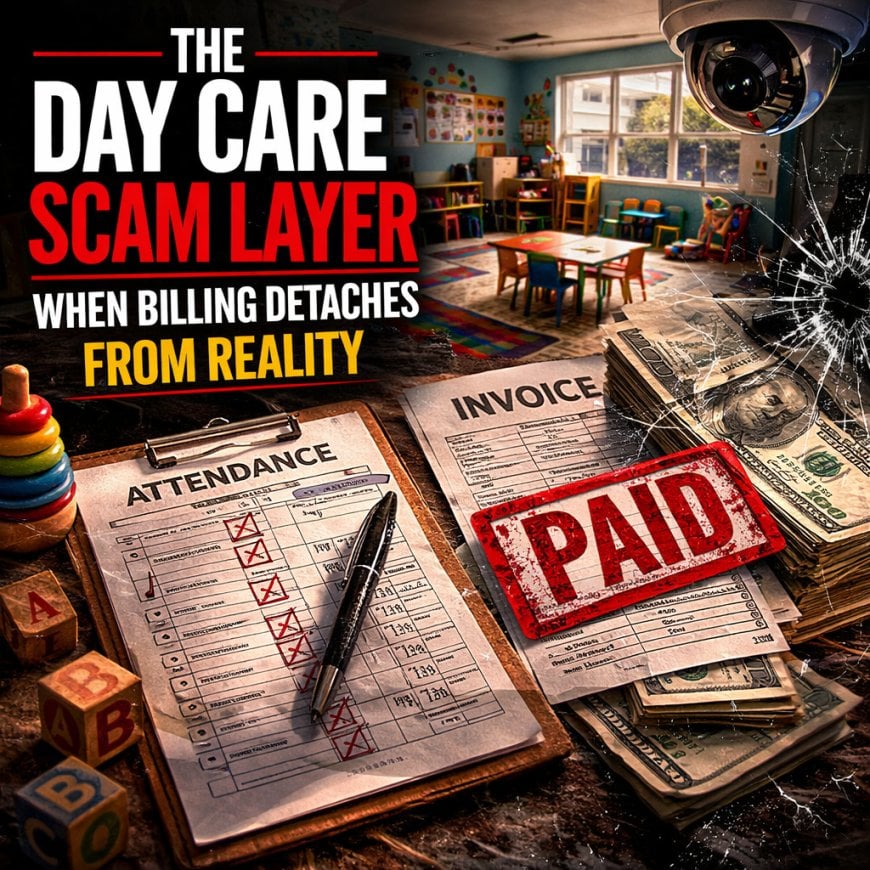
The daycare scam story is real, but it is bigger and more structural than one viral video. This Pattern Nexus article breaks down attendance fraud, weak controls, political theater, and the control-system gap underneath child care billing.
Jump to a section
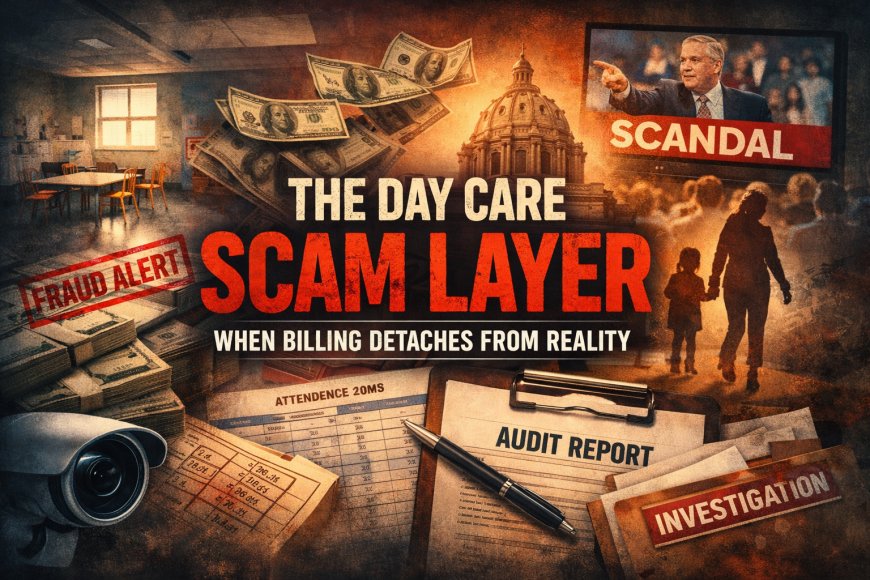

The daycare scam layer is not just about whether one center looked empty on camera. It is about a reimbursement structure that can become detached from physical reality when attendance controls are weak, oversight is slow, and large public funding streams move through systems that are easier to bill than to verify. That is why this is a real story. It is also why it is dangerous to reduce it to a single viral clip or a single political tribe. The real pattern is structural: once care becomes a billing interface, fraud pressure shows up wherever the paper trail can outrun the real-world service.
The core scam vector is not mystical. It is simple: billing claims detach from verified attendance, and the payment system keeps moving anyway.
The risk is not only fraud by providers. The risk is also political exploitation, selective narratives, and institutional responses that outrun verified facts.
Once child care turns into a reimbursement rail first and a verified service second, the system invites both theft and narrative warfare.
Yes, This Is Real — But Not Simple
Let’s get the obvious part out of the way first: yes, this is real.
The reason I say that directly is because too many people try to force every story into one of two lazy buckets. Either everything is a giant conspiracy, or everything is fake panic. That is not how the real world works. The real world is messier. There can be genuine fraud exposure, weak controls, bad incentives, and a broken reimbursement system all at the same time that political actors are also overstating, weaponizing, or selectively framing what is happening.
That is the lane this story sits in.
There is a real documented oversight problem in child care assistance billing. Federal auditors have already said Minnesota’s oversight of attendance documentation was limited enough that overpayments occurred. State legislative audits had been warning for years that the Child Care Assistance Program was vulnerable to fraud and weak controls. So the underlying vulnerability is not made up. It did not suddenly appear because one video went viral. The pressure was already there in the system.
At the same time, it is also true that not every allegation captured in a viral video has been proven. State regulators said nine centers highlighted in that video were operating as expected when they conducted on-site checks, with children present at eight of nine inspected sites and the ninth not yet open for the day. That matters, because fraud is not the same thing as “looked suspicious on one visit.” Suspicion is not proof. Empty optics are not enough by themselves.
But here is the bigger point: the story does not disappear just because every frame of a viral clip is not a courtroom exhibit. The fact that the control system is weak enough for the public to even believe the billing layer may be detached from the real service layer is itself part of the story.
Two things can be true at once: there are real documented fraud and overpayment vulnerabilities in child care reimbursement systems, and some of the loudest public allegations may still outrun what has been formally proven at specific sites.
How the Scam Layer Actually Works
The easiest way to understand this is to stop thinking emotionally about “day care” and start thinking mechanically about the billing chain.
In a legitimate system, a child is actually present, attendance is actually recorded, eligibility is actually valid, the provider actually delivers care, and the payment issued by the public program reflects that real-world service. In a compromised system, one or more of those links break. Attendance gets inflated. Sign-in records become unreliable. Billing is not reconciled tightly enough to what happened in the building. Oversight comes late. Referrals do not get pursued aggressively enough. The service layer and payment layer drift apart.
That is the scam layer.
It is not magic. It is a gap between claim and verification.
And once that gap exists at scale, the incentives get ugly very fast. If you can turn handwritten or weakly verified attendance into steady reimbursement, then the money is no longer tied cleanly to the real child-care event. It is tied to the paperwork and to the system’s willingness to keep accepting the paperwork. That is when public money stops behaving like care funding and starts behaving like an exploitable extraction rail.
That is also why lawmakers in Minnesota responded with proposals focused on things like perjury attestations, annual anti-fraud reporting, and video-monitoring requirements for large recipients. Whether those solutions are ultimately the best ones is a separate argument. The point is that the policy reaction itself tells you the vulnerability is real enough that lawmakers are trying to physically reconnect the billing layer back to the service layer.
In plain English: if you need cameras, stronger attestations, and tighter documentation just to trust whether children are actually present, then you already have a structural integrity problem.
The reason this gets especially explosive in child care is because the moral surface of the program is so sensitive. People hear “child care” and think children, working families, and basic support infrastructure. They should. But that is exactly why fraud inside these systems becomes politically radioactive. Abuse here is not just theft. It is theft routed through one of the most socially protected categories possible.
- Weak attendance verification creates room for inflated or unsupported billing.
- Slow investigations allow money to keep moving while cases are still being sorted out.
- Public trust collapses fast when the billing record no longer looks anchored to visible reality.
Why This Is Bigger Than Minnesota
Minnesota is the visible flashpoint right now, but the structural issue is bigger than one state.
That matters for two reasons. First, Minnesota’s own audit history explicitly says these vulnerabilities are not new. Second, the federal response in early 2026 was not framed only as a Minnesota issue. HHS announced broader tightening around child care reporting, said it was closing what it described as a loophole that allowed payment without counting attendance, and said a new fraud hotline had already received hundreds of reports in just days. That is not how agencies talk when they think the issue is confined to one isolated building.
Even the Minnesota legislative auditor’s older review pointed to wider historical concerns beyond Minnesota, including earlier program reviews triggered by child care fraud reporting in Wisconsin. In other words, this is not some bizarre one-off that came out of nowhere. It is part of a recurring pattern where public benefit systems become vulnerable when administrative trust outruns physical verification.
This is the part most people miss. The problem is not “day cares.” The problem is any publicly funded, high-volume, administratively complex reimbursement system where the person paying is not physically present at the moment the service is delivered. Once that separation exists, the system has to rely on records, and wherever records can be gamed faster than they can be checked, fraud pressure builds.
That is why this story connects to a much larger Pattern Nexus theme. Whenever reality is mediated through paperwork, software, claims systems, third-party verification, or politically protected narratives, you get an interface. And interfaces are where manipulation thrives. Not because every participant is corrupt, but because the control point shifts away from the event itself and toward whatever proxy is being used to represent the event.
In this case, the proxy is attendance, billing, and compliance documentation.
If the proxy becomes more powerful than the physical reality it is supposed to represent, the scam layer wins.
Pattern Nexus Lens
This should be viewed as a control-systems story before it is viewed as a culture-war story.
The reason is simple. The real issue is not whether one side can score points off a viral clip. The real issue is what kind of system architecture allows the gap to form in the first place. Who verifies attendance? How often? In what format? How quickly are anomalies flagged? What kind of documentation is required before payment? How many layers exist between the actual child, the provider, the county, the state, and the federal funding source? How many opportunities are there for lag, ambiguity, or plausible deniability?
That is the real map.
Once you start looking at it that way, this story fits the same broader Pattern Nexus framework I keep writing about everywhere else. It is another example of a visible service sitting on top of an invisible control layer. The public sees “day care.” The real action is in the reimbursement rails, verification rules, licensing visits, inspection gaps, reporting systems, investigative follow-through, and the politics that decide which failures get exposed and which ones get buried.
That is why this is not just a fraud story. It is a mediation story. It is a question of how many layers now stand between reality and the institutional record of reality.
And once that distance gets too wide, the system stops responding to what happened and starts responding to what was billable.
The deeper scandal is not just that fraud may exist in child care systems. It is that modern administrative systems are increasingly built so that proxies, claims, and billing records can outrun physical reality unless someone actively forces the two back together.
FAQ
Are you saying every center in the viral video was proven fraudulent?
No. That is not the strongest version of the argument. The stronger version is that the underlying system has documented control weaknesses and fraud vulnerability, while site-specific allegations in a viral video still require evidence, investigation, and due process.
So was money actually frozen in Minnesota or not?
The public messaging got messy. HHS issued a strong fraud-focused announcement, but Reuters later reported that an HHS spokesperson clarified that no Minnesota child care payments had actually been frozen and that the practical response was tighter nationwide reporting requirements plus audits and documentation demands.
Why does this matter beyond one state or one community?
Because the pattern is larger than one location. Any public reimbursement system built on weakly verified proxies is vulnerable. Child care is just one of the most sensitive and politically explosive places where that vulnerability becomes visible.
What is the real near-term risk?
The real near-term risk is not just theft. It is the collapse of trust. Once people believe the billing layer may be detached from the real service layer, the entire legitimacy of the program starts to erode, even for honest providers and families who depend on it.
Sources
These sources support the article’s discussion of attendance/payment errors, long-standing audit warnings, 2026 legislative responses, federal reporting changes, and the gap between viral allegations and verified findings.
- HHS OIG — Minnesota Could Better Ensure That Childcare Assistance Providers Comply With Attendance Requirements
- Minnesota Office of the Legislative Auditor — Child Care Assistance Program: Assessment of Fraud Allegations
- Minnesota Office of the Legislative Auditor — Child Care Assistance Program: Assessment of Internal Controls
- Minnesota House Session Daily — Video footage could be required to verify child care attendance
- Minnesota House Research — H.F. 3819 Bill Summary: Child care program integrity
- HHS — HHS to Close Rule Allowing States To Pay Child Care Providers Without Counting Attendance
- HHS — HHS Freezes Child Care and Family Assistance Grants in Five States for Fraud Concerns
- Reuters — Trump administration tightens US childcare reporting requirements, no funds frozen in Minnesota
- CBS Minnesota — 9 Minnesota child care centers discussed in viral video "operating as expected," state officials say
- FOX 9 — Minnesota officials respond to day care fraud viral video: “No findings of fraud”
- Minnesota DCYF — Court blocks attempted federal freeze of child care and services funding
Menene Martaninka?
 Kamar
0
Kamar
0
 Karya
0
Karya
0
 Kauna
0
Kauna
0
 Ban dari
0
Ban dari
0
 Wao
0
Wao
0
 Bacin rai
0
Bacin rai
0
 Fushin
0
Fushin
0

Nexus (Christopher)
Founder of Pattern Nexus. I research markets, macro, geopolitics, AI, history, ancient systems, and the patterns most people overlook. I’m also building Market Radar, a trading scanner designed to read pressure, risk, confirmation, and setup quality before ch…
Related research

Fragmented Society: The Elites Don’t Think Like You, and the Elites of the Elites Don’t Think Like Them
Society is not one shared reality. It is a stack of disconnected mindsets layered by survival, class, power, wealth, ideology, and future a…
5 shared topics, same research avenue.
The Regime Reset Stack: Yield Curve Strategy, Dollar Rails, Metals Convexity, and the AI-Fiscal Endgame
A Pattern Nexus control-systems read tying the yield curve, dollar regime, metals, crypto, and equities into one machine: why inversions le…
5 shared topics, same research avenue.
Warsh’s Fed and the Balance-Sheet War: Why “Rates Down” Can Still Mean “Liquidity Tight”
A Pattern Nexus systems read on the incoming Fed regime debate: floor vs corridor, repo backstops, Treasury supply, and why the balance she…
4 shared topics, same research avenue.
The Compliance Stack - ESG, AML, KYC, Sanctions, and Soft Enforcement
Compliance has become an enforcement layer. ESG, AML, KYC, sanctions, and risk frameworks now operate as soft law—shaping capital flows, ac…
4 shared topics, same research avenue.
Data Gravity
Data gravity centralizes power. Platforms pull activity into their ecosystems, fuse identity with behavioral trails, and turn prediction in…
4 shared topics, same research avenue.
Standards as Weapons
Standards are not neutral. ISO frameworks, accounting rules, settlement norms, and governance protocols act as invisible weapons—embedding …
4 shared topics, same research avenue.
Money as Software
An in-depth systems analysis of how money evolved from a sovereign instrument into programmable infrastructure, where payment rails, compli…
4 shared topics, same research avenue.
Sharhu (0)
Security Check
Please complete the captcha to verify you are human.