

The Wealth-Engine Differential: Hard Asset Preservation vs Leverage-Based Multiplication
A clean, numbers-first comparison of $500,000 allocated to gold versus the same $500,000 deployed into leveraged Midwest single-family rentals. The point isn’t which asset “wins” on price—it’s how wealth engines compound through cash flow, tax structure, and balance-sheet optionality.
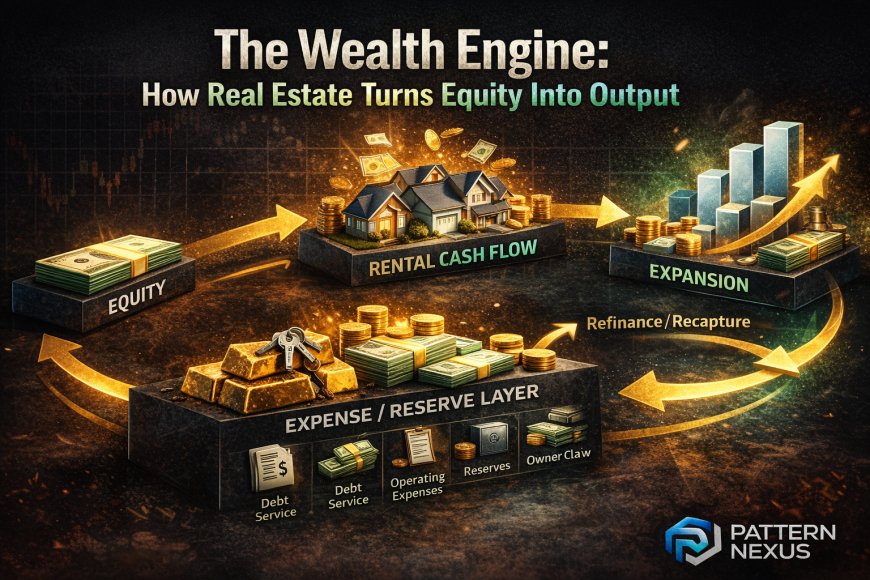
A clean, numbers-first comparison of $500,000 allocated to gold versus the same $500,000 deployed into leveraged Midwest single-family rentals. The point isn’t which asset “wins” on price—it’s how wealth engines compound through cash flow, tax structure, and balance-sheet optionality.
Jump to a section


Most “asset debates” are really debates about price. Wealth is a debate about structure: cash flow, debt terms, taxes, and whether the asset throws off reusable capital without liquidation.
Leverage is a multiplier and a weapon. It magnifies errors, bad underwriting, weak reserves, and operational sloppiness. If you can’t run the business, leverage will run you.
Gold is not useless. It’s a non-productive hard asset with high signal value in liquidity regimes. But most holders treat it like a trophy, not a balance-sheet tool.
The Baseline Comparison: Same Capital, Different Machines
People love arguing which asset “performed better.” That’s usually the wrong frame because it collapses everything into a single number: price change. Price matters, but it’s only one channel. The bigger question is whether the asset is a wealth engine or a wealth container.
A wealth container is simple: you buy it, you hold it, you hope price rises, and your only clean monetization is selling. A wealth engine is different: you buy it, it produces cash flow, it pays down its own debt, it throws off tax advantages, and it creates reusable capital that can be recycled into more assets without selling the original.
So here is the clean comparison using the exact numbers provided. Not theoretical. Not backfilled. Just math and structure.
Entry price: $2,735/oz on January 6, 2025. Current price: $4,523.19/oz on January 9, 2026. Ounces purchased with $500,000: about 182.82 oz. Current value: about $826,990. Nominal gain: about $326,990. Nominal return: about +65.4%. Cash flow: $0. Wealth event requires sale or borrowing.
That’s a strong nominal return for a hard asset. It’s also a one-channel return. Gold did not pay you rent. Gold did not amortize your liabilities. Gold did not generate depreciation. Gold did not create a refinance loop. Gold gave you one thing: price appreciation.
Now compare that to the exact structure you described: $500,000 deployed into down payments to control a much larger notional asset base.
Twelve homes at ~$200,000 each = $2.4M of property controlled. Down payment assumption: ~$40,000 each = ~$480,000 deployed (leaving buffer for closing costs and reserves depending on structure). Rent range: $1,900–$2,400 per home. Gross rent range: $22,800–$28,800 per month, or ~$273,600–$345,600 per year. Debt service estimate: ~$12,000–$14,000 per month (rate/term dependent). Total expenses estimate: ~$17,000 per month (debt + taxes + insurance + maintenance + management + vacancy reserves). Net cash flow estimate: roughly ~$5,800–$11,800 per month depending on rents and expense reality.
The reason this matters is not that the real estate number is “bigger.” It’s that the real estate structure has multiple return channels running at once: cash flow, appreciation on a leveraged base, principal paydown (amortization) paid by tenants, and tax strategy.
The gold structure has one primary channel (price), plus a secondary channel that most people never use (borrowing). The real estate structure is designed around velocity: capital recycles through the balance sheet.
From here forward, the article splits into two tracks on purpose.
Track 1 (Narrative): A clean explanation of what happens when you deploy capital into rentals the right way, and why it can return the initial equity while keeping the asset base intact.
Track 2 (Framework): The actual mechanism—capital stacks, optionality, tax posture, and the behavioral failure points that prevent most people from using these tools even when they understand them.
The Wealth Engine: How Real Estate Turns Equity Into Output
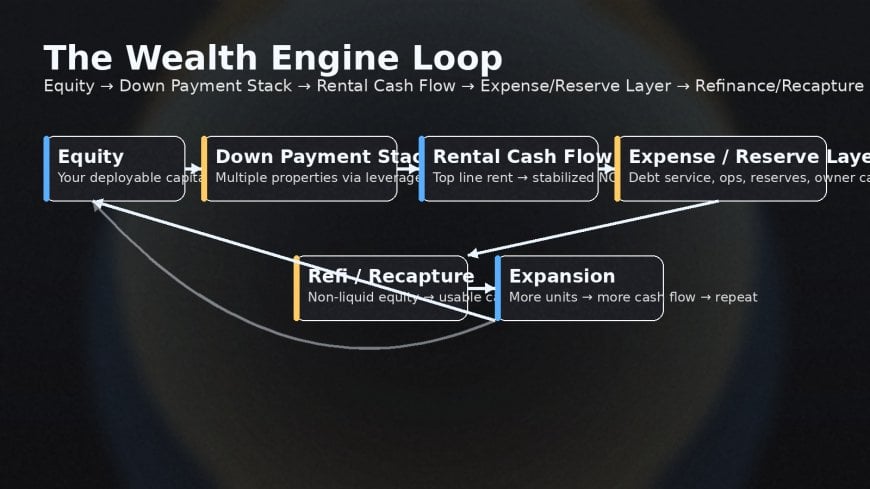
The simplest way to understand leveraged rentals is to stop thinking like an investor and start thinking like an operator.
Gold ownership is passive. Real estate ownership is a business. When you buy twelve units, you did not just buy twelve houses—you bought twelve income lines. Every month those lines pay. Those payments are not “profit” by default; they are a stream that feeds four buckets: debt service, operating expenses, reserves, and owner cash flow.
The beginner mistake is to treat “rent minus mortgage” as cash flow. The correct model is:
Gross rent → vacancy allowance → management → repairs/maintenance → capex reserves → taxes → insurance → utilities (if any) → debt service → net owner cash flow. The engine only works when the reserves are real.
Using your example numbers, twelve $200,000 homes renting for $1,900–$2,400 each produce a gross monthly range of $22,800 to $28,800. That’s the top line. In real operating conditions, the important layer is the stability of net.
If your total monthly outflows run around $17,000 (debt + ops + reserves), then your net sits in a range that might be $5,800 to $11,800 per month depending on where rents land and how tightly you run expenses. That’s roughly $70,000 to $142,000 per year in net cash flow.
That net matters because it is not a one-time wealth event. It’s a recurring output stream. The gold position gave you a one-time mark-to-market gain of about $327,000 across the year, but it did not pay you monthly. The rental stack can pay you monthly and keep paying you if the underwriting is sound.
Now zoom out. The “engine” effect comes from what the tenant is doing for you at the same time:
- They pay your debt service. That includes principal, not just interest. Principal paydown is forced wealth accumulation in the background.
- They help stabilize your cost of capital. Fixed-rate debt locks your payment while rents tend to drift upward over long periods (market dependent).
- They create equity over time. Even if prices go sideways, amortization creates equity. If prices rise, leverage magnifies that equity growth.
- They convert your equity into a scalable asset base. You control $2.4M with $500k. Appreciation happens on $2.4M, not on $500k.
This is where the compounding behavior shows up. A rental portfolio compounds through three channels even before you start doing anything fancy:
- Cash flow compounding: reinvest net cash into repairs, upgrades, and more acquisitions.
- Equity compounding: principal paydown plus appreciation on a leveraged base.
- Tax compounding: depreciation shelter that preserves more of the cash flow inside the engine.
Gold can compound only if you actively rotate it into something else, or if you leverage it. Most people do neither. They treat it as a “hold forever” asset. That is fine for preservation. It is not an engine.
Now the controversial part: returning the original capital while keeping control of the asset base.
When people hear “you get your $500k back,” they assume you mean selling. You don’t. You mean the combination of cash flow over time and the debt system.
If the portfolio nets, say, ~$100,000/year after real expenses and reserves, then in five years you have generated ~$500,000 in cumulative net cash flow. You still own the portfolio. You still control the $2.4M asset base. You have recovered the initial equity through output, not liquidation. That is the definition of a wealth engine.
Then you layer in the advanced mechanism: refinancing.
If the properties appreciate, and/or if you force appreciation through renovation, rent optimization, or operational stabilization, you can refinance and extract equity. That extracted equity is typically treated as debt proceeds, not realized gain. That’s where the “tax-free” liquidity statement comes from.
At that point, the engine can accelerate: extracted equity becomes new down payments. New down payments become more units. More units create more cash flow. More cash flow improves underwriting and access to capital. That’s the compounding loop that gold does not naturally provide.
That’s Track 1. If you only read this far, the takeaway is simple: the same $500,000 can either sit in an asset and hope price rises, or it can be deployed into a machine that pays you, pays down your liabilities, and creates reusable capital.
Now Track 2: the framework, the constraints, and why most people still won’t do it even after they understand the math.
The Framework Pass: Optionality, Tax, and Balance-Sheet Velocity
The cleanest way to describe the difference between gold and leveraged rentals is this:
A container preserves value and expresses a view. An engine produces output, creates internal reinvestment capacity, and expands optionality through structured liabilities.
This is not an emotional statement. It’s a balance-sheet statement. What matters is not “what went up more,” it’s what the asset allows you to do without selling.
1) Multi-Channel Returns vs Single-Channel Returns
Gold’s primary return channel is price appreciation. That’s it. Yes, you can lend gold, yes you can trade derivatives, yes you can borrow against it. But the baseline ownership model most people use is simply: buy and hold. That’s why it behaves like a container.
Leveraged rentals have at least four return channels operating in parallel:
- Net operating income: monthly cash flow after real expenses and reserves.
- Appreciation: price increases apply to the full leveraged asset base.
- Amortization: principal paydown creates equity without market movement.
- Tax shielding: depreciation and cost segregation can reduce taxable income from the cash flow.
When people compare “gold return” to “real estate return” and stop at appreciation, they are comparing one channel to one channel and ignoring the other three. That’s why the debate is so often stupid.
2) Optionality: What Can You Do Without Selling?
Optionality is the ability to make moves without destroying your position.
In the gold position, to get cash you typically sell. If you borrow, you are taking on a liability against a volatile asset whose only primary function is price.
In a rental portfolio, you have multiple non-destructive ways to create liquidity:
- Cash flow: the simplest liquidity source. It’s slow but stable.
- Portfolio-level debt restructure: extend terms, adjust rates, consolidate.
- Refinancing: recapitalize equity into usable cash without liquidation.
- Selective disposition: sell one unit, not the entire position, to rotate capital or reduce leverage.
Optionality is why the engine wins long-run even if the container wins short-run on price. The engine keeps giving you options. The container gives you one option: sell.
3) Tax Posture: Why “Profit” and “Taxable Profit” Are Not the Same
This is the part that breaks most people’s brains: in real estate, you can make money and still show losses on paper.
Depreciation allows the structure to treat part of the property value as an expense over time. Cost segregation can accelerate that depreciation. The result is that a portfolio producing cash flow can still show negative taxable income.
This is what you were pointing at when you described “negative tax liability.” The core concept is:
- Cash flow exists in the bank account.
- Depreciation exists on the tax return.
- They are not the same thing.
Gold does not have this feature. Gold gains are taxed when realized. It does not create deductible operating depreciation the way a building does. Again: container vs engine.
4) Balance-Sheet Velocity: The Recycle Loop
The highest-level reason the rental engine compounds is that it turns time into equity and then equity into more assets.
The basic loop looks like this:
- Equity becomes down payments.
- Down payments become controlled assets.
- Controlled assets generate cash flow.
- Cash flow builds reserves and stabilizes operations.
- Stabilized operations improve financing access.
- Financing allows refinancing and expansion.
- Expansion increases cash flow and repeats the loop.
Gold holders can build a loop too, but it is not automatic. It requires active leverage, rotation, or business reinvestment. Most gold holders don’t do that because gold ownership is culturally framed as “hold and protect.” That framing produces passivity.
5) The Hidden Cost: Operational Skill
Here’s the honest part: rentals are not free money. They are a business. You are underwriting tenants, managing maintenance, handling vacancy, dealing with insurance increases, property taxes, capex events, and regulatory friction.
This is why the leverage engine is not for everyone. The engine only works when the operator is competent and the reserves are real.
If you run 12 houses with thin reserves, no maintenance plan, and optimistic rent assumptions, the engine becomes fragile. The same leverage that multiplies gains will multiply mistakes.
That’s why the “gold vs real estate” debate is not just math. It’s also the question: do you want to run a machine, or do you want to hold an asset?
6) Reality Check: The Comparison Is Not “Which Is Better?”
The correct way to think about these assets is not as enemies. They serve different purposes.
- Gold: hedge, signal, preservation, liquidity-regime exposure.
- Real estate: income engine, tax shelter, leverage compounding, operational enterprise.
The mistake people make is using a preservation tool and expecting it to behave like a compounding business, or using a leveraged business and expecting it to feel as calm as a bar of metal in a safe.
The deeper point of this comparison is leverage. Not “leverage as a buzzword,” but leverage as a structural amplifier that changes your scale and changes the tax posture of your cash flow.
It did not generate monthly income. It did not amortize debt. It did not create depreciation. It did not create a refinance loop. It did not expand your controlled asset base. It simply marked up.
And what the rental engine can do, if executed correctly:
- Turn $500k into control of ~$2.4M of assets.
- Turn that asset base into recurring revenue.
- Shield a portion of that revenue through depreciation.
- Accumulate equity through amortization.
- Create refinancing optionality that can recycle capital without liquidation.
That is why the “wealth-engine differential” exists. It’s not a motivational slogan. It’s a description of how the system is built.
Pattern Nexus Lens
This entire comparison is a micro-version of the broader Pattern Nexus theme: outcomes are increasingly enforced by systems and structures, not by surface narratives.
Gold is a clean expression of a liquidity and trust regime. It performs when confidence in currency or policy coherence breaks down, when real rates compress, or when the market is paying for a store-of-value signal. It’s a macro “read” as much as it’s an investment.
Real estate is a structural interface with the credit system. It’s not just “a house.” It’s a debt instrument wrapped around a physical asset, paired with a government-influenced tax code, and serviced by human necessity (housing). It is deeply entangled with banking, underwriting, and policy.
That’s why the argument is not “gold vs real estate.” The argument is:
- Do you want exposure to the macro signal, or do you want exposure to the credit engine?
- Do you want a container, or do you want a machine?
- Do you want to own an asset, or do you want to operate a balance sheet?
In other words, wealth isn’t just “owning the right thing.” It’s controlling the right interfaces—tax interfaces, credit interfaces, cash-flow interfaces—and building a loop that keeps expanding your optionality over time.
Price charts are not a wealth strategy. Wealth strategy is architecture: how capital converts into control, how control converts into output, and how output recycles into expansion without liquidation.
FAQ
Does this mean gold is a bad investment?
No. Gold can be a rational allocation, especially as a hedge or regime signal. The point here is that gold is usually held as a non-productive asset. It can preserve and appreciate, but it does not naturally produce cash flow. If your goal is compounding through output, you need an engine or you need to actively use gold as collateral and redeploy the proceeds.
Are the real estate numbers guaranteed?
No. Rent ranges, debt service, and expenses vary by market, property condition, insurance/tax environment, and financing terms. The purpose of the example is structural: $500k can control a larger asset base and generate output. Whether net cash flow is $5,800/month or $11,800/month depends on underwriting and operations. Bad underwriting can turn the “engine” into a liability.
What makes real estate “tax-advantaged” in this framework?
Depreciation (and potentially cost segregation) can reduce taxable income even when cash flow exists. Refinancing proceeds are typically treated as debt proceeds rather than realized gains, which can create usable liquidity without triggering immediate capital gains tax. Tax treatment depends on jurisdiction and facts; if you’re building this as a real strategy, you should have a competent CPA who understands real estate.
Why do most people fail to use the real estate engine?
Because it is a business. It requires reserves, maintenance discipline, tenant management, and risk control. Most people underestimate capex, vacancy, and insurance/tax drift. Leverage magnifies those errors. The engine works when the operator is competent and conservative.
What’s the cleanest single takeaway?
If you want to compare assets, compare their systems, not just their returns. Gold’s return is mostly price. Real estate’s return is price plus cash flow plus amortization plus tax structure. That multi-channel architecture is the wealth-engine differential.
Sources
References for gold price history mechanics, U.S. rental operating concepts, depreciation basics, and refinance/tax treatment concepts discussed at a high level.
- LBMA Precious Metal Prices (gold reference pricing data)
- IRS Publication 527 (Residential Rental Property depreciation overview)
- IRS Publication 946 (Depreciation basics and MACRS concepts)
- IRS Publication 544 (Sales and Dispositions of Assets, gains/recognition concepts)
- National Association of Realtors research (housing and market context)
Menene Martaninka?
 Kamar
0
Kamar
0
 Karya
0
Karya
0
 Kauna
0
Kauna
0
 Ban dari
0
Ban dari
0
 Wao
0
Wao
0
 Bacin rai
0
Bacin rai
0
 Fushin
0
Fushin
0

Nexus (Christopher)
Founder of Pattern Nexus. I research markets, macro, geopolitics, AI, history, ancient systems, and the patterns most people overlook. I’m also building Market Radar, a trading scanner designed to read pressure, risk, confirmation, and setup quality before ch…
Related research

Pattern Nexus Macro Archive: 328 Timestamped Articles, October 2025–July 2026
A guided public index of 328 timestamped Pattern Nexus articles covering Federal Reserve liquidity, interest rates, the dollar, gold and si…
4 shared topics, 1 shared asset.
The Coastal Housing Repricing Map: Where the U.S. Housing Plateau Is Starting to Crack
The U.S. housing market is not crashing everywhere. It is repricing where the affordability stack broke first: coastal price towers, insura…
3 shared topics, 1 shared asset, same research avenue.
Two Economies, One Balance Sheet: The Unstable Barbell of 2026
Reserve support has returned, but real long rates, fiscal supply, and an AI-energy capital wave are splitting the U.S. economy between capi…
3 shared topics, 1 shared asset.
Hard Assets Follow Liquidity, Not Inflation? The Full Data Reconstruction — 2026 Update
A 2003–2026 reconstruction of Fed liquidity, gold, housing and NASDAQ data, plus an experimental stablecoin-augmented liquidity index. Met…
3 shared topics, 1 shared asset.
Gold Was Right. The 10-Year Was Early. The War Premium Changed the Rate Path.
The original Pattern Nexus gold call hit the structural move: gold was not just trading inflation, it was repricing liquidity, policy failu…
3 shared topics, 1 shared asset.
Pending Home Sales Confirm the Hard-Asset Rotation — Not a Housing “Surprise”
November pending home sales rose 3.3% month over month and 2.6% year over year, confirming a liquidity-driven rotation within hard assets. …
4 shared topics, same research avenue.
Building a Scalable Real Estate Portfolio: The Cash-Flow Formula, DSCR Lending, and the Operating System That Gets You From 1 Property to 10
A real-world, systems-based blueprint for building a rental portfolio without relying on hype or appreciation narratives. Covers deal math,…
4 shared topics, same research avenue.
The Illusion of Ownership: How Leverage and Liquidity Redefined the Middle Class
For decades, the idea of homeownership was synonymous with security. But after 2008, that dream quietly shifted from ownership to leverage …
4 shared topics, same research avenue.
Sharhu (0)
Security Check
Please complete the captcha to verify you are human.