

The Liquidity-Gated Economy: Why Central Banks Control Flow, Not Prosperity
A structural framework explaining modern economies as liquidity-gated systems where central banks regulate monetary flow between upstream credit creation and downstream prices, assets, and inflation.
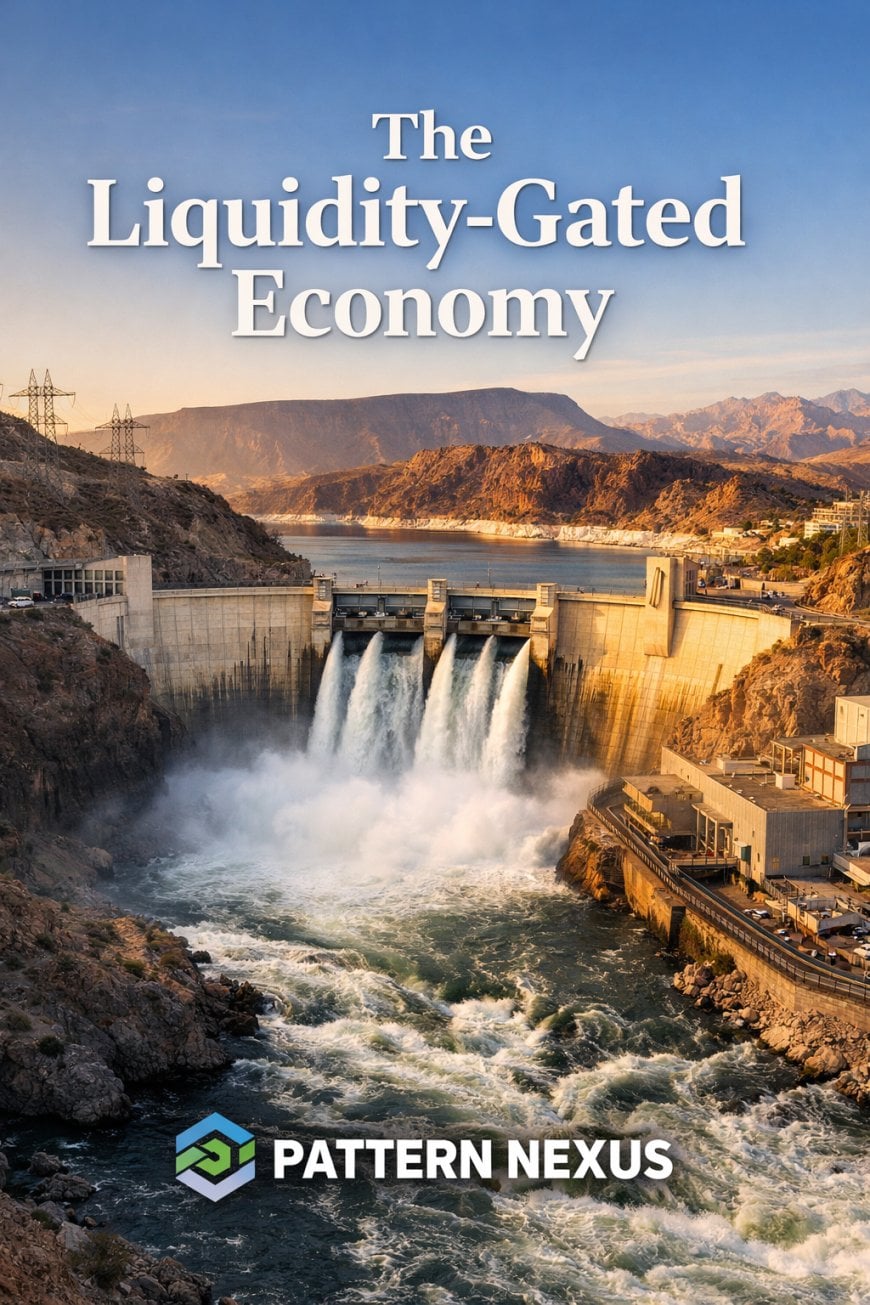
A structural framework explaining modern economies as liquidity-gated systems where central banks regulate monetary flow between upstream credit creation and downstream prices, assets, and inflation.
Jump to a section
Modern economies are not free-flowing systems. They are liquidity-gated structures where money exists upstream, prices exist downstream, and central banks regulate the flow between them. Once you see the system this way, inflation, deflation, asset cycles, and crisis response stop looking like “mysteries” and start looking like plumbing.
PN Summary
The public argues about money supply and narratives. Markets respond to flow and access. In a Liquidity-Gated Economy, upstream capacity can expand indefinitely, but downstream prices only change when liquidity is allowed through the gate.
The Thesis: Flow Is the Variable
Most macro discourse assumes the economy is a continuous system: money is created, it circulates, it becomes spending, and prices adjust. That model is incomplete.
In the real world, liquidity does not move freely. It moves through institutional choke points: bank balance sheets, collateral rules, reserve management, dealer capacity, and policy constraints. Central banks sit at the center of that structure, acting less like “planners” and more like operators managing a gate.
PN Thesis
The dominant variable is not how much money exists in theory. The dominant variable is how much liquidity is permitted to pass into the real economy at any given time — and under what conditions.
The River Map: Upstream, Dam, Downstream
Think of the economy as a large river system with a dam.
- Upstream is latent monetary and credit capacity — a reservoir of potential liquidity.
- The dam is the central-bank and banking-system “plumbing” that determines the flow rate.
- Downstream is where prices live: wages, consumer goods, housing, equities, commodities, and monetary hedges.
Inflation and deflation are downstream outcomes. The reservoir can be massive, but if the gate is closed, downstream cannot inflate. If the gate is opened aggressively, downstream reprices fast — and not always evenly.
PN Clarifier
A full reservoir behind a closed dam is not “inflationary.” It is potential energy. Inflation is the downstream price response to actual release and transmission.
Upstream: The Monetary Reservoir
Upstream is what people loosely call “the money supply,” but that phrase blends together multiple layers that behave differently. In this framework, upstream is best understood as capacity:
- Bank reserves and reserve management structures
- Balance-sheet capacity (banks, dealers, shadow banking)
- Sovereign issuance authority
- Collateralized credit creation
- Institutional leverage potential
In a fiat system, upstream capacity can expand dramatically when the political and institutional system allows it. But capacity is not the same thing as downstream spending power.
PN Mistake Most People Make
They treat “money created” as “money circulating.” In practice, created capacity can remain trapped upstream if transmission is blocked by balance-sheet constraints, collateral scarcity, or risk-off behavior.
Upstream Has Its Own Physics
Upstream liquidity accumulates as reserves, bank deposits, institutional cash piles, and collateral demand. It can inflate financial assets directly if the transmission channel is primarily markets (risk assets) rather than wages. It can also remain bottled if the private sector refuses to expand credit.
This is why you can have huge liquidity creation without immediate CPI response, or tight CPI with asset inflation. Downstream is not a single bucket. It is a distribution system.
The Dam: Central Banks as Gatekeepers
The “dam” is the central bank plus the regulatory plumbing that determines whether liquidity can pass into risk-taking, credit creation, and broad pricing power.
Tools look diverse, but their function is unified: they tighten or loosen the gate.
- Policy rates change the price of flow.
- QE/QT change the availability of reserves and the structure of collateral and duration held by the private sector.
- Repo facilities stabilize funding and collateral transmission.
- Regulatory capital rules constrain balance-sheet throughput.
PN Operational View
Central banks do not directly “set” inflation. They manage the liquidity gate, and the downstream system translates that flow into prices through time-lagged, uneven channels.
The Three Dam States
- Closed: tight conditions, credit contraction risk, velocity decay, recession probability rises.
- Managed: controlled release, selective asset support, “soft landing” attempt.
- Open: crisis response, liquidity flood, backstops, forced stabilization.
These states are not philosophical. They are reactive to stress. The system often remains “managed” until something breaks.
Downstream: Where Prices Actually Live
Downstream is where liquidity becomes visible. It is where we observe:
- Consumer prices and services inflation
- Wages and labor bargaining power
- Housing and rent dynamics
- Equity valuations and risk premia
- Commodity cycles and supply constraints
- Gold and “trust hedges”
In this framework, inflation is not “too much money.” It is too much flow relative to downstream capacity and supply, transmitted through whatever channels are open.
PN Insight
Downstream inflation is frequently a distribution story: where the water goes first, where it pools, and what bottlenecks it hits before it reaches wages and broad consumer baskets.
Structural Deflation: The Default Setting
Our framework correctly identifies the uncomfortable truth: the modern developed-world economic structure is naturally deflationary. Not because “people are pessimistic,” but because the system’s structural forces suppress broad pricing power.
Key drivers:
- Productivity and automation compress unit labor costs.
- Technology pushes marginal cost toward zero in many categories.
- Global competition restrains wage growth.
- Demographics reduce growth impulse and raise savings preference.
- Debt saturation diverts income to servicing and reduces velocity.
If the gate stays closed long enough, the system does what it is designed to do: delever, slow, and drift toward contraction. Deflation is not a theoretical possibility. It is the baseline pressure.
PN Warning
Tightening is not “neutral.” In a structurally deflationary system, sustained gate closure is an active push toward contraction. The only question is how long it takes for the stress to surface.
Why Crises Force the Gates Open
When liquidity flow is restricted, the system does not fail evenly. It fails at weak points: funding markets, credit spreads, leveraged intermediaries, housing turnover, regional banks, or corporate refinancing windows.
That is why crises are not random. They are the moment when the structure reveals itself.
- Credit tightens
- Asset prices roll over
- Leverage breaks
- Funding stress appears
- Policy shifts from “fight inflation” to “stop the bleed”
This is the logic of the dam operator. They will tolerate tightness until the downstream system begins to crack, then they open the gates to stabilize the structure.
PN Cycle Rule
The gate rarely opens because conditions are “good.” The gate opens because conditions are failing and the system must be refilled to prevent a deflationary spiral.
Inflation: Side Effect of Anti-Deflation
Inflation is frequently a downstream side effect of crisis-driven refills. If the gate is opened aggressively into supply-constrained real-world channels, prices jump. If opened primarily into financial channels, assets inflate first. If opened into both, everything moves.
Central banks are not choosing inflation as a goal. They are managing tradeoffs:
- Undershoot: recession / debt deflation / financial stress
- Overshoot: inflation / political backlash / credibility loss
PN Contrast
The public asks, “Why are they printing?” The operator asks, “What breaks if we don’t open the gate?”
Asset Cycles: A Flow-Regime Story
In the Liquidity-Gated Economy, asset cycles are best understood as regime shifts in flow:
- “Bubbles” often begin as sustained flow into risk channels, not retail mania.
- QE acts as a spillway: it reduces duration pressure, changes collateral dynamics, and supports throughput.
- QT is gate tightening: it removes accommodative structure and raises the cost of balance-sheet use.
- Gold is a downstream trust hedge: it rises when the system signals that gate discipline is failing or future refills are inevitable.
This framework also explains why narratives lag. Markets reprice on flow expectations long before consensus media declares a “pivot.”
PN Actionable Takeaway
Stop asking “is the economy strong?” Start asking “is the gate opening or closing, and where is the flow going?”
What to Watch: Practical Flow Indicators
If flow is the variable, the analyst’s job is to track gates and channels. In practice, that means monitoring indicators tied to liquidity transmission and constraint:
- Central bank balance sheet direction (expanding vs contracting)
- Funding stress (repo conditions, SOFR volatility, collateral scarcity signals)
- Credit spreads (stress transmission into corporate funding)
- Bank lending standards (private-sector willingness to transmit)
- Liquidity buffers (reverse repo usage, cash hoarding behavior)
- Real-economy throughput (housing turnover, durable goods demand sensitivity)
PN Note
You can have “tight policy” headlines while flow is quietly being supported through facilities and plumbing. Likewise, you can have “dovish” talk while the gate is effectively closing via balance-sheet constraints.
The Pattern Nexus Takeaway
The modern economic system is not a free market in the simplistic sense. It is a managed, gated structure designed to survive persistent deflationary pressure.
Central banks do not control outcomes in a precise way. They regulate the flow that determines downstream pricing regimes — and they usually act most aggressively only after stress becomes undeniable.
Once you adopt the Liquidity-Gated Economy framework, inflation, deflation, asset rotation, and crisis response stop being confusing narratives and start reading like mechanical consequences of flow control.
This is not ideology. It is structure.
Pattern Nexus Lens
Watch the gates, not the headlines. In a liquidity-gated world, the dominant question is not “how much money exists,” but “how much liquidity is being allowed through — and where does it pool first?”
FAQ
Does this mean “money printing” always causes inflation?
No. Upstream capacity can expand without downstream inflation if transmission is blocked, velocity collapses, or liquidity stays trapped in financial channels.
Why does inflation sometimes persist after tightening?
Because downstream pricing responds with lags, and previously released liquidity continues circulating through supply constraints and wage contracts.
Is deflation inevitable?
Structurally, deflation is the default pressure in advanced economies. Policy can delay or redirect it, but cannot eliminate the underlying forces.
Why do assets inflate faster than wages?
Because financial channels often receive flow first, while wage transmission requires tighter labor markets and broader distribution mechanisms.
Sources
Menene Martaninka?
 Kamar
0
Kamar
0
 Karya
0
Karya
0
 Kauna
0
Kauna
0
 Ban dari
0
Ban dari
0
 Wao
0
Wao
0
 Bacin rai
0
Bacin rai
0
 Fushin
0
Fushin
0

Nexus (Christopher)
Founder of Pattern Nexus. I research markets, macro, geopolitics, AI, history, ancient systems, and the patterns most people overlook. I’m also building Market Radar, a trading scanner designed to read pressure, risk, confirmation, and setup quality before ch…
Related research

Gold Was Right. The 10-Year Was Early. The War Premium Changed the Rate Path.
The original Pattern Nexus gold call hit the structural move: gold was not just trading inflation, it was repricing liquidity, policy failu…
4 shared topics, 1 shared asset.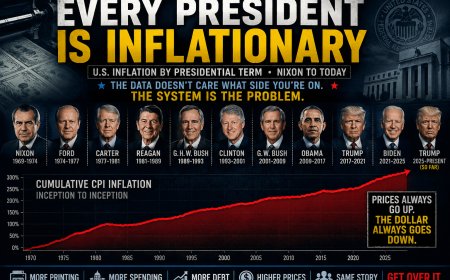
Every President Is Inflationary: The Inflation Chart Both Parties Do Not Want to Read
A Pattern Nexus breakdown of U.S. inflation by presidential term from Nixon to today, showing why the argument over which party “caused inf…
3 shared topics, 1 shared asset, same research avenue.
Mar 12, 2026 Macro Wrap: Dollar at 100, Oil Shock Math, China’s Hormuz Exception, and the Credit Fault Lines
2026 is moving in whiplash mode. The dollar is pressing 100, yields are back in “you’re not supposed to be here” territory, oil is flirting…
4 shared topics, 1 shared asset, same research avenue.
The Plumbing Update (2003–2025) Q4 2025 + Jan 26
A full rebuild of the Pattern Nexus liquidity framework using end-of-month data, z-scores, and a PCA composite (WALCL, TGA, RRP, M2). If yo…
4 shared topics, 1 shared asset, same research avenue.
The Regime Reset Stack: Yield Curve Strategy, Dollar Rails, Metals Convexity, and the AI-Fiscal Endgame
A Pattern Nexus control-systems read tying the yield curve, dollar regime, metals, crypto, and equities into one machine: why inversions le…
3 shared topics, 1 shared asset, same research avenue.
The $X-Billion-Per-Day Machine: U.S. Daily Spending vs Daily Borrowing (FY2000–FY2024)
A Pattern Nexus structural read of U.S. federal average daily outlays versus average daily deficit financing since 2000 — and why persisten…
4 shared topics, 1 shared asset, same research avenue.
Happy New Year 2026: Rate Cuts, Yield Control, Asset Rotation, and the Next Phase of Managed Liquidity
Pattern Nexus 2026 outlook: 4–6 rate cuts (100–275 bps), slower second-half easing, rising probability of yield control, bond-market resist…
3 shared topics, 1 shared asset, same research avenue.
Money as Software
An in-depth systems analysis of how money evolved from a sovereign instrument into programmable infrastructure, where payment rails, compli…
3 shared topics, 1 shared asset, same research avenue.
Sharhu (0)
Security Check
Please complete the captcha to verify you are human.