

QT Ends, Liquidity Returns: Why 2026 Is Almost Certainly the Next Balance-Sheet Expansion Cycle
Quantitative Tightening ends December 1st, and the plumbing shows reserves are already near scarcity. This article explains why 2026 is shaping up to be the next major liquidity-injection cycle, driven by heavy Treasury issuance, reserve demand, and Fed policy shifts.
Quantitative Tightening ends December 1st, and the plumbing shows reserves are already near scarcity. This article explains why 2026 is shaping up to be the next major liquidity-injection cycle, driven by heavy Treasury issuance, reserve demand, and Fed policy shifts.
Jump to a section
Why 2026 Is Almost Certainly the Next Liquidity-Injection Cycle
QT is ending not because the Fed “chose” to end it — but because the system ran out of reserves. 2026 is the year the plumbing forces balance-sheet expansion.
On This Page
- QT Was Always Time-Limited
- The ON RRP Collapse
- Fed Admissions of the Limit
- QT Ending = Reserve Scarcity
- The Reserve Math
- Reserve Distribution Risk
- Liquidity Chain Reaction
- 2019 as the Blueprint
- Why 2026 Is the Inflection
- Treasury Issuance Pressures
- Issuance Math Behind QE-2026
- Funding Markets Under Stress
- 2022 → 2026 Liquidity Map
- 2026 Scenarios
- What QE Will Look Like in 2026
- Why Not 2025 or 2027
- Pattern Nexus Lens
- Tokenized Reserve Era
- Pattern Nexus Playbook
- FAQ: Key Concepts
- The Plumbing Always Wins
QT Was Always Time-Limited — Because the System Is Reserve-Constrained
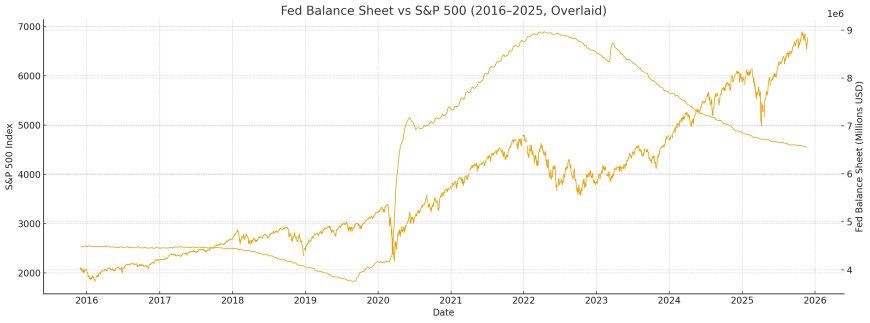
When QT began in mid-2022, most analysts treated it like a long-term reversal of QE. That was never possible. Not in a floor system.
In the modern post-2008 regime:
- Reserves are the base layer of the entire financial system
- Banks require reserves for settlement
- Money-market funds compete with banks for liquidity
- ON RRP acts as the “excess liquidity buffer”
- QT drains reserves indirectly — until ON RRP hits zero
So QT could continue only as long as ON RRP existed. That buffer is now gone.
This is why the entire endgame was predictable years in advance.
The Collapse of ON RRP Was the Point of No Return
ON RRP dropped from $2.3 trillion (2022) → ~$0 (2025), sucked dry by bill issuance and money-market flows.
- Bills offered higher yields → money funds left ON RRP
- QT continued draining reserves
- Dealers hit balance-sheet limits
- Internal bank liquidity floors approached
This was the fuse. The QT end announcement was the explosion.
Fed Officials Are Now Explicitly Acknowledging the Limit
The Fed practically shouted the warning for 18 months — nobody listened.
Jerome Powell: “We will stop runoff when reserves are somewhat above ample. We will not return to 2019 conditions.”John Williams: “We monitor the distribution of reserves. When the buffer shrinks, QT must slow.”Lorie Logan: “QT must adjust when funding conditions tighten.”These are not opinions — they are mechanical descriptions.
QT Ending December 1 Is the Official Acknowledgement of Reserve Scarcity
The balance sheet shrank from ~35% to ~22% of GDP — almost exactly the level where the 2019 repo crisis began. The signals now match that period:
- ON RRP: ≈ 0
- Bank reserves: flat
- Issuance: extreme
- Dealer balance sheets: saturated
- Funding spreads: firming
- Collateral recycling: stressed
The Reserve Math That Guaranteed QT Could Not Continue
Reserves are whatever remains after the Fed meets its liability obligations:
This is why QT has a hard stop:
- Currency always rises
- TGA is rising with issuance
- ON RRP collapsed
- Other liabilities fluctuate upward
- QT was shrinking Fed assets
This boxed reserves into a corner.
The Hidden Risk: Reserve Distribution Across Banks
Total reserves are irrelevant if they’re locked in the wrong banks. This was the lesson of September 2019.
- Reserves pooled in a few megabanks
- Critical clearing banks ran dry
- Repo lending halted
- Rates exploded from 2% → 10%
The Liquidity Chain Reaction Already in Motion
- ON RRP drains → no buffer
- Money funds chase bills → banks lose deposits
- Repo financing grows → dealers hit capacity
- Treasury issuance skyrockets → collateral piles up
- Funding markets tighten → spreads widen
- Reserves fall toward floors → settlement risk rises
- Fed forced to supply reserves → QT ends
2019: The Blueprint for What Happens Next
Almost every structural variable is worse today than in 2019:
| 2019 | 2026 |
|---|---|
| ON RRP low | ON RRP zero |
| Dealer capacity tight | Dealer capacity maxed out |
| Issuance elevated | Issuance record-setting |
| QT ran too long | QT ran to the floor |
| Reserves uneven | Reserves extremely uneven |
| Fed intervention reactive | Fed intervention will be proactive |
Why 2026 Is the Highest-Probability Year for Liquidity Expansion
Several cycles converge:
- Treasury issuance peaks
- QT is over
- Reserve demand rises
- Rate cuts increase volatility
- Funding pressure re-emerges
Treasury Issuance Alone Forces QT’s End
- $1.6–$1.9T per year in new issuance
- $8–$9T in bills rolling over
- Short maturities worsen rollover risk
Issuance Math: The Numbers Behind QE-2026
The system has a simple limitation:
- Dealers have limited balance-sheet space
- Banks have internal liquidity floors
- Money funds drain deposits via bills
- TGA absorbs liquidity during issuance waves
Funding Markets Cannot Handle Reserve Scarcity
When reserves fall too low:
- repo rates spike
- collateral chains shorten
- funding spreads widen
- dealers stop absorbing collateral
- settlement risks emerge
The 2022 → 2026 Liquidity Cycle Map
- 2022: QT begins — runoff starts slowly against a huge ON RRP buffer.
- 2022–2023: ON RRP drains gradually as money-market funds shift toward better yields.
- 2023–2024: Bills outcompete RRP → rapid drawdown of the “excess liquidity” cushion.
- 2024–2025: Dealer saturation increases as issuance stays heavy and balance-sheet space fills up.
- Late 2025: ON RRP ~0 — the system loses its buffer; further QT now hits bank reserves directly.
- Dec 1, 2025: QT ends — the Fed quietly concedes it has reached the reserve floor.
- Early 2026: Rate cuts begin → reserve volatility rises as the policy stance shifts.
- Mid-2026: Treasury issuance spikes into a system with thin reserves and saturated dealers.
- Late 2026: Funding stress emerges — repo and bill markets start to tighten.
- 2026–2027: Fed expands the balance sheet via “technical balance-sheet growth” to restore an ample-reserves buffer.
2026 Scenarios: Base, Stress, Overheat
| Scenario | Description | Fed Action | Market Outcome |
|---|---|---|---|
| Base Case | Issuance heavy but orderly | Bill purchases, reinvestment, SRF usage | Stable yields, risk assets supported |
| Stress Case | Funding spreads widen; repo instability | Outright purchases + high SRF usage | Sharp bond rally; volatility decline |
| Overheat Case | Energy shock + issuance pressure | Targeted liquidity but slower cuts | Curve steepens; higher volatility |
What QE Will Look Like in 2026 (It Will Not Be Called QE)
1. Treasury Bill Purchases
Injects reserves without distorting long-term yields.
2. Ending QT & Reinvesting Maturities
Quiet, mechanical balance-sheet expansion.
3. Standing Repo Facility (SRF)
Reserves on tap — intraday liquidity valve.
4. Outright Buying During Stress
Only if repo spikes or funding breaks down.
Why Not 2025 — And Why Definitely Not 2027
Why Not 2025?
- QT ends late 2025
- Reserves stabilize but do not grow
- Rate cuts begin early 2026
- Issuance pressure peaks mid-2026
Why Not 2027?
- Stress emerges sooner, as issuance and reserve demand collide in 2026
- Reserves are needed pre-issuance, not after the system breaks
Pattern Nexus Lens: Liquidity Isn’t Stimulus — It’s Infrastructure
This is the worldview most analysts miss.
Reserves enable:
- Settlement
- Collateral recycling
- Repo financing
- Treasury auctions
- Corporate cash operations
Without reserves, none of this works.
The Tokenized Reserve Era: Meta-Structure
This ties directly into ourr broader PN thesis:
AI industrialization, energy infrastructure, and global dollarization all amplify reserve demand further.
The Plumbing Always Wins
Forget narrative. Forget ideology.
QT is over. Liquidity expansion is next. 2026 is the year it becomes unavoidable.
Pattern Nexus Lens: What This Actually Means for 2026–2028
Through the Pattern Nexus lens, this isn’t about guessing what Powell “wants” or whether FOMC leans hawkish or dovish. It’s about watching the handful of pipes that actually govern the cycle:
- ON RRP: Already at zero. There is no excess cushion left to drain.
- Bank reserves: Flat near the floor. Any new stress will require injections, not more runoff.
- Treasury issuance and refunding: Accelerating through 2026–2027 into a system that is already balance-sheet constrained.
- Dealer balance-sheet metrics: The first real-time sign that the pipes are clogging.
- SRF usage and “technical” operations: The stealth channel where QE-2026 will appear without being called QE.
In the Pattern Nexus framework, this liquidity cycle also plugs directly into the bigger theses:
- Tokenized Reserve Era: Treasuries + reserves become the core collateral stack for both banking and on-chain rails.
- AI / Energy Industrial Flywheel: Capex-heavy buildout amplifies credit creation and, in turn, reserve needs.
- Everything Bubble III: Every attempt to “normalize” the balance sheet runs into the same structural wall: reserve scarcity versus issuance reality.
From here, the Pattern Nexus playbook is simple:
- Watch ON RRP + reserves together, not in isolation.
- Map issuance schedules against dealer capacity and SRF activity.
- Treat every “technical balance-sheet adjustment” as part of QE-2026, regardless of what they call it.
- Frame trades and macro views around liquidity as infrastructure, not as one-off stimulus events.
FAQ: Terms & Concepts Most Readers Won’t Understand
What is ON RRP?
The “Overnight Reverse Repo Facility.” This is where money-market funds can park cash at the Fed overnight for a guaranteed rate.
What are “reserves”?
The electronic money that banks hold at the Federal Reserve. They are the core settlement asset of the entire financial system.
What does “ample reserves” mean?
It’s the level of reserves where banks feel comfortable settling payments, lending in repo, and taking on collateral without stress.
Why does ON RRP hitting zero matter?
Because ON RRP is the buffer that allows QT to drain reserves safely. When it’s gone, QT drains bank reserves directly.
What is the TGA?
The Treasury General Account — the U.S. Treasury’s checking account at the Fed. When it rises, reserves fall. When it falls, reserves rise.
What is the Standing Repo Facility (SRF)?
A permanent Fed program that gives banks and dealers access to reserves at a fixed rate.
What is a dealer?
Primary dealers are large financial institutions required to bid at every Treasury auction and distribute government debt to markets.
Why do dealers matter for liquidity?
Dealers must take Treasuries onto their balance sheets before selling them. If their balance sheets are full, auctions break down.
What is collateral?
Assets — usually Treasuries — pledged in repo lending to secure short-term funding.
What is repo?
The repurchase agreement market — the core plumbing that lets institutions borrow and lend trillions daily using Treasuries as collateral.
What does “dealer saturation” mean?
When dealers have no more room on their balance sheets to take Treasuries, even if they want to.
What is “reserve scarcity”?
When the system doesn’t have enough reserves to comfortably settle payments, fund dealers, or absorb new issuance.
Why does Treasury issuance force the Fed’s hand?
Because massive issuance requires massive balance-sheet space. Private markets don’t have it. The Fed must supply reserves to make room.
What is “technical balance-sheet growth”?
The Fed’s preferred term for increasing reserves without calling it QE.
Is this inflationary QE?
No. This is reserve management to keep funding markets from breaking. Not asset-price pumping.
Why does the Fed avoid saying “QE”?
Because QE is politically toxic, but reserve injections are mechanically unavoidable. So they rename it.
Why can’t QT continue?
Because there is no excess liquidity left to drain. ON RRP is empty. Banks are at floors. Dealers are full.
So is 2026 guaranteed QE?
Nothing is guaranteed, but the plumbing makes it the highest-probability outcome across all forward scenarios.
Sources
Menene Martaninka?
 Kamar
0
Kamar
0
 Karya
0
Karya
0
 Kauna
0
Kauna
0
 Ban dari
0
Ban dari
0
 Wao
0
Wao
0
 Bacin rai
0
Bacin rai
0
 Fushin
0
Fushin
0

Nexus (Christopher)
Founder of Pattern Nexus. I research markets, macro, geopolitics, AI, history, ancient systems, and the patterns most people overlook. I’m also building Market Radar, a trading scanner designed to read pressure, risk, confirmation, and setup quality before ch…
Related research
Goolsbee Turns AI Data Centers Into a Fed Reaction-Function Test
Chicago Fed President Austan Goolsbee said on September 21, 2026 that policymakers should watch whether AI data-center construction is spil…
5 shared topics.
One Bucket, Many Hoses: Liquidity Control After the Stablecoin Shif
A five-gallon bucket with holes is the simplest way to see modern liquidity. The problem now is no longer one hose and one bucket, but many…
5 shared topics.
The Powell Subpoena and the Liquidity Regime Transition
A subpoena against Powell over his Senate testimony signals institutional pressure toward rate suppression and liquidity convergence betwee…
6 shared topics.
Stablecoins Are the New Treasury Bid: The Quiet Construction of a Private CBDC Rail
Stablecoins are not a crypto sideshow. They are being shaped into regulated dollar settlement instruments backed by U.S. Treasuries, creati…
5 shared topics.
The Day QT Died and QE Began: December 1, 2025 — The Quiet Restart of the Liquidity Engine
QT officially ended on December 1, 2025 — but the real story happened in the plumbing. With the RRP buffer nearly gone, SOFR volumes explod…
9 shared topics.
The New American Crypto Order: How Trump’s Executive Actions, Treasury Strategy, and Federal Reserve Alignment Are Rewiring the Dollar System
The United States has quietly shifted from restricting crypto to absorbing it. Trump’s Strategic Bitcoin Reserve, the Digital Asset Stockpi…
6 shared topics, same research avenue.
The Dollar Fortress: How Bretton Woods, the Marshall Plan, and the 1951 Accord Forged the First Dollar Liquidity Regime (1947–1953)
After World War II, the Bretton Woods system, the Marshall Plan, and the 1951 Treasury–Fed Accord fused into a single architecture: the dol…
5 shared topics, same research avenue.
NAR’s 2026 Housing Boom Fantasy: Why a 14% Rebound Requires a Liquidity Intervention
The National Association of Realtors is projecting a 14% rebound in existing-home sales for 2026 — but their forecast depends on a fragile …
6 shared topics.
Sharhu (0)
Security Check
Please complete the captcha to verify you are human.