

Warren Buffett Retires: A Lifetime of Discipline, Compounding, and Stewardship
Warren Buffett’s retirement marks the end of the capital allocation era. This is not just a leadership change at Berkshire Hathaway, but the closing of a postwar investing regime built on patience, permanent capital, and time arbitrage.
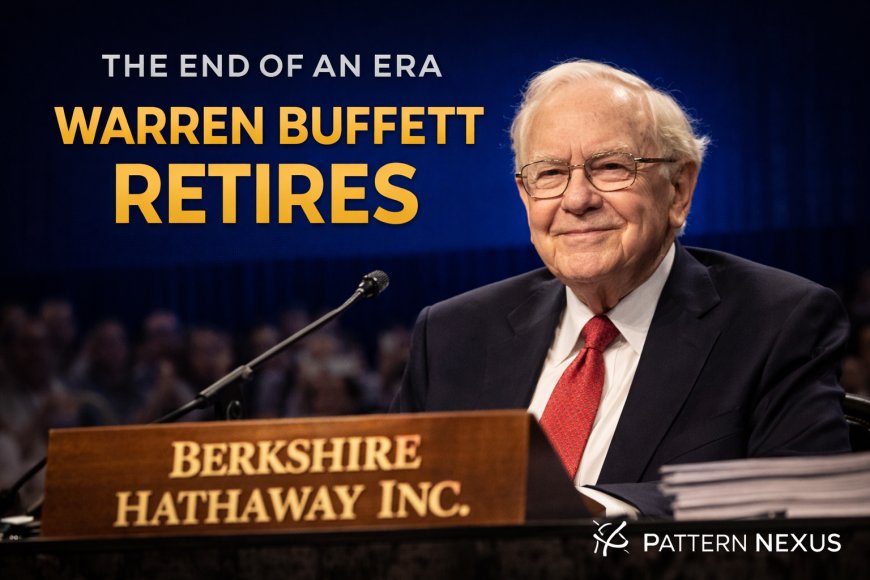
Warren Buffett’s retirement marks the end of the capital allocation era. This is not just a leadership change at Berkshire Hathaway, but the closing of a postwar investing regime built on patience, permanent capital, and time arbitrage.
Jump to a section
At age 95, Warren Buffett has stepped down as CEO of Berkshire Hathaway, closing one of the longest, most disciplined, and most consequential careers in modern financial history. This is not a market event. It is the conclusion of a life spent designing a compounding system built to function across generations, cycles, and leadership transitions — without ever abandoning its core principles.
The Moment
Buffett stepping down as CEO is not notable because it happened late. It is notable because it happened at all.
Few individuals remain operational stewards of an institution into their mid-90s. Fewer still do so without drifting into symbolism. Buffett continued reading, thinking, writing, allocating, and teaching long after most peers had transitioned into ceremony.
This retirement does not mark a leadership reset. It marks the completion of a career in which the same philosophy governed every decade without revision to suit the moment.
Early Life: The Pattern Was There Early
Buffett was born in Omaha in 1930. His father, Howard Buffett, was a stockbroker and later a U.S. congressman. Markets were present, but the environment was restrained, analytical, and practical.
The early markers are not mythology. Buffett bought his first stock at age 11. He filed tax returns as a teenager. He invested in farmland at 14 using money earned through small ventures. These were not curiosities — they were behavioral signals.
The pattern was clear early: patience, numerical fluency, and a preference for productive assets over consumption.
Formation: Graham, Discipline, and Margin of Safety
Buffett’s framework was not intuitive. It was taught, tested, and hardened.
At Columbia Business School, he studied under Benjamin Graham, absorbing the foundational principles of intrinsic value, margin of safety, and analytical distance from price movements.
Over time, Buffett evolved from strict balance-sheet bargains toward durable, high-quality businesses capable of long-term compounding. What never changed was the governing logic: avoid overpayment, avoid leverage you cannot control, and avoid businesses you cannot understand.
By removing the need to be right frequently, Buffett gave compounding the only thing it truly requires: time.
The Partnerships: Proof Before Scale
Before Berkshire, there were the Buffett Partnerships of the 1950s and 1960s. This was the proving ground.
Here, Buffett demonstrated concentrated conviction, disciplined underwriting, and the ability to outperform without narrative appeal. Berkshire was not the origin of the model — it was the vehicle that allowed it to scale permanently.
This matters because it establishes an important truth: Buffett did not “get lucky with Berkshire.” The behavior was already there. Berkshire simply gave it permanence.
Berkshire: From Textile Relic to Capital Engine
Berkshire Hathaway began as a declining textile business. Buffett acquired control in the early 1960s, initially misjudging the textile economics but recognizing the value of the corporate structure.
The business itself was not the objective. The shell became the platform.
Buffett transformed Berkshire into a holding company capable of owning diverse operating businesses while leaving them operationally autonomous. Cash flows were centralized. Decision-making remained decentralized. Capital allocation became the core discipline.
That design choice is the story. Berkshire did not become durable by accident. It became durable because Buffett built it to be durable.
What He Built: A Business Collection, Not a Portfolio
Buffett is often described as a stock picker. That description understates the architecture.
Berkshire is a collection of cash-generating businesses spanning insurance, railroads, energy, manufacturing, services, and consumer products. Public equities were one deployment channel — not the system itself.
- Insurance as the foundational capital engine
- Full ownership of a major North American freight railroad (BNSF)
- A large regulated energy and utilities platform (Berkshire Hathaway Energy)
- Dozens of operating subsidiaries producing consistent free cash flow
Buffett did not optimize for quarterly performance. He optimized for capital permanence.
Insurance Float: The Quiet Advantage That Made Everything Possible
Insurance is the part of Berkshire most people mention without actually understanding. The concept is simple: premiums come in now, claims get paid later, and the “in-between” capital is float.
Buffett built insurance operations that produced large pools of float at attractive economics. That float became patient capital — capital that could be deployed into businesses and investments without the same redemption pressure other investors face.
This is one of the core structural reasons Berkshire could act calmly when the world was not calm.
Float didn’t make Buffett smarter. It made Buffett harder to force. That is a different kind of edge — and it scales.
The Principles That Never Moved
Buffett’s rules were not complicated. They were difficult to follow consistently.
- Invest only in businesses you can understand
- Prioritize durability over excitement
- Trust managers, but verify economics
- Hold exceptional assets for long periods
- Protect downside — survival precedes compounding
Across decades, those principles looked “boring” right up until they looked correct.
Temperament: The Real Advantage
Buffett’s defining advantage was not information. It was emotional control.
He distinguished volatility from risk, patience from inaction, and popularity from quality. This temperament allowed him to act when others froze and wait when others rushed.
This is why so many people can quote Buffett and still fail to replicate Buffett. The quotes are easy. The temperament is the barrier.
Defining Decisions and Signature Moves
Buffett’s legacy is often told through the highlight reel. That reel matters — but only when you understand the logic underneath each move.
A few categories define the “Buffett style” at scale:
- Platform acquisitions: buying businesses that become permanent cash flow engines and long-duration capital bases
- Concentrated conviction: holding meaningful positions when the business economics justify it, rather than diversifying for optics
- Manager alignment: choosing people he could trust to run businesses without constant oversight
- Long holding periods: turning time into the primary compounding lever
This is why his best decisions didn’t look like “trades.” They looked like ownership.
Letters and the Annual Meeting
Buffett’s shareholder letters became instructional documents — not marketing materials. They emphasized errors, trade-offs, and long-term reasoning. The tone was unusually direct, unusually plainspoken, and unusually transparent for a public company leader.
The annual meeting evolved into an educational forum. Attendees came not for spectacle, but to understand how disciplined capital allocation operates over decades — and why “doing nothing” is often the highest-skill action in markets.
Buffett turned education into a form of stewardship: he didn’t just build Berkshire, he built a generation of investors who understood what Berkshire was trying to be.
Retirement: What Changed, What Didn’t
Buffett stepped down as CEO at the end of 2025. He remains chairman and continues to support the institution from Omaha.
There was no philosophical shift, no operational disruption, and no urgency to redefine strategy. That absence of drama reflects intent.
Berkshire was never designed to rely on Buffett’s daily presence. It was designed to survive his absence.
Succession and Continuity
Greg Abel assumes the CEO role following a long-telegraphed succession plan. Ajit Jain continues to oversee the insurance complex that underwrites the enterprise.
The institution’s resilience lies in structure, not personality. Operating autonomy remains intact. Capital discipline remains centralized. The system endures.
The most Buffett-like outcome possible is this: nothing breaks when he leaves.
Philanthropy: Wealth as a Tool, Not a Trophy
Buffett’s view of wealth was unusually utilitarian. He lived with restraint relative to his net worth, and he treated money as something to allocate — not something to display.
His long-term plan has been to give away the vast majority of his wealth, including through commitments associated with large-scale philanthropic initiatives and the broader culture of strategic giving he helped normalize among the ultra-wealthy.
Whether people agree with any given philanthropic institution or not, the underlying pattern remains consistent: Buffett approached giving the same way he approached investing — with planning, patience, and long-term intent.
Legacy
Buffett’s legacy is not defined by wealth accumulation.
It is defined by proof: that long-term thinking, ethical clarity, emotional discipline, and structural patience can operate at extreme scale — and still win.
Berkshire is the artifact. The philosophy is the inheritance.
There will be other successful investors. There will not be another Warren Buffett.
FAQ
Is Warren Buffett fully leaving Berkshire Hathaway?
No. He stepped down as CEO but remains chairman and continues to be engaged.
Who is the new CEO?
Greg Abel, following a succession plan developed over many years.
What changes now?
Day-to-day operations are expected to remain stable. The primary long-term focus remains capital allocation at scale, continuity of culture, and disciplined deployment of capital over time.
Sources
- Reuters: Berkshire falls on Buffett's last day as CEO; stock gained roughly 6,100,000% over 60 years
- People: Buffett, 95, steps down as CEO; remains chairman; comments on staying active
- Wall Street Journal: The cash stewardship question for Greg Abel as new CEO
- Warren Buffett biography and early-life milestones
- Investopedia: Buffett’s path, education under Graham, early investing
- The Giving Pledge: Buffett’s philanthropic commitment
Menene Martaninka?
 Kamar
0
Kamar
0
 Karya
0
Karya
0
 Kauna
0
Kauna
0
 Ban dari
0
Ban dari
0
 Wao
0
Wao
0
 Bacin rai
0
Bacin rai
0
 Fushin
0
Fushin
0

Nexus (Christopher)
Founder of Pattern Nexus. I research markets, macro, geopolitics, AI, history, ancient systems, and the patterns most people overlook. I’m also building Market Radar, a trading scanner designed to read pressure, risk, confirmation, and setup quality before ch…
Related research

The Permitted Memory of the Past
History is not the past. History is the surviving record after water, fire, conquest, empire, religion, language loss, academic filtering, …
2 shared topics, same research avenue.
Sharhu (0)
Security Check
Please complete the captcha to verify you are human.