
QE 2026, AI, and the Cost of Everything: Why Your Life Is Getting More Expensive
A deep, plain-language breakdown of how QE, fiscal policy, and the rising AI-industrial build-out are quietly pushing up the cost of housing, cars, power, and everyday life — and why prices never come back down even when inflation cools.
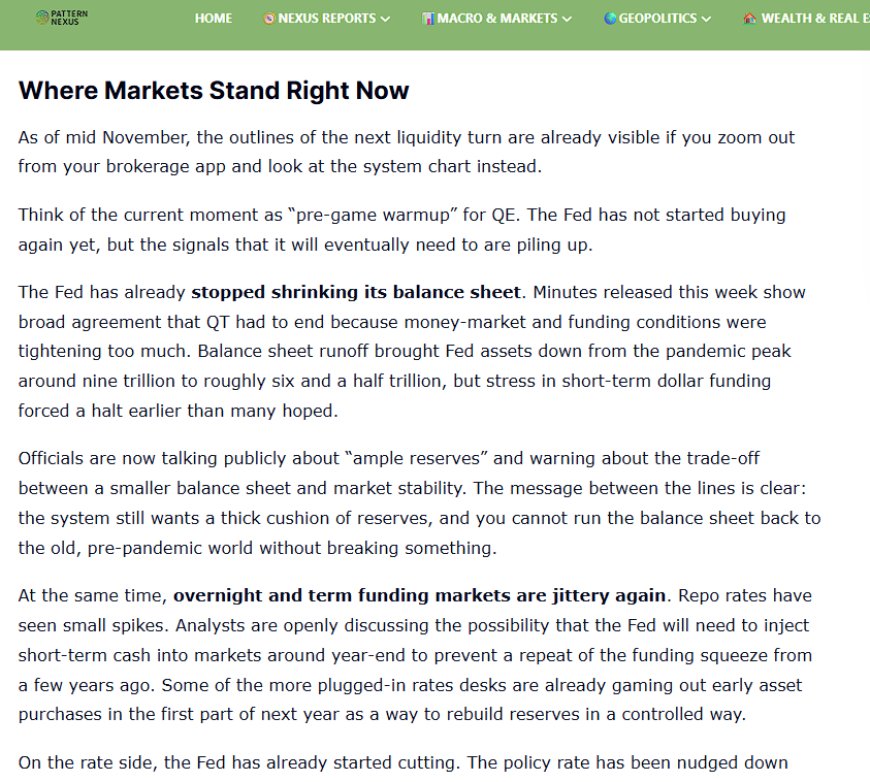
QE 2026: The Trigger, the Mechanics, and How the Next Liquidity Wave Hits Your Life
The Fed has halted QT, money market stress is flashing on the dashboard, Japan is quietly breaking out of decades of zero, and stablecoins are turning into a new global dollar rail. This is the deep dive on what actually forces quantitative easing back on, how it shows up in your rent, wages, and savings, and why this time the hidden layer is tokenized Treasuries and digital dollars.
Pattern Nexus Snapshot
System Reality
QE is not “money printer go brrr.” It is a plumbing decision when the system runs out of balance sheet to hold government debt at tolerable yields.
- Timing
2026 is where math, politics, and plumbing collide. Debt loads, slowing growth, global central bank divergence, and digital dollar rails all converge there.
- Your Life
QE shows up as a slow tilt in your reality. Rents don’t fall, wages lag, assets get rescued, and the “middle” quietly gets squeezed.
What QE Really Is (Plain-Language Version)
If you strip away the jargon, QE is a very simple admission: the system has created more government debt than the private sector can comfortably hold at current yields, so the central bank steps in as buyer of last resort and balance-sheet shock absorber.
Quantitative easing sounds like a spell from a fantasy novel. In reality, it is a plumbing maneuver. The central bank looks at the government bond market, the banking system, and the broader economy and says: there is too much debt, not enough balance sheet to hold it, and yields are about to break something. Then it steps in as a buyer with an unlimited checkbook.
Mechanically, the Federal Reserve creates new reserves inside the banking system and uses those reserves to buy Treasury bonds and mortgage-backed securities from banks, funds, and dealers. The private sector hands the Fed long-term bonds and gets short-term, safe, liquid balances in return. That swap does three big things.
Key idea: QE is not “free money for everyone.” It is a targeted asset swap that rescues the plumbing when the pipes are full of government debt and nobody wants to hold the long end at sane yields.
First, it pushes down long-term yields. When a massive, price-insensitive buyer shows up in the Treasury and MBS markets, prices rise and yields fall. That drops mortgage rates, corporate borrowing costs, and discount rates across the economy.
Second, it frees up balance sheets. Banks and big investors can unload duration risk and get back cash and reserves. That allows them to fund loans, buy other assets, or simply survive stress that would otherwise force them into fire sales.
Third, it signals a backstop. Markets internalize the idea that the central bank will not allow the sovereign bond market or core funding markets to completely seize up. That “implicit put” changes risk behavior everywhere else in the system.
What QE does
- Soaks up unwanted government debt.
- Lowers long-term borrowing costs.
- Stabilizes banks and dealers under stress.
- Boosts valuations across risk assets.
What QE does not do
- It does not directly send checks to you.
- It does not fix bad zoning or housing scarcity.
- It does not solve inequality or wage stagnation.
- It does not magically make governments “responsible.”
Since the global financial crisis, every major shock has ended with some version of this move. The labels change, but the pattern does not. We saw it after the mortgage implosion, after the euro crisis, during pandemic lockdowns, and even in smaller flare-ups like the UK gilt accident and the blow-up in US repo a few years ago. Each time, the message was the same: when in doubt, expand the balance sheet and restore liquidity.
None of that shows up on your grocery receipt. You do not see “liquidity injection” listed above eggs and milk. But if you watched your mortgage quote collapse, your 401(k) rebound, and the price of everything else creep higher over the next few years, you were watching QE ripple through your life in slow motion.
Now, with QT paused, reserves tight, and long-end yields back in the driver’s seat, we are walking toward another iteration. This time, the backdrop is different: the AI build-out, a stressed grid, tokenized Treasuries, stablecoins moving trillions, and central banks around the world trying to normalize and failing at different speeds.
Why QE Feels Wrong But Keeps Happening
Most people’s instincts rebel against QE. It feels unfair, synthetic, almost like cheating. You play by the rules, go to work, watch your budget, and then some unelected committee in a marble building waves a hand and moves trillions around in a spreadsheet.
At a gut level, it feels like the game is rigged.
Here is the uncomfortable truth: you are not wrong about the game being tilted. But the tilt is not random. It is built into how we have chosen to run modern economies.
When politicians and central bankers face crisis, they have two broad options. They can allow a brutal reset—defaults, bankruptcies, collapsing asset prices, rising unemployment, governments cutting programs, banks failing—or they can lean on central bank balance sheets and fiscal fire hoses to smooth it all out.
Over and over again, they have chosen to smooth it out. That is QE’s job. It is not a moral project. It is a choice about whose pain shows up on which timeline.
Letting everything reset would mean landlords dumping properties at fire-sale prices, home prices crashing, expensive projects getting canceled, and governments forced to slash budgets immediately. That is the kind of pain you see on the evening news. It costs elections. It destabilizes countries.
Using QE and other liquidity tools instead means most of that pain is spread out over years and quietly moved onto ordinary people’s balance sheets:
- Higher rents that never fully come back down.
- Wages that lag the price of everything that matters.
- Asset prices that stay propped up, so new buyers are locked out.
- A creeping sense that you are running faster just to stand still.
When you feel that, you are not imagining it. You are feeling the downstream effects of choices that were made to keep the high-level system stable. The trick is to stop pretending those choices are neutral and start understanding the pattern well enough to reposition yourself inside it.
Where Markets Stand Right Now
As of mid November, the outlines of the next liquidity turn are already visible if you zoom out from your brokerage app and look at the system chart instead.
Think of the current moment as “pre-game warmup” for QE. The Fed has not started buying again yet, but the signals that it will eventually need to are piling up.
The Fed has already stopped shrinking its balance sheet. Minutes released this week show broad agreement that QT had to end because money-market and funding conditions were tightening too much. Balance sheet runoff brought Fed assets down from the pandemic peak around nine trillion to roughly six and a half trillion, but stress in short-term dollar funding forced a halt earlier than many hoped.
Officials are now talking publicly about “ample reserves” and warning about the trade-off between a smaller balance sheet and market stability. The message between the lines is clear: the system still wants a thick cushion of reserves, and you cannot run the balance sheet back to the old, pre-pandemic world without breaking something.
At the same time, overnight and term funding markets are jittery again. Repo rates have seen small spikes. Analysts are openly discussing the possibility that the Fed will need to inject short-term cash into markets around year-end to prevent a repeat of the funding squeeze from a few years ago. Some of the more plugged-in rates desks are already gaming out early asset purchases in the first part of next year as a way to rebuild reserves in a controlled way.
On the rate side, the Fed has already started cutting. The policy rate has been nudged down from the steep peak as inflation cooled off the extreme highs, but long-term yields are not obediently following the textbook. The ten year note has spent much of the year grinding in a high, uncomfortable band for an economy loaded with debt. Front-end relief does not automatically translate into a nationwide refinancing party when the long end refuses to come down.
Equity markets have been living in that tension. Indexes pushed to or near new highs on AI optimism and hopes of easier policy, even as higher-for-longer long-end yields tightened credit and kept the real economy on edge. The market narrative rotates between “soft landing, new bull cycle” and “something is going to crack in this environment.”
Underneath that headline story, the monetary base of advanced economies is still huge. A recent cross-country scoreboard notes that the base money of OECD economies has increased by an order of magnitude since the early two thousands, largely driven by years of low inflation targets and repeated QE cycles. Balance sheets have shrunk at the Fed and ECB, but are still massive by historical standards, and the pace of shrinkage has already slowed.
Then there is the new layer that was not mature in earlier cycles: stablecoins and tokenized dollar products. Stablecoin payments this year are on track to rival or exceed traditional card networks on raw volume, with multiple analyses pointing to several trillions in on-chain dollar transactions over the course of the year and large growth versus last year. Major legislative moves like the recent stablecoin framework have put a regulatory fence around the space and opened the door for big banks, card networks, and retailers to treat tokenized dollars as part of mainstream infrastructure.
This is the quiet backdrop to everything else: the Fed ended QT earlier than advertised, funding markets are twitchy, the long end is stubborn, and a new digital layer of dollar demand is coming online right as the Treasury needs to sell an ocean of debt.
Why The Middle Of This Decade Is The Collision Point
It is tempting to think about QE as a political choice: will the central bank “give in” and ease again. The more honest way to think about it is as a collision of math, politics, and plumbing. The middle of this decade is where those lines converge.
- The math
- Trillions in structural deficits, higher interest costs, and a global system built on dollar collateral.
- The politics
- Very little appetite for deep cuts, higher taxes, or telling voters “we are going to let prices fall and unemployment rise.”
On the fiscal side, the United States is running structural deficits measured in trillions per year. That is not a one-off emergency spike; it is an embedded feature of a budget dominated by entitlements, healthcare, veterans’ benefits, and defense, all sitting on top of a large and growing interest bill. Trying to close that gap with discretionary cuts is like trying to patch a breached dam with a roll of tape.
At the same time, the buyer base that once soaked up Treasuries has changed. The old world was a mix of domestic pension funds, insurers, banks, and a foreign bid anchored by export-surplus countries and oil exporters. The new world still has those players, but they are more cautious and more diversified. Some large foreign holders have slowed purchases or reshuffled portfolios. Reserve managers are more aware of sanction risk and geopolitical leverage. That does not mean a sudden dump of Treasuries, but it does mean new issuance has to work harder to find friendly homes.
Meanwhile, households are stretched. Real wages for many workers are flat or down after several years of rapid price gains in housing, utilities, groceries, and services. Consumer debt delinquencies are creeping higher. Auto loans and credit cards are flashing red in ways that rhyme with past stress episodes, even as official unemployment remains low. For the median family, there is less room left to absorb new shocks.
Overlay these three facts and you get a simple but uncomfortable reality. The Treasury must continue to roll and expand its debt stock. Foreign and domestic buyers are not infinite in either risk appetite or balance sheet. Households and small businesses are already under pressure. A sustained increase in long-term yields to attract marginal buyers would be lethal to this matrix.
The system therefore “wants” a large, patient buyer of duration who does not care about mark-to-market losses, does not have to meet redemptions, and can take the other side of panicked selling. There is only one balance sheet designed to play that role: the central bank.
That is why this conversation keeps coming back to QE, regardless of which political party is in power or which talking points are trending on financial television. The plumbing does not care about slogans. It cares about who absorbs duration when the private sector taps out.
The middle of this decade is the collision point because the old tricks are wearing out. The foreign bid is less automatic. The domestic institutional bid is more constrained. Households are tired. Yet the promises—pensions, benefits, security guarantees, subsidies, tax breaks—remain politically untouchable. That is a recipe for QE, not a world where the Fed can quietly walk away and pretend the last twenty years did not happen.
The Liquidity Triangle: SRF, RRP, And The TGA Game
Before the Fed admits that it needs to expand its balance sheet again, it will use every other tool it has to stretch the existing reserves as far as possible. The important three are the standing repo facility, the reverse repo facility, and the Treasury’s own cash account at the Fed.
- RRP
- The giant parking lot for excess cash.
- SRF
- The emergency cash hose for dealers and banks.
- TGA
- The Treasury’s checking account that quietly moves liquidity in and out.
The reverse repo facility was the giant holding tank built during the pandemic and early tightening cycle. Money-market funds and other eligible players could park surplus cash at the Fed overnight in exchange for securities, keeping that money out of the banking system. At the peak, more than two trillion sat there like a lake above the dam. As the tightening cycle dragged on and Treasury offered more short-dated bills at competitive yields, that lake drained. By late this year, it is essentially a shallow puddle compared to where it started.
The standing repo facility is the opposite side of that mirror. Instead of the Fed absorbing cash, the facility allows banks and dealers to bring Treasuries and agencies to the Fed for short-term loans of cash at a known rate when repo markets get stressed. It is like a permanent emergency credit line designed to prevent a repeat of the sudden spike in repo funding costs that marked one of the scarier moments of the last cycle. Recent speeches and conference remarks from New York Fed staff have put just as much emphasis on this facility as on rate levels themselves, which tells you where they see the real risk.
The Treasury General Account, meanwhile, is fiscal policy’s hand on the liquidity dial. When the government issues more bonds than it spends for a while, the TGA fattens and cash is effectively pulled out of the banking system. When it spends down that cash, liquidity is pushed back in. This back-and-forth can temporarily offset or amplify what the Fed is doing, but it cannot change the underlying direction: persistent deficits must be financed, and transactions in and out of the TGA are just the timing layer on that reality.
A recent treasury-focused research note put it bluntly: both the Treasury, by leaning more heavily on bills and shutdown theatrics, and the Fed, by telegraphing QT into money-market stress, have been tightening conditions in ways that are harder to see than a headline rate move but just as real for funding desks and risk managers.
The takeaway is simple. The shock absorbers are still there, but they are not bottomless. The reverse repo lake is mostly drained. The standing repo facility is already being eyed as a year-end lifeline. The TGA game can buy time but not unlimited time. Once those three are stretched, the only way to provide lasting relief is to change the size and composition of the Fed’s own balance sheet.
When The Bond Market Becomes The Real Fed
In theory, the Fed controls the price of money by moving one rate at the front end of the curve. In practice, the more leveraged and financialized the system becomes, the more important the intermediate and long maturities are. Mortgages, corporate borrowings, infrastructure projects, state budgets, and valuation models for everything from utilities to tech all key off the longer end of the curve.
When the central bank cuts the overnight rate but the ten year does not follow, or even rises, you end up in a strange world where the official stance looks easier but the real cost of borrowing for most of the economy is still restrictive. It is the market saying: we do not fully believe this easing, and we want more compensation to hold long-term government paper.
When the long end stops listening to the Fed, the bond market becomes the real central bank. It sets the terms. The Fed either adapts or things break.
We have already watched other countries hit this wall. The United Kingdom saw its bond market rebel against a fiscal package, forcing an emergency round of purchases to stabilize gilt yields. Japan is now in the early stages of its own regime change: yields on their government bonds have lifted to levels not seen since before the global financial crisis as the Bank of Japan slowly loosens its old policy of pinning the curve.
In Japan’s case, that change is happening in a country with decades of experience managing ultra-high debt loads, a much more captive domestic investor base, and an institutional architecture that expects the central bank to quietly bend reality. Even there, moving away from hard caps on yields has provoked spells of volatility and forced policymakers to walk a narrow path between allowing normalization and preventing a sudden spike in funding costs.
In the United States, with a far more globalized investor base and a financial system that exports dollar funding conditions to the rest of the world, a sustained rise in long-term yields is even harder to manage without knock-on effects. Central bankers know this. That is why you see such careful language about “smooth market functioning” in Treasury conferences and official speeches when long yields are misbehaving.
When the long end refuses to cooperate with cuts at the front end, the Fed has two choices: accept a harder landing, or step into the market as a direct buyer of duration. Over time, the pattern has been clear. They talk about “letting markets work” until the pain gets close enough to the core, then they choose to buy.
What Actually Forces QE Back On
So what does the moment look like when this stops being theory and becomes another line on the Fed’s balance sheet chart.
One obvious trigger is a slow-motion funding wall in Treasuries themselves. Auction statistics soften, dealers are forced to take more inventory than they want, and yields start to grind higher in the intermediate and long sectors even as growth cools. Treasury and the Fed can adjust the mix of bills and bonds, lean on primary dealers, and conduct small-scale buyback operations, but those tricks do not change the aggregate volume that has to be placed.
Another trigger is a funding accident. If overnight or term repo markets seize up around a big date, or a core money-market fund family wobbles, or a large dealer struggles to roll financing, the Fed can throw standing repo at the problem for a while. But if the issue is too much duration sitting in the wrong hands, short-term loans do not fix it. Something has to take that duration away.
Layered on top of that is the cycle risk. A recession, even a shallow one, widens deficits as tax receipts fall and automatic spending kicks in. That is not a theoretical discussion; it is the embedded logic of how modern welfare states are structured. When that happens, issuance rises, the private sector becomes more cautious, and financial conditions tighten at the worst possible time. Historically, that is when balance sheets expand.
Then there is the new structural demand source: tokenized dollar assets. Stablecoins, tokenized Treasury funds, and on-chain money-market products are not niche curiosities anymore. Reports from industry and regulators alike show stablecoin payment volumes in the trillions over the course of this year, with forecasts of tokenized cash reaching into the trillions of market cap over the remainder of the decade if adoption keeps accelerating under new legislative umbrellas.
Here is the subtle twist: these new products are both a relief valve and a risk. They provide a new channel of demand for Treasuries, especially bills and short-term paper. But they also concentrate the system’s dependence on the Treasury market as the backbone of a digital payments stack. That makes true market dysfunction in Treasuries even less acceptable than before.
Put all the pieces together and the path to the next QE cycle looks less like a single dramatic crisis and more like a series of quiet constraints tightening at once. A soft auction here. A funding hiccup there. A mild recession. A continued AI-capex boom that needs safe collateral. Stablecoins and tokenized funds leaning ever harder on the T-bill complex. Eventually, the combination of those forces makes it easier for policymakers to expand the balance sheet than to keep improvising with smaller tools.
Global Central Banks: Moving Together, Breaking Apart
The United States does not make these decisions in a vacuum. One of the defining features of the post-crisis era has been the way the major central banks move broadly in sync, even when their domestic conditions differ. The Fed, the European Central Bank, the Bank of England, and the Bank of Japan have not marched in perfect lockstep, but their balance sheets and rate cycles have been variations on a common theme: ease hard when things break, normalize very cautiously, and stay ready to backtrack if markets start to fracture.
Over the past year, the Fed has shifted from aggressive tightening and QT to a more cautious stance: cuts at the policy rate, a halt to runoff, and public discussion about the right size of reserves in a post-pandemic world. The ECB has been pressing on with reductions in its own balance sheet and signaling that it is done with cuts for now, while the Bank of England is still leaning slightly toward further easing as its economy sputters and inflation trends lower with a lag.
That broad pattern is familiar. What is less familiar is the outlier: Japan.
For decades, the Bank of Japan was the global poster child for maximum accommodation. It pinned short-term rates below zero, capped yields along its government bond curve, and willingly expanded its balance sheet to monstrous proportions to keep that structure intact. Now, in a reversal of roles, the BoJ is nudging rates higher and loosening its grip on the bond market just as other central banks creep toward easing.
Inflation in Japan has been running above their target for an extended stretch. That, combined with market pressure and yen weakness, has pushed policymakers to step away from the strictest form of yield curve control and allow long-term yields to drift up. The ten year JGB is now trading around levels not seen since before the global financial crisis, and ultra-long yields have poked into territory that would have been unimaginable a few years ago.
Japan is the outlier that can still shock the system. For decades, Japanese institutions have been some of the world’s most important buyers of foreign bonds, including Treasuries, because yields at home were pinned near zero. As JGB yields become more attractive, some of that capital may slowly migrate back home or demand higher hedging costs when deployed abroad. That changes the marginal bid for dollar assets in a way that matters for US funding.
The euro area is its own question mark. On paper, the ECB is pushing ahead with normalization, allowing bonds to roll off and talking about a future with a smaller footprint in markets. Underneath, euro area banks are still deeply interwoven with their domestic sovereigns, and the long memory of the earlier debt crisis shapes every decision. Recent research has flagged that banks want more clarity on the ECB’s future liquidity tools once QT ends, which is another way of saying that everyone knows the system still leans heavily on central bank support even if the form changes.
China occupies a different space entirely. The People’s Bank of China does not announce big bang QE programs in the same way Western central banks do. It prefers targeted lending facilities, reserve requirement tweaks, and quiet guidance to state banks. But its choices still matter for global liquidity. If China grows more slowly and devotes more of its financial system to domestic stabilization, it has less spare capacity to act as a buyer of foreign debt or as an engine of global demand. At the same time, its own experiments with digital currency and capital controls mean it is both an alternative system and a partial user of the existing dollar-based one.
Then there is the quietly critical piece: the eurodollar system, the offshore network of dollar deposits, loans, derivatives, and funding relationships that does not sit neatly on the Fed’s balance sheet but still relies on it as a backstop. Offshore dollar markets amplify whatever the Fed and Treasury decide to do. When dollar funding is tight, the pressure shows up first in cross-currency basis swaps, funding spreads, and emerging market stress. When the Fed opens swap lines or signals easier policy, that pressure eases.
You can think of the current moment as a global three-body problem. The Fed is trying to glide from tightening toward a softer stance without losing control of inflation or bond markets. The ECB and BOE are normalizing at different speeds. The BoJ is finally walking away from ultra-loose policy. The eurodollar and offshore dollar markets are constantly arbitraging those differences. Any misstep in one corner can transmit stress to the others.
Stablecoins and tokenized dollars sit on top of that whole structure as an increasingly important rail. They are both an extension of the eurodollar world and a potential reinforcement of the dollar’s role if managed well. They could deepen the pool of buyers for Treasuries and dollar assets, or they could become a point of vulnerability if poorly regulated or built on fragile platforms. Policymakers know this. That is why you see central bank officials discussing stablecoin growth in the same breath as they discuss global saving gluts and future demand for dollar assets.
Lived Reality: Landlords, Tenants, And The Slow Break
All of this can sound abstract until you zoom down to the level of one landlord, one tenant, one family budget. That is where you feel the system’s design in the most human way.
Look around the rental market right now. You see tenants falling behind and needing government programs to catch up. You see others stringing together multiple jobs just to tread water. Some quietly abandon properties because the math stops working. Landlords file insurance claims after vandalism or walk away from “good tenants” whose lives suddenly blew up.
None of that is random. It is what a liquidity-driven, asset-protecting system feels like at street level when the cost of living has ratcheted up and wages are struggling to keep pace.
- Tenants feel it as anxiety, shame, and impossible choices between rent, food, and car repairs.
- Landlords feel it as higher default risk, more damage, more churn, and a sense that the numbers on paper are disconnected from the actual people in the units.
- Communities feel it as higher vacancy in some pockets, crowding in others, more turnover at the margin, and a slow erosion of stability.
When QE props up asset prices and prevents a full deflationary reset, it also locks in a higher cost structure. Rents may wobble. They rarely crash back to what they were before the last liquidity wave. Utilities, insurance premiums, materials, labor—each new cycle ratchets them higher. On the other side of that ratchet are real humans trying to decode a world that keeps telling them “inflation is under control” while their actual bills say otherwise.
The slow break is already happening. It is not a Hollywood crisis with empty shelves and riots in the street. It is the quiet math that forces normal people into desperate moves while the system, at the top, looks “stable.”
When you put your own experience next to the charts, you can see the contour of QE more clearly. The system does not care about any single landlord, tenant, or worker. It cares about the functioning of the bond market, the banking system, and the sovereign’s ability to roll debt. That is the level at which decisions are made.
The point of understanding QE is not to become numb to that reality. It is to stop being surprised by it and start planning around it.
How QE Shows Up In Your Life
All of this can sound like a story about people in suits staring at term sheets and basis points. But the point of understanding QE is not to impress bond traders. It is to answer basic questions that normal people ask every day.
Questions you feel
- Why did my rent jump so fast.
- Why does it feel like my paycheck buys less every year.
- Why do markets recover faster than neighborhoods.
- Why can mega-caps borrow for nothing while I fight for a basic loan.
QE’s quiet answers
- Because the system protects asset prices more than it protects you.
- Because liquidity waves flow into financial assets first, essentials later.
- Because support is targeted at balance sheets, not households.
- Because scale gets access to cheap capital; individuals get what’s left.
On housing, QE does not build new units or fix zoning. What it does is compress mortgage rates, support bank balance sheets, and make it easier for large investors to finance property. That combination tends to stabilize or lift house prices rather than letting them clear lower in a major downturn. Owners with low fixed-rate mortgages become a kind of protected class, while renters and would-be buyers face a plateau of high nominal prices that do not fall far even when demand softens. We are living in that plateau now.
On wages, QE traditionally helps the capital side of the equation first. It props up asset values, which helps companies refinance, consolidate, and keep the machine running. In an AI-dominated cycle, that effect is sharpened. Liquidity makes it cheaper to invest in automation, data centers, and software, which allows firms to expand output and profits without hiring as many people at the margins. The result is a wedge between the fortunes of asset owners and the lived experience of wage earners.
On prices, QE interacts with deeper structural forces. Without liquidity and emergency support, a severe downturn could force rapid deleveraging and outright deflation in some sectors. With QE, those busts are softened or averted, but the cost is that price levels for many essentials ratchet higher and rarely come fully back down. You might see the inflation rate cooled from extreme spikes, but the price of your grocery basket is measured from a new, higher starting point.
The system has chosen a bias. When confronted with the choice between letting asset prices, banks, and sovereign bond markets reset brutally, or sustaining them with liquidity and tolerating higher living costs and inequality, the repeated answer has been to save the balance sheets and let households absorb the slow bleed.
That is not an argument for despair. It is a recognition that, if you want to protect yourself inside this design, you need to tilt your own life in the same direction the system is tilted. That means thinking less about how to perfectly time the next policy move and more about how to migrate gradually from being pure labor to having some exposure—however small at first—to the assets and capabilities that benefit from liquidity cycles instead of being fully crushed by them.
Tokenization: The Hidden Architecture Behind The Next QE
Earlier QE cycles played out on a mostly analog backbone. Banks moved reserves, dealers moved bonds, and most of the action lived on closed ledgers. This time, there is another layer sitting on top of the traditional system: tokenized versions of cash and safe assets that move continuously across public and permissioned networks.
Stablecoins are the simplest version of this. A token on a blockchain promises to be redeemable for a dollar and is backed, ideally, by a pile of cash and short-term Treasuries in a regulated structure. Over the past year, payment volumes through these tokens have exploded. Analysts, industry reports, and official commentary all line up around the same story: trillions in annual volume, rapid growth in share of total crypto transactions, and a tilt toward being used as real payment rails, not just speculative chips.
Alongside them, large institutions are building tokenized money-market funds and Treasury products. Asset managers and banks are experimenting with wrapping slices of government bond portfolios in digital form so that they can settle faster, move across venues more seamlessly, and plug into new kinds of financial applications. Some legal and policy work describes these structures explicitly as “digital asset treasuries” or as a new generation of collateral in global markets.
Why does this matter for QE.
- New demand channel: tokenized products constantly need T-bills and short-term Treasuries as backing.
- Higher velocity: once those assets are digitized, they can move and be reused quickly, increasing system speed.
- Tighter linkage: confidence in the dollar and confidence in the digital rails become the same question.
First, it creates a new type of structural demand for safe assets. Every stablecoin that is properly run wants T-bills. Every tokenized money-market product wants government paper. As the space grows, that demand becomes more important in the overall ecosystem of buyers.
Second, it increases the velocity and visibility of collateral. When Treasury exposure is represented as a token that can move instantly across platforms, it can be used and re-used more dynamically as backing for loans, trading, and settlement. That can make the system more efficient, but it can also amplify stress if everyone suddenly wants to move in the same direction at once.
Third, it tightens the link between trust in the dollar and the smooth operation of these rails. If there is a serious disruption in the Treasury market, or if questions arise about the safety of underlying holdings for major stablecoins, the shock would not be contained to a few hedge funds. It would ripple through payment apps, exchanges, merchant networks, and possibly retail transactions.
Seen through that lens, QE 2026 becomes more than a domestic macro decision. It becomes part of a broader strategy to underwrite the credibility of the digital dollar stack, making sure that the collateral everyone is building on top of is liquid, stable, and anchored by a backstop that is willing to show up when needed.
Why Everything Feels More Expensive: Housing, Cars, And Your Electric Bill
If all you remember from this article is one idea, make it this: when the system refuses to let prices and debts reset, it pushes the adjustment into your monthly bills instead. QE is one of the main tools that keeps that “no-reset” world alive.
For a normal person, “liquidity,” “duration,” and “funding markets” are just noise. What you actually feel is simple: the cost of existing keeps ratcheting up, and nothing ever seems to go fully back to normal, even when inflation headlines say “cooling.”
To see how QE and the broader policy pattern show up in your real life, it helps to walk through three big line items: housing, cars, and utilities.
- Housing
- QE props up house prices and keeps rents from clearing lower.
- Cars
- Cheap financing inflated car prices; higher rates locked them in.
- Utilities
- Big, debt-fueled energy projects and a stressed grid show up in your electric bill.
Housing: Why Prices Won’t Come Back To You
Start with housing, because that’s where most people really feel the break between the official story and lived reality.
- QE and low rates made mortgages cheap for a long time.
- Big investors and regular buyers could borrow more against the same income.
- Instead of that benefit showing up as “cheap houses,” it showed up as higher house prices.
Every time the system hits a major shock, QE or similar support comes in and catches house prices on the way down. Banks get breathing room. Markets stabilize. Owners who locked in low fixed rates are protected. But the side effect is that the market never fully clears.
Think of it like a staircase with broken stairs down. Each cycle, prices jump up a step. When things get rough, they wobble, maybe dip a bit, but the broken stairs keep you from ever walking back down to the old floor.
At the same time:
- Land and materials get more expensive as cheap money chases new builds, renovations, and investor portfolios.
- Insurance and taxes rise with property valuations and disaster risk.
- Landlords’ costs climb, even if they’re not getting richer—they’re just trying to stay ahead of repairs, vacancies, damage, and rising bills.
For owners who bought earlier and locked in low rates, that translates into security and (on paper) wealth. For renters and late buyers, it translates into sticker shock on both rent and home prices, with very few “entry points” that feel fair.
Cars: The Monthly Payment Trap
Cars live in the same world, just with shorter timelines.
For years, low rates and plentiful credit meant dealers and finance companies could stretch loans out for longer and longer. The pitch wasn’t “this car is cheaper now,” it was “look, your monthly payment is manageable.” Under the hood:
- Cheap money encouraged higher sticker prices and more expensive trims.
- Longer loan terms (six, seven, even eight years) became normal.
- People shopped by monthly payment, not total cost.
Then supply chains broke, chip shortages hit, and production stumbled. Prices spiked. When rates finally rose, prices didn’t magically come back down—but the cost of financing those prices went up hard.
The result: the car that used to be a stretch is now a choke point. You’re paying more per month for the same or worse vehicle because the combination of high sticker prices and higher interest has locked in the new normal.
QE connects here in a slower way. Each time the system gets stressed, liquidity support helps big manufacturers, finance arms, and markets stabilize. The industry as a whole gets a softer landing than you do. Prices on the lot may wobble, but they don’t reset back to the old baseline. Instead, your monthly payment “adjusts” to support the new price level.
Utilities: Why Your Electric Bill Won’t Chill Out
Electric bills are where a lot of people feel gaslit. You’re told inflation is “under control,” but your power bill is up 20–40% from a few years ago. What’s going on there.
At a simple level, your utility bill reflects four big pressures:
- The cost of fuel (gas, coal, renewables plus backup systems).
- The cost of the grid itself (wires, transformers, substations, maintenance).
- The cost of financing giant long-lived projects (plants, lines, storage).
- Regulation and the required “return on equity” utilities are allowed to earn.
In a QE world, and in the post-QE rate cycle, those pieces shift like this:
- Cheap money and policy support make it easier to approve huge new projects—generation, transmission lines, renewables, storage, and now power-hungry AI data centers and industrial facilities.
- Utilities borrow billions to upgrade infrastructure. Regulators usually let them pass those costs on to you over time.
- When rates rise later, the cost of new borrowing for upgrades, repairs, and replacements is higher, which again bleeds into what you pay.
- Fuel markets are whipsawed by supply shocks, wars, transitions, and policy shifts. Those show up directly in the power component of your bill.
Put simply: the system decided to finance a huge wave of infrastructure and industrial demand on the back of cheap money. The bill for that decision shows up monthly, with your name on it.
The Slow Ratchet: Why Nothing Ever Feels Like It Comes Back Down
All three—housing, cars, utilities—are versions of the same pattern:
- Step 1
- Cheap money and QE-era policies push prices and investment higher.
- Step 2
- A shock hits. QE, backstops, and fiscal support prevent a full reset.
- Step 3
- Official inflation cools, but the new price level stays elevated.
- Step 4
- You live with the higher baseline in your rent, car payment, and electric bill.
This is what it means when we say the system has chosen to protect balance sheets and assets first and let the adjustment flow into the cost of living over time. QE is not the only piece of that story—but it is one of the core tools that keeps the staircase of prices from ever really going back down.
What Could Go Differently (And Why It Probably Won’t)
It is always worth asking whether there is an alternative path. Could policymakers thread the needle without returning to balance sheet expansion.
In theory, yes. The United States could embark on a serious, sustained program of fiscal consolidation, trimming entitlement growth, cutting defense, and raising taxes where needed to stabilize the debt trajectory. The Fed could keep rates high enough and the balance sheet tight enough to force a meaningful deleveraging. Markets could be allowed to clear, bad bets could be written down aggressively, and households and firms could rebuild from a lower base of prices and debt.
In practice, that would mean accepting a level of near-term pain that modern political systems have shown very little appetite for. It would involve higher unemployment, more defaults, sharper corrections in housing and equities, and real stress for local governments and banks. It would likely interact badly with geopolitical pressures, as rivals framed any visible weakness as evidence that the dollar-centric model was failing.
On the other side, there is the path we have been following since the first big bailout packages of the past century. When push comes to shove, policymakers prefer to backstop the system using the balance sheet of the central bank and the fiscal capacity of the sovereign rather than let it reset violently. They may talk hawkishly about discipline on the way up, but when the edge of the cliff comes into view, they step back and build a bridge with reserves and bond purchases.
That does not mean QE 2026 is guaranteed on the exact timetable or in the exact form laid out here. It does mean that the underlying logic of the system points consistently toward some version of it when conditions tighten enough. The names and technical settings can change. The pattern has not.
The true “alternative path” would require something deeper than policy tweaks: a cultural decision to accept shorter, sharper pain in exchange for a healthier baseline. It would mean governments telling voters, openly, that asset prices will fall, some institutions will fail, and living standards will reset for a while. It would mean building safety nets that actually protect people during that reset instead of repeatedly inflating away the damage.
So far, that has been politically impossible. Which is why, if you are betting on what actually happens, you should bet on the pattern you have already seen, not the fantasy of a different civilization suddenly waking up and choosing austerity plus honesty at scale.
Positioning Yourself: A Personal Liquidity Playbook
Understanding QE is interesting. Using it is life-changing. The question is not just “what will they do” but “who do I become in a world where they keep doing this.”
- Step one
- Stop being surprised by the pattern.
- Step two
- Shift from pure labor to some exposure to assets and skills that benefit from liquidity.
- Step three
- Build margin so the next shock does not break you before the rescue arrives.
Shift Your Mental Model
Most people live in a story where “hard work and good behavior” map cleanly to security. In a QE-driven world, that mapping is broken. You can be a disciplined, hard-working person and still get blindsided because the rules of the game changed at the plumbing level.
Updating your mental model means accepting three things:
- The game is played on balance sheets, not in slogans.
- Rescues arrive at the top first and trickle down slowly, if at all.
- Cycles are now managed, not allowed to fully reset.
Get On The Right Side Of The Tilt (Even A Little)
You do not need to become a hedge fund to change your trajectory. You do need to stop being exclusively a wage earner with no leverage, no assets, and no plan.
Depending on where you are starting from, that can look like:
- Building even a small emergency buffer so you are not forced into worst-case choices at the bottom of the next shock.
- Taking your first steps into ownership of productive assets—equity, real estate, a small business, or a skill you can monetize on your own terms.
- Positioning yourself near the new build-out: AI, data, energy, infrastructure, anything that sits close to where QE and fiscal flows will actually land.
Respect Liquidity Cycles Without Worshipping Them
Liquidity cycles can make you rich on paper and poor in reality if you confuse temporary asset price spikes for permanent safety. The play is not to blindly chase whatever bubbles QE inflates next. It is to use those waves to move yourself into stronger, more durable positions.
That might mean:
- Using periods of easy liquidity to lock in long-term financing on real assets.
- Using asset price spikes to de-risk, pay down fragile debts, and buy back time.
- Refusing to anchor your expectations to the frothiest moments of each cycle.
The goal is not to “beat QE.” The goal is to stop being roadkill every time the cycle turns and the system chooses, once again, to save itself with liquidity instead of resetting honestly.
Putting It All Together: The Next Liquidity Supercycle
Right now, in late autumn, it still feels calm enough on the surface that this can be treated as a remote discussion. Markets are not in free fall. Headlines are not screaming about emergency interventions. The plumbing, though, is already whispering the next chapter.
QT has been halted because the Fed ran into the limits of how far it could drain reserves without unsettling money markets. Short-term funding stress has begun poking through at the edges. Long-end yields are reminding everyone that the market, not the dot plot, ultimately sets the price of long-term borrowing. Central banks abroad are trying to normalize balance sheets while still carrying the weight of past programs. Japan is finally diverging from the pack, with its long-dormant yield curve waking up. The eurodollar system and offshore dollar markets are constantly arbitraging every basis point of difference between those regimes.
On top of that, a parallel infrastructure of tokenized dollar instruments is emerging. Stablecoins and tokenized funds are creating new channels through which dollar liquidity moves, settles, and is rehypothecated. Legislation and regulation are racing to catch up, sometimes clumsily, sometimes surprisingly quickly, because everyone understands that whoever controls the rails of digital value transfer controls a great deal more than just finance.
That is the world into which the next round of QE will arrive. It will not land on the blank slate of an old textbook. It will splash into a dense network of pipes, switches, and feedback loops that cover everything from your mortgage rate and your rent to your favorite app’s payment rail and the strain on the local substation feeding a nearby data center.
The important question is not “will they or won’t they.” The important question is: when the liquidity wave comes, are you positioned as someone it lifts or someone it quietly drowns.
That is why Pattern Nexus keeps coming back to the same themes: the plateau in housing, the AI industrial build-out, the grid squeeze, the tokenized reserve era, the plumbing of repo and reverse repo, the shape of the yield curve, the slow-motion decisions inside central banks, and the way those decisions pass through into the very un-glamorous reality of whether your kid’s shoes cost more this year.
You do not need to master every acronym. You do need to understand that the system has a repeated habit: privatize upside in the good years, socialize downside through liquidity and fiscal support in the bad ones. QE 2026 is simply the next likely expression of that habit in a new technological and geopolitical context.
If you can see that clearly, you are already ahead of most of the professionals who will spend this entire period debating forecasts that never mention the pipes. The pipes are where the story starts. And the pipes are already humming.
The AI Industrial Build-Out: Competing With You For Power, Land, And Materials
There is a new player bidding against you for the basics of modern life. It doesn’t live in your neighborhood. It doesn’t vote. It never sleeps. It is the AI industrial build-out: data centers, chip fabs, and automation infrastructure that eat power, steel, copper, concrete, land, and skilled labor at industrial scale.
When people talk about the “AI revolution,” most of the focus is on software and jobs. But before you ever get to the software, there is a brutal, physical story underneath it: the machines need power, cooling, land, buildings, and hardware. And that demand now sits on top of a system that already struggled to keep housing affordable and utilities reasonable for normal people.
Data Centers And The New Power Hunger
Modern AI runs on vast warehouses of servers stuffed with specialized chips. Those buildings are not light users of electricity. They are hungry, constant loads that want round-the-clock, high-quality power and redundant connections.
To feed that hunger, developers and utilities are doing things like:
- Locking up large blocks of power capacity from local grids years in advance.
- Driving demand for new transmission lines, substations, and generation projects.
- Soaking up transformers, switchgear, steel, copper, and concrete that everyone else also needs.
QE and broader liquidity support don’t flip the lights on in a server hall directly. What they do is lower the financial friction for the massive capex that builds those halls, funds the power plants and grid expansions behind them, and underwrites the big tech and infrastructure firms leading the push.
From your perspective as a household, that means: the grid is being upgraded and expanded not just for you, but for clusters of machines whose power needs dwarf your entire neighborhood.
Land And Buildings: Industrial Versus Residential
AI data centers, chip fabs, and supporting facilities do not drop randomly out of the sky. They are placed strategically:
- Near major substations and transmission lines.
- Near fiber backbones and low-latency network routes.
- In areas where land is still relatively cheap—until big players arrive.
When they move in, a few things tend to happen at once:
- Land values around key infrastructure corridors jump as more industrial users bid for the same sites.
- Construction capacity—crews, materials, engineers—gets pulled into multi-billion-dollar projects.
- Local governments often compete to attract these projects with tax deals and incentives, reinforcing the shift.
None of this happens in a vacuum. Those same materials, labor, and land are needed for houses, apartments, local shops, and normal community infrastructure. When AI and heavy industry win the bidding war for those inputs, the result is:
- Higher costs and longer delays for residential buildings and renovations.
- Upward pressure on local rents and property prices as land and construction costs rise.
- More intense competition for skilled trades, pushing up wages in those sectors—which then feed into higher project costs.
Raw Materials And The Machine Supply Chain
The AI build-out also leans hard on global supply chains for physical stuff:
- Chips and advanced manufacturing equipment.
- Copper and aluminum for wiring, motors, and power systems.
- Steel, concrete, glass, specialized cooling equipment.
These aren’t just abstract commodities. The same copper that goes into a data center or EV plant also goes into:
- The wiring in your house or apartment renovation.
- The motor windings and electronics in your next car.
- The local transformer that needs replacing after a storm.
When AI and heavy industry ramp up their orders, they crowd the front of the line. You don’t see that directly—but you feel it as higher quotes, backorders, and contractors telling you “we can’t get that part for months and our costs just went up again.”
QE 2026 As The Fuel Behind The Build-Out
Now connect this back to QE. When the next liquidity wave hits, it won’t arrive in a vacuum. It will splash into a world where:
- Big tech and industrial firms already have huge pipelines of AI and automation projects.
- Governments have committed to energy transitions, grid upgrades, and national security industrial policy.
- Capital markets are primed to fund anything that looks like “compute,” “power,” or “critical infrastructure.”
QE 2026, or whatever branding it arrives with, will help:
- Keep yields in a range where long-dated infrastructure and AI projects still pencil out.
- Support the valuations and borrowing costs of the firms building this new layer of the economy.
- Provide the collateral and reserves that backstop the tokenized and traditional funding pipes feeding it all.
From the point of view of the system, that looks like “supporting growth, productivity, and strategic capacity.” From your point of view, it looks like:
Upside
- More services and tools powered by AI.
- Potentially cheaper or better digital products.
- New jobs and industries in some regions.
Downside
- Persistent upward pressure on housing and land near key infrastructure.
- Higher or stickier electric bills as grids are upgraded and loaded.
- More competition for materials and labor, feeding into the cost of everything physical.
Humans Versus Machines For The Basics
Underneath all the charts and acronyms is a simple story: you are now sharing a finite pool of power, land, and materials with an entirely new class of industrial “user” that doesn’t sleep and doesn’t vote. When policy and liquidity favor that user, the trade-offs hit you quietly in your budget.
That is what “competing with the AI industrial revolution” actually means at ground level. It’s not just about losing a job to an algorithm. It’s about paying more for the basics because the system is financing a new machine layer of civilization on top of your existing cost of living.
QE 2026 is likely to be remembered as the moment when the monetary side of that build-out was normalized: when supporting the bond market and supporting the AI–power–infrastructure complex became two halves of the same policy story. If you understand that, you can start making decisions that recognize the new hierarchy of who gets rescued first—and who gets the bill later.
References & Data Sources
- Federal Reserve speeches and minutes on QT, reserves, and balance sheet policy, including Chair Powell and Governors’ remarks in 2023–2025.
- New York Fed commentary on money markets, repo facilities, and the role of “ample reserves” in the post-QT framework.
- Cross-economy data on central bank balance sheets and base money expansion in OECD economies from BIS, IMF, and national central bank statistics.
- ECB and BOE speeches and research on post-QT liquidity tools, bank funding conditions, and balance sheet normalization.
- Coverage of Japan’s shift away from strict yield curve control, rising JGB yields, and the interaction with fiscal policy and the yen.
- Industry and policy reports on stablecoin volumes, tokenized money-market funds, and “digital asset treasuries,” including material from IMF, BIS, TRM Labs, a16z, and major asset managers.
- Treasury and primary dealer commentary on bill vs coupon issuance, shutdown risk, and the intersection of TGA management with broader financial conditions.
Mi a reakciód?
 Tetszik
0
Tetszik
0
 Nem tetszik
0
Nem tetszik
0
 Szeretet
0
Szeretet
0
 Vicces
0
Vicces
0
 Hűha
0
Hűha
0
 Szomorú
0
Szomorú
0
 Mérges
0
Mérges
0

Founder of Pattern Nexus. I research markets, macro, geopolitics, AI, history, ancient systems, and the patterns most people overlook. I’m also building Market Radar, a trading scanner designed to read pressure, risk, confirmation, and setup quality before chasing a move. Pattern Nexus is where I connect the dots between data, history, technology, and the bigger system playing out around us.













Hozzászólások (0)