

Iran’s Election Pause: The Escalation Window Has Narrowed
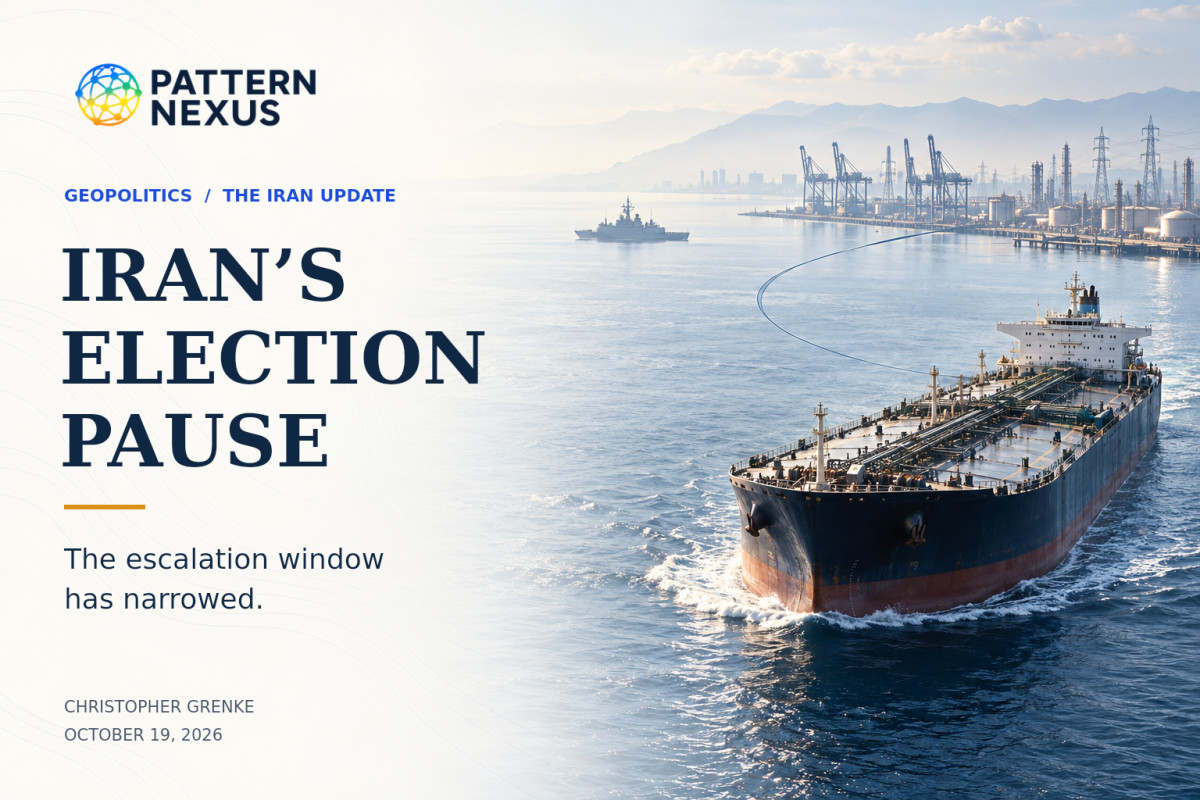
The first follow-up to the October 8 Iran forecast confronts Trump’s election pause, checks actual naval posture, and follows the conflict through shipping, infrastructure, fuel and financing. The November 5 endpoint stays fixed. Four original figures, dated source notes and reproducible data are included.
The first follow-up to the October 8 Iran forecast confronts Trump’s election pause, checks actual naval posture, and follows the conflict through shipping, infrastructure, fuel and financing. The November 5 endpoint stays fixed. Four original figures, dated source notes and reproducible data are included.
Jump to a section
The calendar has changed. The operating conflict continues.
- The timing case is weaker. Trump’s October 8 statement rules out an American attack before the November 3 election. I am reducing confidence in my original window. [1][2]
- The deadline stays fixed. November 5 remains the endpoint. Continuing maritime violence cannot be substituted for the broader renewed infrastructure campaign I forecast. [1]
- Posture needs a location and a mission. Dispatch, arrival, overlap and sustained operations are different stages. A third carrier headline does not establish all four. [3][16]
- A bargain needs performance. The Hormuz offer remains conditional. Relief requires accepted obligations, nuclear verification and commercial passage that works repeatedly. [5][6]
The Iran war has acquired a political pause. The systems carrying its costs are still under pressure.
On October 8, I put October 22 through November 5 on the calendar for a broader renewed campaign against Iran. Later that same day, Trump publicly ruled out an American attack before the November 3 midterms. That is a material change to the timing case, and it belongs at the beginning of this update. [1][2]
I am reducing confidence in the original calendar. I still see a dangerous infrastructure conflict with several ways to widen, but the machinery being available does not tell us when a president will use it. The distinction between preparation and execution was central to my January work. It applies to my own forecast too. [1]
As of October 19, the window has not opened. This is the entry assessment: what changed, what remains exposed, and what would count as success or failure when the original endpoint arrives.
Research cutoff: October 19, 2026. Observation dates and forecasts are labeled separately.
An election pause changes the timing judgment; a working settlement changes the system
The October 8 timing call retains its original endpoint.
Trump’s statement weighs against the earlier part of the window.
An announced reinforcement has to become available capacity.
Accepted terms must become access, restraint and reliable voyages.
The first correction came later the same day
The saved October 8 article has a reporting cutoff of 14:22 UTC. Trump’s post followed at 16:17 UTC, or 12:17 p.m. Eastern. He said there would be no American attack before the November 3 election while the blockade continued. The American Presidency Project preserves the statement and links the original post. [1][2]
That sequence matters. The forecast was written before the statement. An October 19 follow-up has had eleven days to absorb it. I cannot keep the opening assessment unchanged and treat a direct presidential restraint on the use of force as background noise.
The statement is a public policy position. It can affect expectations and diplomacy even while military options remain ready. It can also be revised after an attack or another political decision. My analysis has to allow those possibilities without assuming that a reversal is already planned.
The stronger evidence now favors continued pressure and negotiation before the election over the earlier part of my proposed American campaign window. A naval buildup can support that pressure. It does not cancel the political decision to wait.
The continuing blockade is part of the conflict. So are commercial attacks and regional retaliation. A pause in one type of American operation can coexist with all of them. That explains why the underlying risk can remain elevated while my confidence in a particular calendar range comes down.
What would actually satisfy the forecast?
The October 8 call concerned a broader renewed campaign, with a sustained expansion into Iran’s energy, power, transport and trade-supporting infrastructure. It also warned that retaliation could widen the regional logistics problem. Those are two connected parts of the scenario, with the American campaign and its target set doing essential work in the forecast. [1]
A tanker attack does not, by itself, establish that campaign. Neither does an old strike newly documented by investigators, a reinforcement still at sea, or another announcement that the military has options. Those can inform the assessment without satisfying the event I put on the calendar.
I will record an operation’s start separately from the evidence that it became sustained. If a limited action occurs on November 5 and expands later, the original date does not automatically earn a full timing success. The record must say what was actually established inside the window, and what became clear only afterward.
The same discipline applies if an operation starts earlier than October 22. A campaign outside the proposed dates can support the infrastructure-risk argument while missing the timing range. Getting a mechanism right does not repair a date.
There is still time for the public restraint to change, for a wider campaign to emerge near the election, or for an agreement to intervene. There is also a straightforward outcome in which the deadline passes without the described campaign. If that happens, the timing forecast has missed. A dangerous world is not evidence that every dangerous-world forecast was correct.
| Test | Evidence required | October 19 status |
|---|---|---|
| Timing | The described broader campaign occurs in the published October 22–November 5 range. | Unscored: the window has not opened. Public restraint weakens the earlier portion. |
| Target expansion | Repeated expansion into the systems that keep Iran operating, with sustained follow-on activity. | Prospective risk. Regional damage already recorded elsewhere is a different observation. |
| Regional transmission | Retaliation reaches the surrounding logistics and infrastructure network. | An active concern; it does not independently confirm the first two tests. |
| Settlement | Accepted obligations become verification, restraint and dependable passage. | A route to lower risk; an exchanged proposal is incomplete. |
The third carrier story now needs its arrival check
The October 2 PN brief ended with the right question: would the prospective carrier overlap become a rotation, a deterrent position or the staging layer for a new operation? It identified inconsistent arrival expectations at the time. A follow-up needs to resolve that question with newer observations. [16]
The Navy’s October 16 indexed announcement corroborates Theodore Roosevelt’s Yokosuka arrival. USNI’s October 19 tracker places its subsequent departure from Japan on Monday, attributing that movement to ship spotters. The tracker lists Makin Island moving west in the Pacific, while George Washington and George H.W. Bush operate in the Arabian Sea. These are dated, approximate public positions. [3][4]
That is enough to reject an assumption that the entire announced reinforcement is already concentrated in the Iran theater. It does not establish that a later overlap is impossible. Transit, replenishment, exercises, relief arrangements and mission assignments determine when a force becomes useful for a particular task.
The meaningful count is available capability over time. An arriving carrier and a departing carrier can briefly produce a large headline number while preserving roughly the same sustained presence. A longer overlap changes that calculation. So does the need to protect ships, regional facilities and commercial traffic while reserving capacity for another mission.
A public tracker is also not a command order. Even confirmed concentration would establish an expanded option, while the president’s decision and the operational mission would remain separate evidence. My earlier window was partly an inference about the convergence of those stages. The latest posture gives that inference less immediate support.
| Formation | October 19 public picture | What the observation establishes |
|---|---|---|
| Theodore Roosevelt | Japan departure reported by USNI, citing ship spotters. | Movement; a Middle East arrival is still a separate event. |
| Makin Island | Pacific westward transit in the USNI tracker. | Reinforcement underway; theater availability remains ahead. |
| George Washington / George H.W. Bush | Arabian Sea operations in the USNI tracker. | Existing regional presence; no inference of a permanent three-carrier overlap. |
The seven-day offer still turns on who moves first
Reuters reported on October 18 that Araqchi’s conditional Hormuz offer remained available: relief from the port blockade and oil sanctions, an end to regional hostilities, then reopening within the proposed sequence. Washington’s insistence on addressing enrichment at the outset remained a central disagreement. That is a proposal under discussion, rather than an implemented bargain. [5]
Each side is trying to preserve the leverage the other side wants removed. Tehran wants access and relief before giving away the corridor’s bargaining power. Washington wants a nuclear result before surrendering pressure. Continuing to exchange messages can prevent a rupture while leaving that sequencing dispute unresolved.
The most useful next document would specify obligations that can actually be performed. Which restrictions change? When? Who verifies nuclear access? What happens to a vessel already underway if another theater erupts? Who handles a disputed incident before it becomes a reason to abandon the arrangement? A seven-day headline cannot answer those questions on its own.
For the verification baseline, the IAEA’s September 7 statement described missing information and access and a loss of continuity of knowledge about affected nuclear material. That is a dated official assessment, carried here with its date. I have not established a subsequent restoration of that continuity in the sources reviewed for this update. [6]
Uncertainty about material and access leaves room for opposing claims. It supplies neither a current verified stockpile count nor proof that the nuclear issue has disappeared. A settlement would need a monitoring arrangement capable of replacing assertions with observations.
Araqchi’s October 19 remarks beside Lavrov called for diplomacy and a regional security arrangement without foreign forces. That expresses Tehran’s preferred security order. It does not establish regional acceptance or an agreed implementation mechanism. [18]
I would lower the escalation assessment for a partial agreement that genuinely reduces risk. It does not have to solve every political dispute. But the benefit must survive repeated voyages and actual inspection work. The more modest the agreement, the more precisely its scope needs to be defined.
Hormuz is moving cargo under conditions that still impose a cost
UKMTO’s October 16 overview gives weekly outbound/inbound totals of 125/129, versus 129/146 previously. It combines AIS-derived observations and U.S.-stated facilitated movements that UKMTO cannot fully verify. These count vessels, not barrels. [7]
Twelve attacks were reported across Hormuz and adjacent Gulf waters; underreporting limits the count. A Bab el-Mandeb event was classified as land-conflict spillover. [7]
Those qualifications are central to the economic interpretation. A reporting system with reduced visibility should not be used to manufacture a precise attack probability per voyage. A claim that protected traffic is moving needs its own evidence too. A voyage can be real and costly; incomplete observation can hide successful movements as well as incidents.
Reuters’ October 14 account attributes an election-related price-pressure strategy to two Iranian officials and a switch toward small-boat spotters to a U.S. official. These are attributed accounts of intent and tactics, rather than independent proof of who caused every maritime incident. [8]
My control-valve argument survives recovering traffic only if it remains specific. A corridor can impose leverage through delay, uncertainty and the resources needed to keep it operating. It does not need to stop every ship. Conversely, stronger and more dependable passage would be a real loss of leverage for the party trying to restrict it.
The update I want next is a consistent series of completed movements, loaded volumes, arrivals and costs, with the coverage kept clear. An AIS-only count, a protected movement reported by a navy and a monthly cargo estimate answer different questions. Combining their most dramatic observations would make a stronger story and a weaker measurement.
A crude recovery can leave the product system short
The IEA’s October report estimates September Gulf crude exports at 13.9 million barrels a day, more than three-quarters of pre-war levels. Middle East refined-product exports were 1.9 million against a 4.7-million pre-war reference; LPG was 0.67 million against 1.5 million. Those imply roughly 40% and 45% recoveries for the latter categories. September estimates do not measure today’s passage. [9]
This is why I keep separating a barrel leaving an export terminal from the fuel a customer can use. Crude still needs compatible refining capacity, a product yield, loading slots and a reliable route to its destination. A damaged conversion step can prevent a recovery in feedstock from becoming an equivalent recovery in useful supply.
There is genuine good news in more crude reaching the market. It gives refiners more choices and reduces the loss relative to a continuously shut corridor. The product comparison explains why that improvement may coexist with expensive freight, emergency measures and continuing pressure on household purchasing power.
I will not use a September regional total as proof that the route is normal in late October. Nor will I erase the September improvement because renewed attacks make the outlook uncomfortable. A useful forecast must accommodate repair and adaptation as carefully as it accommodates new damage.
The infrastructure warning is about recovery as well as damage
Reuters’ October 15 investigation identified at least 135 strikes on 84 Gulf infrastructure sites since February 28, including energy-routing equipment, LNG facilities, airports and pipeline stations. That cumulative record concerns Iran and its allies’ regional attacks. It is retrospective evidence of vulnerability, not a count of new October strikes or confirmation of my forecast for a renewed American campaign inside Iran. [10]
The distinction strengthens the analysis. There is already an observed regional infrastructure conflict. The additional question I forecast was whether Washington would make sustained attacks on Iran’s operating systems central to its next campaign, and what retaliation would follow. The existing record shows a mechanism that can matter. It cannot supply the missing date or decision.
My October 8 Stone Age warning concerned modern services failing together: electricity, fuel distribution, water pumping, medical care, communications and transport. The relevant unit is a network of dependencies. A generator helps only while it has fuel, maintenance and a working connection to the service it is supposed to support. [1]
Repeated damage can force an economy to spend its available labor, equipment and foreign currency restoring yesterday’s function. A repair crew may be capable of replacing a component and still wait for transport, imported parts or a bank to process payment. The cost of recovery can rise long before a country loses every route or every source of power.
Iran has industrial capacity, technical expertise and experience adapting under pressure. Any assessment that assumes a passive system will overstate damage. The practical question is whether restoration can outrun new losses across enough essential services at once.
The same test belongs on the other side of the Gulf. A successful interception rate does not, by itself, measure whether an airport, pumping station or industrial complex keeps operating. Nor does one damaged facility prove the entire bypass network has failed. Operating hours, restored capacity and dependable output provide a more useful record than the first image of a strike.
My Libya comparison was a warning about the gap between breaking a state and providing a workable aftermath. Economic destruction does not guarantee political liberalization or an orderly transfer of control. Security institutions can remain cohesive while civilian life becomes much harder. That remains an essential part of the infrastructure-risk case, regardless of whether my timing forecast succeeds. [1]
The second corridor needs its own evidence
Yemen and Bab el-Mandeb remain connected to the Iran problem through shipping, regional security and the burden of protecting infrastructure. They also have their own actors, decisions and incident record. I will not treat every event near the second corridor as a centrally directed Iranian operation.
There is a distinction between a land campaign that threatens ports or nearby shipping and a renewed campaign deliberately targeting merchant vessels. Both can matter economically. Their causes, immediate responses and prospects for restraint can differ.
The cost is also civilian. AP’s October 18 report relayed Houthi officials’ account of at least nine civilians killed in a Saada airstrike, which they blamed on Saudi Arabia. The casualty account and attribution remain theirs. [19]
Civilian harm can create displacement, impair local services and harden political positions even while the governments involved describe the campaign in military terms. A regional security framework must be judged against the services it protects and the escalation it contains, as well as the equipment it deploys.
The October 8 article examined announced Saudi–Pakistani–Turkish collective-defense arrangements and disputed reporting about a possible Syrian role. Those historical announcements should not become a fresh claim that every proposed force is deployed or that Syria has entered the war. New personnel, missions and command arrangements need new evidence. [1]
The exposure grows when more governments have facilities, people and political commitments at stake. That can improve deterrence. It also makes the consequences of an ambiguous incident harder to contain. The next update should establish what each government has actually committed to do before assuming an automatic chain of responses.
Emergency supply buys time for a system that still needs repair
The G7’s October 2 statement calls for implementing earlier commitments with a coordinated 100-million-barrel release over four months, accounting for commitments already fulfilled. Diesel is frontloaded within the first twenty days, with an implementation report due before twenty days. That places an early check near October 22. It does not establish completed deliveries. [11]
The useful follow-up is a delivery ledger. Which country offered which product? When was it awarded, loaded and delivered? Which user or region gained access? What stock remains? An announced gross volume cannot answer the immediate question of usable supply.
The October 16 White House order adds another policy adjustment through broad waivers under the new Russia-and-Iran sanctions statute, while preserving existing Russia executive-order sanctions. The legal scope matters: it is not the removal of every Russian sanction. Permission still needs buyers, finance, transport and working production to produce a physical result. [12]
This continues the older PN logistics argument. The August Jones Act brief examined legal flexibility as a substitute for constrained shipping capacity; the September global oil-war article followed physical pressure into financial access. Those are dated stages in the research chain. Their old conditions should not be silently carried forward as today’s operating facts. [17][20]
Emergency measures can prevent a more severe shortage and deserve credit when they work. They also create a test: does the time purchased allow maintenance, replenishment and more reliable flows, or does the next interruption consume the benefit? That is the bridge between the first Diesel Trap package and this Iran update.
The election pause does not suspend the economic bill
September CPI rose 0.6% for the month and 3.7% over the year. Gasoline’s 9.1% monthly increase accounted for more than half the monthly all-items rise. Those are BLS observations for September, released October 14. They do not isolate the portion caused by Iran. [13]
A new campaign would meet an economy already absorbing higher energy costs. A continuing pause can help that adjustment if it allows reliable supply and repair. A pause that leaves maritime costs elevated can still transmit pressure through freight, inventory carrying costs, business margins and household budgets.
Financing is another constraint. The October 19 H.15 release reports October 16 observations of 5.09% for the nominal ten-year Treasury and 5.43% for the thirty-year, with a 3.16% inflation-indexed thirty-year yield. These are dated levels, rather than live October 19 quotes. [14]
Those yields cannot diagnose a funding crisis by themselves. They do explain why a business trying to hold more expensive inventory or replace equipment may face an additional financing hurdle. Physical resilience often requires spare capacity and working capital at the moment both become costly.
The Fed’s October 27–28 meeting falls inside my original window. [21] The September record separated maintaining ample reserves through reserve-management operations from a program aimed at lowering long-term yields. A future supply shock does not determine in advance which instrument the Fed would use. [15]
The household version is less abstract. A worker pays the fuel bill and the cost embedded in deliveries. An infrastructure owner may receive more revenue for providing scarce capacity. Debt, contracts, public policy and ownership determine who can absorb the adjustment. The war’s economic transmission continues between military decision dates.
What changed, and what remains unresolved
The evidence is moving in different directions. The public election restraint weakens an imminent American escalation case. Continued maritime incidents and infrastructure vulnerability sustain the reason to watch. Recovering crude exports improve one part of the balance, while the product system remains a separate test.
I am not averaging those observations into a precise probability. The choice to widen a war, the response to a disputed incident and the implementation of a bargain are not quantities I can recover from this small record. I can state which observations move the assessment and what would change it again.
| Date / observation | Evidence stage | Implication for the October 8 call |
|---|---|---|
| Oct 8, after the article cutoff: Trump’s pre-election restraint [2] | Primary public statement | Lowers confidence in the earlier part of the timing range; continued blockade remains explicit. |
| Oct 14: Reuters reports changed maritime tactics [8] | Attributed officials’ accounts | Supports monitoring the pressure campaign; intent is not a verified closure. |
| Oct 14 release: September energy flows [9] | Monthly estimates | Supply improvement and uneven recovery coexist; these do not measure October 19 traffic. |
| Oct 15: Reuters infrastructure investigation [10] | Cumulative retrospective reporting | Demonstrates regional vulnerability; it is not a newly launched US campaign. |
| Oct 16 publication: UKMTO weekly overview [7] | Reported movements and incidents, with coverage limits | Commercial reliability remains contested; no complete attack census is inferred. |
| Oct 16 / 19: Navy arrival notice and USNI tracker [3][4] | Official corroboration plus dated public tracking | Reinforcement has stages; actual theater overlap remains a separate test. |
| Oct 18–19: diplomacy reports [5][18] | Conditional offer and stated regional preference | A channel remains open; mutual performance has not been established here. |
| Oct 22–Nov 5: original PN window [1] | Forecast, still prospective at this cutoff | Score timing and sustained expansion separately. Preserve the endpoint. |
Three paths still fit the operating conflict
The first path is a performed bargain. Restricted activities change in an accepted order, inspectors gain usable access, and commercial operators complete enough reliable voyages to plan the next ones. This would lower the escalation assessment and create room to repair and replenish. A partial bargain could be valuable if it has a clearly defined scope and a way to handle incidents.
The second is prolonged coercion with bounded military actions. Pressure, protection and negotiations continue while each side tries to improve its position. This path can keep a broader campaign off the calendar without creating normal conditions. It is also a plausible way for the original forecast to miss while the economy continues paying for the conflict.
The third is a sustained infrastructure expansion followed by wider retaliation. The threshold is operational: repeated action across essential systems, persistent disruption and a repair burden that grows. An initial limited action can become part of that sequence, but its expansion has to be observed before I describe the larger campaign as established.
My October 8 assessment put more weight on that third path within the specified window. The election restraint and the distinction between dispatched and available forces now make that calendar less convincing. I give more weight to continued coercion and negotiation before the vote. The post-election decision remains open.
The next few weeks can contain several of these stages. That does not permit an elastic definition in which any outcome confirms the original call. A bargain is an improvement. A bounded action is bounded until evidence shows otherwise. A broader campaign needs its own dated record.
Keep the endpoint. Follow the system between the headlines.
The next decision window is political, military and physical at once. The vote influences the political calendar. A deployment influences available options. Shipping and infrastructure influence the bill paid while leaders decide. None gives a complete account on its own.
For the next check, I will look for actual theater arrival and relief arrangements, accepted diplomatic obligations, nuclear verification work, completed commercial voyages, restored infrastructure output and delivered emergency products. Each has a different observation period. A useful update will identify those periods before connecting them.
The October 22 opening date is a checkpoint, rather than a promise that something must happen that day. The final assessment belongs after November 5, when the original range has passed. If events warrant an earlier article, it should record a real change rather than recycle the forecast as a new warning.
My present read is that a wider infrastructure conflict remains a serious risk, while the original American escalation timetable has weakened. That is the update. The public pause deserves weight; the continuing operating conflict deserves attention.
The core Pattern Nexus question is whether the systems keeping a society and its trading partners functioning can restore more capacity than the conflict consumes. Military power can create options. An agreement can create permission. The lasting outcome depends on power returning, equipment working, payments clearing and cargoes arriving.
November 5 stays on the calendar. If the broader campaign I described has not happened, I will mark the timing call as a miss and explain what changed. Maintaining the research chain means carrying its corrections forward with the rest of the evidence.
Questions readers may have
Has Pattern Nexus moved the October 22–November 5 forecast?
The endpoint remains November 5. This update lowers confidence in the original timing after Trump’s public pre-election restraint. If the broader campaign described on October 8 does not occur in the published range, the timing call misses. [1][2]
Does Trump’s statement guarantee there will be no military incident?
It is a public American policy position, rather than a guarantee controlling every actor, incident or future decision. Continuing violence elsewhere also cannot be used as an automatic success for the specific campaign forecast.
Are three American carriers already concentrated near Iran?
The reviewed evidence does not establish that posture. Dispatch, transit, regional arrival, overlap and sustained mission availability require separate observations. The article’s posture check is dated October 19. [3]
Does a reopened shipping route settle the nuclear dispute?
A maritime arrangement and nuclear verification need accepted obligations connecting them. A workable partial bargain can lower risk, but a conditional offer has to become performed steps before its benefits can be assumed.
What would change the current assessment most?
An implemented agreement with usable verification and repeated safe commercial passage would lower risk. A confirmed sustained expansion into essential infrastructure, with wider retaliation and failing restoration, would strengthen the structural danger. Either outcome still needs its own dates.
Sources and calculation notes
- Pattern Nexus / Christopher Grenke. Iran: Escalation Ladder — Reactivation Enabled. October 8, 2026; saved body cutoff 14:22 UTC.
- Donald J. Trump / American Presidency Project. Truth Social posts of October 8, 2026. October 8, 12:17 p.m. EDT / 16:17 UTC.
- U.S. Naval Institute News. Fleet and Marine Tracker: October 19, 2026. October 19; approximate positions based on Navy and public data.
- U.S. Navy. USS Theodore Roosevelt Arrives in Yokosuka. October 16, 2026.
- Reuters. Iran urges US to accept proposal to reopen Strait of Hormuz. October 18; updated October 19.
- IAEA / Director General. Introductory statement to the Board of Governors. September 7, 2026; historical verification baseline.
- UK Maritime Trade Operations. Voluntary Reporting Area weekly overview, report 11. Produced October 16; relevant reporting through October 14.
- Reuters / Hafezi, Saul and Stewart. Iran shifting tactics to step up attacks on shipping before US vote, officials say. October 14, 2026.
- International Energy Agency. Oil Market Report — October 2026. Released October 14; September estimates.
- Reuters Investigations. Iran’s precision strikes picked apart Gulf infrastructure, blunting US war plans. October 15, 2026.
- G7 / Élysée. Leaders’ statement on global energy security and market stability. October 2, 2026.
- White House. Implementing the Lindsey O. Graham Sanctioning Russia and Iran Act of 2026. October 16, 2026.
- U.S. Bureau of Labor Statistics. Consumer Price Index — September 2026. Released October 14; September observation month.
- Federal Reserve. H.15 selected interest rates. Released October 19; October 16 observations used.
- Federal Reserve. Minutes of September 15–16 FOMC meeting. Released October 7; next scheduled meeting October 27–28.
- Pattern Nexus / AI Nexus. Washington Turns a Third Carrier Into an Iran-War Escalation Option. October 2, 2026.
- Pattern Nexus / Christopher Grenke. The Oil War Is Becoming a Global Economic War. September 21, 2026.
- Reuters. Iran’s Araqchi blames US for Strait of Hormuz tensions, calls for diplomacy. October 19, 2026.
- Associated Press. Airstrike kills at least 9 in rebel-held Yemen, and other Mideast news. October 18, 2026.
- Pattern Nexus / AI Nexus. Washington Turns the Jones Act Waiver Into an Iran-War Fuel Bypass. August 17, 2026.
- Federal Reserve. FOMC meeting calendars and information. Updated October 7; October 27–28 meeting listed.
Reporting cutoff: October 19, 2026, U.S. Central time. This is a pre-window assessment, not a November 5 outcome score. Source publication dates, observation periods, statements, estimates and PN forecasts are kept separate. Live source pages may change after review.
Forecast provenance: the complete saved October 8 predecessor was reread for this update. Its original cutoff was 14:22 UTC; the presidential post followed at 16:17 UTC. Both times fall on October 8. The source trail also includes complete reads of the October 2 carrier brief and August 17 Jones Act brief; the September 21 oil-war body was read in the preceding batch.
Figure 1 is a calendar comparison of published dates, not an operational model. It does not assign a launch time on election day or assume a statement cannot change. No numerical probability has been fitted.
Figure 2 uses the source’s paired totals. No attack-per-voyage rate is calculated. [7]
Figure 3 computes category-specific ratios from rounded estimates: 1.9/4.7 × 100 = 40.4%; 0.67/1.5 × 100 = 44.7%. It is not Hormuz throughput. [9]
Figure 4 is an explanatory dependency diagram based on the PN infrastructure and recovery framework. It is not a geographic map, observed damage inventory or simulation. Treasury observations are October 16 values in an October 19 release; CPI observations concern September.
Source-access boundary: the full Navy page returned an access error; its indexed official title/date corroborate the narrow arrival fact, while USNI supplies the qualified posture account. The long Reuters visual special report could not be opened; only its retrieved original dispatch is used for the explicitly attributed cumulative finding. The dated IAEA statement is not portrayed as a new October inspection.
The deadline stays where I put it. The next judgment belongs to the evidence.
What's Your Reaction?
 Like
0
 Dislike
0
 Love
0
 Funny
0
 Wow
0
 Sad
0
 Angry
0

Nexus (Christopher)
Founder of Pattern Nexus. I research markets, macro, geopolitics, AI, history, ancient systems, and the patterns most people overlook. I’m also building Market Radar, a trading scanner designed to read pressure, risk, confirmation, and setup quality before ch…
Related research
The Diesel Trap: Why the Oil War Is Bending Sanctions Before Winter
The October Russia-sanctions waiver adds a new policy chapter to the Pattern Nexus oil-war thesis. I connect the diesel bottleneck to emerg…
8 shared topics.
Iran: Escalation Ladder — Reactivation Enabled
The Iran escalation ladder is active again. I examine the October strike risk, the infrastructure-war danger, rising tanker attacks alongsi…
7 shared topics, same research avenue.
Washington Turns a Third Carrier Into an Iran-War Escalation Option
The United States is dispatching the USS Theodore Roosevelt carrier strike group and the Makin Island amphibious ready group toward the Mid…
6 shared topics, same research avenue.
Tehran Turns Hormuz Reopening Into a Seven-Day Energy-Security Bargain
Iranian Foreign Minister Abbas Araghchi says Tehran has sent Washington a seven-day roadmap through Qatar that would reopen the Strait of H…
5 shared topics, same research avenue.
The Oil War Is Becoming a Global Economic War
An extensive Pattern Nexus reconstruction linking the Iran/Hormuz disruption with Ukrainian refinery attacks, diesel shortages, Saudi pipe…
4 shared topics, 1 shared asset.
Washington Turns Iran Sanctions Into a China Oil-Flow Loyalty Test
The U.S. and Iran traded warnings before a planned Monday sanctions announcement by Treasury Secretary Scott Bessent. Reuters, AP and Bloom…
5 shared topics, same research avenue.
The Price of a Fractured World: Why the 30-Year Treasury Is Sending a Geopolitical Signal
Something about the global system feels uncomfortable, and the last month of data suggests that feeling has a measurable foundation. The U.…
4 shared topics, 1 shared asset.
Washington Turns the Hormuz Deadline Into an Oman Strike Threat
AP reported on August 17, 2026, that Trump again threatened Oman while Iran said it had reached an understanding with Muscat over a Strait …
5 shared topics, same research avenue.
Comments (0)
Security Check
Please complete the captcha to verify you are human.