

Iran: Escalation Ladder — Reactivation Enabled
The Iran escalation ladder is active again. I examine the October strike risk, the infrastructure-war danger, rising tanker attacks alongside recovering exports, the Gulf defense response, financial isolation, current oil inventories and the Federal Reserve’s position. My working window is October 22–November 5. The…
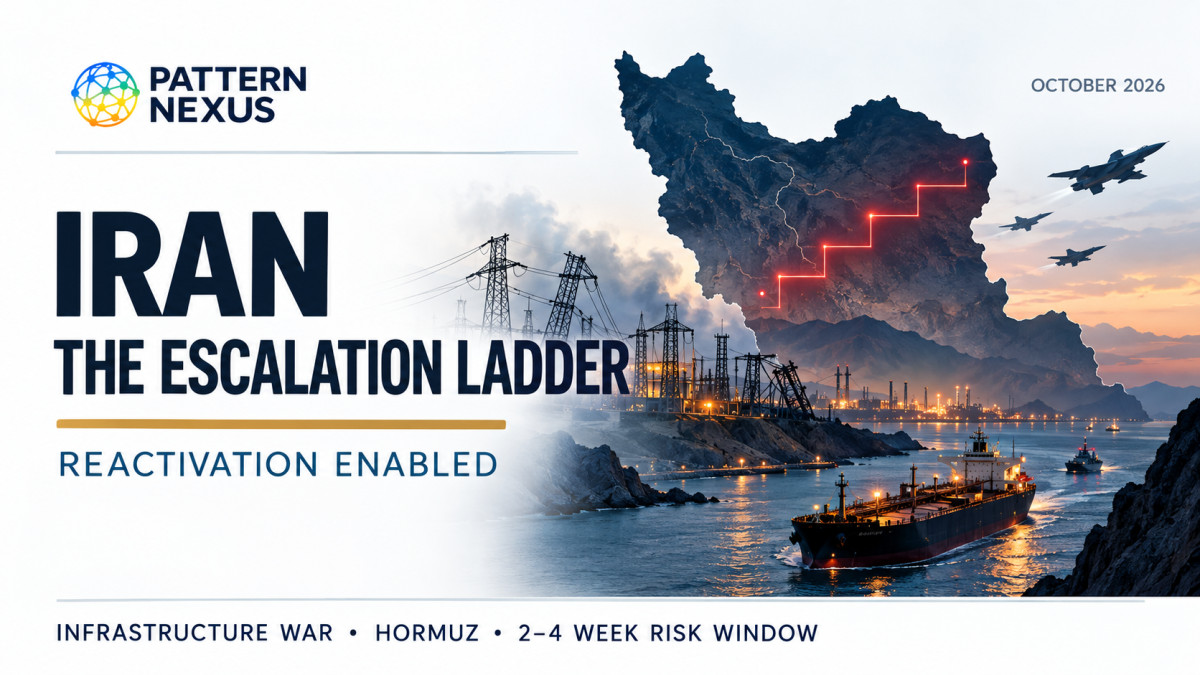
The Iran escalation ladder is active again. I examine the October strike risk, the infrastructure-war danger, rising tanker attacks alongside recovering exports, the Gulf defense response, financial isolation, current oil inventories and the Federal Reserve’s position. My working window is October 22–November 5. The…
Jump to a section
PATTERN NEXUS · IRAN / ENERGY / GLOBAL MACRO
Iran: Escalation Ladder — Reactivation Enabled
Infrastructure war, the Hormuz control valve, and my October 22–November 5 risk window.
October 8, 2026 · Christopher Grenke / Pattern Nexus · 37–45 minutes
I am watching October 22–November 5 for a broader renewed Iran campaign. The infrastructure risk reaches power, fuel, water, transport and recovery capacity. Regional exports have improved, while tanker attacks continue to challenge reliable access. The next round could widen through Gulf bases, energy assets and a second maritime corridor, then reach inventories, inflation and financing. This update connects the new evidence to the PN research trail from January onward.
October 22–November 5 is my two-to-four-week window. A workable agreement would change the call.
More regional exports and unreliable maritime access can exist together. Watch sustained delivery and safety.
Use the product and location of a barrel, not only the gross total, to assess what it can replace.
A damaged civilian economy can coexist with durable political control. Destruction does not supply a transition plan.
The next decision window is opening
Iran. Escalation ladder. Reactivation enabled. My working window is two to four weeks from October 8: October 22 through November 5. I expect another substantial escalation if the diplomatic gap remains unresolved and the maritime attacks continue.
If the next campaign goes after the infrastructure that allows Iran to function, parts of the country could be knocked back into the Stone Age. Power, fuel, water, transport and medical care can fail together. That is the danger behind my Libya 2.0 warning. The damage would reach beyond the first military targets and beyond Iran itself.
I am returning to the escalation ladder because the next step could turn a recurring strike-and-retaliation cycle into a sustained attack on the systems that keep a country operating. Iran then has every incentive to widen the bill across the region. Oil inventories, shipping, inflation and financing are all part of that bill.
Axios reports possible renewed Iran strikes; Trump has not made a final decision. [1] The accompanying reporting describes preparations for a larger campaign and possible energy, infrastructure and nuclear targets. [2] I read that combination as an attempt to make the military option executable while the political decision remains open.
On October 1, AP reported the dispatch of roughly 9,000 troops with the Theodore Roosevelt carrier group and Makin Island amphibious group. A possible late-October overlap would increase the options available to Washington. Arrival dates, rotations and actual stationing still matter; a projected overlap is not three carriers already operating together in the Gulf. [29]
More force gives a president more choices. It also gives commanders more capacity to sustain an operation, protect regional positions and respond to retaliation. The deployment can support coercive diplomacy. It can support war. You have to follow the next decisions to know which purpose becomes dominant.
Reactivation enabled. My central watch window is October 22–November 5, 2026. The trigger I am watching is a sustained expansion against Iran’s energy, transport and supporting infrastructure, followed by retaliation that reaches the regional logistics system.
I am not starting a new theory because a new headline appeared. I am updating a sequence I have been following since January. The pressure has moved through domestic instability, military options, direct strikes, maritime disruption, infrastructure damage, inventory depletion and financial strain. October is another decision point inside that sequence.
How we got here: January’s decision window became a systems war
In The Iran Decision Window on January 12, I separated the preparation of options from the decision to use them. That distinction still holds. A briefing creates a choice. A deployment makes that choice easier to execute. Neither supplies a launch time by itself.
Two days later, I widened the frame to embassy pullbacks, airspace, blackouts and the retaliation problem. The physical signs around a conflict often tell you more than another threat at a podium. The internal question was also important: economic pain and public anger do not automatically remove a government whose security institutions remain cohesive.
By February 28, the escalation ladder had become a direct strike problem. The March updates followed the spillover into ports, commercial vessels and the Gulf. The Hormuz Theory then asked whether a mission to protect shipping could create pressure for coastal control and a longer war. That was a conditional path, not a claim that occupation had already happened.
In July, War Is Back On examined the expansion into power, ports, transport and trade corridors. My later update stressed that damaging a route does not isolate an entire country. Iran has redundancy, repair capacity and alternative connections. The relevant question is the cost and reliability of the routes that remain.
The June and August inventory work added the economic clock. Supply interruptions can be covered for a time, but repeated disruption prevents the system from rebuilding its cushion. The September work carried that argument into diesel, the dollar, Treasury financing and the distribution of costs between owners and people living on wages.
That is the research trail behind this article. The links at the end let you read it in order. Some calls developed as new evidence arrived. Some timing judgments were wrong. A useful framework has to survive corrections, rather than use yesterday’s article as a reason to ignore today’s facts.
Why I am watching October 22–November 5
The two-to-four-week window is my forecast. It is a calendar range measured from this article’s date. It is not an official schedule and it does not mean that a weapon cannot be fired before October 22.
What I am trying to time is a broader renewed campaign: an operation with enough preparation and political commitment to expand the target set and sustain follow-on action. Force availability, diplomacy, shipping incidents and the response from regional governments all influence that decision.
The American midterms are November 3. [27] A campaign that pushes fuel prices higher would carry an obvious political cost. Leaders can also decide that waiting creates a larger military or diplomatic cost. The election gives the decision a deadline in public debate; it does not tell us which side of that deadline the decision will land on.
I give more weight to observable preparations than to confident statements about what Trump supposedly must do. A leader can use the threat to seek concessions, authorize a limited operation, choose a sustained campaign or delay while retaining the ability to act. The machinery can be ready under all four choices.
A mass-casualty shipping attack, a strike against a major regional installation or a severe misreading of the other side could pull the window forward. A workable agreement could close it. Continued talks without an enforceable arrangement could push it later while leaving the underlying conflict intact.
If November 5 passes without the broader campaign I am describing, this timing call has missed. I will reassess it against the evidence then. I will not keep moving the date and call that the same forecast.
For now, my bias is toward renewed escalation rather than a durable settlement. I am looking for changes that would force me to lower that assessment: verifiable concessions, a functioning monitoring arrangement, reliable commercial transit and a force posture consistent with reduced operations.
The nuclear bargain still has a sequencing problem
Vance’s October 6 Reuters interview put a meaningful reduction in Iran’s enrichment capacity at the center of Washington’s demands. A senior Iranian official responded that recognition of the right to enrich was a red line, with technical details negotiable later and Tehran’s conditions to be met first. [4]
That leaves a familiar problem. Each side wants the other to surrender leverage before it grants the concession the other side needs. A proposal can look close on a headline level and remain far apart on sequence, inspection, sanctions relief and what happens if a party fails to comply.
The nuclear question also requires better evidence than the language of total destruction. Reuters’ October 7 assessment described damage to the known enrichment facilities and uncertainty over remaining material and capacity. The often-cited 440.9 kilograms of uranium enriched to 60 percent was a pre-attack inventory, not a verified count of what Iran holds today. [5]
The IAEA’s September 7 statement described the loss of continuity of knowledge after more than a year without the necessary information and access. That verification gap cuts in both directions. It does not establish that Iran has built a weapon. It also prevents a confident claim that every relevant capability or stockpile has been eliminated. [24]
Bomb damage, access to nuclear material and the political willingness to permit inspections are separate questions. A military campaign can alter the first while making the other two harder to resolve. A settlement has to deal with all three.
I want to see who accepts which obligations, in what order, with what inspection access and what enforcement mechanism. Another exchange of proposals can keep diplomacy alive without solving any of those questions.
Hormuz: the export recovery now faces another traffic drop
The most important complication in the latest evidence is that exports have recovered while maritime attacks have intensified. You have to hold both facts at once.
Reuters reported that provisional Kpler data put regional crude exports at a seven-day average of 18.3 million barrels per day on September 30. Its regional measure included Hormuz, Red Sea and Gulf of Oman terminals and ship-to-ship transfers. It was not a measurement of 18.3 million barrels passing through Hormuz each day, nor a September monthly average. [7]
Separately, Reuters reported at least 12 tanker attacks from September 28 through October 5, based on three maritime-security sources. The IMO had verified nine in that period. Those are different counts with different verification processes; you do not add them together and announce 21 attacks. [6]
The October 8 update adds deterioration: Kpler counted seven commodity-vessel transits on Tuesday, October 6, the fewest since July 23, and ten on Wednesday, against more than twenty on Sunday and Monday. Alternative Gulf of Oman and Red Sea exports helped sustain regional volumes. [34]
That makes the location of the recovery even more important. A regional total can hold up while traffic through its most contested route weakens. The vessels being counted and the barrels being measured also describe different things; neither series should be substituted for the other.
Higher exports are a real improvement. They can relieve shortages, support refinery runs and make the economic outcome less severe than a continuously closed corridor. I am not going to discard that evidence because it complicates my risk case.
But commercial throughput and dependable access are different measures. A cargo can leave while the next cargo faces a higher insurance bill, a damaged vessel, a crew refusing the route or a delayed loading schedule. Ships moving under protection are still moving. They may also be moving at a cost that changes who can afford to trade.
An Iranian official said on October 7 that routes Tehran regarded as illegal near Oman would be blocked. That was a statement of intent and a claim of authority, not independent verification that those routes had closed. [8] Vessel reports and incident warnings need to be checked against maritime notices such as UKMTO’s, rather than assigned a perpetrator from the location alone. [9]
Reuters’ 13:17 UTC update reported heightened tanker risk following Iranian warnings against unauthorized export routes. Sources said political leaders and the Revolutionary Guards backed the plan. This describes reported intent; it does not verify closure of every threatened route. [38]
The valve can open enough to restore substantial exports while remaining contested enough to impose costs, delays and political conditions. Durable normalization requires reliable access over time. A strong seven-day export reading is one part of that test.
This is the mechanism I followed in March: passage need not fall to zero for the corridor to exercise pressure over the world economy. Repeated interruptions, threatened interruptions and expensive protection can all consume the cushion.
What I mean by “Stone Age”
If a sustained campaign moves deeply into the systems that make Iran function, my blunt description is that parts of the country could be knocked back into the Stone Age. I mean the failure of modern services: electricity, fuel distribution, water pumping, communications, transport, refrigeration and medical care.
Those systems depend on one another. A power outage affects a refinery, a pump, a hospital and a warehouse differently, but it reaches all of them. Fuel shortages make backup generators harder to sustain. Transport damage slows the replacement parts and supplies needed for repairs. Lost revenue and restricted banking make the repair bill harder to pay.
You can damage the ability to recover as well as the ability to operate. That is where an infrastructure campaign becomes more dangerous than a list of targets suggests. The first outage may be temporary. Repeated damage, spare-parts shortages and blocked payments can turn it into a recurring failure.
Iran is a large country with technical capacity, industrial experience, dispersed networks and people who have adapted to years of pressure. It will repair, reroute and improvise. I would not infer national collapse from footage of a single facility, or claim that destroying one bridge ends every northern trade connection.
The risk is cumulative. Repairs have to outrun new damage. Fuel has to reach the repair crews. Imports have to remain financeable and deliverable. If several of those conditions fail together, the operating standard of civilian life can decline much faster than the government’s coercive apparatus does.
A population can lose reliable power, clean water, income and medical access while the institutions that enforce political control continue to function. Economic devastation does not guarantee an orderly transition or a freer society.
That is the part I want you to keep in view when the discussion turns to decisive military results. An air campaign can achieve specific military objectives and leave a much larger reconstruction problem behind. The people living inside that problem do not experience it as a clean strategic victory.
Libya 2.0: the warning behind the shorthand
“Libya 2.0. Thank Hillary for the playbook.” That is my political shorthand for an intervention that removes or cripples the existing power structure and treats the functioning state that must follow as someone else’s problem.
There is a record behind the criticism. The British Foreign Affairs Committee’s 2016 review found that the Libya intervention drifted from civilian protection into regime change without a coherent strategy for the aftermath. It linked that failure to political and economic collapse, militia warfare, displacement and the growth of extremist groups. [25]
Clinton was a prominent participant in the 2011 policy. Her March 29 London remarks supported military action, sanctions, political isolation and a transition away from Qadhafi. The United States, Britain, France, NATO and regional partners all had roles. Pinning the whole intervention on one person would erase how the policy was actually made. [26]
I am using Libya as a warning about the gap between breaking a state and building a workable replacement. Iran is not Libya. Its population, geography, industrial base, security institutions and regional relationships are different. The outcome would not follow a carbon copy of 2011.
That difference can make an infrastructure campaign more consequential. A larger state can absorb more damage before it fails, and it can create a larger regional problem if essential systems do fail. A weakening government may respond with tighter control. Armed institutions may compete for revenue and territory. Outside powers may favor different outcomes.
Who keeps the water running, the hospitals supplied, the transport system working and the armed institutions under control? Any claim of a clean endgame has to answer that question before it celebrates destruction.
I do not see public evidence of a complete, agreed reconstruction and political-transition arrangement for Iran. That absence does not prove a secret intention to create chaos. It does mean I cannot treat a successful bombing campaign as proof that a stable outcome is waiting on the other side.
Iran can widen the bill beyond Iran
Reuters reported on October 1 that Iran was preparing a broader retaliation option if a major U.S. campaign resumed. The reported discussion included targets beyond narrowly American assets and preparations by partners in Lebanon, Yemen and Iraq. A response plan was being considered; the report did not establish that every option had been approved. [3]
The logic is straightforward. If Iran cannot defeat the opposing air campaign on equal terms, it can try to increase the cost of sustaining it. That can mean pressure on regional bases, shipping, energy infrastructure and the political relationships that allow foreign forces to operate.
Host governments then face a problem of their own. An installation serving American operations is also physically inside another country. Retaliation against it can endanger local workers, nearby infrastructure and that country’s airspace. The host may need to defend itself even if it did not choose the original strike.
This was central to my July work on the Gulf basing network. The network distributes capability. It also distributes exposure. You cannot assess retaliation by drawing a circle around Iranian territory and stopping there.
Yemen adds the second maritime pressure point. Hormuz affects passage out of the Gulf. Pressure around Bab el-Mandeb and the Red Sea affects another route used to move goods and energy between regions. Rerouting can keep cargo moving, but longer voyages require more fuel, vessel time and financing.
The humanitarian cost is already visible. Reuters reported IOM’s October 7 count of more than 200,000 people displaced by the renewed Yemen fighting, up from 76,000 in mid-September. [37] Those are people losing access to a home and basic services while the surrounding governments argue over security arrangements.
Lebanon and Iraq have their own domestic constraints, leadership decisions and military conditions. I would not assume that every armed group acts in perfect coordination with Tehran or that a ceasefire in one theater guarantees restraint in another. The Commons Library’s October 2 Lebanon briefing shows why withdrawal, disarmament and ceasefire implementation remain practical questions. [12]
A conflict that looks contained from an aircraft’s target list can therefore widen through the retaliation list. That is the escalation ladder I am watching: more infrastructure pressure produces more incentive to spread the cost, which produces more pressure for a wider response.
The Gulf defense response is becoming more organized
The Saudi–Pakistani–Turkish relationship now needs to be read through an official document. The October 5 Makkah Alliance committee statement announced activation of practical collective-defense commitments and planning for rapid deployment in Saudi Arabia under the participating countries’ legal arrangements. [10]
That is a meaningful step beyond a general expression of support. It creates a framework for a larger shared security presence. It does not mean every planned force has arrived, that the participants have declared war on Iran, or that every future incident will produce the same military response.
I want to know the mission, command relationships, locations and conditions for use. Air defense, protection of infrastructure, deterrence, maritime security and an offensive campaign involve different commitments. Treating them as one automatic alliance decision would hide the choices that still have to be made.
Axios also reported Saudi–Syrian discussions about a possible Syrian role in Yemen. I am treating that as a reported proposal, not a verified deployment or a completed commitment. [11] It matters because the defense of Saudi territory and the effort to contain Houthi pressure can pull additional governments into the wider security problem.
There is a direct dispute over that story. Reuters’ updated report records Syrian presidential adviser Ahmad Zaidan denying the claim that Saudi Arabia requested Syrian forces. A Syrian diplomat emphasized domestic recovery and official bilateral channels. [35] I would not turn that contested discussion into a headline announcing Syria’s entry into the war.
The immediate pressure on Saudi Arabia is physical. Reuters’ October 8 dispatch relayed Saudi reports of three deaths in attacks on Riyadh and Abha airports earlier in the week. It also described Turkish defensive support and Pakistani equipment and forces in Saudi Arabia. [36] The scale, mission and next steps still require verification.
The more organized the regional response becomes, the more difficult it is for Iran to impose costs on one actor without affecting another. The same development can strengthen deterrence and multiply the number of governments with forces, facilities and political credibility at risk.
The next useful evidence is actual personnel, equipment, command arrangements and operating rules. A signed statement changes the political framework. Deployment changes the physical balance.
My August carrier analysis made the parallel point for the United States. A ship concentrated in the Middle East cannot simultaneously provide the same presence elsewhere. Sustained protection consumes readiness, maintenance time and attention even when the force is doing its job successfully.
Russia, China and the financial side of isolation
Iran’s connections to Russia and China remain part of the war’s endurance problem. Trade, diplomacy, equipment, payment channels and physical corridors can help a country keep operating under pressure. They do not all provide the same kind of support, and they do not establish a promise of direct military intervention.
Russia and China vetoed an extension of the Iran expert-panel mandate at the Security Council in September. That vote did not simply erase the sanctions dispute. The parties continued to disagree over the status and legitimacy of the relevant measures. [15] China’s own September statement called for diplomacy, restraint and cooperation with the IAEA. [17]
The U.S.–China Economic and Security Review Commission’s September assessment described China’s economic importance to Iran and alleged procurement links supporting sensitive programs. [16] Those are reasons to examine how Iran retains access to money and goods. They are not evidence that Beijing has accepted every cost of an open-ended war.
The U.S. is attacking those connections financially as well as politically. OFAC’s October 5 alert warned foreign financial institutions that business with Iran’s sanctioned financial sector could expose them to sanctions under Operation Economic Outcast. [13] Its August Hormuz alert addressed sanctions exposure associated with payments for passage. [14]
That puts pressure on the transaction between a willing buyer and a willing seller. The cargo may exist. The route may be usable. But a bank, insurer or intermediary may decide that the payment is too costly or risky to process. Physical access and financial permission then become parts of the same constraint.
A functioning trade connection requires cargo, transport, insurance, settlement and a destination able to receive it. Pressure at any of those points can make an alternative route slower and more expensive without sealing the country off completely.
This is why I keep returning to network isolation rather than a cartoon of total isolation. The issue is the quality and cost of the remaining connections. Iran’s partners may keep important channels open while avoiding other exposure. That mixture can sustain the state and still leave the civilian economy under severe strain.
The latest inventory ledger: the cushion is still being spent
In The Oil Inventory War Machine, I described inventory as stored time. It gives the system a bridge across interrupted flow. That bridge has a location, an owner, a product specification and a delivery schedule. The gross number is only the beginning.
The latest EIA release available for this article was published October 7 and covers the week ending October 2. U.S. SPR stocks were 282.983 million barrels. Commercial crude and petroleum products excluding the SPR totaled 1,237.400 million barrels. Distillate was 105.138 million and kerosene-type jet fuel 42.504 million. [18] [19]
Across the six displayed weeks, the SPR fell by 3.621 million barrels. Commercial crude and products first built, then fell by 13.956 million between September 18 and October 2. That is a recent draw in an aggregate series, not evidence that every product or region moved in the same direction. [18] [31]
Commercial crude alone was 424.134 million barrels in the latest week, close to its August 28 reading. That is a useful check on the story. A nearly flat crude comparison can sit beside declines in other parts of the system. Watching only crude would miss the product mix.
Distillate fell 2.721 million barrels from its September 11 level. Jet fuel fell 3.370 million from August 28. Gasoline, meanwhile, edged higher in the latest week. The movements are uneven, which is exactly why I separate the products. [19] [32] [33]
| U.S. inventory · million barrels | Aug 28 | Oct 2 | Change |
|---|---|---|---|
| Strategic Petroleum Reserve | 286.604 | 282.983 | −3.621 |
| Commercial crude + products · excludes SPR | 1,242.342 | 1,237.400 | −4.942 |
| Commercial crude · excludes lease stocks | 424.460 | 424.134 | −0.326 |
| Distillate fuel oil | 104.187 | 105.138 | +0.951 |
| Kerosene-type jet fuel | 45.874 | 42.504 | −3.370 |
| Motor gasoline | 205.669 | 204.744 | −0.925 |
The comparison dates matter. Distillate is above August 28 and below its September peak. Saying only that it rose or fell would conceal part of the sequence. These weekly observations also reflect refinery operations, trade, demand and seasonal factors. They cannot assign the entire change to Iran.
The world does not need to reach zero oil for a shortage to become serious. A refinery needs compatible crude. A truck needs diesel in its delivery area. An aircraft needs jet fuel at its airport. An unusable or distant barrel cannot solve every immediate problem.
The American figures are a current, visible part of the ledger. They are not a complete measurement of the global cushion, and I am not extrapolating six weeks into a precise worldwide exhaustion date.
The G7 response tells you which part of the barrel matters
The G7’s October 2 declaration addressed refinery maintenance, utilization, product supply and emergency stocks. It set out a coordinated 100-million-barrel release over four months, including a significant diesel release in the first 20 days, while accounting for commitments already fulfilled under the March arrangements. It also reaffirmed avoiding energy export restrictions within the G7 and called for follow-up monitoring. [30]
I would not add 100 million barrels to every earlier release headline and assume that all of it is new supply. Nor would I treat the announcement as proof that the full amount has already reached users. The relevant ledger is commitments, barrels made available, barrels delivered and the stocks left afterward.
The focus on diesel and refining is important. Crude is feedstock. It has to be processed into usable products, in the right proportions, at facilities connected to the places that need them. A disruption to conversion or distribution can keep product markets tight while a crude benchmark looks more comfortable.
This connects to my September article on Iran, Ukraine, Russia, Venezuela and Cuba. Different conflicts and policies can affect different parts of the energy system. Supply, refining, sanctions, electrical generation and access to foreign currency do not have to fail in the same country to produce a connected economic shock.
It also connects to The Fertilizer Strait. Energy and shipping costs can change fertilizer production, availability and farmers’ purchasing decisions. The World Bank’s May analysis documented the earlier fertilizer surge and made recovery conditional on easing disruption. [23] Those historical prices should not be presented as today’s quotation.
The later risk is a planting and affordability problem. A farmer who cannot obtain or finance enough inputs may make a different planting decision months before the smaller harvest appears in an inflation report. That is a path to a 2027 food shock, not proof that a global famine has already been scheduled.
Emergency barrels can cushion a shock and prevent a worse shortage. A durable recovery requires dependable production, refining and delivery to rebuild the buffer after it is used.
The commodity dollar and America’s uneven advantage
My Commodity Dollar argument is about the relationship between physical supply and the financial system around it. Production, refining, exports, shipping security, insurance, credit and sanctions influence who can obtain energy on workable terms.
The United States has advantages across several of those functions. During a disruption, some producers, exporters and infrastructure owners can receive stronger revenues or a more important strategic role. Buyers with secure access may gain an advantage over buyers who depend on a threatened corridor.
That does not make the shock free for America. Households buy fuel and food. Businesses pay for freight, materials and financing. Higher revenues for an energy producer can exist beside weaker margins for a manufacturer and lower real purchasing power for a worker.
It also does not establish that oil legally backs the dollar, or that a company benefiting from higher prices proves someone planned the war for that purpose. Incentives, benefits and demonstrated intent have to be kept separate if the analysis is going to hold up.
The power lies in the whole arrangement. A country able to supply a scarce product, finance the purchase and influence access to transport has several forms of leverage at once. A country that can buy the product only through expensive detours and restricted banks has fewer choices, even if it still has money on paper.
National energy leverage can rise while household affordability deteriorates. Watch who owns the productive assets, who receives the revenues, and who has to absorb the higher operating cost.
That is how the oil war becomes a distribution problem as well as a geopolitical one. The same price can be an income stream to one participant and a loss of freedom to another.
The Fed is already tightening into the long-end problem
I previously argued that the debt burden would constrain the Fed’s ability to raise rates. The September decision forced a correction: the Fed raised its target by a quarter point to 3.75–4.00 percent, on a unanimous 12–0 vote. Inflation remained the stated reason for tightening. [21]
I addressed that directly in Fed Just Hiked Into a 5% 10-Year. The debt constraint did not prevent the hike. It still matters for the cost of carrying and refinancing liabilities, but it cannot be used as a rule that the central bank will never tighten.
The latest completed Treasury observation available here is October 7. The official par curve put the two-year at 4.77 percent, the five-year at 5.03 percent, the ten-year at 5.28 percent and the thirty-year at 5.67 percent. These are dated official observations, not a live October 8 market quote. [20]
| Official Treasury maturity | Oct 7 yield |
|---|---|
| 2-year | 4.77% |
| 5-year | 5.03% |
| 10-year | 5.28% |
| 20-year | 5.71% |
| 30-year | 5.67% |
A war-driven supply shock can leave the Fed facing higher prices and weaker activity together. Tighter money can reduce spending. It cannot rebuild a damaged refinery or shorten a shipping detour. If growth deteriorates while fuel prices remain elevated, the policy choice becomes harder.
My expectation of eventual liquidity support remains conditional on the strain that develops. Funding stress, impaired market functioning and credit contraction can create a need for intervention even while the inflation problem is unresolved. The form of that intervention matters.
The September meeting record allows reserve-management purchases of Treasury bills and, if needed, securities with three years or less remaining to maintain ample reserves. That is not an announcement of a new large-scale program to suppress long-term yields. The next scheduled FOMC meeting is October 27–28. [22]
The minutes released October 7 also described stable funding markets, a pause in reserve-management purchases and support among most participants for another hike by year-end. That is the current official assessment. [22] My case for eventual intervention concerns stress that could develop later. It cannot be presented as the Fed’s description of a crisis already underway.
My case for renewed support depends on financial stress forcing a response. Watch funding conditions, credit, market functioning and the actual instruments announced. A reserve-management operation and a broad asset-purchase program have different purposes and effects.
There is no guarantee that a future rate cut brings the long end down immediately. Investors can still demand compensation for inflation, supply uncertainty and fiscal risk. The oil shock can therefore tighten financial conditions beyond the policy rate itself.
The bill eventually reaches the reader
Reuters’ updated October 8 oil report put Brent at $104.75 and WTI at $92.28 at 12:05 UTC, with maritime supply concerns and hurricane-related U.S. offshore disruption among the factors. These are dated observations, not continuously updating quotes. Every move should not be assigned to Iran alone. [28]
There is already a concrete example of the cost reaching another region. Reuters reported that Maersk was increasing its emergency fuel surcharge on inland transport in the UK and Ireland because of the Middle East conflict. [38] A shipping war becomes a local delivery bill.
The question for most readers is what happens after the quote. Fuel enters freight. Freight enters delivered goods. Energy enters fertilizer and manufacturing. Higher financing costs enter rents, business investment and the price of carrying inventory. The effects arrive at different speeds.
A company can absorb a cost increase for a time, raise prices, reduce output, postpone investment or cut labor. A household has a different set of choices: pay more, substitute, travel less, defer a purchase or take on debt. Those adjustments can lower measured demand while also lowering the standard of living.
That is why I treat demand destruction carefully. A lower oil price can reflect restored supply and genuine relief. It can also reflect an economy that has become less able to buy energy. To distinguish those paths, watch physical delivery, product availability, employment and income alongside the benchmark.
This is the bridge to The Two-Tier Future. People who own productive capacity or receive income from scarce assets may be better positioned to adapt. People relying on a wage have to negotiate each cost increase against an income that may not move with it. Automation adds another source of pressure to that bargaining position, though its effects will vary by industry and job.
I am not saying every owner wins or every worker loses. Debt, asset prices, business exposure and public policy can change the outcome. I am saying that the distribution of ownership changes who has choices when essential costs rise.
A society can have fuel, food and housing available at prices that more of its people cannot comfortably pay. Physical supply and purchasing power both determine whether everyday life continues to work.
The Iran update belongs inside that larger story. A missile can create costs that reach people who have never seen the Gulf, through the systems they depend on every day.
Three paths from here
I see three main paths. They are conditional scenarios, not measured probabilities. I am not assigning precise percentages to decisions for which the public evidence does not support that precision.
| Path | What would establish it | What it would mean |
|---|---|---|
| 1. A workable bargain | Accepted obligations, verification access, sanctions and maritime implementation that both sides actually perform. | Lower escalation risk; more reliable flow; an opportunity to rebuild stocks. Political statements alone would leave the test incomplete. |
| 2. Limited strikes and another unstable pause | A contained target set followed by bounded retaliation and renewed negotiations. | Temporary market relief may return, while protection costs, damage and periodic disruption continue to consume resources. |
| 3. Sustained infrastructure escalation | Repeated attacks on the systems supporting energy, transport and trade, with retaliation widening regionally. | Higher civilian damage, a larger security burden and renewed pressure on delivered fuel, inventories, inflation and finance. |
My present concern is the third path, with the second as an obvious route into it. A limited operation can remain limited. It can also create losses that one side feels compelled to answer, leading to a wider target set in the next round.
The first path is possible and deserves to be tested seriously. A genuine agreement would change my assessment. I would look for visible compliance rather than demand that every political disagreement disappear before recognizing improvement.
The second path is the one markets can mistake most easily for a durable reset. A pause helps. It allows ships to move, repairs to proceed and negotiators to work. But if the agreement leaves the triggers for the next rupture unresolved, the physical system may be spending each pause catching up rather than rebuilding a comfortable margin.
The timing test is October 22–November 5. The structural test is whether the next campaign materially expands into the systems that keep Iran connected and functioning. Getting one right would not excuse getting the other wrong.
What I will watch next
The next useful update should answer specific questions. I will give more weight to changes in operations, implementation and physical balances than to a repetition of the same threats.
| Signal | Evidence that raises risk | Evidence that lowers risk |
|---|---|---|
| Force posture | Verified arrivals, sustained concentration, protection measures and preparations consistent with a larger operation. | Reduced operational tempo or a confirmed posture consistent with an implemented agreement. |
| Diplomacy and nuclear access | No accepted sequence; verification remains absent; public positions harden. | Accepted and performed obligations, with access and a credible monitoring arrangement. |
| Commercial shipping | Continued verified attacks, disrupted loading, unreliable passage and rising protection burdens. | Sustained safe voyages and predictable loading across repeated reporting periods. |
| Infrastructure | A repeated expansion into energy, power, transport and trade-support systems. | A genuinely bounded target set, restoration and repair that outpace further damage. |
| Regional response | Retaliation spreads across bases, energy assets or a second maritime corridor. | Containment backed by observable restraint in the affected theaters. |
| Inventory and products | Repeated product draws, poor replenishment and delayed emergency deliveries. | Reliable product supply, completed deliveries and rebuilding of usable stocks. |
| Finance | Greater payment isolation, expensive trade credit and worsening funding or credit conditions. | Working settlement channels, improved financing and easing market stress. |
I will also watch whether the G7’s product measures arrive when and where they are needed, whether the Gulf defense framework turns into verified deployments, and whether the Fed’s October meeting treats the supply shock as temporary or persistent.
A stronger export number belongs in that update. So does a meaningful reduction in attacks. The thesis should be tested against improvements with the same attention I give deterioration.
That is the discipline behind the forecast. It is a public judgment with an expiration date and observable conditions. If the world changes, the article has to change with it.
Pattern Nexus Lens: the escalation ladder reaches the economy
This is the pattern I want you to see. The strike changes the target. The retaliation changes the shipping route. The shipping route changes the delivery cost. Inventories absorb the interruption until they have to be rebuilt. The cost then reaches inflation, financing and the choices available to ordinary people.
Iran’s energy assets, ports, transport, payment channels and regional relationships affect its capacity to endure a campaign. Pressure on those systems also reaches the countries and markets connected to them. A country does not have to disappear from the map for the standard of life inside it to deteriorate sharply.
Hormuz can carry substantial volumes and remain dangerous. Emergency stocks can prevent a worse shortage and leave less protection for the next shock. The Fed can tighten against inflation and later support a financial system under strain. Each development has to be read at the stage where it occurs.
I think the risk of another substantial escalation is rising. I am watching October 22 through November 5. The danger I am describing is an infrastructure campaign that lowers the operating standard of civilian life, produces wider retaliation and sends another bill through fuel, freight, food and finance.
That is the meaning behind my Stone Age warning and the Libya comparison. Destruction is easier to measure on the first day than the cost of keeping a damaged society alive afterward. Political leaders need to be judged on both.
Iran: escalation ladder. Reactivation enabled. Two-to-four-week watch window. Follow the target set, the retaliation, the reliability of shipping, the usable inventory and the financial response. Those will tell us whether this becomes another negotiated pause or a much wider infrastructure war.
Governments can release reserves and central banks can provide financing. They can buy time. Restoring power, producing usable fuel, repairing transport and making commercial passage reliable still require physical work.
That is where I expect the next stage of this conflict to be decided. My window is October 22 through November 5. A workable settlement would change the call. Until then, I expect the escalation risk to remain high, and I expect the cost to keep moving outward.
The Pattern Nexus research trail
FAQ
Is October 22–November 5 a confirmed strike schedule?
It is my forecast window for a broader renewed campaign, measured from October 8. It is not a confirmed launch schedule. If the campaign has not occurred by November 5, the timing call has missed and needs reassessment.
Do recovering exports disprove the shipping risk?
They improve the supply outlook and must be taken seriously. Reliability, cost and safety remain separate measures. Regional exports also include routes and terminals beyond Hormuz; their total cannot be assigned entirely to the strait.
Does the infrastructure warning mean Iran has already collapsed?
No. I am describing the risk from a sustained expansion of attacks and impaired repair. Iran retains technical capacity, redundancy and alternative connections. The scale and duration of damage will determine the outcome.
Why compare Iran with Libya?
The comparison concerns intervention, state capacity and the absence of a credible aftermath. It is not a claim that Iran has Libya’s geography, institutions or political conditions, or that the two outcomes must be identical.
Do the inventory charts give a date when the world runs out of oil?
No. They show six weekly U.S. observations. Usability depends on product, location, refining and delivery. A local shortage can become serious while large gross stocks still exist elsewhere.
Has the Fed announced another large-scale QE program?
The September record describes reserve-management purchases to maintain ample reserves. My expectation of broader support is conditional on the financial stress that develops and the instruments actually announced.
Sources and data notes
The links below support the dated reporting, official statements and data used in this update. The strike window, causal interpretation and conditional scenarios are my analysis.
- Axios, October 7, 2026
- The Times of Israel, October 8 live coverage
- Reuters, October 1: Iran prepares broader retaliation
- Reuters, October 6: Vance interview and Iranian response
- Reuters, October 7: Iran’s enrichment program and remaining uncertainty
- Reuters, October 7: tanker attacks, via Investing.com
- Reuters, October 5: regional oil exports, via MarketScreener
- Reuters, October 7: Iranian claim about alternative Hormuz routes
- UK Maritime Trade Operations: incident warnings and advisories
- Pakistan Ministry of Foreign Affairs, October 5: Makkah Alliance emergency committee statement
- Axios, October 7: reported Saudi–Syrian discussions about Yemen
- House of Commons Library, October 2: Lebanon and Hezbollah briefing
- U.S. Treasury / OFAC, October 5: foreign financial institutions alert
- U.S. Treasury / OFAC, August 24: Hormuz passage payments alert
- United Nations Security Council, September 17 meeting transcript
- U.S.–China Economic and Security Review Commission, September 14: Iran procurement and sanctions assessment
- China’s UN mission, September 10: statement on the Iranian nuclear issue
- U.S. Energy Information Administration, October 7 release: weekly U.S. petroleum stocks through October 2
- U.S. Energy Information Administration: distillate stock series
- U.S. Treasury: official daily par yield curve, October 7
- Federal Reserve, September 16: FOMC statement
- Federal Reserve: September 15–16 meeting minutes, released October 7
- World Bank, May 14: fertilizer shock and the conditional recovery outlook
- IAEA Director General, September 7: Board of Governors statement, archived by Iran Watch
- UK Foreign Affairs Committee, 2016: Libya intervention and collapse findings
- U.S. State Department, March 29, 2011: Secretary Clinton’s London conference remarks
- Federal Election Commission: election dates and voting information
- Reuters, October 8: oil market report, prices observed at 12:05 UTC
- Associated Press, October 1: additional U.S. naval deployment
- G7, October 2: official energy-security and market-stability declaration
- U.S. Energy Information Administration: weekly total commercial stock history
- U.S. Energy Information Administration: weekly jet-fuel stock history
- U.S. Energy Information Administration: weekly gasoline stock history
- Reuters, October 8: Hormuz vessel transits and alternative-route exports
- Reuters, October 7, updated: Syrian assistance report and presidential adviser’s denial
- Reuters, October 8: Saudi airport attacks and regional assistance
- Reuters, October 7: IOM reports more than 200,000 displaced in Yemen
- Reuters, October 8, 13:17 UTC: higher tanker risks, Iranian warnings and freight costs
Reporting cutoff: October 8, 2026, 14:22 UTC / 9:22 a.m. CDT. Live pages can change after this cutoff. Oil quotes are the observation reported in the cited October 8 dispatch; Treasury yields are the October 7 official curve.
Inventory method: Six weekly end-of-period U.S. EIA observations, August 28–October 2. Native thousand-barrel levels are divided by 1,000 for display. Commercial total excludes the SPR; commercial crude excludes lease stocks. Distillate includes the EIA’s reported sulfur categories. Differences are arithmetic changes between specified dates, not estimates of global lost supply.
Historical comparisons: Archived PN articles establish the research sequence. Their contemporary casualty counts, market levels, forecasts and probabilities have not been carried forward as current measurements. A reported proposal, announced commitment, completed deployment and observed delivery are treated as different stages.
What's Your Reaction?
 Like
0
Like
0
 Dislike
0
Dislike
0
 Love
0
Love
0
 Funny
0
Funny
0
 Wow
0
Wow
0
 Sad
0
Sad
0
 Angry
0
Angry
0

Nexus (Christopher)
Founder of Pattern Nexus. I research markets, macro, geopolitics, AI, history, ancient systems, and the patterns most people overlook. I’m also building Market Radar, a trading scanner designed to read pressure, risk, confirmation, and setup quality before ch…
Related research
September CPI: Inflation Is Running Hot—and the Oil Work Explains Why
September CPI rose 0.6% for the month and 3.7% over the year, with gasoline responsible for more than half the monthly increase. I connect …
4 shared topics, 1 shared asset.
Pattern Nexus Macro Archive: 328 Timestamped Articles, October 2025–July 2026
A guided public index of 328 timestamped Pattern Nexus articles covering Federal Reserve liquidity, interest rates, the dollar, gold and si…
2 shared topics, 2 shared assets.
The 2026 System Pressure Poll: Where Are America and the World Actually Going?
This is not another left-versus-right approval poll. The Pattern Nexus System Pressure Poll examines the deeper structures shaping curre…
6 shared topics.
The System Repriced in 30 Days: Dual Chokepoints, Tariff Inflation, AI Cash Burn, and the Return of the War Economy
In thirty days, the operating assumptions underneath the global system changed. Two maritime chokepoints came under pressure, the United St…
7 shared topics.
The Petrodollar Did Not Die. It Mutated Into the Commodity Dollar
The old petrodollar was built around imported oil, dollar invoicing, military protection, and the recycling of global surpluses into Americ…
7 shared topics, 1 shared asset.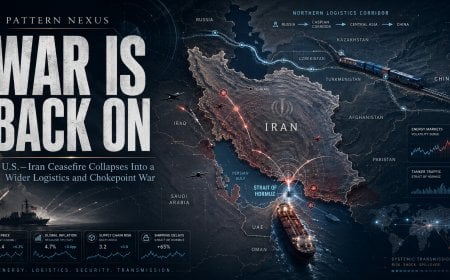
War Is Back On: The U.S.–Iran Ceasefire Has Collapsed Into a Wider Logistics and Chokepoint War
The United States is striking Iranian military, port, power, transportation, and logistics infrastructure. Iran is retaliating against the …
7 shared topics, 1 shared asset, same research avenue.
Peak Insanity: Pure Speculation on a World That No Longer Organizes Itself
This is not a prediction article. It is not a clean thesis. It is a speculative Pattern Nexus thought-run through the pressure stack buildi…
6 shared topics.
Hormuz Ceasefire Breaks Into Direct U.S.-Iran Strike Cycle
The United States launched strikes on Iranian targets near the Strait of Hormuz after the loss of a U.S. Army Apache helicopter, while Iran…
5 shared topics, 2 shared assets, same research avenue.
Comments (0)
Security Check
Please complete the captcha to verify you are human.