
One Bucket, Many Hoses: Liquidity Control After the Stablecoin Shif
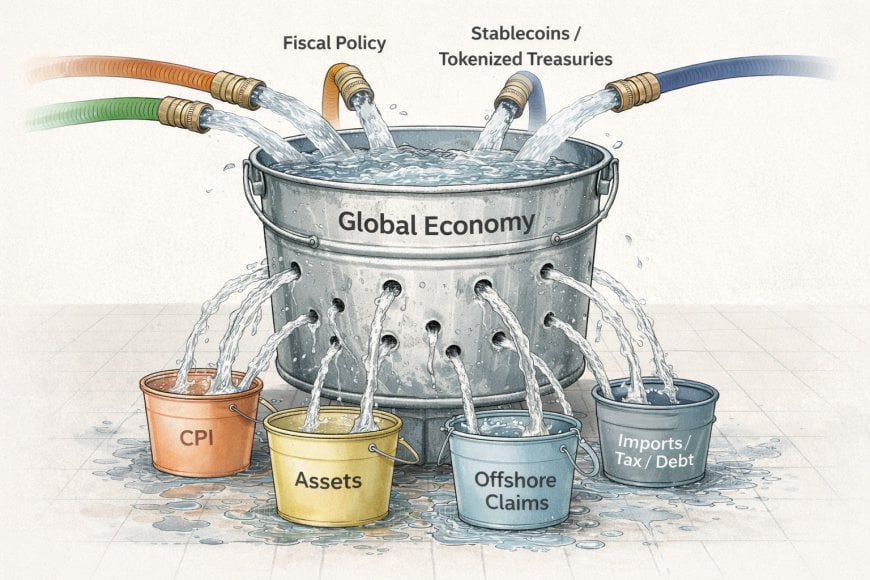
A five-gallon bucket with holes is the simplest way to see modern liquidity. The problem now is no longer one hose and one bucket, but many hoses, many leaks, and new stablecoin rails that redirect how policy hits markets and prices.


LCI White Paper — foundational theory.
Data Reconstruction — empirical verification.
Synthetic Liquidity Engine — modern liquidity rails.
Inflation and deflation are not “too much money” or “too little money” in the abstract. They are outcomes of how fast the bucket fills versus how fast it leaks, and which channels the water is allowed to run through.
As stablecoins and tokenized Treasuries scale, the official firehose does not disappear—but it stops being the only hose. Policy that ignores these parallel rails will misread the risk of both deflationary air pockets and sudden asset repricings.
The next phase is less about the total volume of liquidity and more about flow topology: which pipes connect, who controls the valves, and which assets sit closest to the main inlets.
The Bucket, the Holes, and the Firehose
Start with the simplest possible picture of the economy: a five-gallon bucket. The water level in that bucket is the effective liquidity of the system — not just base money, but the spendable, leverageable, tradable “fuel” that can chase goods, services, assets, and collateral.
When the bucket overflows, you get inflation. Prices rise because there is more liquidity pressing against available capacity in goods, services, labor, and real assets. When the bucket runs dry, you get deflation and systemic stress. Credit contracts, defaults spike, asset prices gap lower, and the system starts eating itself to find dollars.
The trick is that the bucket is not intact. It has holes drilled everywhere: in the sides, in the bottom, in the seams. There is more hole than metal. Liquidity is constantly leaking out in ways that are structural, not optional:
- Debt servicing, amortization, and principal repayments
- Taxes and mandatory transfers
- Imports and external claims on domestic income
- Corporate buybacks, dividends, and cross-border flows
- Demographic drag as more people draw down savings than build them
- Balance-sheet repair, write-downs, and forced deleveraging after shocks
If you left the bucket alone, it would not settle at a nice stable waterline. The leaks would keep draining it. In the modern system, the natural state is not balance; the natural state is slow-to-fast drainage.
Opposite the bucket sits a firehose. In the basic model, that hose is controlled by the combination of the central bank and the fiscal authority. Call it Fed + Treasury for short. Together, they decide how much water to blast into the bucket over time through:
- Interest-rate policy and the price of credit
- Quantitative easing and tightening, changing the quantity and composition of balance sheets
- Direct fiscal spending and transfers, which push income directly into private-sector hands
- Regulatory constraints and incentives that govern how banks and non-banks can extend credit
If the hose is opened too far, for too long, while many of the holes are temporarily plugged (for example, when loan forbearance, stimulus, and supply bottlenecks overlap), the bucket will overflow into visible inflation. If the hose is dialed back while the leaks are still widening — through tighter policy, higher real rates, or shock-driven deleveraging — the bucket can empty faster than policymakers expect.
The modern economy is not a self-leveling tank. It is a leaking bucket that must be actively managed. Policy is not fine-tuning around a stable equilibrium; it is constant firefighting against structural drainage and occasional overflow.
This is already a more honest picture of monetary policy than “money printer go brrr” or “the Fed controls everything.” But it is still missing the key modern problem: there is no longer just one hose.
When New Hoses Appear: Stablecoins and Tokenized Treasuries
For most of the post-war period, the working assumption was simple: Fed + Treasury controlled the main hose, and everything else was an extension of that. Banks, credit markets, and offshore dollar systems responded to the official stance. They were amplifiers and distributors, not independent sources of water.
That story broke slowly with the rise of the Eurodollar system, shadow banking, and collateralized leverage. Non-bank actors began to manufacture “money-like” claims through repo, FX swaps, and securitization. The system quietly evolved from one hose into a network of pipes, valves, and side channels.
Stablecoins and tokenized Treasuries are the latest, and in some ways cleanest, expression of this shift. They are new hoses connected directly to the same water source, but controlled by different hands and aimed at different parts of the field.
The basic stablecoin model looks like this:
- A user gives dollars (or bank deposits) to an issuer.
- The issuer buys short-term Treasuries, repo, or high-grade cash instruments.
- The issuer mints a digital token (the stablecoin) that represents a claim on that collateral.
- The stablecoin moves around crypto rails, DeFi platforms, exchanges, and payment apps, often 24/7 and across borders.
On paper, nothing magical happened. One claim on dollars was swapped for another claim, now mediated through collateral. But two important things changed:
- The claim now moves on a different rail, outside traditional bank payment plumbing.
- The underlying collateral (Treasuries, bills, repo) can be optimized for yield, rehypothecated, or pledged into other collateral chains.
In bucket language, part of the water that used to be poured into the bucket via bank deposits and conventional credit now gets routed through a side hose. That hose still ultimately pulls from the same source (dollars and Treasuries), but it can:
- Spray directly into certain markets (crypto assets, derivatives, offshore venues) without touching CPI-facing spending first.
- Feed leverage loops where the same collateral supports multiple layers of risk-taking.
- Operate with different speed and timing than official policy, responding to arbitrage and sentiment rather than FOMC meetings.
Tokenized Treasuries and “on-chain T-bill funds” extend the same logic. Instead of buying a bond fund through a broker and settling in T+1 or T+2, an investor can hold a token that directly reflects a Treasury-backed position and can be moved, pledged, or traded at chain speed.
Once that architecture exists, the system is no longer:
One bucket, one hose, many holes.
It becomes:
One bucket, many hoses, many holes, and some bypasses that loop liquidity through asset and collateral markets without visibly filling the bucket first.
This is where policy starts to break from the old narrative. When new hoses appear:
- The Fed and Treasury still influence the total amount of water in the system, but
- They lose some control over which channel gets that water first, and
- They have a harder time reading the bucket level from traditional gauges like CPI alone.
That is the core stablecoin and tokenization implication: not “hyperinflation tomorrow,” but a more complex mapping between official policy, effective liquidity, and the price series that move first.
- Asset prices and collateral valuations can respond quickly to flows on these new rails.
- Consumer prices may lag or respond weakly if the new liquidity mostly circulates in financial and digital asset loops.
- Deflationary air pockets can still appear if core leaks widen faster than all hoses combined can refill them.
Policy in a Multi-Hose World
The policy problem after QT is not just “when does QE come back?” The more relevant question is: in a world with multiple hoses and new private rails, how does official policy translate into real-economy outcomes and asset pricing?
In the one-hose world, the logic looked like this:
- Fed eases or tightens → bank credit and asset prices respond → spending and CPI react with a lag.
- Fed buys or sells duration → term premia and risk-free curves adjust → everything reprices off that anchor.
In the many-hose world, the chain is messier:
- Fed and Treasury adjust the core stance, but
- Stablecoin issuers, tokenized funds, and shadow intermediaries decide how much to translate that stance into new collateral and trading capacity, while
- Markets themselves decide which “bucket zones” get the marginal litre of liquidity: commodities, AI equities, real estate, crypto, funding spreads, or offshore dollar claims.
That has several practical implications for the next phase:
- Policy is fighting topology, not just totals. The same quantity of water can produce very different outcomes depending on which hoses are open. A given amount of easing can look “inflationary” if it mostly hits constrained real assets, or “muted” if it mostly circles through financial collateral and digital tokens.
- Volatility clusters where the hoses converge. Wherever multiple rails meet — for example, Treasuries that back stablecoins, sit on dealer balance sheets, and anchor derivatives — small changes in policy can trigger outsized repricings.
- Lag and visibility are degraded. When liquidity moves on-chain, offshore, or in non-bank form, the usual dashboards understate how much “effective water” is in motion until prices have already moved.
For investors, the bucket model with multiple hoses forces a different set of questions than “Will the Fed cut by 50 or 25?”
- Which assets sit closest to the new rails of liquidity?
- Where do stablecoin and tokenized collateral flows actually land first?
- Which parts of the bucket have structural leaks that even aggressive easing will struggle to refill?
- Which segments are so supply-constrained that even modest flow increases trigger step-function repricings?
For policymakers, the uncomfortable reality is that influence is still large, but direct control is weaker. Fed + Treasury remain the primary source of water. But the map from “how much we pump” to “which prices move” is changing as private actors wire new hoses into the system.
The next liquidity update will dig into that map: how to think about the end of QT as a regime change, how stablecoin and tokenization growth plug into Treasury demand, and how this shapes the path of housing, metals, AI infrastructure, and risk assets. The bucket model is the on-ramp. The multi-hose, multi-rail liquidity regime is where the real macro story now lives.
Pattern Nexus Lens
Viewed through a control-systems lens, the global liquidity regime is no longer a simple knob that one institution can turn. It is a feedback system with multiple actuators (Fed, Treasury, stablecoin issuers, shadow banks), multiple sensors (CPI, employment, funding spreads, asset prices), and non-trivial latency. Attempts to control inflation or growth by targeting a single variable — like policy rate or balance sheet size — will increasingly collide with this complexity.
Stablecoins and tokenized Treasuries are not just financial innovations. They are new control channels. They create additional paths for liquidity to bypass traditional constraints, and they introduce actors who can amplify or dampen policy impulses based on their own incentives. When an issuer decides to expand or contract a stablecoin supply, it is effectively opening or throttling a hose that sprays into specific markets and strategies first.
That is why the bucket metaphor matters. It forces a shift from “how big is the money supply?” to “who holds the hoses, where are the holes, and which gauges are still trustworthy?” Once you accept that framing, narratives about “the Fed lost control” or “the Fed controls everything” both miss the point. The system is not controlled by a single hand and it is not fully uncontrolled. It is governed by overlapping mechanisms, some intentional, some emergent, with control quality that varies over time.
The key shift is from thinking about the quantity of liquidity to thinking about its topology. In a multi-hose world, edge positioning—being close to the right inlets and away from the worst leaks—matters as much as the total amount of water in the system.
FAQ
Does this mean the Fed has lost control of inflation?
No. The Fed and Treasury still anchor the system because they control the underlying source of dollar liquidity and the risk-free curve. But their control is less direct. In a world with multiple hoses and private rails, the same policy stance can produce different inflation outcomes depending on where the marginal liquidity flows and how supply constraints look in those zones. Control is now partial, probabilistic, and mediated through more actors than before.
Are stablecoins “extra money” that automatically cause inflation?
Not in the simplistic sense. Most fiat-backed stablecoins are collateralized by existing dollars, short-term Treasuries, or similar instruments. That means they are usually transforming the form and rail of existing liquidity, not inventing brand-new base money out of nowhere. The inflation and asset-pricing impact comes from where that transformed liquidity flows, how it is leveraged, and which markets it connects. A dollar locked in a time deposit behaves differently from a dollar recycled through a high-velocity stablecoin loop tied to speculative assets.
Why does this matter for markets over the next few years?
Because the next phase is likely to combine: softer or sideways policy on the official hose; ongoing structural leaks in parts of the real economy; and rapid growth of new rails that route liquidity into specific asset clusters. That is a recipe for apparent contradictions: pockets of deflationary stress alongside melt-ups in assets that sit close to the strongest hoses. Understanding the bucket, the holes, and the multi-hose topology will matter more than simply tracking whether the next rate move is 25 or 50 basis points.
Sources
Selected references on stablecoins, tokenized Treasuries, and modern dollar plumbing that inform the bucket and multi-hose framing.
- BIS – Stablecoins, Central Bank Digital Currencies and Cross-Border Payments
- IMF – Fintech Notes on tokenization, digital money, and financial stability
- Federal Reserve – Financial Stability Reports and discussion of nonbank and market-based credit
당신의 반응은 무엇인가요?
 좋아요
0
좋아요
0
 싫어요
0
싫어요
0
 사랑
0
사랑
0
 재미있는
0
재미있는
0
 와우
0
와우
0
 슬프다
0
슬프다
0
 화난
0
화난
0

Founder of Pattern Nexus. I research markets, macro, geopolitics, AI, history, ancient systems, and the patterns most people overlook. I’m also building Market Radar, a trading scanner designed to read pressure, risk, confirmation, and setup quality before chasing a move. Pattern Nexus is where I connect the dots between data, history, technology, and the bigger system playing out around us.













댓글들 (0)