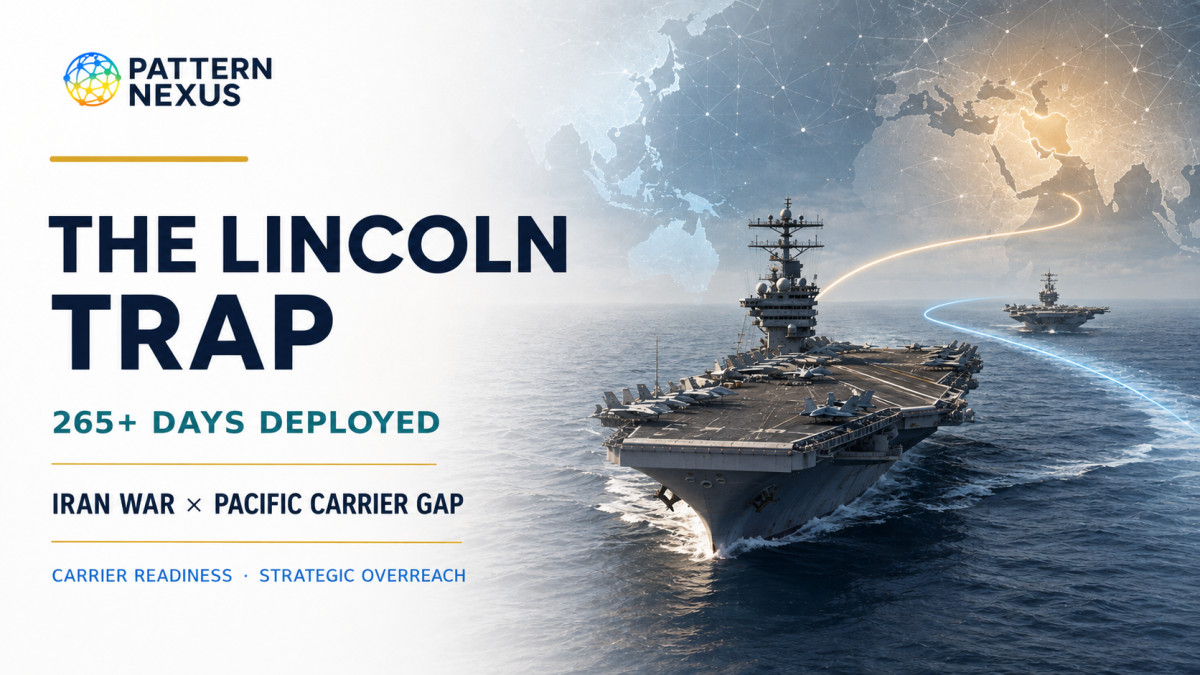
The Lincoln Trap: 265+ Days Deployed, an Indefinite Iran War, and a Carrier Gap in the Pacific
USS Abraham Lincoln was supposed to return home in May. More than 265 deployment days later, the Navy is pulling USS George Washington—the only forward-deployed U.S. carrier in the Pacific—west to relieve it. The rotation exposes the real limit of American carrier readiness: eleven hulls do not equal eleven available carriers, and an open-ended Iran mission is transferring the readiness gap from the Middle East to the Pacific.
 Pattern Nexus Premium Research
The Lincoln Trap: 265+ Days Deployed, an Indefinite Iran War, and a Carrier Gap in the Pacific
USS Abraham Lincoln was supposed to return in May. Instead, the Navy is pulling its only forward-deployed Pacific carrier west to relieve it—exposing how eleven commissioned carriers become almost no strategic margin when war, maintenance, and crew endurance collide.
The Relief Plan Does Not Create Capacity. It Moves the Shortage.
- USS Abraham Lincoln was 265 days into its deployment on August 13 and had spent roughly 241 consecutive days underway since its last port call. It left San Diego on November 21, 2025, stopped briefly in Guam in December, reached the Middle East in January, and was supposed to return home in May.[1]
- The Lincoln has not simply been floating offshore. It helped open Operation Epic Fury, supported the Iran bombing campaign and blockade, and—according to U.S. Central Command—its strike group had completed 10,000 aircraft flights and expended 1.5 million pounds of ordnance by August.[2]
- The Navy acknowledges the deployment is straining sailors, families, equipment, and logistics. It has also acknowledged that combat disrupted normal regional supply hubs, forcing leaders to prioritize food, then hygiene items, then mail. The Navy maintains that the ship remains mission-capable and disputes descriptions of a shipboard crisis.[1]
- USS George Washington is moving west from the Pacific to relieve Lincoln. Washington is based in Japan and is the Navy’s only forward-deployed aircraft carrier. Public reporting says the move will leave the Pacific without a U.S. carrier presence for an unknown period.[2][3]
- This is not occurring in a quiet Pacific. George Washington had been operating in the South China Sea after serious China–Philippines confrontations. During the week it moved west, Russia was conducting large Pacific Fleet drills, North Korea launched another ballistic missile, and Japanese fighters responded to Chinese and Russian aircraft activity.[7][8]
- Eleven carriers do not equal eleven available carriers. Three were deployed; Eisenhower, Vinson, and Theodore Roosevelt were at different post-maintenance or workup stages; Ford, Stennis, Truman, and Reagan were in maintenance; and Nimitz was serving as a training and service-life bridge. The carrier audit below covers every hull individually.[5][15][16][17]
- The political argument is now obscuring the readiness argument. President Trump dismissed concern over Lincoln’s deployment as “not nearly long enough,” while Defense Secretary Pete Hegseth said the Iran blockade can continue “indefinitely” by rotating ships.[9][13]
- Pattern Nexus read: Washington’s movement does not solve a carrier shortage. It transfers the shortage from the Middle East to the Pacific. The Lincoln controversy is not proof that the Navy has excess power. It is proof that the operational margin has been consumed.
Washington is not filling an empty slot. It is moving the empty slot.
Lincoln’s continued combat performance does not prove that the carrier force has surplus capacity. It proves that the Navy kept spending crew endurance, maintenance margin, and logistics resilience after the scheduled deployment plan had already expired.
Relieving Lincoln is necessary. The strategic problem is that the relief ship is USS George Washington—the only forward-deployed American carrier in the Pacific. The rotation restores one exhausted crew by opening a carrier-presence gap in the theater the United States identifies as its central long-term challenge.
This report reconstructs Lincoln’s deployment and continuous-underway clocks, separates confirmed facts from disputed shipboard reports, maps the Iran-war operational load and Pacific tradeoff, and audits every one of the Navy’s eleven commissioned aircraft carriers individually against public maintenance, training, workup, and deployment status. Twenty public sources are linked in the source architecture at the bottom.
Deployment
265 days
As of August 13
Continuous Underway
About 241 days
Since the Guam port call
Operational Load
10,000 flights
1.5 million pounds of ordnance
Fleet Reality
3 deployed
Out of 11 carrier hulls
1. The deployment is longer and harder than the shorthand suggests
USS Abraham Lincoln left San Diego on November 21, 2025, for what began as a scheduled Pacific deployment. It made a brief Guam port call in December, moved through the South China Sea and Indian Ocean, and reached the northern Arabian Sea in late January. When Operation Epic Fury began on February 28, aircraft from Carrier Air Wing 9 participated in the opening strike cycle.[1][11]
Lincoln was expected home in May. August arrived and the ship was still on station.
| Date | Publicly reported milestone | What it means |
|---|---|---|
| November 21, 2025 | Lincoln departs San Diego. | The deployment clock begins. |
| December 11–12, 2025 | Brief Guam port call; the last publicly documented port visit. | The uninterrupted-underway clock begins immediately afterward. |
| Late January 2026 | Lincoln arrives in the Arabian Sea. | A Pacific deployment becomes a Middle East war deployment. |
| February 28–March 2026 | Operation Epic Fury begins; Lincoln launches combat sorties. | The ship enters sustained wartime operations. |
| May 2026 | Original expected return window passes. | Readiness, maintenance, family, and supply assumptions begin moving right. |
| August 13, 2026 | 265 days deployed; about 241 consecutive days underway. | The extension is no longer marginal. It is the mission architecture. |
This matters because “250 days at sea” sounds like a single endurance statistic. It is not. It contains several different loads: months away from home, months without a normal liberty cycle, months of saltwater wear, months of flight-deck operations, months of replenishment risk, and more than five months tied directly to the Iran war.
2. Nuclear propulsion is not human or logistical infinity
A nuclear carrier can steam for years without refueling its reactors. That fact is often misused as if it means the entire carrier strike group has unlimited endurance.
It does not.
The reactors do not eat. Five thousand sailors and Marines do. The reactors do not need toothpaste, spare aircraft parts, safe water, functioning toilets, mail, sleep, mental-health support, or time with their families. Aircraft consume parts, tires, fluids, engines, weapons, and maintenance hours. Catapults, arresting gear, elevators, plumbing, cooling systems, electronics, and thousands of mechanical components keep accumulating use whether the nuclear fuel is full or not.
The Navy’s own Optimized Fleet Response Plan schedules one eight-month deployment inside a 36-month cycle that also has to contain maintenance, training, certification, sustainment, and reset. The purpose is not bureaucratic neatness. It is to preserve the force that must deploy next time.[6]
Lincoln crossed the eight-month deployment model in July and continued into a ninth month. It also lost the port-call rhythm that normally gives carrier crews some relief every 30 to 45 days. Stars and Stripes reported roughly 200 days without a port call by mid-August; USNI’s date-based count was longer still.[1][3]
Then add wartime use. CENTCOM said the strike group had conducted 10,000 aircraft flights and expended 1.5 million pounds of ordnance. That is not a passive presence mission. It is a high-throughput industrial operation being run on a moving airfield in a contested logistics environment.[2]
The carrier can remain technically mission-capable and still be consuming tomorrow’s readiness today. Those two statements are not contradictory.
3. The Navy disputes a crisis—but confirms the structure producing one
Families, lawmakers, and military publications have reported food shortages, inadequate hygiene supplies, water contamination, plumbing problems, poor air conditioning, mail failures, exhaustion, and serious mental-health concerns. Some accounts describe sailors attempting to jump overboard.[2][3]
The Navy disputes the broadest version of those reports. Officials say the ship has clean water, functioning air conditioning, healthy meal options, and adequate supplies. They also say commanders have not identified an increase in reported suicidal ideation or suicide attempts.
But the official response confirms several foundational facts:
- Extended deployments place significant strain on service members and their families.
- The Iran conflict disrupted traditional regional supply hubs.
- Leadership had to prioritize mission-critical supplies in the order of food, hygiene items, and mail.
- Supplies occasionally ran low for brief periods.
- A sailor went overboard in early August, was recovered, treated, and transferred off the ship for follow-on care. Officials did not publicly classify the incident as a suicide attempt.[1][2]
The evidence does not require exaggeration. The most serious individual claims should remain attributed until the Navy releases data or an investigation establishes them. The structural problem is already visible without them.
A ship can be combat-capable while its human margin deteriorates. A crew can keep performing while the cost of that performance rises. “Mission accomplished” and “system healthy” are not synonyms.
4. When endurance becomes a political prop, readiness becomes invisible
On August 14, President Trump was asked about families who believe Lincoln’s deployment has gone on too long. He rejected the premise and said it had been “not nearly long enough.” He also pointed to the coming replacement carrier.[13]
The day before, Defense Secretary Pete Hegseth said the Navy could enforce the blockade of Iran “indefinitely” because ships would be rotated in and out. The same public response argued that reports from Lincoln were misrepresenting conditions.[9]
This is where the Lincoln story stops being only a Navy story.
The political value comes from performing toughness: the blockade is indefinite, the force is resilient, the deployment is not too long, and another carrier is already coming. Each sentence can be defended in isolation. Together they conceal the balance sheet.
The replacement is not free. It is being pulled from another theater.
The blockade is not self-sustaining. It consumes ship days, missiles, aircraft hours, maintenance capacity, and crew endurance.
The Lincoln’s record is not evidence that deployment limits were foolish. It is evidence that the government exhausted the normal plan and then converted the exception into a political symbol.
5. George Washington is a transfer, not additional capacity
USS George Washington is based at Yokosuka, Japan, and is the Navy’s only forward-deployed aircraft carrier. It began its 2026 patrol in May and spent the summer operating around the Philippine Sea and South China Sea. In early August it visited Da Nang, Vietnam. It then moved west through the Singapore and Malacca straits toward the Indian Ocean.[1][3]
The Navy confirmed that Washington will replace Lincoln in the Arabian Sea. That is the right thing to do for Lincoln’s crew. The wrong thing is pretending the move carries no strategic cost.
Washington is not a fourth carrier appearing from reserve. It is one of the three carriers already counted as deployed. Its movement changes the location of scarce capacity:
| Before the move | After the move |
|---|---|
| Lincoln and George H.W. Bush in the Middle East | Bush and Washington in the Middle East after relief |
| Washington forward-deployed in the Western Pacific | No U.S. carrier physically present in the Pacific for an unknown interval |
| Lincoln’s crew and maintenance debt continue accumulating | Lincoln can finally begin the long transit and reset process |
The rotation solves the most urgent human problem. It does not solve the force-generation problem. It moves it.
6. The carrier is leaving the theater it was forward-deployed to cover
Associated Press reporting was explicit: Washington’s move will leave Pacific waters without a U.S. carrier presence for an unknown period.[2]
That does not mean the Pacific becomes undefended. The United States still has Japan-based destroyers, submarines, land-based aircraft, Marines, regional bases, allies, and treaty partners. A carrier is not the whole force.
But it is the most visible mobile concentration of U.S. naval aviation, command, surveillance, electronic warfare, and strike capacity. Removing it changes the escalation ladder and the signal available to allies and adversaries.
The timing is especially difficult.
- George Washington had moved into the South China Sea after renewed China–Philippines clashes around disputed maritime features. A July 20 confrontation at Second Thomas Shoal included a Chinese Coast Guard officer striking a Philippine Navy SEAL, followed by further harassment near Scarborough Shoal.[7]
- During the week Washington moved west, Russia was running a large Pacific Fleet exercise involving 13,000 personnel, 60 surface ships and submarines, and 30 aircraft and unmanned systems.[8]
- North Korea launched another ballistic missile from Wonsan.
- Japan scrambled fighters in response to Chinese and Russian surveillance activity near its airspace.[8]
None of those events proves an attack is imminent. That is not the point.
Deterrence is built before the crisis. A carrier gap matters precisely because the purpose of a forward-deployed carrier is to shorten response time and prevent an adversary from believing it has a temporary window.
7. All eleven carriers, one by one: the inventory is not the deployable force
The United States has eleven commissioned aircraft carriers. A political speech can turn that into an image of eleven interchangeable ships waiting for orders.
That is not how carrier availability works.
On August 11, The War Zone’s public fleet tracker summarized the force this way: three carriers deployed, three working up or at homeport in different states of readiness, four in maintenance, and one used primarily for training.[5]
| Hull | Carrier | Public status, August 11–14 | Immediate meaning |
|---|---|---|---|
| CVN-68 | USS Nimitz | Final homeport at Norfolk; assigned primarily to train naval aviators during its remaining service life. | A training and transition bridge, not a normal globally deployable reserve carrier. |
| CVN-69 | USS Dwight D. Eisenhower | Completed planned maintenance and sea trials in April; conducting carrier qualifications and post-maintenance activity. | Back in the fleet pipeline, but not deployed and not equivalent to a strike group already on station. |
| CVN-70 | USS Carl Vinson | Completed planned maintenance June 12; conducting short underways and flight operations from San Diego. | Regenerating readiness after maintenance, with time still required for integrated strike-group preparation. |
| CVN-71 | USS Theodore Roosevelt | Returned to San Diego after leading RIMPAC 2026; conducted a friends-and-family cruise August 8. | Closest visible Pacific backfill candidate, but not physically covering the Pacific gap at the time of Washington’s move. |
| CVN-72 | USS Abraham Lincoln | Deployed in the Arabian Sea after 265 days away and roughly 241 consecutive days underway. | Combat-capable but overdue for relief, maintenance, crew recovery, and reset. |
| CVN-73 | USS George Washington | The forward-deployed Japan carrier is moving west to relieve Lincoln. | Relief is being purchased by removing the carrier already assigned to the Western Pacific. |
| CVN-74 | USS John C. Stennis | In the late phase of a multiyear Refueling and Complex Overhaul at Newport News. | Not operationally available; redelivery must still be followed by testing, certification, and workups. |
| CVN-75 | USS Harry S. Truman | In the multiyear midlife-overhaul sequence after returning from deployment in June 2025. | Removed from the deployable pool for years, not months. |
| CVN-76 | USS Ronald Reagan | Finishing a 17-month docking availability at Puget Sound, scheduled to conclude at the end of August. | Maintenance completion begins the return-to-readiness process; it does not produce an instantly deployable carrier. |
| CVN-77 | USS George H.W. Bush | Deployed in the Arabian Sea as the second carrier supporting the Iran blockade. | Fully committed to the same theater creating the demand for Lincoln’s relief. |
| CVN-78 | USS Gerald R. Ford | In its first planned incremental availability at Norfolk Naval Shipyard after a 326-day deployment. | Unavailable while scheduled modernization and restoration of fire-damaged spaces are completed. |
CVN-68 · USS Nimitz: commissioned, but no longer a normal reserve deployment option
Nimitz arrived at its final homeport of Norfolk on July 9 after a four-month Southern Seas deployment. The Navy said the ship will spend its remaining service life training the next generation of naval aviators while standing ready if called. USNI separately reported that the ship is scheduled for deactivation in 2027 and will function primarily as a training carrier during the transition.[15]
That makes Nimitz strategically useful, but it does not make the oldest carrier an interchangeable replacement for a fully certified carrier strike group in the Pacific or Arabian Sea. It is a service-life bridge carrying training demand while the Navy waits for new capacity.
CVN-69 · USS Dwight D. Eisenhower: out of maintenance, rebuilding operational depth
Eisenhower completed sea trials and its Planned Incremental Availability ahead of schedule in April. It subsequently supported carrier qualifications in the Atlantic, including training for fleet replacement squadrons and student naval aviators.[16]
That is a materially better position than being trapped in a shipyard. It is not the same thing as already having an embarked air wing, escorts, logistics train, certifications, and deployment orders aligned for an immediate theater replacement. Eisenhower represents recovering capacity, not unused capacity.
CVN-70 · USS Carl Vinson: maintenance complete, readiness being regenerated
Vinson completed a Planned Incremental Availability at North Island on June 12 after entering dedicated maintenance in November 2025. The Navy described the ship as returning to sea and restoring combat readiness. Public reporting then showed short flight-operation periods and brief August underways from San Diego.[17][5]
A carrier fresh from maintenance is moving in the correct direction, but the ship, air wing, escorts, and strike-group staff still have to train and certify together. Vinson is evidence that the pipeline is moving. It is not evidence that a fourth deployed carrier was sitting idle.
CVN-71 · USS Theodore Roosevelt: the nearest visible Pacific backfill, but not yet the backfill
Theodore Roosevelt returned to San Diego after roughly two months away leading RIMPAC 2026 and conducted a one-day friends-and-family cruise on August 8. The War Zone described its next tasking as unresolved immediately before the Washington decision; earlier reporting placed a full deployment in September.[5][12]
Roosevelt may eventually restore a Pacific carrier presence or be sent toward the Middle East. Either outcome proves the timing problem. A ship that may deploy in the coming weeks does not occupy the gap today, and accelerating it would consume more of the future schedule.
CVN-72 · USS Abraham Lincoln: available only because the Navy kept spending the crew and maintenance margin
Lincoln is the clearest example of why a binary “available or unavailable” label is inadequate. The ship remained fully capable of assigned missions, but it reached 265 deployed days, approximately 241 consecutive days underway, a missed May return window, months of combat operations, and acknowledged logistics strain.[1][2]
Lincoln counts as deployed. It should not count as free capacity. Its presence in the Arabian Sea is the obligation that must be relieved.
CVN-73 · USS George Washington: the Pacific carrier being spent to solve the Middle East problem
Washington is the Navy’s only forward-deployed aircraft carrier and is based at Yokosuka. It began its 2026 patrol in May, operated in the Philippine Sea and South China Sea, visited Vietnam, and then moved west to relieve Lincoln.[1][3]
This is the central strategic trade. Washington is not spare capacity arriving from a reserve pool. It is the Pacific carrier changing theaters. When it leaves, the Navy has relieved one overstretched ship by opening a carrier-presence gap somewhere else.
CVN-74 · USS John C. Stennis: late in overhaul is still in overhaul
Stennis entered its Refueling and Complex Overhaul in May 2021. The project refuels the reactors and rebuilds or modernizes propulsion, aviation, combat, electronics, living, and support systems across the ship. The Navy’s published schedule targeted redelivery in October 2026, after an extended industrial effort of more than 25 million labor hours.[18]
Redelivery will be important, but it is not the same date as operational deployment. The ship must complete testing, certify the crew, integrate an air wing and escorts, and move through workups. In August, Stennis remained unavailable.
CVN-75 · USS Harry S. Truman: entering the years-long midlife hole
Truman entered the maintenance sequence for its Refueling and Complex Overhaul after returning from an eight-month deployment in June 2025. Stars and Stripes reported the carrier at Norfolk awaiting its move into the Newport News overhaul, while USNI described HII as performing the RCOH and the Navy restructuring shipyard work to protect sailors’ training time.[4][19]
This is not a short repair window. The midlife overhaul removes a carrier for years. Truman should be counted in the statutory inventory, but it cannot be counted in a near-term Iran or Pacific force plan.
CVN-76 · USS Ronald Reagan: almost out of the yard is not the same as ready to deploy
Reagan was scheduled to complete its 17-month Docking Planned Incremental Availability at the end of August. The Navy explained that maintenance completion is followed by sea trials, crew and air-wing training, reintegration, and return to the deployment cycle. It declined to provide a future deployment date.[4]
Reagan will restore options, but not on the day the shipyard period ends. Treating an expected maintenance completion as immediate carrier coverage erases the entire certification process that makes the ship useful in combat.
CVN-77 · USS George H.W. Bush: operational—and already consumed by the Iran requirement
Bush was the second carrier in the Arabian Sea alongside Lincoln, supporting the blockade and other operations in the region. It is one of the three deployed carriers counted in the August 11 snapshot.[5]
Bush therefore cannot be the answer to the Lincoln problem. It is already part of the same two-carrier demand. Once Washington relieves Lincoln, Bush and Washington preserve that demand while Lincoln finally leaves.
CVN-78 · USS Gerald R. Ford: a record deployment converted directly into shipyard demand
Ford returned to Norfolk on May 16 after 326 days deployed, 57,713 nautical miles sailed, more than 12,200 flight launches, and 23 replenishments at sea. On July 7 it entered Norfolk Naval Shipyard for its first Planned Incremental Availability. Stars and Stripes reported that the work includes restoration of spaces damaged in the March laundry fire during Operation Epic Fury.[10][20]
Ford is the newest carrier in the fleet and still unavailable for immediate tasking. That fact shows the limit more clearly than the age of Nimitz: even the newest hull alternates between deployment and maintenance because carrier power is generated through a cycle, not stored permanently in the ship.
These categories will change as ships finish trials, qualifications, repairs, and workups. That is exactly the point. Carrier readiness is a pipeline, not a parking lot.
8. Ford shows how the Iran war consumes availability even without an enemy hit
USS Gerald R. Ford entered the Iran campaign after an already extended deployment. On March 12, a fire began in its main laundry spaces while the carrier was supporting Operation Epic Fury. Two sailors suffered non-life-threatening injuries. CENTCOM said the fire was not combat-related and did not damage the propulsion plant.[10]
The fire still mattered. It reportedly took more than 30 hours to extinguish, displaced hundreds of sailors from berthing spaces, and contributed to the carrier leaving the theater for assessment and repair. Ford returned home in May after a 326-day deployment and entered planned maintenance in July. That availability includes restoration of fire-damaged spaces.[2][5]
The distinction is important:
Ford was damaged during the Iran operation. Public evidence does not show that Iran caused the damage.
That does not weaken the readiness argument. It strengthens it.
A high-tempo deployment does not have to produce a battle-damage headline to remove a carrier from the available pool. Fire, equipment failure, delayed maintenance, and accumulated wear can produce the same strategic result: one less ship ready for the next demand.
9. A less damaging posture requires admitting that every theater cannot receive everything
Relieving Lincoln is necessary. Sending Washington is understandable if policymakers insist that two carriers remain tied to the Iran mission.
The question is whether that premise should remain unquestioned.
The United States already has USS George H.W. Bush, more than twenty Navy ships publicly reported in the region, land-based aircraft, bombers, surveillance assets, regional bases, and allied support. The blockade is a policy choice requiring a particular force level. It is not a law of physics.[1][5]
A less damaging posture would require some combination of:
- Reducing the carrier requirement in the Middle East after Lincoln departs.
- Using land-based and distributed maritime forces for missions that do not require a second carrier air wing.
- Defining a real political end state for the blockade instead of calling it indefinite.
- Protecting scheduled maintenance and crew reset instead of treating every readiness buffer as available political capital.
- Restoring a carrier presence in the Pacific as soon as a genuinely ready ship—not merely a hull at homeport—can assume the mission.
None of those choices is costless. Strategy is the act of choosing which cost to accept.
The current posture avoids making that choice publicly. It keeps the Middle East force level, eventually sends Lincoln home, and quietly accepts the Pacific gap. That is still a choice. It is simply being presented as if no tradeoff exists.
10. The next month will show whether this is a short gap or a deeper readiness failure
- Lincoln’s actual relief and departure: Washington entering the broader region is not the same as Lincoln immediately beginning the trip home.
- Whether George H.W. Bush is extended: replacing one exhausted carrier while extending another would repeat the same mechanism.
- Theodore Roosevelt’s September deployment: destination and certification will determine whether Pacific carrier presence is restored or another ship is drawn toward the Middle East.
- Ronald Reagan’s post-maintenance trials: completion of shipyard work is only the first step back into operational rotation.
- Ford’s maintenance duration: scheduled work and restoration of fire-damaged spaces will determine when the newest carrier returns to the usable pool.
- The blockade’s political end state: “indefinitely” is not a strategy. Watch for defined conditions that would reduce the force requirement.
- Pacific behavior during the gap: watch China–Philippines interactions, Chinese air and naval pressure around Taiwan and Japan, Russian Pacific activity, and North Korean launches. No single event proves exploitation, but a pattern would matter.
All locations in this article are broad, delayed public reports. Pattern Nexus is not publishing live ship positions or tactical movement data.
11. The Lincoln is not a symbol of unlimited power. It is the receipt for strategic overreach.
The sailors and Marines aboard USS Abraham Lincoln have done their job. The carrier remains in the fight after more than 265 days deployed, a record-breaking underway period, disrupted logistics, a missed return window, and months of combat and blockade support.
That endurance should not be converted into proof that the deployment is harmless.
The ship was supposed to return in May. It did not. The crew kept performing because military crews perform. The machinery kept running because maintenance teams kept it running. The logistics network kept feeding the mission because priorities were narrowed and supplies were moved at sea.
Now the Navy is taking its only forward-deployed Pacific carrier and moving it west to provide relief.
That is the fact that cuts through the politics.
If the carrier force had genuine excess capacity, the United States would not have to choose between relieving Lincoln and maintaining a carrier in the Pacific. If the Iran mission were truly sustainable at no strategic cost, it would not consume the ship specifically positioned to deter pressure in East Asia.
The move is understandable. The system producing it is not healthy.
Washington is not filling an empty slot. It is moving the empty slot.
That is the Lincoln trap: a temporary surge became a permanent demand, the permanent demand consumed the readiness buffer, and political theater now treats the disappearance of that buffer as strength.
The Carrier Force Is a Throughput System, Not a Hull Count
A carrier fleet has inputs, constraints, buffers, and outputs.
- Inputs: maintenance labor, dry-dock time, spare parts, trained crews, qualified air wings, munitions, escorts, oilers, and logistics access.
- Constraints: shipyard capacity, certification schedules, human endurance, aircraft maintenance, missile inventory, and the calendar.
- Buffers: surge-ready carriers, forward-deployed forces, allied access, land-based aviation, and ships inside sustainment windows.
- Outputs: combat sorties, blockade enforcement, deterrence, crisis response, and visible presence.
The Iran war increased demanded output. Lincoln’s extension consumed the buffer. Ford’s long deployment and fire reduced near-term availability. George H.W. Bush was committed to the same theater. Washington became the next movable unit. Once Washington moved, the Pacific buffer disappeared.
This is how a global military becomes locally strong and globally thin at the same time.
The Atlantic Council reached a similar structural conclusion in May: two of the three carriers it assessed as then available were committed to Operation Epic Fury, with consequences for deterrence and readiness against China. The same tracker found heavy use of bombers, destroyers, missile defense, ISR, and amphibious forces—not only carriers.[11]
The problem is not one bad rotation. It is a demand system assuming that every regional commitment can be made permanent while the maintenance and force-generation system remains finite.
FAQ
Has USS Abraham Lincoln really been at sea for more than 250 days?
Lincoln had been deployed for 265 days as of August 13, 2026. USNI News separately counted about 241 consecutive days underway since its last port call in Guam. Some reports use “at sea” for the entire deployment; the more precise wording distinguishes deployed time from continuous underway time.
Has Lincoln been fighting in the Iran war since March?
Yes. Lincoln reached the Arabian Sea in January and aircraft from its air wing participated in the opening of Operation Epic Fury on February 28. It has supported the bombing campaign, retaliatory strikes, maritime security operations, and the blockade since then.
Is Lincoln no longer combat-capable?
No public evidence shows that Lincoln has lost combat capability. The Navy says it remains fully capable of assigned missions. The article’s argument is that mission capability at one moment does not erase accumulated crew strain, equipment wear, delayed maintenance, and reduced readiness elsewhere.
Were U.S. carriers damaged by Iran?
Public evidence does not show an Iranian strike damaging a U.S. carrier. USS Gerald R. Ford suffered a serious, non-combat-related laundry-space fire while supporting Operation Epic Fury. The fire injured two sailors, displaced hundreds from berthing, and required repair. It demonstrates operational vulnerability and repair debt, not confirmed Iranian battle damage.
Will moving George Washington leave the Pacific undefended?
No. The United States retains destroyers, submarines, land-based aircraft, Marines, bases, allies, and other forces. It will, however, leave the Pacific without a physically present U.S. aircraft carrier for an unknown period, removing a major mobile concentration of naval aviation and a powerful deterrence signal.
Why can’t one of the other eleven carriers replace Lincoln?
Because the fleet count includes ships in maintenance, overhaul, training, post-deployment reset, workups, and mixed states of readiness. On August 11, only three were deployed: Lincoln, George H.W. Bush, and George Washington. The other eight were not eight interchangeable, immediately deployable replacements.
Is sending George Washington to the Middle East a bad decision?
Relieving Lincoln is necessary. The strategic criticism is that keeping a two-carrier demand in the Middle East forces the Navy to remove its only forward-deployed carrier from the Pacific. The damaging part is the open-ended force requirement and lack of margin, not the act of finally relieving Lincoln.
Sources
Carrier positions are generalized and time-stamped. No real-time tactical data is included. Reports about shipboard conditions are attributed, and the Navy’s response is included wherever those claims appear.
- USNI News — USS George Washington Heading West, Lincoln Deployment Nears 9 Months, August 13, 2026
- Associated Press via WMRA — New carrier heads toward Mideast after reports of issues on long-deployed USS Lincoln, August 14, 2026
- Stars and Stripes — USS George Washington headed to Middle East to relieve USS Abraham Lincoln, August 13, 2026
- Stars and Stripes — USS Ronald Reagan set to leave shipyard and return to operational status, August 10, 2026
- The War Zone — Where Are the Aircraft Carriers: August 11, 2026
- U.S. Fleet Forces Command — Optimized Fleet Response Plan
- USNI News — George Washington CSG in the South China Sea After Philippine-Chinese Clashes, July 27, 2026
- USNI News — Western Pacific Pulse, August 14, 2026
- Reuters — U.S. says it can keep naval blockade on Iran indefinitely, August 13, 2026
- USNI News — Carrier USS Gerald R. Ford Suffers Fire, March 12, 2026
- Atlantic Council — Tracking U.S. military assets in the Iran war, updated May 15, 2026
- Forbes — USS Theodore Roosevelt returning to San Diego, August 2, 2026
- Associated Press — Trump says record-setting Navy deployment was “not nearly long enough,” August 14, 2026
- U.S. Central Command — USS Abraham Lincoln supports Operation Epic Fury, March 2, 2026
- USNI News — USS Nimitz Arrives in Norfolk for Homeport Shift, July 9, 2026
- U.S. Navy — USS Dwight D. Eisenhower Completes Planned Incremental Availability, April 28, 2026
- U.S. Navy via DVIDS — USS Carl Vinson Completes Planned Incremental Availability, June 29, 2026
- U.S. Navy Program Executive Office Aircraft Carriers — USS John C. Stennis Begins Second Phase of Refueling and Complex Overhaul
- USNI News — Navy Restructures Supplemental Work During USS Harry S. Truman Overhaul, June 12, 2026
- U.S. Navy — Norfolk Naval Shipyard Welcomes USS Gerald R. Ford for Planned Incremental Availability, July 8, 2026
What's Your Reaction?
 Like
0
Like
0
 Dislike
0
Dislike
0
 Love
0
Love
0
 Funny
0
Funny
0
 Wow
0
Wow
0
 Sad
0
Sad
0
 Angry
0
Angry
0

Founder of Pattern Nexus. I research markets, macro, geopolitics, AI, history, ancient systems, and the patterns most people overlook. I’m also building Market Radar, a trading scanner designed to read pressure, risk, confirmation, and setup quality before chasing a move. Pattern Nexus is where I connect the dots between data, history, technology, and the bigger system playing out around us.


Comments (0)