
The Fiscal-Monetary Fusion: Pandemic Money, Inflation Whiplash, and the Militarized Liquidity Regime (2020–2025)
COVID didn’t just trigger stimulus — it fused fiscal and monetary policy into a single war machine. Between 2020 and 2025, governments and central banks ran coordinated mega-deficits, bought their own debt at scale, ignited the first real inflation shock of the QE era, and then slammed rates higher into a fragile, over-financialized system — all while AI, energy constraints, and a new cold war turned liquidity into an explicit weapon.
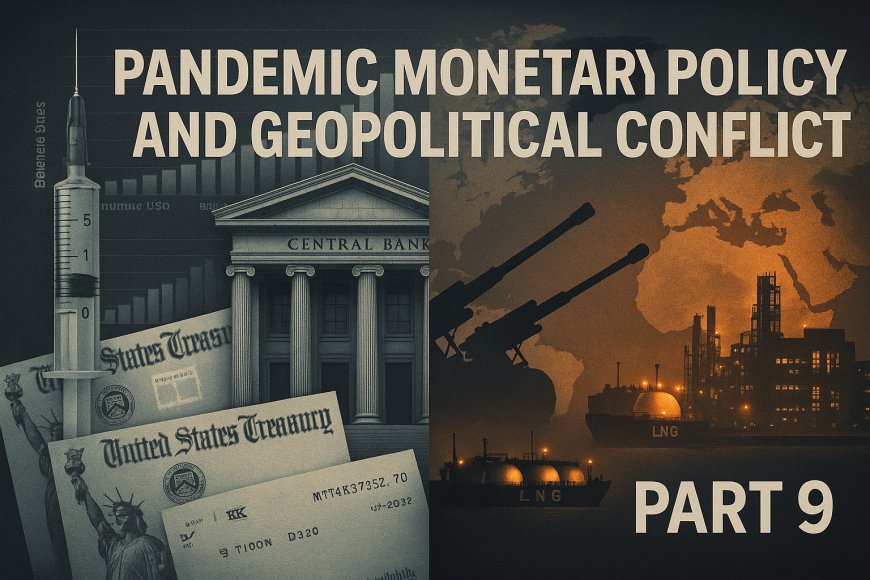
The 2020 Shock: Freeze the Real Economy, Flood the Financial One
In early 2020, the global system hit a scenario that most macro playbooks treated as a thought experiment: a deliberate shutdown of large chunks of the real economy. Lockdowns, travel bans, and emergency public-health measures crushed services, disrupted manufacturing, and snapped global supply chains.
Markets responded exactly as you’d expect. In March 2020:
- equities crashed, credit spreads exploded, and funding markets wobbled
- the Treasury market — the supposed safest asset — briefly lost liquidity as everyone tried to sell at once
- dollar demand spiked worldwide as firms and banks scrambled for cash
The lessons of 2008 were still fresh. Policymakers did not wait for a slow-motion collapse:
- the Federal Reserve slashed rates back to zero and launched open-ended QE, buying Treasuries and agency MBS at enormous pace
- dollar swap lines were reopened and expanded, turning the Fed into the instant lender of last resort to the global core again
- emergency facilities were rolled out to backstop corporate credit, municipal bonds, and money markets
But this time, the response did not stop at the central bank. It moved directly into fiscal space.
Checks, PPP, and QE Infinity: The Fiscal-Monetary Merge
The key break from the QE decade wasn’t just scale; it was who got the money and how.
Between 2020 and 2021, the U.S. alone passed multiple, multi-trillion-dollar fiscal packages: direct checks to households, enhanced unemployment benefits, forgivable small-business loans, airline support, and more. Other advanced economies followed variations on the same theme — furlough schemes, wage subsidies, and targeted transfers.
Crucially:
- these programs were funded by rapid issuance of government debt
- central banks bought large portions of that debt via QE, often at the same time
- household cash balances surged; some measures briefly pushed personal income higher than pre-crisis levels despite job losses
The result wasn’t the narrow “portfolio rebalancing” of the 2010s. It was a direct injection of purchasing power into household balance sheets, underwritten by central-bank asset purchases. In functional terms, the wall between fiscal and monetary policy dissolved:
- legislatures authorized spending and guarantees at wartime scale
- central banks ensured that financing remained cheap and plentiful
- the entire operation was framed as temporary emergency response
From a Pattern Nexus standpoint, this is the pivot:
Supply Chains, Energy, and the Inflation Wave
For a moment, the fusion seemed costless. Output recovered faster than many expected. Unemployment fell sharply. Asset prices rocketed off the 2020 lows. But beneath the “everything is back” narrative, the seeds of the first real inflation spike of the QE era were germinating.
Three forces converged:
- Supply-chain snarls: lockdowns, port congestion, and just-in-time logistics colliding with post-pandemic demand created shortages in everything from semiconductors to shipping containers.
- Energy underinvestment: years of low prices and ESG pressure had dampened upstream oil and gas investment, leaving capacity tight just as demand rebounded.
- War and sanctions: Russia’s invasion of Ukraine in 2022 and subsequent sanctions fractured energy and commodity flows, especially in Europe.
Against that backdrop, turbocharged household demand — fueled by stimulus checks, savings buffers, and low rates — slammed into constrained supply. Consumer-price inflation surged across advanced economies to levels not seen in decades.
The line that “QE doesn’t cause inflation” had to be rewritten with an asterisk: QE plus direct fiscal transfers plus supply shocks absolutely can.
From Zero to Volcker-Lite: The Rate-Hike Whiplash
Having spent a decade worrying about deflation and “lowflation,” central banks suddenly found themselves behind the curve. Once inflation breached targets and stayed there, the narrative pivoted from “transitory” to “we will do whatever it takes to restore price stability.”
The Federal Reserve led with the most dramatic pivot:
- policy rates were hiked from near zero to levels not seen since before the GFC, and at the fastest pace since the Volcker era
- balance-sheet runoff (QT) began, reversing part of the QE accumulation
- forward guidance flipped from “lower for longer” to an explicit willingness to tolerate demand destruction
Other central banks followed with their own tightening cycles, though at varying speeds.
The whiplash was structural, not just emotional:
- households and firms had adjusted to a decade of low rates and rising asset prices
- governments had layered on much higher debt stocks during COVID
- financial plumbing had been built on the assumption of abundant reserves and suppressed term premia
Raising rates into that configuration did more than “fight inflation.” It:
- compressed the value of long-duration assets
- triggered mark-to-market losses on bond portfolios across banks, insurers, and funds
- set up the conditions for the next fracture: interest-rate risk in a system that thought it was safe
Bank Fractures, BTFP, and the New “Silent Bailout” Template
In 2023, those mark-to-market losses stopped being theoretical. Several mid-sized U.S. banks failed after rapid deposit withdrawals exposed bond portfolios that had been hammered by higher yields. The institutions weren’t primarily undone by credit losses; they were undone by duration mismatch and the speed of digital-era bank runs.
Regulators and the Fed responded with a new tool that illustrates exactly how the regime now works:
- the Bank Term Funding Program (BTFP) allowed banks to borrow from the Fed against high-quality securities like Treasuries and agency MBS at par, regardless of their depressed market prices
- this effectively neutralized unrealized losses for liquidity purposes, buying time and preventing fire sales
- guarantees and backstops were extended to reassure depositors that their money was safe
Officially, this wasn’t a “bailout” — equity and some bondholders were wiped out, and the rhetoric focused on protecting the system rather than individual firms. Functionally, it did three things:
- it signaled that core collateral would be protected at par in a crisis
- it reinforced the principle that central banks will engineer liquidity facilities whenever higher rates threaten systemic stability
- it demonstrated that even in a post-QE, “QT” environment, the balance sheet can be turned back on instantly when needed
This is the new template: raise rates to fight inflation, but build emergency pipes to prevent those rates from blowing up the collateral base. De facto yield-curve control and collateral protection, even if the term is never used.
War, Sanctions, and Liquidity as a Geopolitical Weapon
While the macro plumbing was being re-engineered, geopolitics turned liquidity into an explicit weapon.
The invasion of Ukraine triggered:
- sanctions on Russian banks, firms, and individuals
- the freezing of a significant portion of Russia’s foreign reserves held in Western institutions
- restrictions on technology exports, financing, and energy flows
Simultaneously, tensions over Taiwan, semiconductor supply chains, and critical minerals reshaped the strategic map:
- the U.S. and allies rolled out industrial policies and subsidies for chip fabs and energy infrastructure
- “friendshoring” and “de-risking” initiatives began to redirect trade and investment away from perceived adversaries
- financial sanctions and access to dollar funding became levers of statecraft, not just technical policy
For the rest of the world, the message was clear:
This realization drives:
- efforts by some states to diversify reserves into gold, alternative currencies, and commodities
- talk of “de-dollarization” that often confuses headlines with actual transactional data
- increased interest in building alternative payment systems and local-currency trade arrangements
But structurally, the dollar’s deep markets and network effects still dominate. What changes is not the core, but the edge architecture and the political risk premium attached to it.
The AI Supercycle Ignites Inside the Liquidity Cage
Against this backdrop, an AI boom lights up. Breakthroughs in large language models and generative AI make it obvious that:
- compute is the new industrial steel
- data centers are the new factories
- power and cooling are the new railroads and pipelines
Capital, still searching for real yields and secular growth stories, piles in:
- hyperscale cloud providers accelerate capex plans for data centers and fiber
- utilities, private equity, and infrastructure funds race to finance new generation, transmission, and storage
- chipmakers become geopolitical assets; export controls and subsidies converge on a new industrial battleground
All of this takes place inside a liquidity regime that:
- cannot tolerate a “hard landing” without risking social and political fracture
- is constrained by higher inflation volatility and debt loads
- is increasingly comfortable using targeted credit facilities, guarantees, and subsidies to steer capital, not just set overnight rates
The AI supercycle is therefore not a free-market miracle. It is a state-shaped, central-bank-cushioned build-out of the next industrial base — one that will require enormous, continuous funding and stable collateral structures.
Stablecoins, On-Chain Treasuries, and the Parallel Dollar Stack
While official pipes militarize, a parallel set of pipes matures in public view.
Stablecoins — dollar-referenced tokens backed largely by cash and short-term Treasuries — grow from crypto curiosities into meaningful holders of U.S. government debt. Tokenized Treasury products and on-chain money-market wrappers appear, offering:
- 24/7 settlement
- global access without traditional bank accounts
- programmable integration into smart contracts and DeFi protocols
For the U.S., this has an odd dual effect:
- it extends dollar reach into jurisdictions and populations outside the traditional banking perimeter
- it creates new, mostly unregulated channels for capital flows and credit creation
For other states, it raises uncomfortable questions:
- do you embrace on-chain dollars and tokenized Treasuries, effectively deepening reliance on U.S. assets?
- do you try to build local digital currencies that can compete on efficiency and trust?
- what happens when sanctioned actors route around restrictions using decentralized rails?
The parallel stack looks like this:
- Layer 0: physical energy, compute, and networks
- Layer 1: central bank and sovereign balance sheets (Treasuries, reserves, swap lines)
- Layer 2: regulated intermediaries and payment systems
- Layer 3: stablecoins, tokenized collateral, and AI-driven execution riding on top
Part 9 is the moment when Layer 3 stops being niche and becomes macro-relevant.
Pattern Nexus Framework: The Militarized Liquidity Regime
Putting it into the long-cycle map, Part 9 is where the system stops pretending that money is neutral and markets are independent. The mask is off.
1. Fusion as Default
The regime now assumes:
- fiscal deficits can be large and recurring, especially in emergencies
- central banks will manage yields and collateral stress as needed
- “temporary” programs will persist in altered forms, creating an expectation of rescue
The separation doctrine — independent central banks, market discipline, limited fiscal activism — is gone. What remains is an integrated state-balance-sheet complex.
2. Liquidity as Weapon and Welfare
Liquidity is simultaneously:
- a domestic stabilizer — used to prevent mass unemployment and asset crashes
- an international weapon — used to sanction adversaries and reward allies
- a political bargaining chip — invoked in debates over debt ceilings, social programs, and industrial policy
Every major shock now comes with an implicit question: how will the liquidity be pointed, and at whom?
3. Higher-Variance Inflation, Lower-Variance Bailouts
The price of fusion is volatility in places that used to be stable:
- inflation oscillates more sharply as demand, supply, and policy interact
- energy and food prices are more politicized and more constrained by geopolitics
- asset markets remain under an invisible put, but at the cost of more sudden repricings when the put’s strike moves
Bailouts — broad or targeted — become a semi-permanent feature, whether labeled as such or not.
4. AI–Energy–Dollar Triangle
The AI supercycle, energy transition, and dollar system are now welded together:
- AI build-out demands enormous capex in data centers, chips, and power infrastructure
- that capex is financed in dollars, collateralized by sovereign debt and long-term contracts
- states treat both energy corridors and compute clusters as strategic assets, not just private investments
This triangle is the core of the endgame mapped in Part 10.
5. Parallel Stacks and Exit Fantasies
Crypto, stablecoins, and alternative payment systems are often framed as exits. Structurally, most of them:
- wrap the same underlying collateral (Treasuries, bank deposits) in new skins
- increase the system’s complexity and speed rather than replacing the base layer
- create additional channels through which stress can propagate in the next crisis
The real exit is not obvious. What is obvious is that the system is now deeply path-dependent: reversing fusion, depoliticizing money, or shrinking balance sheets without major disruption is extremely hard.
FAQ: Quick Answers and “So What?”
Was the COVID stimulus just “money printing” that caused inflation?
It was more specific than that. The combination of direct fiscal transfers, ultra-loose monetary policy, and supply constraints created conditions where demand could outstrip supply across multiple sectors simultaneously. QE alone in the 2010s didn’t deliver high inflation because it mostly operated through asset portfolios. The 2020s shift was about putting purchasing power directly into household and firm cash flows while supply was constrained.
Are central banks still independent in any meaningful sense?
Legally, yes; politically and functionally, less so. Once central banks are expected to finance large deficits indirectly, backstop entire sectors, and manage market confidence in real time, their decisions become tightly intertwined with fiscal and political considerations. Independence becomes a sliding scale, not a bright line.
Did the rate hikes “normalize” the system after COVID?
They reduced headline inflation from peak levels and signaled a willingness to tighten. But they did not unwind the structural dependence on cheap funding and central-bank backstops. The need to create programs like BTFP when rates rose is evidence that the system can’t fully tolerate high rates without new forms of support.
Is de-dollarization a real threat in this period?
Fragmentation is real — some countries increase gold holdings, experiment with local-currency trade, and seek alternatives to dollar rails. But the dollar remains dominant in global reserves, trade invoicing, and funding markets. The shift is better described as dollar diversification at the margins rather than a wholesale regime change, at least so far.
How does all of this set up the next phase for investors and builders?
It sets up a world where:
- policy reaction functions are faster and more aggressive
- inflation and rates are more volatile than in the 2010s
- AI and energy infrastructure become the main sinks for long-term capital
- digital representations of safe collateral (on-chain Treasuries, stablecoins) become central to how value moves
If you’re building or allocating capital, the key is to understand that the baseline now assumes permanent intervention, not a return to some pre-2008 “normal.”
Sources
- Federal Reserve documentation on COVID-era facilities, QE, and rate hikes.
- BIS and IMF analyses of pandemic fiscal responses, global inflation dynamics, and swap-line usage.
- Official and academic material on the Eurozone’s pandemic programs and energy shock after the Ukraine invasion.
- Regulatory and central-bank reports on 2023 bank failures and the design of the Bank Term Funding Program.
- Industry and policy research on the growth of stablecoins, tokenized Treasuries, and AI-related infrastructure investment.
Care este reacția ta?
 Îmi place
0
Îmi place
0
 Dezaprobat
0
Dezaprobat
0
 Iubire
0
Iubire
0
 Amuzant
0
Amuzant
0
 Wow
0
Wow
0
 Tristețe
0
Tristețe
0
 Înfuriați
0
Înfuriați
0

Founder of Pattern Nexus. I research markets, macro, geopolitics, AI, history, ancient systems, and the patterns most people overlook. I’m also building Market Radar, a trading scanner designed to read pressure, risk, confirmation, and setup quality before chasing a move. Pattern Nexus is where I connect the dots between data, history, technology, and the bigger system playing out around us.

















Comentarii (0)