
When $38 Billion Was a Crisis And $38 Trillion Is a Shrug
A plain-language Pattern Nexus breakdown of how U.S. federal debt went from tens of billions to tens of trillions in a century, why a billion dollars used to move history, and why most people today can’t feel the weight of trillion-dollar policy anymore.
December 8, 2025
Big picture: the dollar’s scale drifted, and most people never noticed
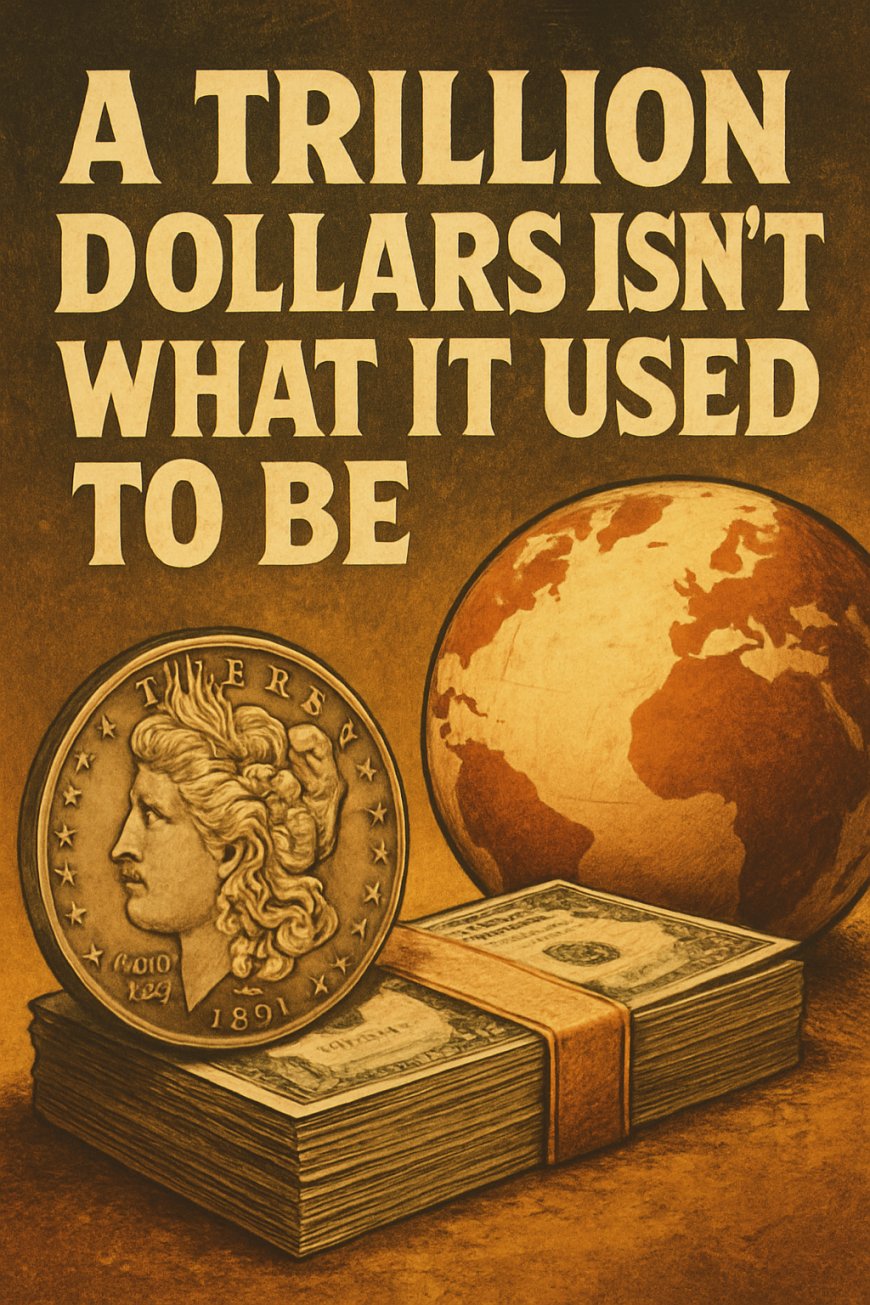
Right now, the United States is carrying roughly $38 trillion in federal debt. The number is so large that most people just glaze over. It lives in the same mental space as “distance to the Sun” or “number of stars in the galaxy” – abstract, untouchable.
Less than a century ago, federal debt was measured in the tens of billions of dollars. That was enough to trigger newspaper editorials, political panic, and serious debates about whether the country could handle it. Policymakers argued over billions the way they now argue over line items inside a trillion-dollar spending bill.
This isn’t just about “things got more expensive.” It’s about monetary scale drift – the way inflation, population growth, economic expansion, and permanent deficit spending changed the meaning of the numbers themselves. A billion dollars stopped being a world-historical number and became something you see in a single tech valuation or a modest line item in a federal budget.
When billions were empire money
To understand how far we’ve drifted, you have to rewind to the early 20th century. Coming out of World War I and into the 1920s, U.S. federal debt sat in the ballpark of $17–26 billion. Policymakers were already focused on paying it down. Surpluses in the 1920s chipped it lower. A number like $38 billion in total federal debt wasn’t just large, it was the kind of thing that made front-page news.
Back then:
- A billion dollars was a national-level number, not a corporate rounding error.
- Major programs and wars were measured in hundreds of millions, not trillions.
- Debt-to-GDP swings were felt in real time through taxes, austerity, or inflation fears.
Governments and the public treated those billions as heavy. There was a real sense that you only borrowed at that scale for war, depression, or existential emergencies. The default cultural assumption was that you aimed to get back to balance.
From tens of billions to tens of trillions
Fast forward less than a century and the picture is unrecognizable. Instead of arguing about whether $20 or $30 billion in debt is sustainable, we now argue about whether $38 trillion vs. $40 trillion is a “serious concern” or “manageable.”
The jump is not subtle:
- Early 1930s: federal debt around the teens to low tens of billions of dollars.
- Late 1930s and 1940: debt rising into the $30–40 billion range.
- 2025: total U.S. federal debt above $38 trillion.
Even if you ignored inflation completely and just compared the raw numbers, you’re looking at a jump from tens of billions to tens of trillions – roughly a thousand-fold increase in the face value. The nominal scale of what we’re willing to put on the national credit card exploded in a way prior generations would have considered insane.
Of course, the economy is bigger too. The U.S. population grew, GDP grew, and the financial system became more complex. But even when you account for that, the comfort level with very large nominal debt numbers has changed dramatically. What used to be “war or depression only” borrowing is now what we call “normal governance.”
What $2 and $10 meant a hundred years ago
To make this real instead of abstract, let’s bring it down from trillions to the level of a wallet. A century ago, a few dollars was not the same thing it is today. It carried a different weight in a normal person’s life.
Using long-run inflation estimates, prices today are roughly 18 times higher than they were in the mid-1920s. That means:
- $2 in the 1920s behaved like roughly $35–$40 today.
- $10 in the 1920s behaved like roughly nearly $200 today.
So when you say:
“A few dollars was a lot of money a hundred years ago. Ten dollars was pretty liquid.”
You’re not claiming that ten bucks made someone “rich”—you’re pointing at something subtler:
- A couple of dollars was real money in weekly life. It could cover multiple meals, basic goods, or a good portion of a week’s discretionary spending.
- Ten dollars was the kind of cash that could change your week – like suddenly having an extra $150–$200 appear in your budget today.
That’s the mental gap people miss. Our great-grandparents were dealing with a world where single-digit and double-digit bills were heavy. Now a lot of people can’t fill a gas tank or a grocery cart without crossing the $50 line.
If that’s what happened at the scale of $2 and $10, imagine what happened at the scale of $1 billion vs. $1 trillion.
The psychology of “number numbness”
Human brains were not built for trillion-scale thinking. We evolved to think in terms of “days of food,” “number of animals,” and “how many people live in the village.” Once you cross into the realm of billions and trillions, almost everyone’s intuition breaks.
That’s a problem, because the system we live under now runs on those huge numbers. Governments, megacorporations, AI infrastructure buildouts, and global capital markets all operate at scales most people can’t feel.
A few examples of how this shows up:
- Billion-dollar blindness: We hear that a bill “costs” $50 billion and shrug. Our intuition doesn’t scream, “That’s fifty thousand million-dollar chunks.”
- Trillion-dollar normalization: We talk about $1–2 trillion packages the way previous generations talked about $1–2 billion emergencies.
- Per-person invisibility: Dividing the total debt by the number of citizens or taxpayers gives numbers that would horrify most households if they saw them on a personal balance sheet, but the aggregation hides the impact.
Over time, this creates what I call number numbness. The more frequently we see giant numbers, the less any of them feel real. The problem is, bond markets, interest costs, and future tax burdens are very real. It’s just that the pain shows up slowly, through things like higher baseline rates, weaker currencies, and limited fiscal room in the next crisis.
Why this actually matters for normal people
It’s easy to think, “Okay, so the numbers got bigger, who cares?” But this shift has real-world consequences, especially for people who don’t live anywhere near the circles that pull the levers.
Here’s why the drift from $38 billion to $38 trillion matters:
- Interest costs crowd out everything else. When you owe tens of trillions, interest payments themselves become one of the largest “programs” in the entire federal budget. That money isn’t going to infrastructure, healthcare, defense, or tax relief. It’s going to bondholders.
- Policy gets locked into the debt machine. Once you normalize running deficits every year, the political system reorganizes around it. “Paying down the debt” becomes politically impossible, because almost every constituency now depends on constant spending.
- Rate sensitivity goes off the charts. When your debt is small, a 1% rate change is annoying. When your debt is tens of trillions, a 1% rate change is a budget event.
- Hidden tax through inflation and financial repression. Historically, high debt is often “managed” through inflation, slow devaluation of the currency, and keeping real interest rates lower than they would otherwise be. That usually shows up as a slow bleed on savers and wage earners.
The bottom line: even if you never see a Treasury auction, never read a bond prospectus, and never think about fiscal policy, you are still living inside its consequences. Your rent, your mortgage rate, your wages, the price of groceries, the return on your savings – all of them are downstream from a system that decided trillions were normal.
Pattern Nexus Lens: from war-scale borrowing to “Tuesday afternoon policy”
A hundred years ago, war, depression, or total systemic crisis was the level of event you needed to justify large, sustained federal borrowing. Debt spikes were rare and tied to very specific historical shocks.
Today, that same rough scale of borrowing is just Tuesday afternoon policy. The cycle looks more like this:
- Economy slows, a crisis hits, or a program is politically popular.
- Government issues more debt, often in the hundreds of billions or low trillions.
- Central banks and global capital markets absorb it, at least for a while, because the system has been built around the assumption that U.S. debt is “risk-free.”
- The new higher level of debt becomes the baseline, not a temporary spike.
From a Pattern Nexus perspective, that’s the shift: we moved from “exceptional borrowing for exceptional events” to “structural borrowing as a permanent operating mode.”
Once you see that, the $38 billion vs. $38 trillion comparison stops being a trivia fact and becomes a story about how the entire monetary framework changed in a single century, while most people were just trying to keep up with grocery bills.
FAQ: The $38 billion vs. $38 trillion world
Was $38 billion really that big a deal back then?
Yes. In the early 20th century, federal debt in the tens of billions was considered serious, especially relative to the size of the economy and the government’s tax base. It was not “background noise” – it was a major policy and political issue.
Is it fair to compare $38 billion then to $38 trillion now?
You always have to be careful comparing across time because of inflation and economic growth. But the point here isn’t “these numbers are identical in real terms.” The point is how our tolerance and comfort level with giant nominal numbers changed. We went from treating tens of billions as a crisis to treating tens of trillions as routine.
How much is $10 from back then in today’s money?
Roughly speaking, $10 in the mid-1920s would buy what close to $180–$200 buys today. So when older generations talked about a few dollars being a lot of money, that wasn’t exaggeration – in day-to-day life, it really was.
Does this mean the U.S. is about to collapse under its debt?
High debt doesn’t automatically mean collapse, but it does mean less flexibility. It narrows the policy options when new crises hit, raises the stakes on interest-rate moves, and increases the temptation to solve problems through inflation or financial repression instead of clean accounting.
What should a normal person actually do with this information?
You can’t fix federal debt on your own. But you can:
- Understand that the dollar you earn exists inside this system.
- Recognize that long-run inflation and policy choices will shape your real returns.
- Think in real terms: not “How many dollars do I have?” but “What can those dollars buy?”
- Pay attention to how often “temporary” trillions become permanent baselines.
Sources
Care este reacția ta?
 Îmi place
0
Îmi place
0
 Dezaprobat
0
Dezaprobat
0
 Iubire
0
Iubire
0
 Amuzant
0
Amuzant
0
 Wow
0
Wow
0
 Tristețe
0
Tristețe
0
 Înfuriați
0
Înfuriați
0

Founder of Pattern Nexus. I research markets, macro, geopolitics, AI, history, ancient systems, and the patterns most people overlook. I’m also building Market Radar, a trading scanner designed to read pressure, risk, confirmation, and setup quality before chasing a move. Pattern Nexus is where I connect the dots between data, history, technology, and the bigger system playing out around us.













Comentarii (0)