
🧭 IMF Warns Global Debt Could Exceed 100% of GDP by 2029
The IMF’s latest Fiscal Monitor warns that world public debt could climb beyond 100 percent of GDP by 2029 — a threshold unseen since the aftermath of World War II. Behind the numbers lies a structural problem: modern economies are addicted to debt-funded growth, and the world’s fiscal architecture is entering a critical phase.
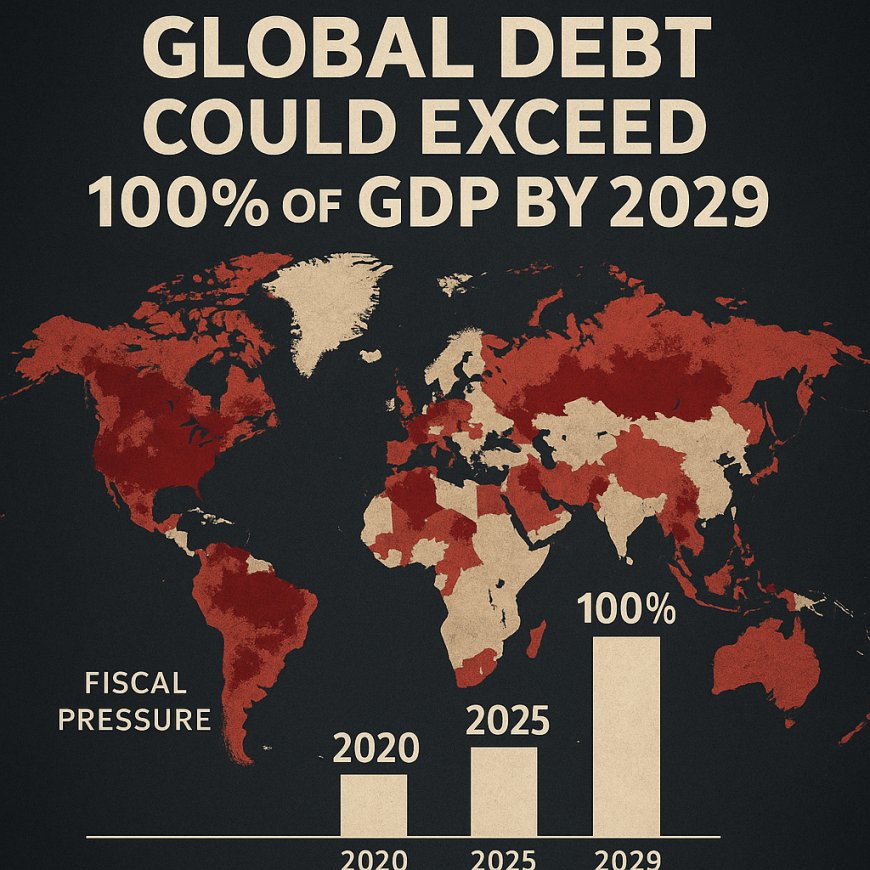
IMF Warns Global Debt Could Exceed 100% of GDP by 2029
The International Monetary Fund’s Fiscal Monitor 2025 doesn’t mince words. Global public debt, already hovering around 93 percent of GDP, is projected to surpass the 100 percent mark by 2029 — and could rise as high as 123 percent in a stress scenario. That’s more than $100 trillion in collective obligations, growing faster than the world’s productive capacity. On the surface, this looks like an abstract problem for economists. But debt, in reality, is the architecture of our modern lives — because every dollar borrowed by a government becomes liquidity for someone else.

At its core, debt is not just borrowing — it’s the promise of future liquidity. When governments run deficits, they issue bonds; when investors buy those bonds, the proceeds flow into the economy as spending. That spending becomes income for businesses, wages for workers, and deposits for banks. In other words, debt is money — not in form, but in function. It lubricates the gears of modern finance, allowing an inherently fragile system to appear stable. The problem isn’t that the world borrows; the problem is that it cannot stop. Every slowdown in liquidity eventually triggers a crisis, and every crisis demands more debt to fix the last one.
The IMF’s warning that total debt will breach 100 percent of GDP by 2029 isn’t a surprise — it’s an inevitability. Since 2008, the global economy has been addicted to leverage. Governments discovered that cheap borrowing could buy political stability and economic growth simultaneously. Central banks learned that the easiest way to prevent deflation is to flood the system with liquidity, even if that liquidity never reaches the average person right away. It first fills the reservoirs of banks and institutions. They use it to buy assets — bonds, equities, real estate, commodities — driving valuations higher and enriching those already closest to the financial pipeline. Only after those asset prices stabilize or trickle outward through wages, lending, and consumption does inflation appear on Main Street. By that time, the cause and effect have become separated by years — leaving people confused as to why groceries, housing, or insurance premiums have doubled while their income barely moves.
This time lag is critical. When the Federal Reserve or the European Central Bank adds liquidity to calm markets, it does so by buying bonds or accepting them as collateral in repo operations. That injects reserves into the banking system — not directly into the hands of consumers. Banks then decide what to do with that new liquidity: they can lend it, park it in Treasuries, or use it to speculate in risk assets. If they lend aggressively, money velocity rises, and inflation appears quickly. If they hoard it or recycle it into asset purchases, inflation is delayed — but asset bubbles form instead. Eventually, those bubbles become systemic, and when they pop, central banks respond again with even more liquidity. It’s a cycle of reaction disguised as management.
The IMF’s numbers show that the cost of servicing debt is now rising faster than GDP in over half of the world’s economies. That’s a first in modern history. As interest expenses grow, governments must borrow more just to cover the cost of previous borrowing — compounding the problem. In the United States, the Treasury’s annual interest bill will surpass one trillion dollars in 2026. Japan already spends nearly half its tax revenue on debt service. Europe, constrained by energy imports and an aging population, is following close behind. This isn’t a liquidity event — it’s structural entrapment. And the only way out is through inflation, which erodes the real value of that debt over time.
The IMF doesn’t say it directly, but the institution’s models implicitly assume that inflation will remain above pre-pandemic norms for the rest of the decade. That’s not a bug — it’s a feature. Mild inflation allows debt-to-GDP ratios to fall in real terms even as nominal debt rises. It’s the same strategy used after World War II: hold rates below inflation, grow nominal GDP through investment, and inflate the debt away slowly. But the world today is different — global capital flows move instantly, supply chains are digitized, and inflation leaks across borders like water through sand. You can’t contain price pressure in one country without affecting another.
The result is a strange equilibrium. Central banks are tightening on paper, but the global liquidity base continues to expand through back doors — currency swaps, repo facilities, and digital asset collateral. The Bank for International Settlements calls it “cross-border liquidity elasticity.” In plain English, it means that when one country tightens too much, another eases, and liquidity simply finds the path of least resistance. The financial system behaves like a living organism seeking balance. Each injection of liquidity somewhere creates inflation somewhere else — not immediately, but inevitably.
The average person doesn’t see this process directly. They feel it years later when the cost of living adjusts upward to the new monetary base. By then, the narrative has shifted: politicians blame supply chains, corporations, or foreign wars, but the real driver is always the same — liquidity. When too much money chases too few assets, prices rise. When those assets are concentrated in markets, we call it a bubble. When it spills into consumption, we call it inflation. Either way, the outcome is the same: the erosion of purchasing power.
The IMF’s Fiscal Monitor captures this dynamic without fully articulating it. It notes that fiscal policy and monetary policy are becoming increasingly intertwined, with central banks effectively financing government deficits through balance-sheet operations. That is, central banks buy what governments issue, keeping yields artificially low to preserve stability. But stability has a cost: the longer rates stay suppressed, the more speculative behavior builds up in the private sector. Once those pressures unwind, as they did in 2008 and again in 2020, the response requires an even larger expansion of liquidity than before.
In the old world, debt accumulation was an occasional necessity; in the new one, it’s the foundation of the global economy. Modern capitalism runs on credit creation — and governments have become the ultimate counterparty. When private debt collapses, public debt expands to absorb it. When consumption falters, fiscal stimulus replaces it. This is why the IMF’s warnings about sustainability ring hollow: the system cannot survive without the very leverage it condemns.
What makes this cycle more dangerous now is that liquidity is becoming digital. Projects like BlackRock’s tokenized Treasury ETF and Circle’s programmable dollar funds are the early prototypes of what will soon become a global web of tokenized debt instruments. These assets can move instantly, settle globally, and be traded or collateralized 24/7. On the surface, this looks efficient — and it is. But efficiency in finance often means fragility in human terms. When liquidity can move at the speed of code, panic can too. And when inflation finally catches up, it will arrive faster than ever before.
What the IMF calls “fiscal adjustment” is really a controlled retreat — a gradual acceptance that the world cannot pay down its debt, only roll it, reprice it, and repackage it. That repricing process is what ordinary people experience as volatility, higher costs, or slower wage growth. Every dollar that governments inject into the system to stabilize markets eventually manifests as a higher baseline cost of living. The lag between liquidity creation and price transmission may take months or years, but the direction is constant. Liquidity doesn’t disappear; it migrates.
If there’s a lesson in the IMF’s warning, it’s not that debt is inherently evil. It’s that debt, once unleashed, transforms the fabric of society. It redistributes wealth upward during expansion and downward during inflation. It rewards speculation over production, short-term optimization over long-term resilience. And it does all of this quietly — through numbers and policies that most people never read, but whose effects they live every day.
The world will cross the 100 percent threshold of global debt to GDP long before 2029. The IMF’s projection is conservative; the real curve is exponential. And while economists will argue about sustainability, the truth is simpler: the debt itself is now the system. Every rate hike, every repo operation, every Treasury auction is a line of code in a much larger operating system — one that trades stability today for volatility tomorrow. And that volatility, when it reaches the average person, doesn’t look like a market crash; it looks like higher rent, higher food prices, and the feeling that no matter how hard they work, money just doesn’t go as far as it used to.
The debt is not the crisis. The liquidity is. And liquidity always finds a way — until it doesn’t.
Sources & Further Reading
- IMF Fiscal Monitor 2025
- OECD General Government Debt Database
- BIS Project Guardian Report (2024)
- BlackRock & Circle — Tokenized Treasury Announcement
- Reuters — IMF Global Debt Projection (2025)
- Financial Times — Global Fiscal Monitor Breakdown
#IMF #GlobalDebt #Liquidity #FiscalPolicy #Inflation #MacroEconomics #PatternNexus
Care este reacția ta?
 Îmi place
0
Îmi place
0
 Dezaprobat
0
Dezaprobat
0
 Iubire
0
Iubire
0
 Amuzant
0
Amuzant
0
 Wow
0
Wow
0
 Tristețe
0
Tristețe
0
 Înfuriați
0
Înfuriați
0

Founder of Pattern Nexus. I research markets, macro, geopolitics, AI, history, ancient systems, and the patterns most people overlook. I’m also building Market Radar, a trading scanner designed to read pressure, risk, confirmation, and setup quality before chasing a move. Pattern Nexus is where I connect the dots between data, history, technology, and the bigger system playing out around us.















Comentarii (0)