
Star Catcher Just Broke DARPA’s Record — The Hidden Industry About to Reshape Global Energy
Star Catcher surpassed DARPA by beaming 1.1 kW at NASA, signaling the rise of space-based solar power — a new industry that will reshape global energy.
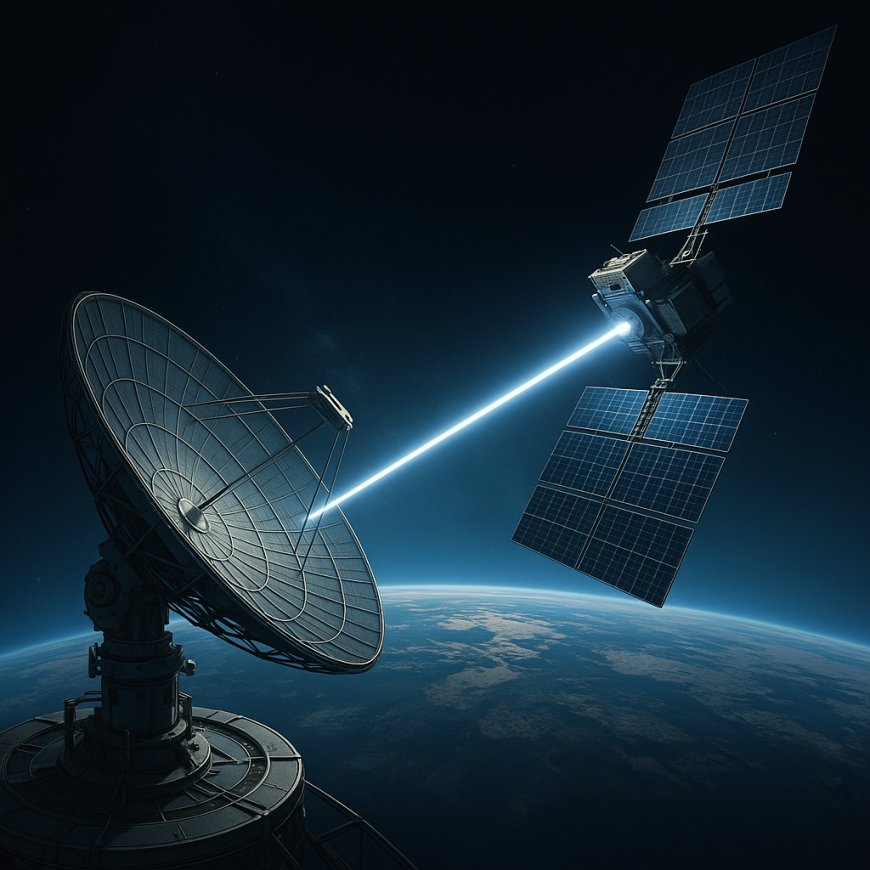
Star Catcher Breaks DARPA’s Record — The Space Solar Race Just Entered a New Phase
Space-based solar power — an idea born in the 1960s — just became significantly more real. Star Catcher Industries announced that its Star Catcher Network achieved a record-setting 1.1 kW optical power beam during testing at NASA’s Kennedy Space Center. The company used commercial off-the-shelf solar panels to receive the power, proving the concept without exotic hardware.
This breaks the previous record set by the U.S. Defense Advanced Research Projects Agency (DARPA) in June 2025, when DARPA successfully transmitted 800 W via microwave beam. A private-sector newcomer surpassing a major defense agency is not normal — and it signals something bigger: the technology is maturing.
The Original Vision: Unlimited Solar Power From Space
Space-based solar power (SBSP) was first proposed in 1968 by aerospace engineer Peter Glaser. The concept was bold:
- Place gigantic solar arrays in orbit.
- Collect constant 24/7 sunlight.
- Convert it into a microwave or laser beam.
- Send it to Earth to be turned back into electricity.
In orbit, there's no night, no clouds, and no atmospheric loss. Sunlight is up to 8× stronger than what ground panels receive. SBSP has always been the holy grail of clean baseload power — but the engineering challenges were massive.
Now? Those barriers are falling.
Why Star Catcher’s Demonstration Matters
Star Catcher used optical laser-based power beaming, not microwaves. That matters:
- Optical beams can be more precise.
- Receivers can be smaller and cheaper.
- Commercial solar panels can already absorb tuned wavelengths.
- Scaling to higher density becomes easier.
The company's beam hit off-the-shelf solar panels and produced 1.1 kW of usable power. That’s not grid-scale energy — but it’s the strongest optical-beam demo to date.
The Competitors: DARPA, NASA, China, Japan, EU
Star Catcher isn’t alone. SBSP has become a quiet geopolitical race.
DARPA: The U.S. Defense Track
DARPA’s SSPIDR program is the main U.S. government SBSP effort. Their focus:
- high-efficiency microwave beaming
- lightweight deployable orbital arrays
- autonomous space assembly
DARPA still leads in microwave SBSP — the approach with fewer atmospheric losses and safer energy densities. But Star Catcher’s leap shows that private optical-based SBSP is catching up faster than expected.
NASA’s Role
NASA is not leading SBSP, but it provides:
- test facilities
- lunar energy research
- power-beaming safety protocol development
- materials research for ultra-light solar arrays
NASA sees SBSP as essential for:
- lunar bases
- Martian logistics
- deep-space manufacturing
China: The Most Aggressive Program in the World
China has invested billions into SBSP and plans:
- a 10 MW orbital SBSP platform by 2030
- a gigawatt-scale system by 2040
- a massive ground receiver station in Chongqing
They’ve already tested tall microwave receiver towers and launched in-space power transmission experiments. China sees SBSP as a path to:
- energy independence
- military logistics dominance
- global grid influence
Why the Technology Is Finally Ripe
Advances in several fields made today’s breakthroughs possible:
- thin-film photovoltaics
- adaptive laser optics
- high-efficiency diodes
- autonomous space-assembly robotics
- ultra-light materials
- cheap orbital launch from SpaceX and Blue Origin
The cost barriers that killed SBSP in the 1970s and 1990s are collapsing.
What SBSP Unlocks for the U.S. Energy Grid
Space-based solar power is not a replacement for ground energy — it’s a strategic layer that solves one of America’s biggest problems:
SBSP provides:
- 24/7 baseload — like nuclear, but sunlight-powered
- location independence — beam power anywhere on Earth
- disaster resilience
- military logistical energy in war zones
- off-grid power for remote AI clusters
This is why the U.S., China, UK, Japan, and the EU are all racing toward it. Energy is the new silicon, and whoever controls cheap baseload power controls the entire technological stack.
The Real Bottlenecks Ahead
We’re still early. The major challenges now:
- scaling from kilowatts → megawatts → gigawatts
- launch volume and orbital construction
- thermal management on laser receivers
- military safety and misalignment controls
- global regulatory frameworks
None of these are impossible — they’re engineering problems. And engineering problems get solved.
What Star Catcher’s 1.1 kW Signal Means
Star Catcher’s test matters because it shows that:
- private industry is entering the SBSP race
- optical beaming is a viable competitor to microwave SBSP
- scaling can now proceed on standard commercial hardware
- the gap between Earth testing and orbital deployment is shrinking
This is no longer an academic concept. It’s a real technology with real momentum.
The Pattern Nexus Projection (2025–2040)
Based on current global programs:
- 2027–2030: first orbital 10–100 kW demos
- 2030–2035: military SBSP → 1–10 MW
- 2035–2040: civilian grid SBSP → 100 MW–1 GW
- 2040–2050: full orbital baseload energy layer
It will not replace ground power — but it will transform it.
Care este reacția ta?
 Îmi place
0
Îmi place
0
 Dezaprobat
0
Dezaprobat
0
 Iubire
0
Iubire
0
 Amuzant
0
Amuzant
0
 Wow
0
Wow
0
 Tristețe
0
Tristețe
0
 Înfuriați
0
Înfuriați
0

Founder of Pattern Nexus. I research markets, macro, geopolitics, AI, history, ancient systems, and the patterns most people overlook. I’m also building Market Radar, a trading scanner designed to read pressure, risk, confirmation, and setup quality before chasing a move. Pattern Nexus is where I connect the dots between data, history, technology, and the bigger system playing out around us.














Comentarii (0)