
CHINA: Scarborough and the Slow Manufacture of Sovereignty
China’s new “clearing operation” language near Scarborough Shoal is not just another maritime incident. It is the next layer in a longer control sequence: presence becomes enforcement, enforcement becomes administration, and administration is meant to harden into accepted sovereignty.
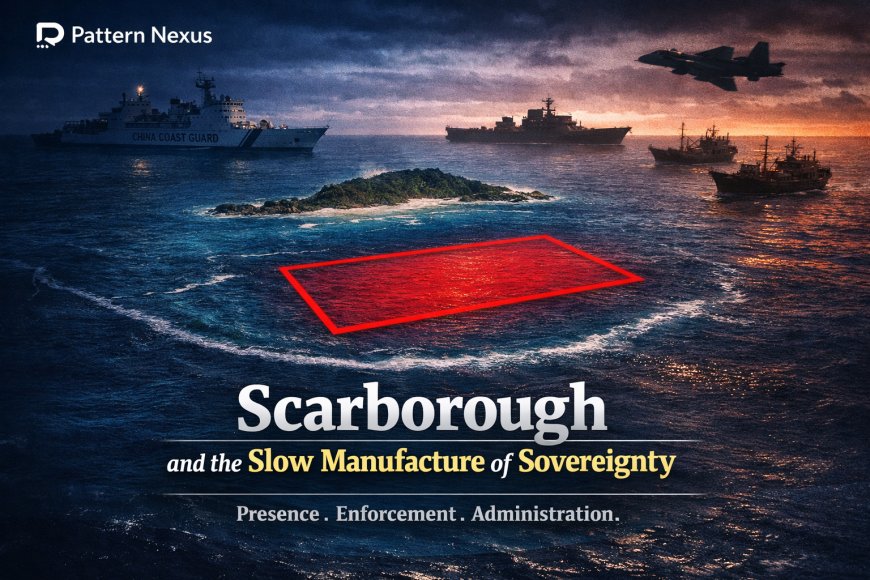
The March 24 Scarborough incident matters because China was not just shadowing or harassing. It was using administrative language. A “clearing operation” implies the right to define a zone, manage a zone, and decide who belongs inside it. That is the real pattern here. Scarborough is being conditioned, slowly and repeatedly, from contested space into behaviorally controlled space. The fishermen are the immediate target, but the larger target is the region’s mental model of who gets to decide what happens in that water.
This is not just a fishing dispute. It is administrative conditioning at sea.
Risk is not only collision or war. Risk is the gradual normalization of someone else acting like the operating authority inside your own waters.
Presence becomes enforcement. Enforcement becomes administration. Administration is how sovereignty gets rehearsed before it is formally accepted.
What Happened at Scarborough
On March 24, the Philippine side said it documented, for the first time, a live China Coast Guard radio broadcast announcing a “clearing operation” near Bajo de Masinloc. According to the Philippine account, the Chinese side gave four coordinates outlining a rectangular area in the southern portion of Scarborough Shoal. During the same patrol window, the Philippine side reported six China Coast Guard vessels, 20 Chinese maritime militia ships, and one PLA Navy warship operating nearby.
That wording matters more than most headlines will capture. “Clearing operation” is not neutral language. It implies management. It implies the right to define an area, regulate activity inside it, and decide who belongs there. In plain English, it is the language of authority. China was not just showing up. It was speaking like the operator of the space.
This also did not happen in a vacuum. The incident followed reports that more than 20 Filipino fishing boats had been harassed by Chinese Coast Guard speedboats. The Philippine response was to deploy coast guard and fisheries vessels to protect fishermen and sustain their operations. That is important, but it also shows the real asymmetry. One side is trying to keep access open. The other is trying to redefine access as something it grants or removes.
The shift is not only the number of ships. It is the move from pressure to procedure. A live broadcast declaring a “clearing operation” is administrative theater with real strategic purpose.
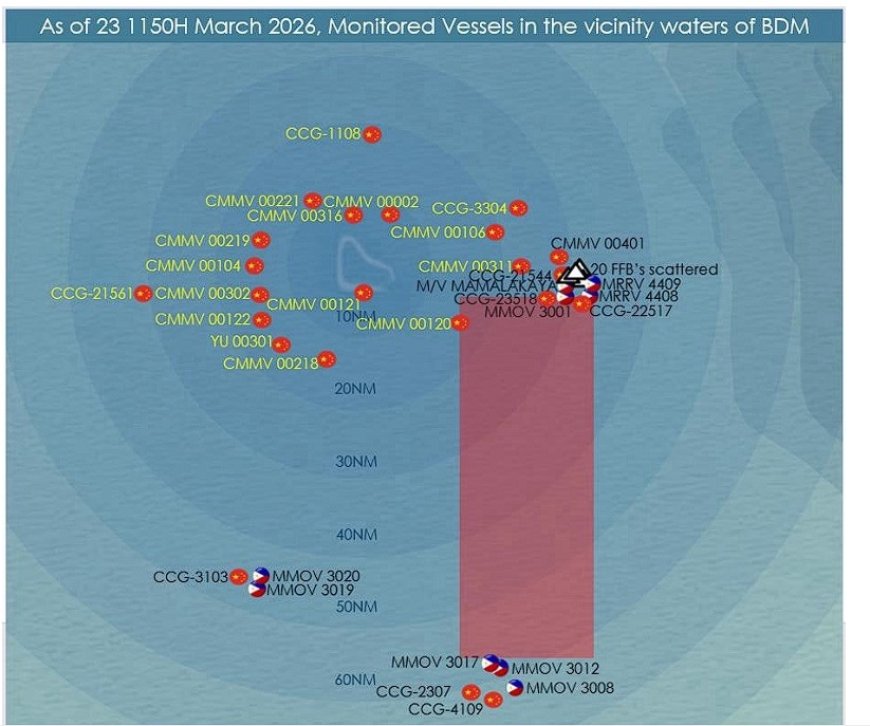
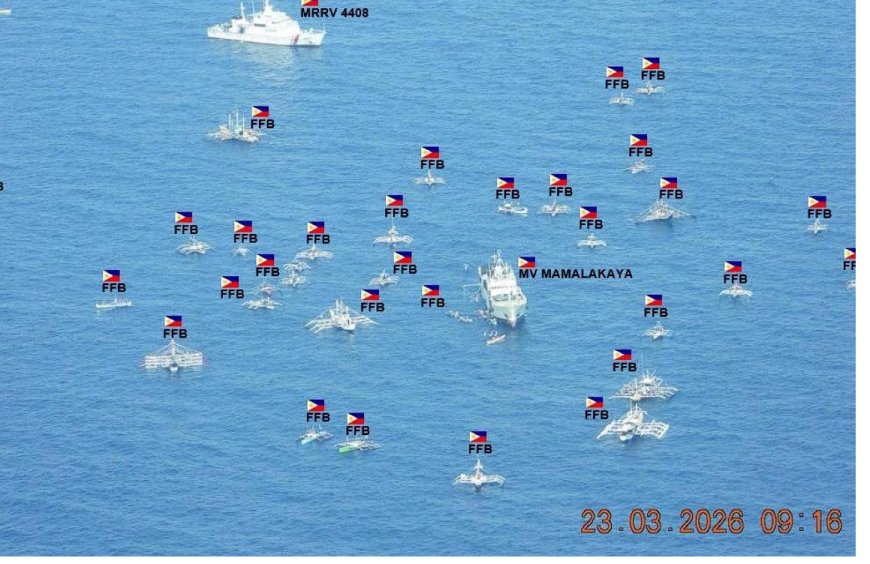
From Presence to Administrative Control
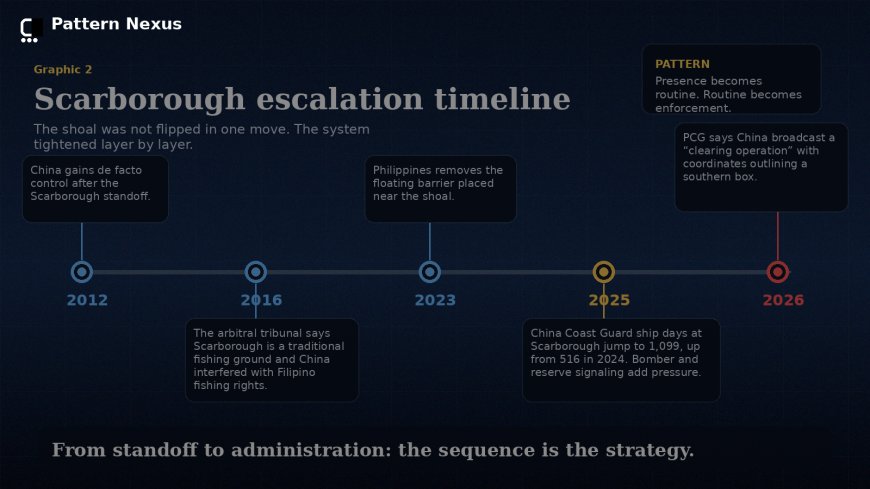
The larger story is not March 24 by itself. The larger story is the sequence. China took de facto control of Scarborough after the 2012 standoff. The 2016 arbitral ruling then found that Scarborough was a traditional fishing ground for multiple nationalities and that China, through the operation of its official vessels, had unlawfully prevented Filipino fishermen from engaging in traditional fishing there. That should have been a hard legal limit. Operationally, it was not.
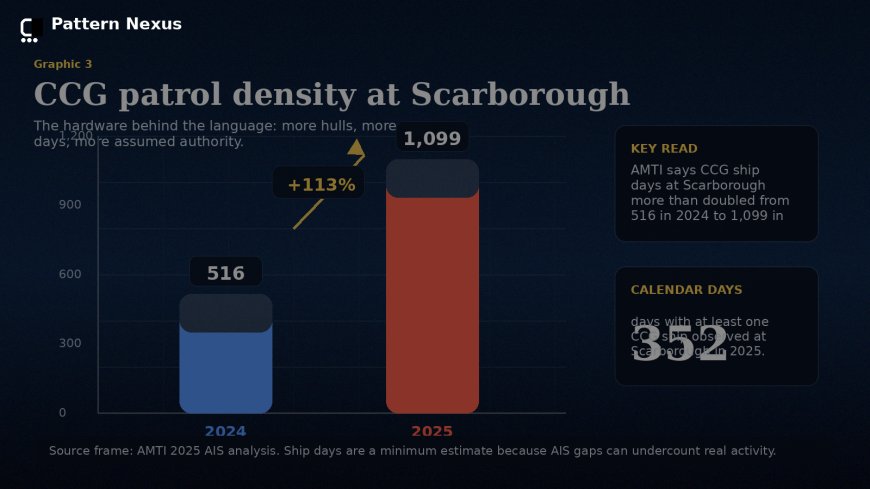
Since then, the pressure has been layered. A floating barrier at the shoal entrance. Repeated exclusion behavior around Filipino fishermen. A move to create a nature reserve that looks less like conservation and more like jurisdictional conditioning. Bomber signaling around the feature. Air and sea warnings. And now a “clearing operation” vocabulary that sounds more like municipal management than maritime dispute.
This is how modern sovereignty is often tested in contested space. Not always by formal annexation. Not always by gunfire. Sometimes by routine, repetition, and administrative language until everybody around the dispute begins behaving as though the control claim is already real.
- Presence creates familiarity.
- Friction creates hesitation.
- Declared procedures create implied authority.
Why This Matters Beyond the Shoal
Scarborough is not just a reef story. It is a control story. The fishermen matter because they are the human edge of the system. But the system itself is bigger than fish. It is about who sets permissions, who defines access, who decides what counts as intrusion, and who gets forced into reacting on someone else’s terms.
That is why this fits the broader Pattern Nexus frame so cleanly. Control does not always announce itself as conquest. Often it shows up as process. As compliance language. As safety language. As conservation language. As “routine operations.” By the time the legal fight catches up, the behavioral map has already changed.
Scarborough also sits inside a larger maritime system. The South China Sea is one of the most important trade arteries in the world. So even when a given flashpoint looks local, the logic underneath it is not local at all. It is about corridor control, risk pricing, naval access, and whether repeated operational pressure can become accepted political reality.
Scarborough is small on the map. That is exactly why it matters. Small places are where large powers test what they can normalize before scaling it outward.
Pattern Nexus Lens
Scarborough shows the difference between legal reality and operational reality. Law can say one thing. Ships can say another. The state that can show up more often, shape procedure, and condition behavior can manufacture a form of lived sovereignty even while the formal dispute remains unresolved. That is the same core pattern seen across other domains: control comes through layers, permissions, rails, and habit. Maritime gray-zone coercion is just the ocean version of a broader systems truth.
Scarborough is not mainly about who says they own a shoal. It is about whether repeated control behavior can train the region to act as though the answer has already been decided.
FAQ
What is Scarborough Shoal?
Scarborough Shoal, also known as Bajo de Masinloc or Panatag Shoal in the Philippines and Huangyan Dao in China, is a contested maritime feature in the South China Sea that has long been used as a fishing ground and has become a recurring flashpoint between Manila and Beijing.
Why does the phrase “clearing operation” matter?
Because it is not just warning language. It implies the right to manage space and remove unwanted activity from it. That turns a pressure operation into something that sounds like administration.
Why should people outside the region care?
Because Scarborough is part of a larger maritime system tied to trade, naval access, insurance, routes, and regional deterrence. Incidents there are local expressions of a much bigger struggle over corridor control and practical sovereignty.
Sources
These sources support the incident details, the legal backdrop, the patrol-density shift, and the broader corridor significance.
- Philstar — China Coast Guard broadcasts “clearing operation” near Scarborough Shoal
- Permanent Court of Arbitration — South China Sea Arbitration Award (2016)
- AMTI — Eyes on the Prize: CCG Patrols Prioritize Scarborough in 2025
- Reuters — Philippines removes Chinese barrier at disputed shoal
- Reuters — China to establish nature reserve in disputed Scarborough Shoal
- Reuters — Satellite images show fresh Chinese bomber deployment near Scarborough
- Reuters — China says it drove away Philippine aircraft over disputed shoal
- CSIS ChinaPower — How Much Trade Transits the South China Sea?
Какова ваша реакция?
 Нравится
0
Нравится
0
 Не нравится
0
Не нравится
0
 Любовь
0
Любовь
0
 Смешно
0
Смешно
0
 Вау
0
Вау
0
 Грусть
0
Грусть
0
 Сердитый
0
Сердитый
0

Founder of Pattern Nexus. I research markets, macro, geopolitics, AI, history, ancient systems, and the patterns most people overlook. I’m also building Market Radar, a trading scanner designed to read pressure, risk, confirmation, and setup quality before chasing a move. Pattern Nexus is where I connect the dots between data, history, technology, and the bigger system playing out around us.













Комментарии (0)