
Treasury Retires $142 Million in TIPS — Quiet Confirmation of the Buyback Era
The U.S. Treasury retired $142 million in TIPS on Nov 12, 2025 — a direct confirmation of the buyback-driven liquidity cycle we've been tracking. Here’s what the operation reveals about collateral stress, pre-QE interventions, and the evolving monetary plumbing.
Treasury Retires $142 Million in TIPS — Quiet Confirmation of the Buyback Era

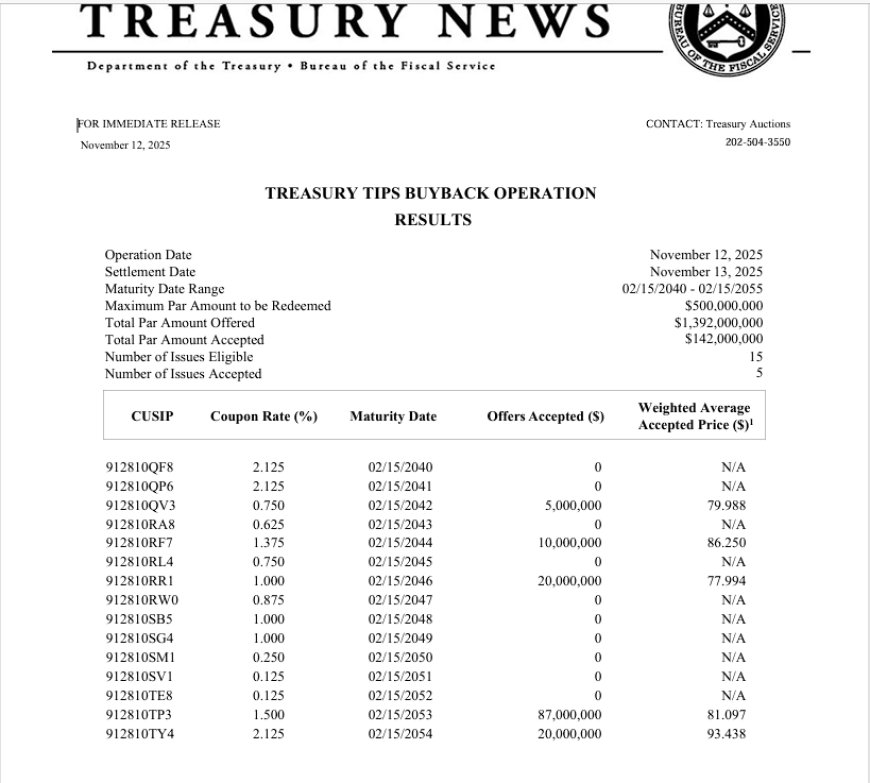
The U.S. Treasury just released the official TIPS Buyback Operation Results for November 12, 2025 — and this single PDF quietly confirms everything we’ve been tracking across Pattern Nexus for the past month.
$142,000,000 in TIPS retired in one operation.
On the surface, this looks like a simple balance-sheet maneuver. But in the structural framework we’ve mapped — Buyback Era → Collateral Recycling → Pre-QE Intervention → Controlled Yield Environment — this operation is unmistakably part of the next stage of U.S. liquidity management.
📌 What Today’s Release Shows
- Operation Date: November 12, 2025
- Settlement Date: November 13, 2025
- Maturity Range: 02/15/2040 – 02/15/2055
- Maximum Par Redeemable: $500,000,000
- Total Par Offered: $1,392,000,000
- Total Par Accepted: $142,000,000
- Issues Accepted: 5
Treasury had authorization to redeem up to $500 million and ended up accepting $142 million, nearly 30% of the maximum. Dealers were eager to unload: they offered more than $1.39 billion in eligible TIPS. The fact that Treasury took a meaningful portion of that tells us something about where the stress is and how policymakers are responding.
🔧 Why This Matters (and How It Confirms the Pattern Nexus Liquidity Thesis)
For weeks, we’ve been mapping the progression:
Buyback Operations → Collateral Recycling → Balance-Sheet Room → Controlled QE → Yield Management → Cycle Reset.
Today’s operation fits directly into that architecture. This is not “random.” This is not “just another auction.” This is Treasury performing quiet, targeted balance-sheet surgery to stabilize the long end of the curve, ease collateral pressure, and pre-position the system for the next liquidity cycle.
🥇 Buyback Operations: The Foundation
Buybacks were publicly revived in 2024, but we’ve been arguing since early 2025 that their true purpose is not cosmetic. They provide Treasury with a precise tool for:
- removing older, less liquid securities (off-the-run TIPS)
- reducing auction pressure by retiring supply before new issuance
- freeing dealer balance-sheet space, easing regulatory burdens
- managing the curve without calling it “yield curve control” (even though this is a form of it)
The $142M retirement today is a perfect example: the maturities range from 2040 to 2055 — the exact region of the curve that has been the most sensitive to funding stress.
♻️ Collateral Recycling: Clearing the Plumbing
The “collateral plumbing” term isn’t metaphorical — it’s literal. Older TIPS with specific maturity buckets have been clogging the repo and derivatives collateral chain. Retiring them and replacing them with cleaner on-the-run issuance is like clearing a bottleneck in a hydraulic system.
This aligns with our article: The Hidden Liquidity Crunch: Repo Stress, QT’s End, and the Dollar’s Trap .
Treasury buybacks reduce disorderly spikes and smooth volatility — all without needing to announce policy changes. Quiet intervention is still intervention.
🏛️ Pre-QE Balance-Sheet Expansion: QE Without Saying QE
We have repeatedly stated:
QE returns not by announcement, but by function.
Buybacks accomplish the following:
- Stabilize long-term yields without a formal QE program
- Rebuild market depth after years of QT drain
- Reduce volatility in illiquid pockets of the curve
- Prepare the system for controlled liquidity injections
This is the pre-QE stage we outlined in:
The mechanism is simple:
Retire old collateral → issue new → stabilize yields → grant dealers space → re-expand system liquidity.
📉 Controlling Yields Even If They Print
One of our core theses — repeated across multiple PN articles — is that even if the Fed or Treasury prints, they will control the yields. This is not optional. It is structural.
Why?
- The Treasury cannot fund rolling $11T/year issuance with unpredictable long-end volatility.
- The derivatives market cannot function if collateral haircuts spike.
- Banks cannot hold capital if long-end yields disorderly widen.
- Mortgages, credit, corporate funding, and pensions are all anchored to the long end.
Buybacks are the cleanest way to control yields without announcing a formal YCC program. It is QE in everything but name.
As we said in: The Hidden Liquidity Crunch :
Controlled QE always beats uncontrolled QE. Buybacks are controlled QE.
🌀 This Is the First Turn in the Liquidity Cycle
Today’s buyback — a simple, boring PDF on a government website — is actually the start of a full liquidity cycle turn:
- QT slows
- Buybacks ramp
- Collateral stabilizes
- Funding stress cools
- Curve flattens, then bull-steepens
- QE becomes inevitable (in controlled form first)
This is not an opinion — it is visible in Treasury’s own operations.
🔗 Official Sources
- Buyback Results & Announcements: TreasuryDirect – Buyback Press Releases
- Buyback FAQs (how the operations work): TreasuryDirect – Buyback FAQs
- Current Buyback Rules (31 CFR Part 375): Code of Federal Regulations
- Tentative Buyback Schedule (quarterly): PDF – Treasury Tentative Buyback Schedule
Today’s result is not a footnote — it is a signal. The buyback era is not coming. It’s here.
And as we’ve shown across Pattern Nexus, once this process begins, it does not reverse until the liquidity cycle is fully reset.
Aká je vaša reakcia?
 Páči sa mi to
0
Páči sa mi to
0
 Nehodnotiť
0
Nehodnotiť
0
 Láska
0
Láska
0
 Zábavné
0
Zábavné
0
 Wow
0
Wow
0
 Smútiť
0
Smútiť
0
 Rozhněvaný
0
Rozhněvaný
0

Founder of Pattern Nexus. I research markets, macro, geopolitics, AI, history, ancient systems, and the patterns most people overlook. I’m also building Market Radar, a trading scanner designed to read pressure, risk, confirmation, and setup quality before chasing a move. Pattern Nexus is where I connect the dots between data, history, technology, and the bigger system playing out around us.












Komentáre (0)