
Housing Is the Target: The 2026 Mortgage-Rate Compression Play
Trump’s directive for Fannie and Freddie to buy $200B in mortgage bonds, alongside a still-easing rate backdrop, signals an explicit attempt to compress mortgage spreads and support housing. This framework maps the plumbing, the limits, and what would have to break for home prices to stop grinding higher.


The Signal: Policy Will Not Let Housing Correct
Start with the basic message nobody in government will say out loud: the United States cannot allow a broad housing price correction because household balance sheets, municipal tax bases, banking collateral, political legitimacy, and credit creation all sit on top of housing. If housing goes, everything above it buckles. That means housing is defended, not liberated.
This cycle just made that explicit. The administration didn’t “suggest” lower rates. It ordered the two government-sponsored liquidity pipes that originate and guarantee most mortgage production to buy $200B in MBS. That is not rhetoric. That is balance-sheet power directed at price.
Combine that with an easing backdrop, slowing inflation impulse, and Treasury issuance tilted toward bills, and the structure supports mortgage compression. In a country millions of units short, compression does not make housing cheap. It reprices the same shortage higher.
Don’t wait for policymakers to gift you affordable housing. They are running the opposite playbook.
The Plumbing: Rates Don’t Move How People Think
Most people think “the Fed cuts rates so mortgage rates drop.” That’s not how the mechanism works. Mortgages price off the long end of the Treasury curve plus the MBS spread plus the primary-secondary margin. That means you can get mortgage relief without the Fed doing anything dramatic if spreads compress.
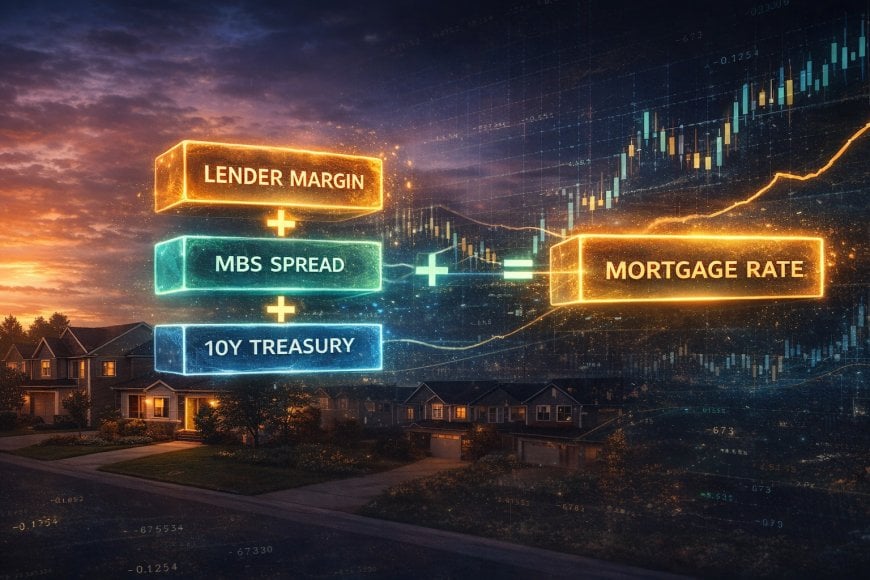
When the government tells Fannie and Freddie to bid MBS, it hits the spread. When liquidity conditions improve, lender margins compress. Put those together and mortgage quotes get lower even if the 10-year Treasury is unchanged. This is the part amateur macro and mainstream media never explain because it ruins the “Fed causes everything” narrative.
Once payments drop a few hundred dollars per month, the marginal buyer reappears. And in a shortage, the marginal buyer sets the price.
Payment relief does not create affordable houses. Payment relief gives buyers the ability to bid more principal for the same house.
The Setup: 2026 Housing Is a Collateral Protection Regime
Now combine the plumbing with the structural background. The United States is 3–4 million units short of equilibrium supply. Builders cannot catch up fast enough to materially change inventory. Local zoning blocks density. Permitting lags. Insurance costs rise. Land is scarce in the metros with jobs. None of that resolves fast. Supply does not meet demand; demand is throttled and rationed through price.
When the government compresses mortgage rates into that shortage, the outcome is not ambiguous. Housing does not crash. Housing sets new nominal highs. Then people complain about affordability while policymakers congratulate themselves for “helping homebuyers” with lower rates.
The only people who lose are the ones who wait for a price regime policymakers are not allowing to exist.
If you need housing and have a multi-year horizon, waiting for affordable housing is how you get permanently priced out.
The 100-Year Table: What the System Actually Does
This is where the data cuts through the feelings. People keep asking “When will housing crash?” as if crashes are the default state. They are not. Crashes are the anomaly. The default state is slow, persistent upward repricing of the collateral layer interrupted by rare liquidity shocks.
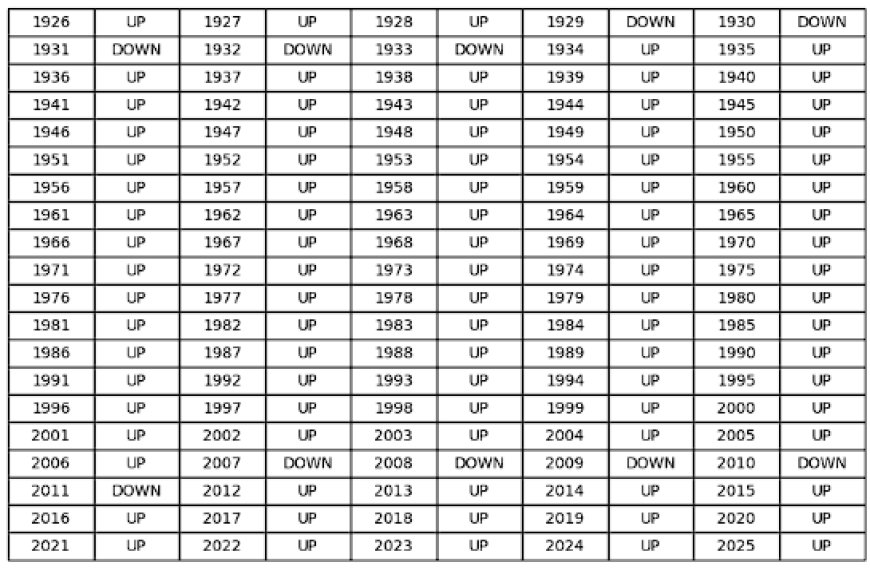
Here is the uncomfortable part nobody wants to admit: the table is the gameboard. It shows 100 years of annual UP/DOWN resolution. The pattern is not random. The pattern is that the system spends almost all of its time repricing the collateral layer upward, occasionally pausing, and almost never allowing the collateral layer to clear lower for long. Down years are rare—they cluster around systemic liquidity shocks—and then the system immediately moves to restore price.
This is not psychology. It is structural mechanics. Housing sits at the foundation of the household balance sheet, the banking system, municipal tax bases, pension collateral, consumption confidence, and political legitimacy. When the foundation wobbles, the State does not celebrate lower prices. It panics and intervenes. The table is the forensic record of that reflex.
Count the downs. Count the ups. Count how quickly the downs are repaired. Then count how many times the system voluntarily allowed multi-year real price destruction for the sake of young buyers or affordability. The answer is effectively zero. Affordability is not a policy objective. Collateral integrity is.
The takeaway is simple: if you are waiting for a generational entry point where policymakers allow the housing market to naturally clear down to your comfort level, you are waiting for a regime that has not existed in 100 years and is not going to be permitted now—especially not after the government just activated the mortgage-basis lever directly through the GSE complex.
This is why the “don’t buy now, wait until it crashes” script almost never works in the real world. You are running a playbook against a system that actively prevents the outcome you are betting on. The table is your warning label.
It shows the system is not designed to reward people who wait for affordability. It is designed to reward people who acquire collateral and survive the cycle.
The table does not say “housing always goes up.” It says “policy and credit infrastructure are designed to prevent prolonged down cycles.” Once you see that, the correct housing questions change from “When do prices crash?” to “What would policymakers have to abandon for prices to crash?” and “Why would they ever do that?”
Housing is not a free market good; it is a collateral layer for the financial system.
Waiting for affordability is how a generation gets structurally locked out.
Policy protects collateral, not buyers.
Pattern Nexus Lens
The system is revealing its true logic: defend collateral → defend banks → defend consumption → defend legitimacy. Housing is not the target of support because government cares about homeowners. Housing is supported because it is the base layer that holds everything else upright.
If you understand the control layer, the trade is obvious: buy housing before policymakers finish compressing the financing layer they just signaled they intend to compress.
FAQ
Does this make housing affordable?
No. It makes payments cosmetically lower while prices reset higher.
Can this fail?
Yes. It fails if the long end spikes, if credit tightens, or if unemployment blows out. But policymakers will throw multiple tools at housing before they accept a price correction.
If I haven’t bought a house, should I?
If you need housing and have horizon, yes. If you are playing musical chairs with leverage and luck, no. The system helps the first group, not the second.
Sources
Policy directives, mortgage data, housing supply estimates, and price indices referenced in this piece.
- Reuters — $200B MBS directive
- Freddie Mac — Weekly mortgage rate prints
- Freddie Mac — Housing supply shortage
- FHFA — Price indices and GSE framework
- Case-Shiller — Home price index
Aká je vaša reakcia?
 Páči sa mi to
0
Páči sa mi to
0
 Nehodnotiť
0
Nehodnotiť
0
 Láska
0
Láska
0
 Zábavné
0
Zábavné
0
 Wow
0
Wow
0
 Smútiť
0
Smútiť
0
 Rozhněvaný
0
Rozhněvaný
0

Founder of Pattern Nexus. I research markets, macro, geopolitics, AI, history, ancient systems, and the patterns most people overlook. I’m also building Market Radar, a trading scanner designed to read pressure, risk, confirmation, and setup quality before chasing a move. Pattern Nexus is where I connect the dots between data, history, technology, and the bigger system playing out around us.















Komentáre (0)