
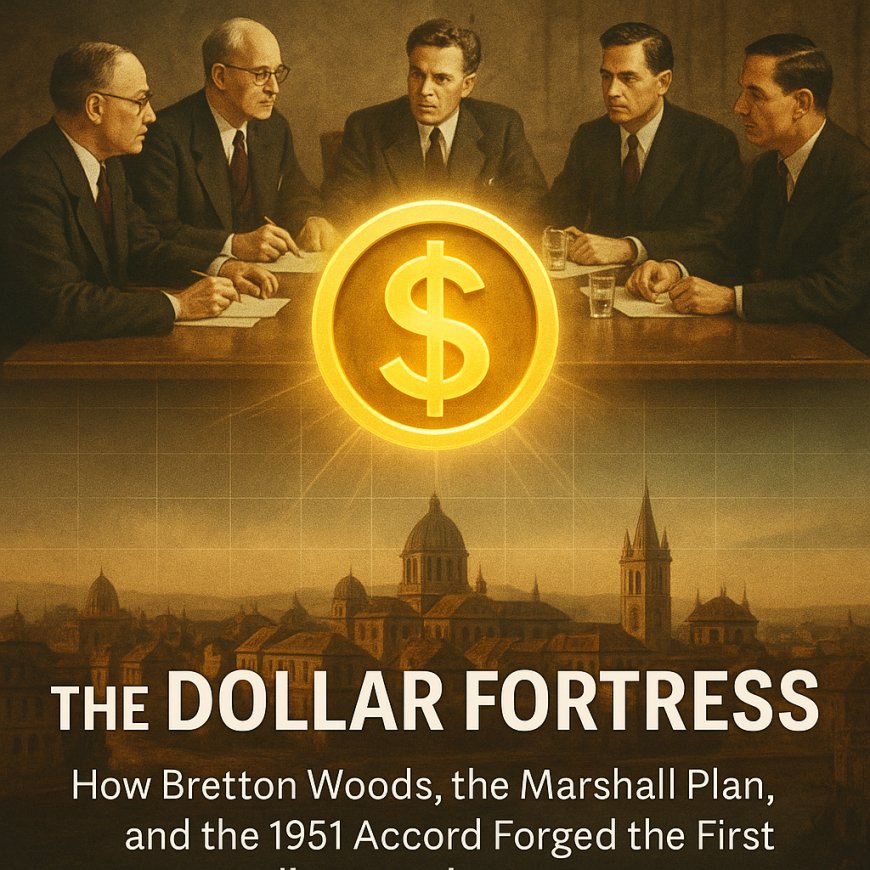
The Dollar Fortress: How Bretton Woods, the Marshall Plan, and the 1951 Accord Forged the First Dollar Liquidity Regime (1947–1953)
After World War II, the Bretton Woods system, the Marshall Plan, and the 1951 Treasury–Fed Accord fused into a single architecture: the dollar anchored to gold, capital controls, and state-directed credit. Between 1947 and 1953, this “Dollar Fortress” quietly set the rules of global liquidity that still shape markets today.
The Setup: A Ruined World and a Blank Monetary Canvas
In 1945, the physical landscape of Europe and large parts of Asia was rubble. Industrial capacity was shredded, currencies were broken, and sovereign balance sheets were wrecked. The only major economy that walked out of the war stronger, richer, and with intact infrastructure was the United States.
The U.S. held the majority of the world’s monetary gold and a dominant share of industrial capacity and exports. That combination meant something simple but profound: whoever designed the postwar monetary rules was going to decide how global liquidity would flow for decades.
The answer was not “let markets figure it out.” The architects of the postwar order had just watched the 1930s play out:
- competitive devaluations and currency wars
- trade collapses and tariff spirals
- financial crises feeding political extremism
So they went the opposite direction: rules, pegs, and institutions. The Bretton Woods agreements of 1944 were the blueprint; 1947–1953 was when the blueprint was poured into concrete.
Bretton Woods Architecture: Pegs, Gold, and the Dollar Hub
The Bretton Woods system created a dollar-centered, fixed-but-adjustable exchange rate regime. The key pieces:
- Each member state fixed its currency to the U.S. dollar at a par value, and kept the market rate within ±1% of that parity.
- The U.S. dollar, in turn, was pegged to gold at $35 per ounce for foreign central banks and governments.
- The IMF was created to provide temporary financing to countries with balance-of-payments problems so they wouldn’t be forced into competitive devaluations.
- The World Bank (then the International Bank for Reconstruction and Development) was created to fund reconstruction and development projects.
Functionally, this made the dollar “as good as gold” for official transactions: other countries could accumulate dollar reserves and, in theory, convert them into gold from the U.S. Treasury at the fixed price. In practice, most countries were happy to hold dollars, because dollars were how you bought American capital goods and paid for imports.
The structural message of the system was clear:
- The U.S. would provide the reserve asset (dollars convertible into gold).
- Other countries would stabilize their exchange rates to that anchor.
- Trade and payment flows would be organized around dollar settlement.
- Adjustments for temporary imbalances would run through the IMF rather than chaotic markets.
This was the original dollar liquidity regime — not yet the free-flowing eurodollar universe of the 1960s and onwards, but a structured, state-managed, dollar-and-gold architecture with tight capital management.
The Marshall Plan: Seeding the Dollar System with Aid
A monetary framework is useless without some way to reboot the real economies plugged into it. That’s where the Marshall Plan, formally the European Recovery Program, came in.
Announced in 1947 and enacted in 1948, the plan committed the U.S. to large-scale financial aid for Western Europe. Over four years, Congress appropriated roughly $13.3 billion (late-1940s dollars) for European recovery — a huge number at the time.
The goals were blunt:
- Rebuild industrial capacity and infrastructure.
- Restore trade and production to prevent economic collapse.
- Anchor Western Europe in a U.S.-led economic and political sphere, limiting Soviet influence.
On paper, the Marshall Plan was about reconstruction. In practice, it was also about injecting dollar liquidity into a shattered system and tying that liquidity to U.S. goods, standards, and institutions.
European countries received dollar aid which they used to import American machinery, raw materials, and food, while setting up counterpart funds in their own currencies for domestic investment. This simultaneously:
- Stimulated U.S. exports and industrial production.
- Rebuilt Europe’s productive base.
- Deepened reliance on the dollar for trade and reserves.
If Bretton Woods was the operating system, the Marshall Plan was the initial liquidity boot sequence: huge, targeted dollar flows that restarted the machine and locked allies into the new architecture.
Capital Controls and Financial Repression: The Walls of the Fortress
There’s a myth that Bretton Woods was some early version of the free-capital, free-floating system we have now. It was almost the opposite.
The architects explicitly feared speculative capital flows and believed that free, short-term capital movement would destabilize trade and employment. So the system encouraged current-account convertibility (for trade in goods and services) but tolerated or even favored capital controls — restrictions on cross-border financial flows.
In parallel, many advanced economies embraced what later economists would call financial repression:
- Regulation and guidance of banks’ balance sheets.
- Ceilings on deposit and lending rates.
- Requirements to hold government debt.
- Limited competition and managed credit allocation.
This wasn’t an accident or a bug. With large war debts and a political imperative for full employment and welfare states, governments needed to keep interest costs low and maintain tight control over credit. Bretton Woods, plus domestic regulations, gave them that platform.
The result was a walled dollar fortress:
- Externally: fixed exchange rates, dollar–gold convertibility, IMF support for countries in temporary trouble.
- Internally: managed interest rates, captive savings, and banking systems steered toward government financing and targeted investment.
It was not a free market utopia. It was a tightly supervised regime designed to prevent 1930s-style chaos while gradually normalizing trade and production.
IMF and World Bank: Institutionalizing the Plumbing
The IMF and World Bank were the institutional embodiments of the new system’s safety valves and development tools.
The IMF’s role under Bretton Woods:
- Monitor exchange rates and balance-of-payments positions.
- Provide short-to-medium-term financing to countries facing temporary deficits, so they didn’t have to slam the brakes on imports or devalue immediately.
- Supervise adjustments when parities became unsustainable.
Countries contributed quotas — a mix of gold or dollar reserves and domestic currency — which determined both their voting power and how much they could borrow.
The World Bank (IBRD) focused on long-term reconstruction and development: loans for infrastructure, power plants, transport, and other projects meant to rebuild productive capacity and integrate economies into the new trade system.
The key Pattern Nexus detail here is not the bureaucratic structure; it’s the logic of the plumbing:
- Short-term liquidity problems → IMF.
- Long-term investment needs → World Bank.
- Reserve and settlement baseline → dollar and gold, with the U.S. at the center.
Instead of dozens of bilateral ad hoc deals, the postwar system channeled most official flows through these institutions, making the rules legible and tying everyone more tightly into the dollar-centric order.
The U.S. Balance Sheet: War Debt and Yield Pegs
While Bretton Woods was being launched internationally, the U.S. was dealing with its own domestic hangover from the war: a large stock of government debt and the question of how to manage interest rates without destabilizing the recovery.
During World War II, the Federal Reserve had effectively subordinated itself to the Treasury, agreeing to support government bond prices and cap yields at low levels to keep borrowing costs down. After the war, this policy continued: the Fed maintained a peg on long-term Treasury yields and supported the market when needed.
This arrangement meant:
- The Treasury could finance war and postwar obligations at stable, low interest rates.
- The Fed had limited freedom to tighten policy in response to inflation or credit conditions.
- Banks and financial institutions were encouraged to hold government securities as safe, yield-pegged assets.
In other words, the U.S. — the anchor of the new global system — was itself running a form of financial repression at home: directing savings into government debt at administered rates.
Over time, rising inflation pressures and disagreements over monetary policy made this arrangement increasingly unstable. That conflict set the stage for a pivotal institutional break: the 1951 Treasury–Fed Accord.
The 1951 Treasury–Fed Accord: Birth of Modern Monetary Policy
The Treasury–Fed Accord of March 1951 is one of those events that sounds boring but completely rewires the system.
In essence, the Accord ended the Fed’s obligation to peg Treasury yields and reasserted the central bank’s independence over monetary policy. The Fed would no longer be a guaranteed buyer at fixed prices; it would use its balance sheet primarily to pursue macroeconomic goals, not to finance the government on demand.
Why it mattered:
- It separated debt management (Treasury’s job) from monetary policy (Fed’s job).
- It gave the Fed room to tighten policy to fight inflation without being blocked by borrowing-cost concerns.
- It marked a step away from wartime command-and-control finance toward a more flexible, market-linked system — within the constraints of Bretton Woods.
From a Pattern Nexus perspective, the Accord was the internal software patch that made the dollar fortress adaptive instead of purely static:
- Externally, the dollar remained pegged to gold, and other currencies remained pegged to the dollar.
- Internally, the Fed gained tools and autonomy to manage domestic liquidity and inflation while still supporting the overall regime.
The modern concept of an “independent central bank” with a dual mandate and flexible policy toolkit traces back to this moment. The irony is that this independence was born inside one of the most tightly controlled macro-financial systems in history.
Geopolitics: Liquidity as a Weapon in the Early Cold War
None of this happened in a geopolitical vacuum. The entire postwar economic architecture doubled as a Cold War containment strategy.
The Marshall Plan and Bretton Woods institutions were open to all initially, but Soviet leadership quickly rejected participation, seeing them as tools of U.S. influence. That left two emerging blocs:
- A U.S.-led camp integrated into the dollar system, receiving aid, investment, and access to markets.
- A Soviet-led camp operating outside that architecture, with its own centralized planning and trade frameworks.
In this context, liquidity wasn’t just about smoothing trade; it was a strategic weapon:
- Dollar grants and loans could stabilize allies and pull states into the Western orbit.
- Control over capital flows and technology exports could be used to reward or punish behavior.
- Participation in the IMF/World Bank ecosystem came with expectations about policy and alignment.
The infrastructure of global finance was built with an explicitly political goal: make the dollar-centric capitalist world more attractive, more stable, and more prosperous than the alternative.
Why 1947–1953 Mirrors the Coming Digital Dollar Cycle
The details are different — atoms then, bits now — but the structural parallels between 1947–1953 and the coming digital dollar era are hard to ignore.
Pattern Nexus Framework: The Dollar Fortress in the Megacycle Map
This article is Part 2 of the Pattern Nexus “Cycles of Power” Megacycle Series. Part 1 covered the 1870–1914 industrial supercycle — the tech–energy–liquidity explosion that built the modern industrial world.
Part 2 shows what came next: the deliberate construction of a dollar fortress to manage that world after it nearly destroyed itself.
Core Pattern Nexus takeaways from 1947–1953:
- Monetary orders are designed, not accidental. Bretton Woods, the Marshall Plan, and the 1951 Accord were conscious engineering choices to create a stable, dollar-centered regime.
- Liquidity systems are always political. The lines between “economic” and “geopolitical” instruments are blurred by design.
- Stability requires constraints. Capital controls, financial repression, and central bank–Treasury coordination were not bugs; they were the price of running a tightly pegged system.
- Institutional upgrades happen under stress. The 1951 Accord only happened because the existing arrangements were breaking under inflation and policy conflict.
- Once installed, a monetary architecture persists long after the original context fades. The dollar’s central role, and the existence of the IMF/World Bank complex, are direct legacies of this short window.
As we move deeper into the series — toward the 1970s energy shocks, the Volcker reset, the eurodollar expansion, and even earlier pre-industrial cycles — this 1947–1953 episode sits at the center like a hinge:
First we built the industrial machine (1870–1914). Then we built the dollar fortress to control it (1947–1953).
The question now is what kind of architecture will be built to manage the AI–energy–digital-finance stack of 2025–2040 — and who will own the keys.
FAQ: Quick Answers and “So What?”
Was Bretton Woods a return to the gold standard?
Not exactly. Gold sat behind the system, but only the U.S. dollar was directly linked to gold at $35/oz for official holders, and other currencies were pegged to the dollar. Capital controls and institutions like the IMF made it a very different environment from the pre-1914 classical gold standard.
Was the Marshall Plan mostly charity?
It was strategic. The Plan helped rebuild Europe, but it also opened markets for U.S. exports, strengthened allies against Soviet influence, and deepened the use of the dollar in trade and finance.
What did the 1951 Accord change in practice?
It ended the Fed’s commitment to peg Treasury yields and restored its control over monetary policy tools, laying the foundation for modern central bank independence. It was a shift from wartime finance to a more flexible, macro-driven framework — within the constraints of the Bretton Woods regime.
Why does this era matter for investors and builders today?
Because we’re doing a quieter version of the same thing: redesigning the monetary and liquidity architecture around new technology and geopolitical realities. Understanding how the last redesign worked — what trade-offs were made, what institutions were created, and how politics shaped them — gives clues to what the digital dollar and AI-era system will look like.
Is the dollar at risk of losing its central role?
The dollar’s dominance comes from a mix of deep markets, network effects, and institutional trust built since Bretton Woods. That doesn’t vanish overnight, but it can erode if the underlying political and institutional foundations are undermined — or if alternative systems become more attractive.
Sources
- Overview of the Bretton Woods system, dollar–gold link, and institutional design. Bretton Woods System
- Federal Reserve history of the creation and operation of Bretton Woods. Creation of the Bretton Woods System
- World Gold Council explanation of Bretton Woods’ dollar–gold parity and fixed exchange rate regime. World Gold Council — Bretton Woods System
- State Department and National Archives material on the Marshall Plan and its economic impact. Marshall Plan, 1948
- Marshall Foundation summary of the Marshall Plan’s design and goals. The Marshall Plan — Marshall Foundation
- Federal Reserve history article on the 1951 Treasury–Fed Accord. The Treasury–Fed Accord
- Levy Institute paper on Marriner Eccles and the Accord, detailing the conflict over yield pegs and independence. Marriner S. Eccles and the 1951 Treasury–Federal Reserve Accord
- Richmond Fed article on financial repression and Bretton Woods-era capital controls. A Look Back at Financial Repression
- Historical overview of the Marshall Plan from the U.S. National Archives. Marshall Plan, 1948 — National Archives
Aká je vaša reakcia?
 Páči sa mi to
0
Páči sa mi to
0
 Nehodnotiť
0
Nehodnotiť
0
 Láska
0
Láska
0
 Zábavné
0
Zábavné
0
 Wow
0
Wow
0
 Smútiť
0
Smútiť
0
 Rozhněvaný
0
Rozhněvaný
0

Founder of Pattern Nexus. I research markets, macro, geopolitics, AI, history, ancient systems, and the patterns most people overlook. I’m also building Market Radar, a trading scanner designed to read pressure, risk, confirmation, and setup quality before chasing a move. Pattern Nexus is where I connect the dots between data, history, technology, and the bigger system playing out around us.
















Komentáre (0)