
Why the Fed Will Try to Keep QE Small — and Why It Won’t Work in 2026
The Fed will try to keep QE “light” in 2026 to protect inflation credibility and avoid backlash. But modern market plumbing is nonlinear: undersized liquidity fails fast, forcing escalation into real QE.
The Fed’s default move in 2026 will be “QE without saying QE.” It will try to keep purchases technical, limited, and politically survivable. The problem is structural: modern liquidity does not behave linearly. Undersized intervention fails quickly, volatility rises, and the system forces escalation.
Summary
- The Fed’s 2026 incentive structure favors “technical” balance-sheet expansion rather than openly accommodative QE.
- That approach can stabilize reserve levels, but it does not guarantee market depth, collateral flow, or term-premium containment under stress.
- Modern market plumbing is nonlinear: undersized liquidity support fails quickly, volatility rises, and escalation becomes the least-bad option.
- The pivot point is not ideology. It is mechanics: Treasury market structure, dealer balance-sheet limits, repo funding sensitivity, and leverage unwind dynamics.
- The visible story will be “temporary” and “targeted.” The functional outcome can still be broad easing if escalation is forced.
Pattern Nexus framing: The Fed will attempt QE minimalism. The system will refuse it. The escalation is the story.
Why the Fed Wants QE to Look Small
Start with incentives, not forecasts. The Fed’s problem is not that it “doesn’t know” liquidity matters. The problem is that it cannot easily admit it. After the post-pandemic inflation cycle, the institution is operating with three constraints that did not exist at this intensity in 2009:
- Credibility constraint: “Printing” has become a political synonym for inflation, even when the plumbing story is more nuanced.
- Optics constraint: Large, obvious purchase programs invite backlash, hearings, and narrative warfare.
- Institutional constraint: The Fed now prefers language that separates rate policy from balance-sheet mechanics, even when markets trade them as one system.
So the default playbook becomes: avoid the word QE, avoid long-duration buying if possible, and frame any balance-sheet growth as “technical,” “operational,” or “market functioning.” That is not a conspiracy. It is bureaucratic survival.
Why “Light QE” Fails in a Nonlinear System
The core mistake in mainstream discourse is linear thinking: if QE helped before, a smaller version should help a little. But a heavily levered, duration-heavy, collateral-sensitive market does not respond smoothly. It responds in thresholds.
In a nonlinear system, small interventions often do one of two things:
- Do nothing measurable because they are below the stabilization threshold, or
- Trigger outsized repricing because the market front-runs the next step and assumes escalation is inevitable.
That is why “light QE” is unstable as a regime. If it’s too small, it fails. If it’s credible enough to matter, it changes expectations and pulls forward the entire easing arc.
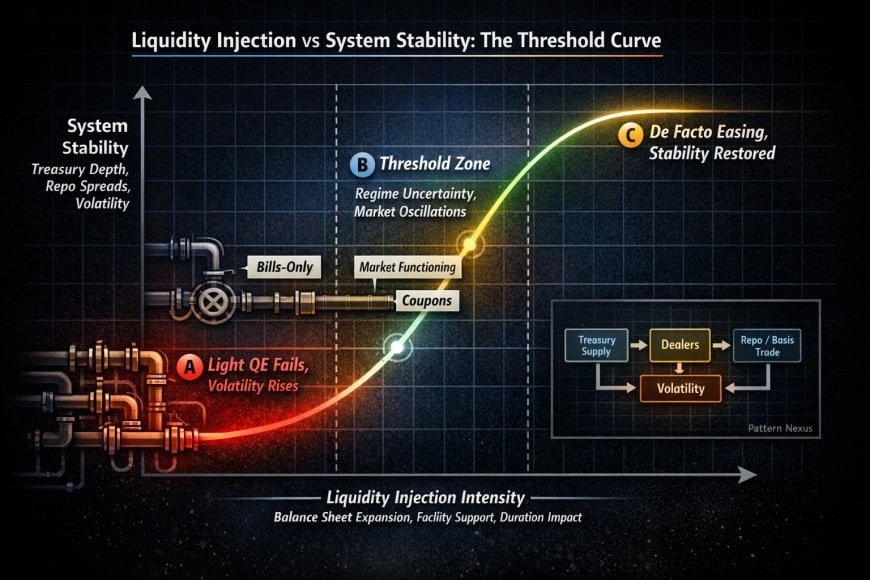
Key idea: QE doesn’t fail gradually. It fails suddenly, and then it expands aggressively.
The Illusion of Control: Bills, Facilities, and Language
When the Fed wants to avoid “real QE,” it leans on three substitutes:
- Composition control: skewing purchases to bills and framing it as reserve management rather than easing.
- Facility substitution: leaning on repo facilities, swap lines, and standing tools to dampen spikes without sustained buying.
- Messaging discipline: insisting that balance-sheet actions are “technical” and do not reflect the stance of policy.
These tools can work when the binding problem is reserve distribution or short-term funding friction. They fail when the binding problem is market depth, dealer risk capacity, and term-premium repricing across a massive Treasury complex that must clear continuously.
In other words, the Fed can manage the floor. It cannot always manage the plumbing above the floor with language alone.
Where the Fed Loses Control
The escalation trigger is not a headline recession print. It’s a mechanical break in market function or confidence. The Fed’s “light QE” posture starts to fail when any of the following become persistent:
- Auctions that don’t clear cleanly (repeated tails, weak bid-to-cover, unstable dealer absorption).
- Repo stress that ignores “ample reserves” messaging (spreads widen, specialness deepens, liquidity becomes segmented).
- Levered unwind dynamics (basis trade deleveraging, forced Treasury selling into thin depth).
- Credit spread gapping alongside falling policy-rate expectations (a sign transmission is breaking).
- Foreign official behavior shifts that increase net supply hitting a fragile intermediate layer.
At that point, the Fed is no longer choosing the size of the response. The market is choosing it for them.
Control-systems translation: when feedback becomes unstable, the controller must increase gain or the loop oscillates into failure.
Why QE Escalates Fast Once It Starts
Once markets detect that the initial response is insufficient, volatility rises. Rising volatility tightens financial conditions. Tightening conditions increase the probability of forced selling. Forced selling worsens liquidity. Liquidity deterioration forces larger intervention. That is the escalation ladder.
The Fed will frame each step as incremental and conditional. Mechanically, it looks like this:
- Step 1: Bills and technical language
- Step 2: Market-functioning support in coupons
- Step 3: Sustained net buying that compresses term premium
- Step 4: De facto easing, whether or not the Fed uses the word QE
This is why the “we’ll keep it small” plan is fragile. The moment it is tested, it either holds or it cascades. There is rarely a stable middle.
A 2026 Pathway: Likely, Not Desired
Pattern Nexus is not calling for money printing. This is a structural read of incentives and failure modes.
A plausible 2026 arc looks like this:
- Early phase: the Fed continues emphasizing technical balance-sheet tools and avoids the appearance of broad easing.
- Stress phase: the Treasury and repo complex shows binding constraints that cannot be solved by language, bill skew, or facilities alone.
- Escalation phase: the Fed expands the program in size and maturity to stabilize term premium and restore market depth.
- Normalization phase: officials reframe the outcome as “necessary to maintain transmission,” even if markets interpret it as a pivot.
That is the core thesis: the Fed will try to keep QE light, and it will fail, because the constraints in 2026 are not public-narrative constraints. They are system constraints.
The Real Question Isn’t “How Much QE”
QE discourse often devolves into a single number. That misses the point.
Fed balance-sheet expansion is the base layer. The total liquidity impact comes from the cascade it enables:
- credit creation layered on reserves
- duration repricing across portfolios
- fiscal dynamics that become easier to fund
- global spillovers that reprice currencies and risk premia
- shadow leverage rebuilding once volatility is capped
In the modern regime, QE does not need to be gigantic to be destabilizing. It only needs to be insufficient at first, because insufficiency triggers the escalation loop.
Bottom line: The danger is not the headline amount. The danger is the nonlinear response and the liquidity cascade that follows.
PN Lens
We don’t analyze QE as politics. We analyze QE as control architecture.
The Fed is a controller operating a system whose internal state variables are not “growth” and “inflation” alone. The state variables include collateral velocity, dealer intermediation capacity, repo segmentation, and leverage unwind dynamics. When those state variables move into unstable territory, the controller has two choices: accept instability or increase intervention.
That is why the 2026 debate will be poorly framed in public. It will be argued as morality and ideology. It will be executed as plumbing.
If you want a single Pattern Nexus sentence to remember: the Fed will try to preserve credibility with small QE, but credibility does not clear Treasury auctions.
FAQ
Isn’t “reserve management” basically QE?
Functionally, it can be balance-sheet expansion. The difference is intent, composition, and duration impact. Reserve management tries to maintain rate control and adequate reserves. “Real QE” targets broader financial conditions by compressing term premia and stabilizing risk transmission. Markets often trade them similarly once escalation risk becomes credible.
Why can’t the Fed just use facilities instead of buying assets?
Facilities can reduce acute funding spikes and smooth distribution. They do not automatically restore market depth, reduce term premium, or rebuild dealer risk capacity. When the binding constraint is structural liquidity, facilities may slow deterioration but not reverse it.
Wouldn’t QE risk reigniting inflation?
Yes, and that is part of the Fed’s reluctance. But a system-level liquidity break forces a tradeoff: accept instability and cascading defaults or provide liquidity and manage the inflation consequences later. The Fed tends to choose the option that prevents immediate system fracture.
How can “small QE” fail quickly?
Because market response is nonlinear. If the initial support is below the stabilization threshold, volatility rises. Rising volatility tightens conditions and increases forced selling risk. Forced selling worsens liquidity. That loop forces escalation.
Does this mean QE is guaranteed in 2026?
No. This article argues a pathway and a failure mode: the Fed is incentivized to start small if it must intervene, but structural constraints can force it to expand beyond what it initially intends. Whether that pathway is activated depends on how funding, Treasury depth, and credit conditions evolve.
Aká je vaša reakcia?
 Páči sa mi to
0
Páči sa mi to
0
 Nehodnotiť
0
Nehodnotiť
0
 Láska
0
Láska
0
 Zábavné
0
Zábavné
0
 Wow
0
Wow
0
 Smútiť
0
Smútiť
0
 Rozhněvaný
0
Rozhněvaný
0

Founder of Pattern Nexus. I research markets, macro, geopolitics, AI, history, ancient systems, and the patterns most people overlook. I’m also building Market Radar, a trading scanner designed to read pressure, risk, confirmation, and setup quality before chasing a move. Pattern Nexus is where I connect the dots between data, history, technology, and the bigger system playing out around us.













Komentáre (0)