

Fed Minutes: The Cut Trade Broke Because Inflation Has More Than One Engine
The June 16–17 FOMC minutes, released July 8, show a Fed that held rates steady but removed the easy easing bias. The deeper signal is that inflation pressure is now coming from multiple rails at once: tariffs, Middle East energy shock risk, AI infrastructure demand, Treasury term premium, and uneven consumer credit…
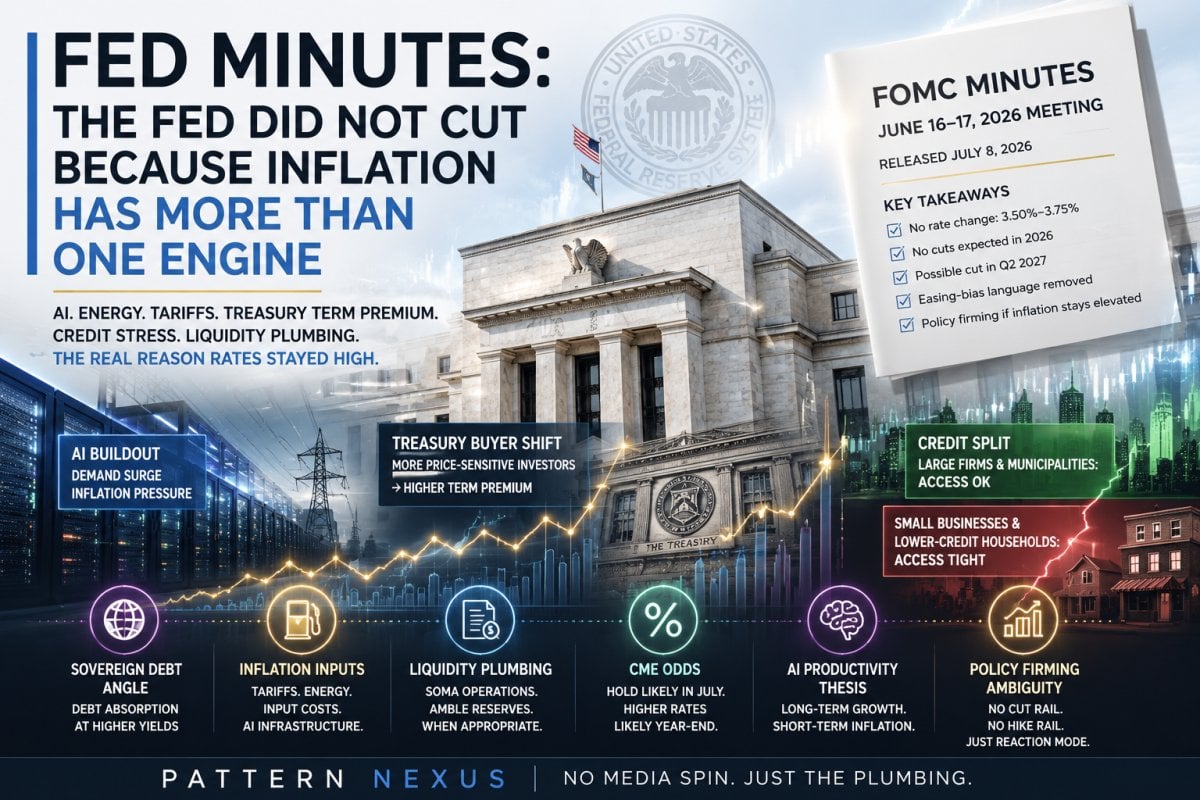
The June 16–17 FOMC minutes, released July 8, show a Fed that held rates steady but removed the easy easing bias. The deeper signal is that inflation pressure is now coming from multiple rails at once: tariffs, Middle East energy shock risk, AI infrastructure demand, Treasury term premium, and uneven consumer credit…
Jump to a section
Watch the video first. The written breakdown below expands the full Fed-minutes read through the Pattern Nexus lens: the rate path, Treasury absorption, AI buildout, credit split, SOMA language, and the Fed’s reactive policy trap.
The Federal Reserve released the minutes from the June 16–17 meeting on July 8. The committee held the federal funds target range at 3.50% to 3.75%. On the surface, that looks simple. They did not cut. They did not hike. They held.
But that is not the real story.
The real story is that the Fed removed the clean easing bias, admitted inflation pressure is coming from more than one source, and showed a policy committee split between two outcomes. One path says inflation fades and rates can eventually come down. The other path says inflation stays elevated, the labor market remains stable, and policy has to firm again.
The market wanted a clean cut path. The minutes gave something else: no rate changes expected for the rest of 2026 in the Fed survey median, a possible cut not appearing until the second quarter of 2027, and a committee openly debating whether policy may need to firm if inflation does not break.
Pattern Nexus read: the cut trade did not break because the Fed randomly turned hawkish. It broke because inflation is no longer running through one pipe. It is running through tariffs, energy, AI infrastructure, electricity, Treasury funding costs, credit stress, and consumer psychology at the same time.
The useful read is not “rates stayed the same.” That is the headline layer. The premium read is the plumbing underneath the hold.
The Fed is now dealing with inflation from several directions at once. Tariffs are feeding goods prices. Energy risk is feeding transportation and input costs. AI demand is feeding data centers, chips, equipment, electricity, grid upgrades, and capital spending. Treasury term premium is feeding borrowing costs. Credit stress is hitting small businesses and lower-credit households first.
That means the Fed does not have a clean problem, so it does not have a clean plan.
The Fed is trying to keep rates tight enough to fight inflation while keeping the liquidity plumbing stable enough to prevent the system from breaking. That is the modern central-bank trap.
The Fed minutes show a system caught between two competing realities.
The first reality is the soft-landing story. Inflation cools. Gasoline falls. Tariff pressure fades. AI productivity eventually increases supply. The labor market stays balanced. In that world, the Fed can hold rates and eventually cut.
The second reality is the hard-plumbing story. AI investment keeps demand above potential. Energy risk stays alive. Treasury buyers demand more yield. Tariffs keep bleeding through the goods chain. Credit gets tighter for smaller borrowers. Lower-income households keep leaning on credit. In that world, the Fed may have to firm policy again.
The minutes did not choose one clean path. They kept both alive.
That is why this release matters. The Fed is no longer giving the market a free easing rail. It removed the comfort language. It shortened the statement. It leaned into optionality. It wants the market to stop assuming the next move is automatically down.
Pattern Nexus read: the Fed is reacting because the system itself is unstable across too many rails. Inflation, AI capex, Treasury absorption, credit bifurcation, and liquidity plumbing are all crossing at once.
- The Rate Hold Was Not the Story
- The Policy Fork
- CME Odds and the Market Reaction
- Treasury Buyers and the Sovereign Debt Rail
- The War-Risk Treasury Problem
- Inflation Has More Than One Engine
- The Money-Printing Problem They Do Not Say Plainly
- SOMA and the Plumbing Clause
- Credit Is Splitting
- The Consumer Split
- Gasoline Is Only a Temporary Relief Valve
- AI Is Now Inside the Fed’s Inflation Model
- AI as the Grow-Out-of-the-Debt-Crisis Thesis
- The Fed Held Unanimously, But the View Is Not Unified
- Policy Firming Is Deliberately Vague
- The 2% Target Problem
- The Communication Shift
- The Pattern Nexus Read
- What the Market Should Watch Next
- Sources
No Clean Cut Rail
The Fed held rates, but it did not give the market a near-term easing path.
The Buyer Base Changed
More price-sensitive private investors means Treasury supply has to clear at a real price.
Growth Rail, Inflation Rail
AI is a productivity hope later, but an immediate demand shock now.
Top Fine, Bottom Tight
Large borrowers still have access. Small firms and weaker households feel the hard system.
Tight Rates, Ample Reserves
The Fed can fight inflation at the rate level while keeping the system supported underneath.
Reactive Fed
The Fed is not leading the system. It is waiting to see which pressure pipe breaks first.
The Rate Hold Was Not the Story
The Fed held rates. That is the headline. But the headline is too shallow.
The real story is what the minutes showed underneath the hold. The Fed is not giving the market a clean cut path. It is not saying inflation is solved. It is not saying policy is already restrictive enough. It is not saying the AI buildout is just a productivity gift. It is saying the system is more complicated than that.
The committee held the federal funds target range at 3.50% to 3.75%. That decision was unanimous. But a unanimous vote does not mean a unified forward path.
The minutes show a Fed trying to keep both doors open. If inflation breaks, they can hold and eventually cut. If inflation stays hot and the labor market stays stable, they can firm policy again.
The Policy Fork: Inflation Breaks or Policy Firms
The minutes describe two policy paths.
The first path is the market-friendly path. Inflation slows. Gasoline prices help the headline number. Tariff pass-through fades. AI productivity eventually helps supply. The labor market stays balanced. Under that scenario, the Fed can keep rates where they are and eventually lower them.
The second path is the problem. Inflation stays elevated. AI demand keeps pressing electricity, data centers, technology products, and capital goods. Energy risk stays alive. Tariffs keep bleeding through the goods chain. The labor market does not break. In that setup, policy firming becomes a real option.
That is the entire fork.
The market wants the first path. The Fed minutes kept the second path alive.
CME Odds and the Market Reaction
The video correctly focuses on the odds before and after the minutes. For the July 29 meeting, the market was already assigning the highest probability to no change before the release. There was also a smaller but meaningful probability of a 25 basis point hike.
After the minutes, the odds barely moved. The probability of a July hike slipped only slightly. The year-end expectation also barely changed, with the market still pricing a strong chance that rates would be higher at the end of the year than they are now.
That matters because the minutes did not shock the market. They confirmed a direction the market had already started pricing.
Pattern Nexus read: the minutes did not move the market because the market had already moved toward the minutes.
That is important. People often look for the one-minute candle after a release and think that is the whole story. It is not. Sometimes the real information is in what does not move. If odds barely change after a supposedly important release, that means positioning was already adjusted before the headline hit.
Treasury Buyers and the Sovereign Debt Rail
The most important plumbing sentence in the minutes is not about the Fed funds rate. It is about Treasury ownership.
The Fed noted that ownership of Treasury securities has shifted from relatively price-insensitive official-sector holders toward more price-sensitive private investors.
That is a major sovereign-debt signal.
Official-sector buyers often buy Treasuries for reserve management, currency policy, liquidity, and global trade plumbing. Private buyers are different. They care about yield. They care about inflation risk. They care about duration. They care about debt supply. They care about whether the return compensates them for the risk.
So when the buyer base shifts toward private investors, Treasury supply becomes more sensitive to price. The government can still issue the debt. The question becomes: what yield clears the market?
The War-Risk Treasury Problem
Normally, when geopolitical stress spikes, Treasuries are supposed to behave like a safe haven. War risk rises, investors buy Treasuries, bond prices rise, and yields fall.
But the video points out the strange part. When the Iran conflict broke out, Treasury values fell and yields rose. That is backwards for the old safe-haven model.
That matters because if investors see war risk as inflationary, deficit-expanding, energy-price-raising, and issuance-heavy, they may demand more yield instead of blindly buying duration.
That is how sovereign debt stress starts to show up inside the world’s “safe” asset.
This is why the Treasury ownership shift matters. If the market is dominated more by price-sensitive buyers, then Treasuries may not behave as cleanly as the old safe-haven asset during every shock.
Inflation Has More Than One Engine
The Fed’s inflation discussion is the center of the release. Total and core inflation were higher than a year earlier, and the staff tied the pressure to several channels: tariffs, higher energy costs, input costs, Middle East conflict effects, and demand from the AI buildout.
That last part is the key.
The inflation story is no longer just “too much consumer demand.” It is not just wages. It is not just housing. It is not just oil. It is now a multi-rail inflation structure.
Tariffs move into goods prices, margins, supply chains, and consumer costs.
Energy moves into transportation, groceries, chemicals, logistics, and production.
AI moves into chips, servers, data centers, construction, cooling, grid upgrades, copper, and electricity.
Term premium moves into mortgages, credit, private markets, and long-duration risk.
Credit stress hits small businesses and lower-credit households before it hits the top of the system.
That is why the Fed is stuck. Inflation is not coming from one source that can be cleaned up with one clean tool. It is coming from multiple pipes at once.
The Money-Printing Problem They Do Not Say Plainly
The minutes talk about tariffs, energy, input costs, and AI demand. That is all real. But there is another layer the Fed never wants to frame in plain English: the monetary and balance-sheet side.
The Fed does not say, “We kept the system liquid.” It says SOMA operations, reserve management, rollovers, reinvestments, Treasury bill purchases, standing repo operations, and overnight reverse repo operations.
Technically, this is not the same thing as emergency pandemic QE. That distinction matters. But from a Pattern Nexus lens, the practical point is still clear: the Fed is maintaining the plumbing underneath the system while claiming it is still fighting inflation from the top.
That is the contradiction. Policy can be tight at the rate level while still supportive at the plumbing level.
This is why people get confused. They look at rates and say the Fed is tight. Then they look at liquidity operations and say the Fed is still supporting the system. Both can be true.
The Fed can hold rates high while making sure reserves remain ample and money-market plumbing does not break.
SOMA and the Plumbing Clause
The operating instructions matter because they show the plumbing under the headline rate decision.
The Desk was instructed to keep the federal funds rate inside the target range, conduct repo and reverse repo operations as needed, roll over Treasury principal payments, reinvest agency principal payments into Treasury bills, and increase SOMA holdings through Treasury bills or short Treasury securities when appropriate to maintain ample reserves.
That phrase, “when appropriate,” is doing a lot of work.
It gives the Fed room to keep the system liquid without calling it a pivot. It gives the Fed room to manage reserves without saying it is easing. It gives the Fed room to protect the plumbing while maintaining a public inflation-fighting posture.
The Fed is saying: rates stay restrictive enough to fight inflation, but reserves stay ample enough to prevent the funding system from seizing up.
That is the modern central-bank game.
Credit Is Splitting
The minutes said financing conditions remained generally accommodative for larger businesses and municipalities, but somewhat restrictive for small businesses and households.
Credit remained tighter for small businesses and household borrowers with lower credit scores.
That is not a small detail. That is the real economy splitting into tiers.
Large businesses can still access bond markets. Municipalities can still finance. AI-linked companies can still raise money. Strong borrowers can still get capital. But smaller businesses and weaker households are facing the hard version of the rate environment.
This creates a strange economy where the top looks fine and the bottom feels broken.
The S&P can rise because mega-cap tech is being rewarded for AI capex. Corporate issuance can stay solid because large firms still have access to capital. But the small business owner, the lower-credit borrower, and the household living on revolving credit are not in the same economy.
Pattern Nexus read: the credit system is not frozen. It is selective. And selective credit always hits the bottom first.
The Consumer Split
The minutes showed the consumer split clearly.
Higher-income households are still supported by equity gains, strong earnings, tax refunds, and asset-price support. Lower-income households are relying more on credit while still getting hit by gasoline, groceries, and daily-life inflation.
This is the part that makes the headline data deceptive.
Consumer spending can look solid because the top end of the economy is still spending. But that does not mean the whole consumer base is healthy. It means asset holders are still spending while lower-income households are borrowing to maintain the same standard of living.
That is not strength. That is stress hidden inside aggregate numbers.
Gasoline Is Only a Temporary Relief Valve
The staff projected total inflation would slow over the second half of the year if retail gasoline prices declined. That makes sense. Energy prices feed directly into headline inflation, and lower gasoline gives consumers some breathing room.
But this is where the market can get too excited.
Lower gasoline can pull headline inflation lower, but it does not automatically solve core services, tariffs, electricity, AI equipment, insurance, credit costs, or supply-chain pass-through.
It can make the headline look better while the deeper inflation rail stays alive.
That is why the Fed is not rushing to declare victory. Gasoline can give them a temporary disinflation window. But if the other pipes stay hot, a lower gas price alone does not rebuild the cut case.
AI Is Now Inside the Fed’s Inflation Model
This is one of the biggest shifts in the minutes. AI is no longer just a stock-market narrative. It is now part of the Fed’s macro framework.
The minutes tied AI to business investment, high-tech equipment, software, data centers, imports, exports, electricity demand, technology-product prices, and eventually productivity.
That means AI is now touching both sides of the inflation debate.
On one side, AI is inflationary right now because the buildout is physical. It needs land, power, cooling, chips, servers, construction, transmission, transformers, substations, copper, labor, debt financing, and grid upgrades.
On the other side, AI could be disinflationary later if it increases productivity, lowers production costs, expands aggregate supply, and helps the economy grow faster without creating the same level of wage and cost pressure.
AI as the Grow-Out-of-the-Debt-Crisis Thesis
One possible way out of the sovereign debt problem is massive productivity growth.
If the economy can grow faster, produce more, collect more tax revenue, and lower unit costs through technology, then the debt burden becomes easier to carry relative to output.
That is the optimistic AI thesis.
The government is looking at AI like a national productivity engine. Not just a tech trend. Not just chatbots. A possible fiscal escape hatch.
But the timing problem is brutal.
To get the productivity gains, the country first has to build the infrastructure. That means more power demand, more grid strain, more data centers, more capital spending, more financing, and more competition for industrial inputs.
In other words, the solution to long-term debt stress may create short-term inflation pressure.
That is the paradox: AI may be the thing policymakers hope saves the fiscal path, but the buildout itself can keep the Fed from cutting.
The Fed Held Unanimously, But the View Is Not Unified
At the June meeting, all participants supported maintaining the current target range for the federal funds rate. That means nobody forced a dissent for a hike at that meeting.
But that does not mean everyone agreed on the path forward.
A few participants said there was a case for raising rates, even though they supported holding at this meeting. Several participants said they did not see current policy as restrictive. A few others saw policy as only slightly restrictive.
That is a major detail.
If several Fed officials do not think policy is restrictive, then they do not think rates are doing enough to slow inflation. That means the bar for future hikes is lower than the market wants to admit.
The unanimous vote gave the appearance of unity. The policy discussion showed division.
Policy Firming Is Deliberately Vague
The phrase policy firming is classic Fed language because it gives them room to move without committing to a specific tool.
Policy firming could mean raising the target range.
It could mean holding rates elevated for more time.
It could mean slowing support through the balance-sheet side.
It could mean changing language so markets stop pricing cuts too aggressively.
That is why the wording matters. When the Fed talks about inflation coming down, the language around eventually lowering rates is easier to understand. But when the Fed talks about inflation staying elevated, “policy firming” gives them a whole menu of options.
Pattern Nexus read: the Fed is refusing to tell the market exactly which tool comes next because the Fed does not know which pressure pipe will break first.
The 2% Target Problem
The Fed still says the target is 2%. That is the official anchor. But in practice, markets often behave like anything moving toward the high 2s is “close enough” to restart the easing conversation.
That creates a credibility problem.
If inflation falls from around 4% to around 3%, does the Fed cut?
If it does, it risks validating a higher inflation regime. If it does not, it risks over-tightening into a weakening consumer and credit market.
That is why the Fed is trapped. The target is 2%. The market wants relief before 2%. The debt system wants lower rates. The consumer wants lower borrowing costs. But inflation is not low enough to give the Fed a clean exit.
The Communication Shift
The Fed changed the tone of the statement. The committee removed the prior language that suggested an easing bias, shortened the postmeeting statement, and leaned harder into optionality.
That is meaningful. It tells the market the Fed does not want to keep promising the next move before the data forces it.
But the deeper machine remains the same.
The Fed is still trying to manage inflation expectations, protect employment, keep Treasury and funding markets functional, maintain ample reserves, and prevent financial plumbing from breaking.
So yes, the tone changed. But the structural bind did not.
The Fed still has to fight inflation with rates while protecting the financial system with liquidity plumbing. That is the same contradiction that has defined the post-GFC central bank era.
The Pattern Nexus Read
This Fed-minutes release is not about one number. It is about the system getting harder to manage.
The Fed is trying to say the right thing on inflation while still protecting the plumbing underneath the market.
It wants inflation expectations anchored, but it also needs Treasury markets to function.
It wants rates restrictive, but it also wants reserves ample.
It wants to stop the market from front-running cuts, but it also does not want to trigger a credit accident.
It wants AI productivity later, but it has to deal with AI inflation now.
That is the trap.
The old market story was simple: inflation falls, the Fed cuts, liquidity comes back, risk assets run.
The new story is not that simple.
If inflation falls because gasoline drops, but AI demand keeps electricity and equipment hot, the Fed may not get enough relief.
If Treasury buyers demand higher yields, the Fed may get tightening from the bond market even without moving rates.
If the lower-income consumer weakens but inflation stays sticky, the Fed is boxed in.
If AI capex keeps surprising higher, growth can stay supported while inflation pressure remains alive.
That is why the minutes matter. They show the Fed does not have one problem. It has a system of problems.
What the Market Should Watch Next
The next signal will not come from one headline. It will come from the interaction of several pressure points.
- CPI and PCE: if inflation cools but stays near 3%, the market will try to price cuts again. The Fed may resist if broader price pressure remains sticky.
- Oil and gasoline: gasoline can bring headline inflation down, but renewed Middle East stress can reverse that quickly.
- Electricity costs: if AI power demand keeps pushing grid costs higher, the AI inflation story gets stronger.
- Treasury auctions: weak demand or higher tail risk tells you the debt absorption problem is getting worse.
- Credit spreads and private credit flows: if stress moves from lower-quality borrowers into broader credit, the Fed’s employment mandate comes back into play.
- Lower-income consumer credit: credit-card delinquencies, auto loan stress, buy-now-pay-later usage, and subprime pressure will show the real consumer before the headline data does.
- AI capex guidance: if companies keep raising capex plans beyond expectations, AI remains a growth rail and an inflation rail at the same time.
The Final Pattern Nexus Read
The Fed held rates, but the minutes were not dovish.
The cut trade broke because inflation has more than one engine. Tariffs, energy, AI infrastructure, electricity demand, Treasury term premium, and credit stress are all moving through the system at the same time.
The Fed wants to sound controlled, but the release shows a central bank still reacting. If inflation falls, they can eventually cut. If inflation stays hot and labor holds, they can firm policy again. If the consumer weakens while inflation stays sticky, they are boxed in.
The key point is simple: the Fed is trying to keep rates tight enough to fight inflation while keeping liquidity plumbing stable enough to prevent the system from breaking.
That is not a clean pivot.
That is not a clean tightening cycle.
That is the modern central-bank trap.
Sources
- Federal Reserve — FOMC Minutes Archive
- Federal Reserve — FOMC Calendars, Statements, and Implementation Notes
- New York Fed — Monetary Policy Implementation
- New York Fed — SOMA Holdings
- CME Group — FedWatch Tool
- FRED — 10-Year Treasury Constant Maturity Rate
- FRED — Effective Federal Funds Rate
- FRED — Personal Consumption Expenditures Price Index
- FRED — Core PCE Price Index
- FRED — Consumer Credit Owned and Securitized, Outstanding
- Pattern Nexus — Federal Reserve Archive
- Pattern Nexus — Liquidity Archive
- Pattern Nexus — AI / Data Centers Archive
What's Your Reaction?
 Like
0
Like
0
 Dislike
0
Dislike
0
 Love
0
Love
0
 Funny
0
Funny
0
 Wow
0
Wow
0
 Sad
0
Sad
0
 Angry
0
Angry
0

Nexus (Christopher)
Founder of Pattern Nexus. I research markets, macro, geopolitics, AI, history, ancient systems, and the patterns most people overlook. I’m also building Market Radar, a trading scanner designed to read pressure, risk, confirmation, and setup quality before ch…
Related research

The Convergence — Audio-Video Edition
The finale of the Pattern Nexus Cycles of Power audio-video series connects 150 years of industrial, monetary, computing, energy, and liqui…
5 shared topics.
Housing in 2026: Prices Are High, but the Market Is Barely Moving
The July Case-Shiller index reached another nominal high, but inflation, financing costs and weak sales tell a different story for the marg…
2 shared topics, 2 shared assets.
Goolsbee Turns AI Data Centers Into a Fed Reaction-Function Test
Chicago Fed President Austan Goolsbee said on September 21, 2026 that policymakers should watch whether AI data-center construction is spil…
5 shared topics.
Fed Just Hiked Into a 5% 10-Year: Why the Next Liquidity Cycle May Arrive Faster
The Federal Reserve just raised the federal-funds target to 3.75%–4.00% while the 10-year Treasury closed at 5.01%, the 30-year at 5.35%, a…
4 shared topics, 1 shared asset, same research avenue.
QE 2026, Phase Two: When the Long End Forces Duration Control
The Fed already ended QT and expanded Treasury holdings through bill-focused reserve-management purchases, but that repaired the reserve la…
4 shared topics, 1 shared asset.
August CPI Just Activated the Fed’s One-Hike Option—and Deepened the Long-End Trap
August CPI rose 0.4% on the month and 3.4% from a year earlier, while core CPI rose a hotter-than-expected 0.3% even as its annual rate eas…
4 shared topics, 2 shared assets, same research avenue.
Two Economies, One Balance Sheet: The Unstable Barbell of 2026
Reserve support has returned, but real long rates, fiscal supply, and an AI-energy capital wave are splitting the U.S. economy between capi…
7 shared topics, 1 shared asset, same research avenue.
Warsh Turns Jackson Hole Into a Rate-Hike Liquidity Shock
Kevin Warsh’s Jackson Hole speech gave markets a hawkish Fed signal, with AP reporting a jump in the two-year Treasury yield after the rema…
5 shared topics.
Comments (0)
Security Check
Please complete the captcha to verify you are human.