They Put a Fly Brain in Minecraft. The Mind-Uploading Pipeline Is No Longer Hypothetical.
A complete fruit-fly central nervous system can now be mapped at synaptic resolution, instantiated as a computational network and wired into virtual worlds. Minecraft, Doom and flight-controller demos are not digital fly minds—but beneath the viral layer is a real transition from connectome to executable model to synthetic embodiment. Pattern Nexus maps the 2023–2026 milestones, explains what is actually happening from first principles, compares them with my 2024 mind-uploading roadmap, and separates the astonishing engineering progress from what still has to be solved before whole-brain emulation becomes genuine mind uploading.
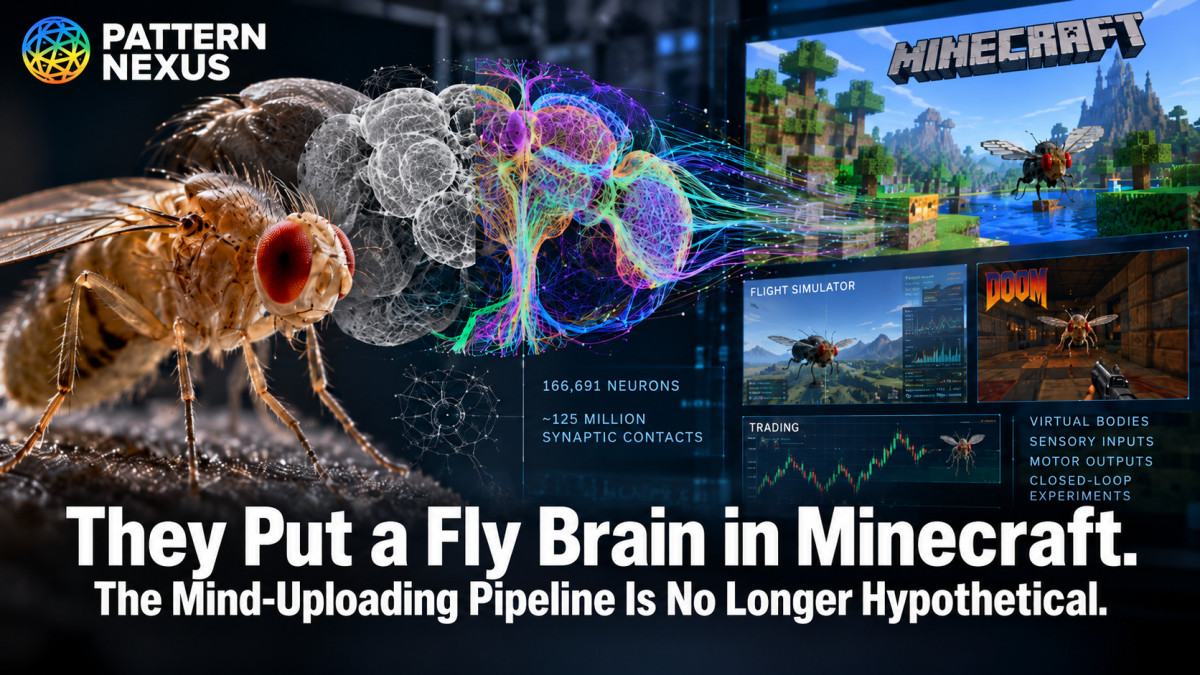

They Put a Fly Brain in Minecraft. The Mind-Uploading Pipeline Is No Longer Hypothetical.
Two years after I laid out a path from brain mapping to executable neural models to synthetic embodiment, researchers and developers now have a complete fruit-fly central nervous system connectome, whole-brain spiking models, virtual bodies, and closed-loop experiments in Minecraft, Doom, flight simulators, trading systems, biomechanical bodies and other digital environments. This is not a digital fly mind. It is not consciousness uploaded into a computer. But the engineering stack I was talking about is beginning to exist.
By Christopher Grenke · Pattern Nexus · September 17, 2026 · Connectomics, Whole-Brain Emulation, AI, Digital Minds
I had to read this twice because the headline sounds like internet nonsense: people are putting a mapped fruit-fly nervous system into Minecraft, Doom, flight-control experiments and other digital environments. Underneath the meme, however, is a real scientific transition. In September 2026, a complete male Drosophila central nervous system connectome was released with 166,691 neurons and roughly 125 million synaptic contacts. The dataset includes the brain, optic lobes and ventral nerve cord, which means researchers can trace information from sensory inputs toward motor outputs across nearly the entire central nervous system.[1][2] This follows the 2024 adult female whole-brain connectome and a peer-reviewed whole-brain computational model that already predicted portions of feeding circuitry and was experimentally validated.[3][5] The viral game demos are not faithful digital flies; they contain simplified neuron dynamics and engineered interfaces. But they demonstrate something that matters enormously for whole-brain emulation: a biological wiring architecture can now be extracted, instantiated computationally, connected to artificial senses and artificial motor outputs, and allowed to operate inside a nonbiological world.
Official count in the complete 2026 male fly CNS connectome.
A full sensory-to-motor structural graph at a scale that can be downloaded and modeled.
Whole adult brain map → executable whole-brain model → full brain-and-cord maps → community closed-loop embodiments.
Why This Hit Me So Hard
I have been writing about mind uploading for years, but I need to separate what I mean by that from the science-fiction version because otherwise this entire article gets misunderstood before we even start. I have never thought this was going to happen because one day somebody presses a button and a human consciousness magically jumps from wet tissue into a server. That is the wrong mental model. The path I have been following is a stack of engineering problems that get solved separately and then begin to converge: map the physical network, determine enough of the state and dynamics to make the network executable, build an interface between the network and an environment, give it a body or a virtual body, test whether the resulting system behaves like the biological system, then keep increasing fidelity until the distinction between simulation and emulation becomes meaningful rather than rhetorical.
That is why this latest wave matters to me. I did not predict that somebody would literally put a fly connectome into Minecraft. I did not predict Doom, Bitcoin trading or a flight simulator. Those are implementations. What I was trying to describe in 2024 was the architecture beneath them: biological nervous system → high-resolution map → computational reconstruction → artificial sensory input → neural dynamics → motor output → synthetic environment → feedback. Once that loop exists, even crudely, a category boundary has been crossed. The question stops being whether a biological connectome can be extracted and attached to another substrate. It becomes how much biological information has to be preserved before the resulting system deserves to be called an emulation rather than a connectome-shaped controller.
That distinction is the entire article. The headlines are simultaneously too dramatic and not dramatic enough. “A fly brain is playing Minecraft” is too dramatic because no one has captured every molecular, electrical, chemical and learned state of a living fly and resurrected its individual mind in a block world. But dismissing the experiment as a gimmick misses the deeper point. A complete animal nervous-system wiring map now exists at a scale large enough to support sophisticated behavior, and independent developers can download that structure, give its neurons simplified dynamics, connect biological sensory populations to arbitrary digital inputs, read biological descending and motor populations as commands, and close the loop inside a virtual world. That is an embryonic form of the exact computational substrate-transfer problem whole-brain emulation has always required.
The milestone is not “Minecraft.” The milestone is that the nervous system has become a portable computational object. The same underlying biological graph can be attached to multiple environments. That is the beginning of a platform, not the end of a science experiment.
Start at Zero: What Is a Connectome, and Why Should Anyone Care?
If you have never followed neuroscience, start here. A neuron is a specialized biological cell that receives signals, transforms them and sends signals onward. Neurons communicate at junctions called synapses. A brain is not simply a bag of neurons; what matters is which cells connect to which other cells, where those connections occur, what kind of signal they transmit, how strong those signals are, how the cells change over time, and how all of that interacts with the body and the outside world.
A connectome is a wiring map. At synaptic resolution, it attempts to tell us which neuron connects to which other neuron through individual synapses. Think of it as taking the most complicated electrical schematic you can imagine and replacing every wire with a biological structure that branches thousands of times, changes chemically, carries state, adapts and sometimes behaves differently depending on context. The connectome gives us the topology of that network. It does not automatically give us every dynamic variable required to reproduce the living system.
The way researchers make these maps is brutally difficult. Tissue is fixed, cut into enormous numbers of ultrathin sections and imaged with electron microscopes. Algorithms then have to determine which tiny fragments in one image belong to the same neuron in the next image. Modern AI and computer vision reconstruct those fragments into three-dimensional cells and identify candidate synapses. Human experts still perform extensive proofreading because a single segmentation mistake can incorrectly merge two cells or split one cell into several pieces. Google describes the modern pipeline directly: section the nervous system, image it at nanoscale resolution, use AI to stitch and segment the images, reconstruct the neural shapes, detect synapses, classify cells, and then have experts verify the result.[1]

Why is that valuable? Because structure constrains function. A visual receptor cannot directly command a muscle if there is no path between them. A sugar-sensing neuron has a limited set of downstream partners. A neuron that controls backward walking occupies a particular place in the network. Once the graph is known, you can begin asking computational questions that were impossible when the network was incomplete: if I stimulate this sensory population, where does activity flow? Which downstream cells cross firing thresholds? Which motor populations become active? What happens if I remove a connection, alter a weight or change a neurotransmitter sign?
But here is the first crucial warning for a reader new to this topic: a connectome is not a mind. If I give you the wiring diagram for a computer motherboard, I have not necessarily given you the contents of its RAM, the files on its storage device, the voltages currently present on every line, the firmware state or the program that was executing at the moment I photographed it. Biology is even more complicated. A connectome is an extraordinary structural foundation, but the state of a living nervous system also depends on membrane voltages, receptor distributions, neuromodulators, synaptic efficacy, short-term plasticity, gene expression, hormones, glia, metabolic conditions, body feedback and other variables that are only partially represented—or not represented at all—in a conventional structural connectome.
The Mind-Uploading Pipeline, Reduced to the Engineering Problem
When I wrote my 2024 mind-uploading roadmap, I treated whole-brain emulation as a sequence of engineering layers rather than one giant mystical event. That remains the useful way to think about it. There are at least three giant transformations that have to occur before we can even argue about identity or consciousness. First, biology has to become data. Second, the data has to become an executable dynamical system. Third, the executable system has to become embodied—meaning it must receive sensory information, act on an environment and receive the consequences of those actions back as new sensory information.
This way of framing the problem is useful because it prevents us from being hypnotized by the word “upload.” Mapping is one field. Computational neuroscience is another. Neural interfaces are another. Robotics and simulation are another. AI-assisted image segmentation is another. High-performance computing is another. If all of those curves improve independently, the final capability can arrive much faster than a straight-line forecast built from any one discipline would suggest.
That is exactly what is happening now. The connectome people are solving capture and reconstruction. Computational neuroscientists are turning static graphs into dynamical models. Embodied-AI researchers are building realistic bodies and environments. Game developers are creating crude but fast closed-loop interfaces. Activity-recording projects such as ZAPBench are trying to capture the missing temporal dimension. None of these groups has to be “working on mind uploading” for the underlying technological stack to converge on the same problem.
How Fast the Science Moved: 2023 to September 2026
The speed here is the part I think most people are going to miss. We are not talking about a single 2026 breakthrough appearing out of nowhere. We are watching a staircase, and the distance between the steps is getting shorter.
In 2023, the complete larval fruit-fly brain connectome contained 3,016 neurons and about 548,000 synaptic sites. That was already a major jump from organisms such as C. elegans, whose adult hermaphrodite nervous system contains 302 neurons.[21][18] In October 2024, FlyWire published the adult female fly brain with 139,255 neurons and 54.5 million synapses, accompanied by a cell-type atlas containing 8,453 annotated types.[3][4]
Then, in the same 2024 release window, another paper did something qualitatively different: it did not merely display the connectome. It created a computational model of the entire adult fly brain using simplified leaky integrate-and-fire neurons, connectomic connection weights and neurotransmitter identity. That model was used to stimulate sugar- and water-sensing populations, predict downstream feeding-related activity and generate experimentally testable hypotheses. Researchers then validated selected predictions with optogenetic and behavioral experiments in living flies.[5]
That is an enormous conceptual shift. Once a connectome can make a prediction about a living nervous system that survives experimental testing, the graph has stopped being merely a beautiful anatomical database. It has become an executable hypothesis about computation.
The 2024 Breakthrough Most People Missed: They Already Ran the Whole Brain
This is the part I wish more of the public discussion understood, because the Minecraft story makes it sound as though somebody just had a weird idea in September 2026 and plugged a brain diagram into a game. The scientific foundation was already there. Shiu and colleagues published a whole-brain computational model in Nature in 2024. Every modeled neuron accumulated incoming influence until it crossed a threshold and fired, then affected downstream neurons according to the number of mapped synaptic contacts and the sign inferred from neurotransmitter identity.[5]
A leaky integrate-and-fire model is intentionally simplified. A biological neuron has ion channels, dendrites, nonlinear conductances, receptor distributions and a complicated intracellular state. LIF compresses much of that into a small set of equations: incoming current changes a membrane-potential variable; the potential decays over time; if it crosses a threshold, the neuron emits a spike and resets. It is not a molecular simulation of the cell. The reason it matters is that it lets you ask whether the structure of the network itself contains enough information to reproduce meaningful patterns of information flow.
For selected feeding and grooming circuits, the answer was surprisingly useful. The model correctly identified neurons that responded to sugar and water stimulation, predicted cells involved in feeding initiation and generated motor-neuron predictions that could be checked experimentally. That does not mean the entire fly brain was perfectly emulated. It means a brain-wide structural network plus extremely compressed neural dynamics had predictive power in real biology. That is exactly the kind of validation ladder whole-brain emulation needs: build the model, make a prediction, test the living system, find the failures, add missing biology, repeat.
This is why I would not call 2024 “mind uploading,” but I absolutely would call it one of the foundational steps toward whole-brain emulation. The anatomical object existed. An executable representation existed. Biological validation existed. What was still missing was a much more complete body loop and much more accurate physiology.
September 2026: The Brain Is No Longer Floating by Itself
The September 3, 2026 MaleCNS release changes the geometry of the problem. The official publication reports 166,691 neurons spanning the male fly brain and nerve cord, fully proofread and annotated into 11,691 types. Google describes approximately 125 million synaptic connections, making it the largest complete brain map by neuron count at the time of release.[1][2]

For a non-neuroscientist, the ventral nerve cord is roughly the fly analog of a vertebrate spinal cord. It contains motor-control circuitry and receives sensory information from the body. The earlier adult female whole-brain map was transformative, but a brain-only connectome still left a major gap between high-level processing and the muscles that produce behavior. The new whole-CNS maps make it possible to follow pathways across the brain and cord in one connected system.
The female BANC project, published in Nature in June 2026, arrived at the same conceptual frontier from another direction. It reconstructed an adult female brain-and-nerve-cord dataset with on the order of 160,000 neurons and roughly 108 synaptic connections. Its analysis found that behavioral control is not a simple command hierarchy running from “brain” down to “body.” Instead, the fly contains distributed local feedback loops linked by ascending and descending circuits, while higher brain regions supervise behaviorally specialized modules.[6]
That matters for uploading because it attacks a common conceptual error: the idea that the brain is software and the body is irrelevant hardware. The data keep pointing in the opposite direction. Nervous systems are embodied control systems. Sensory surfaces, peripheral feedback, motor circuits, endocrine cells, visceral state and body mechanics participate in the computation. A future high-fidelity whole-brain emulation may have to emulate far more than the anatomical object inside the skull.
So What Does “A Fly Brain in Minecraft” Actually Mean?
Now we can finally talk about the thing that set me off tonight. The open-source Fly Brain Minecraft project takes the 2026 male connectome, instantiates its neurons as simplified leaky integrate-and-fire units, injects game-derived sensory information into identified biological sensory populations, lets activity propagate through the network and then reads activity from identified descending and motor populations to determine what a Minecraft fly mob does.[11]
The project describes a real-time loop that is conceptually simple even though the graph inside it is enormous. Minecraft generates an environment. The software translates aspects of that world into sensory signals: visual change can drive photoreceptor-related inputs; food can drive gustatory receptor populations; collisions, rain or motion can be translated into mechanosensory drive. Those signals are delivered to neurons corresponding to real sensory classes. The modeled activity propagates through the connectome. A decoder watches populations associated with walking, turning, stopping, escape, grooming, feeding or flight. Their activity becomes a command to the game avatar. The avatar moves, the environment changes, and that generates the next sensory frame. The loop repeats.[11]
Some of the behaviors in the Minecraft project are reported as emerging from the mapped pathway under the project's chosen dynamics. Sugar input can activate a feeding pathway toward the MN9 proboscis motor neuron. Bitter input can suppress feeding. Looming input can activate an escape pathway. Grooming and basic walking/turning are read from identified populations. But the project is unusually explicit about where biology ends and scaffolding begins: looming drive is partly hand-built, steering gains are hand-built, odor-guided walking can fall back to a reflex layer when the modeled antennal lobe saturates, and flight/landing uses a hand-built state machine.[11]
That honesty is why I think the experiment is actually more interesting, not less. We now have a visible boundary between the portions of behavior the connectome can plausibly produce under a crude neural model and the portions engineers still have to supply. That boundary is a research agenda. Every time a handcrafted layer can be removed and replaced by a validated biological mechanism, the system moves one step from “connectome-constrained controller” toward “emulation.”
There is also a data-count nuance worth making explicit. The peer-reviewed MaleCNS publication reports 166,691 neurons. The Minecraft derivative reports 176,422 entries in its imported graph and then thresholds connections to approximately 6.29 million edges representing about 90 million of the dataset's 125 million synaptic contacts.[2][11] Those counts should not be casually treated as identical. They reflect different project inclusion and filtering choices. For this article, I use the peer-reviewed 166,691 figure when describing the official biological resource and the repository's own numbers only when describing its specific implementation.
Doom, Trading, Flight Simulators and the September 2026 Demo Wave
Minecraft is only one example. The MaleCNS release immediately created a strange open-source ecosystem because the underlying data are available for other people to use. A community index assembled in September lists experiments connecting the fly connectome to Doom, Mario 64, Beat Saber, market trading, browser pets, locomotion systems and other environments.[17] Some are serious research prototypes. Some are artistic or playful. Some have stronger validation than others. They should not be blended into one giant claim that “the fly can do all of these things.” What matters is that many independent teams are testing the same architectural proposition: can a biological connectivity graph be used as the central policy or dynamical substrate in a new environment?
DOOMFLY
DOOMFLY is one of the cleaner examples because its own documentation is aggressive about not overselling the result. It retains a MaleCNS graph of 166,700 neurons and roughly 25.6 million directed edge rows representing about 124.2 million contacts. Actual Doom frames are translated into visual inputs that drive thousands of modeled photoreceptors. Neural activity propagates through the network, and a fixed decoder maps selected neural populations to Doom controls such as turning, movement and firing.[13]
The project's neuroscience review says exactly what a responsible description should say: this is a real closed-loop, connectome-based simulation controlling a Doom-engine scenario, but it is not a validated emulation of fly vision, natural fly action selection or learning. The developers found and corrected a numerical error, published negative validation results and explicitly state that survival learning has not been demonstrated.[13] That is not a weakness in the story. It is science. The important thing is that we can now test failures in an end-to-end embodied connectome instead of arguing in the abstract.
Stonkfly
Stonkfly takes the same concept into a completely unnatural domain. Market prices are converted into an RGB chart, that image drives visual input populations in the retained MaleCNS graph, a fixed neural readout proposes buy, sell or hold, and an execution layer can connect the proposal to a trading interface. Positive and negative portfolio changes are mapped to identified dopamine populations as engineered reinforcement signals. The project explicitly warns that profitable learning has not been demonstrated and that those reward signals are not modeled pain or pleasure.[14]
This is not evidence that a fly understands Bitcoin. It is evidence that developers can translate arbitrary external data into the sensory language of a biological network and translate neural output into arbitrary actions. That interface flexibility is the deeper substrate point.
Flight and Drone Experiments
A separate flybrain repository uses the 2024 female FlyWire connectome as a controller in simplified flight simulations and includes integration code for ROS/Gazebo, X-Plane hardware-in-the-loop and DJI Tello-class hardware. The repository claims connectome-driven forward flight and altitude control in simulation and contains scripts intended for camera-driven drone deployment.[15] But its own documentation also lists real hardware deployment and fully closed-loop camera/motor feedback under future work. That contradiction is important. I would therefore describe the defensible result as a connectome-derived flight controller demonstrated in simulation with hardware-integration code, not as independently established proof that a physical drone has been flown end-to-end by an emulated fly brain.
Again, that more cautious statement is still remarkable. The existence of ArduPilot, X-Plane, ROS and game interfaces means the output substrate is increasingly arbitrary. The biological graph does not know whether the motor command ultimately moves a fly leg, a Minecraft entity, a camera, a virtual aircraft or a robot. The adapter determines that.
A nervous-system graph controlling an alien environment does not prove the animal understands that environment. A motor decoder can turn one population's firing rate into “move left” even if that population evolved for something else. The scientifically meaningful question is how much useful behavior arises from biologically justified sensor and motor mappings without hidden policies, fallback rules or training that replaces the connectome's role.
The Serious Embodiment Work Underneath the Memes
If all we had were game demos, I would call this interesting but early. The reason the broader pattern is more important is that scientific teams are independently moving in the same direction with biomechanical bodies and formal learning experiments.
The 2026 FlyGM preprint takes the exact static architecture of the adult fly connectome and turns it into a directed message-passing graph used as the structural core of an embodied reinforcement-learning controller. That connectome-constrained network is integrated with a biomechanical fruit-fly model and trained on whole-body locomotion tasks. The authors report more efficient learning and stronger performance than degree-preserving rewired graphs, random graphs and conventional multilayer perceptrons in their tested tasks.[16] This is not the same thing as simulating a living fly neuron-by-neuron—the dynamics are graph-model dynamics and the policy is learned—but it addresses a profound question: does the biological wiring architecture itself provide useful computational priors for embodied control?
The answer appears to be yes, at least in these experiments. That means connectomes may matter not only because they are maps of biological organisms, but because evolution has already searched enormous spaces of network architecture. A connectome can be treated as a discovered computational topology, then tested in artificial environments. That begins to blur the boundary between neuroscience and machine learning in a way I expect to become much more important.
The female BANC work adds another piece by showing that the real fly control system is distributed through local sensory-motor loops coordinated by long-range ascending and descending pathways.[6] That architecture looks suspiciously like something an engineer would design for a robust embodied agent: fast local controllers near the body, higher-level supervisory systems above them, and long-range pathways coordinating tasks. The closer simulations get to that structure, the less sensible it becomes to model “the brain” as an isolated centralized controller.
The Zebrafish Development Is Even Bigger Than the Fly Story
This is where the story intersects my old roadmap so directly that I had to stop and check it again. Fruit flies are invertebrates. Zebrafish are vertebrates. They have a spinal cord and a brain organized along a vertebrate body plan that is much closer, evolutionarily and anatomically, to ours. Larval zebrafish are still small enough to image at extraordinary scale, and because they are transparent researchers can record activity across huge fractions of the living brain before the tissue is later reconstructed.
Google's current Neural Mapping project page says the Fish1 atlas spans the brain and anterior spinal cord with more than 180,000 segmented cell bodies, 40,000 molecularly annotated neurons and 30 million synapses. It is not described as a fully comprehensive connectome, but it includes several complete circuits.[7] More importantly, Google now describes the Fish Fire&Wire project as a single-synapse-resolution wiring diagram for an entire larval zebrafish brain, calling the draft completed in 2026 the first complete connectome for a vertebrate. The same fish's activity had already been recorded during behavior, allowing structural wiring and functional firing to be overlaid in the same individual.[7]

The activity side began publicly with ZAPBench. Researchers recorded roughly two hours of whole-brain activity from 71,721 neurons in a larval zebrafish while the animal received virtual-reality visual stimuli. Those data became a benchmark for predicting neural activity. At the time, the same specimen was undergoing synaptic-level anatomical mapping; the 2026 Fire&Wire work is the convergence of those lines.[8]
This matters more for the long-run emulation problem than simply mapping a larger animal. Whole-brain emulation needs both wiring and state-transition rules. A connectome tells us where signals can travel. Activity recordings tell us what actually happens when a living system encounters a stimulus. If you have structure and activity from the same specimen, you can train and falsify dynamical models against the real animal instead of hoping a generic neuron model is good enough.
That is exactly the direction I expected the field would have to move: first structural maps, then functional overlays, then increasingly accurate digital twins. The fact that this is already being done at whole-brain scale in a vertebrate is a more consequential milestone than the viral game demos, even though the game demos make the architecture easier for everyone to understand.
Now the Hard Part: A Fly Is Not a Human Brain
This is where we need to stop the hype from running away with the argument. The human brain contains on the order of 86 billion neurons. Compared with the 166,691 neurons in the 2026 male fly CNS, that is roughly half a million times more neurons before we even discuss the much greater diversity, geometry, synaptic complexity and state space of mammalian nervous systems.[1] Raw neuron count is not a complete measure of difficulty, but it gives the right intuition: scaling is brutal.
We already have a sobering example of what human-scale mapping means. In 2024, Google and Harvard reconstructed roughly one cubic millimeter of human temporal cortex at nanoscale resolution. That tiny fragment contained about 57,000 cells, around 150 million synapses and required roughly 1.4 petabytes of data.[10] One cubic millimeter is tiny compared with the whole human brain. The data problem alone is staggering.
The MICrONS project gives us another view from mouse cortex. In roughly a cubic millimeter of mouse visual cortex and surrounding visual areas, researchers reconstructed more than 200,000 cells and about 523 million synapses, while also linking the tissue to functional recordings from roughly 75,000 neurons obtained while the mouse viewed visual stimuli.[9] That is not a whole mouse brain, but it is a critical demonstration of structure-function fusion in mammalian cortex. It also tells us why “just scan the human brain” is not a serious plan yet. A grain-of-sand-sized piece of cortex already produces hundreds of millions of connections.
So no, the fly work does not mean a human upload is around the corner. It means the sequence of technologies needed for whole-brain emulation is no longer hypothetical at small-organism scale. The scaling problem is now exposed instead of abstract.
What We Still Do Not Have — and Why This Is Not Yet a Digital Fly Mind
This section matters because without it the article becomes hype. There are several layers of biological information that current connectome-driven systems either simplify aggressively or do not capture at all.
First: the connectome is mostly structural. Synapse count is often used as a proxy for connection strength, but two synapses with the same anatomical count can behave differently because of receptor composition, release probability, dendritic location, neuromodulation and cell state. The 2024 Shiu model is valuable precisely because it shows how far a very simple model can go, not because it establishes that all neurons are actually identical LIF units.
Second: many fly neurons do not behave like textbook spiking neurons. Some visual-system cells use graded signaling. Real cells have adaptation, nonlinear dendrites, electrical synapses, neuropeptide effects and multiple timescales. Several community demos apply one simplified spiking model across huge populations for tractability. That is an engineering approximation, not a claim about the actual physiology of every neuron.
Third: memory is not simply “the wiring diagram.” Some long-term memory may involve structural synaptic changes, but memory can also depend on synaptic efficacy, receptor trafficking, biochemical states, gene expression and recurrent network state. A postmortem EM connectome is a destructive snapshot. It may preserve some anatomical traces of learning while losing important dynamic information. If mind uploading requires preserving an individual's autobiographical memories, preferences and learned internal models, this is one of the largest unresolved capture problems.
Fourth: the body is part of the loop. BANC makes this impossible to ignore. Local sensory-motor control, endocrine signaling, proprioception and visceral state shape behavior. A digital fly with no fly body is not receiving the same data distribution as a living fly. Every virtual environment therefore needs a sensory and motor translation layer, and those translations can dominate behavior if they are not biologically justified.
Fifth: development and individuality matter. Two flies of the same species are not literally identical graphs. The 2026 male-female comparison found thousands of broadly shared types but also sex-specific and dimorphic circuits.[2] Even within a sex, connectivity varies between individuals. A generic species-level emulation and a copy of one particular animal are different goals.
Sixth: consciousness has not been demonstrated here. There is no scientific basis for saying that a Minecraft fly mob is conscious because it is driven by a connectome. The experiments do not resolve whether a sufficiently faithful functional emulation would have subjective experience, and they certainly do not solve the identity question: if a digital system reproduced your behavior and memories, would that system be you, a copy of you, both, or neither? That remains philosophically and scientifically open.
The Pattern Nexus Checkpoint: My 2024 Mind-Uploading Roadmap Versus September 2026
I wrote my long-form mind-uploading roadmap in 2024 because I thought conventional timelines were underweighting convergence. My basic argument was that whole-brain emulation should not be forecast from neuroscience alone. AI was beginning to accelerate segmentation, simulation, model-building and software development simultaneously. I put fruit-fly and zebrafish-scale work in the foundational 2025–2030 window, with progressively more ambitious partial and whole-brain emulation efforts following behind it.[19]
I want to be precise about what the current evidence does and does not validate. It does not validate the later human-upload dates. Small-organism progress can surprise to the upside while human scaling remains much harder than expected. But the near-term architecture is developing almost exactly where I thought it had to develop: synaptic-scale reconstruction, executable network models, whole-nervous-system maps, vertebrate whole-brain activity recording, structure-function fusion and synthetic embodiment.
The distinction matters. A prediction about a specific game would have been trivia. The structural prediction was that increasingly complete biological neural maps would become executable computational objects and then be attached to virtual or physical substrates. That is the part I care about.
There is another piece of my older framework that looks more important now: I argued that uploading would probably arrive progressively through digital shadows, cognitive delegation, memory continuity, parallel selves, synthetic embodiment and eventually some form of substrate independence rather than as one clean event.[20] The fly work reinforces that gradualist model. We are already discovering that “putting a brain in a computer” breaks into dozens of fidelity layers. We can transfer topology before physiology. We can transfer dynamics before memory. We can transfer sensorimotor architecture before identity. Each layer can become useful long before the philosophical problem is solved.
Why the Substrate Question Just Changed
The word substrate independence is usually used too loosely. In the strongest version, it means that the information and dynamics that constitute a mind can be reproduced on a different physical medium without losing the relevant person. We are nowhere near demonstrating that. But there is a weaker engineering version of substrate transfer that has now become concrete.
A fruit fly evolved to control a six-legged biological body in a physical world. Its nervous system did not evolve for Java, Minecraft, ViZDoom, a financial chart, ROS, X-Plane or a GPU. Yet once the wiring map is represented digitally, programmers can place an interface around it. Artificial sensors translate the new world into patterns the biological graph can receive. Artificial actuators translate its outputs into actions the new world can understand.
That means the mapping between nervous system and body is becoming programmable. The biological network can be treated as one component in a larger synthetic control loop. This is not proof that the fly's mind has become substrate-independent. It is proof that a growing portion of the nervous system's computational architecture can be detached from its original physical body and made operational inside another environment.
To me, that is the real conceptual break. Once the interface layer exists, researchers can ask controlled questions about embodiment that were previously philosophical: What happens if the visual field is expanded? What if the body has wheels instead of legs? Which circuits remain useful? Which fail immediately? Can the same graph learn a new body map? Does plasticity let a biological network adapt to a synthetic morphology? What information about an organism is contained in the connectome itself versus the body it evolved with?
Those questions are not science fiction anymore. They are software experiments.
What I Am Watching Next
There are several developments that would move this from “astonishing prototype era” into a much more serious emulation era.
1. Structure and activity from the same individual. Fish Fire&Wire is probably the most important project on my board because it combines synaptic structure with whole-brain activity from the same vertebrate specimen. If models trained on wiring plus activity begin accurately forecasting unseen neural responses, the gap between connectome and dynamical twin narrows substantially.
2. Better cell models without losing whole-brain scale. LIF is computationally cheap. More realistic conductance-based and cell-type-specific models are expensive. AI surrogate models, specialized accelerators and learned reduced-order dynamics could let researchers increase biological realism without making whole-system simulation impossible.
3. Plasticity that predicts real learning. The biggest step will not be a fly that moves in Doom. It will be a fly-connectome model that acquires a new association, changes specific synapses for biologically justified reasons, retains that memory, predicts the living animal's post-learning neural responses and survives experimental validation. That would demonstrate that the model captures part of the mechanism of experience-dependent state change.
4. Full body and internal-state models. Muscle mechanics, proprioception, endocrine state, energy balance, gut signals and other body variables will increasingly be pulled inside the simulation. I expect “whole-brain emulation” to gradually mutate into “whole-organism computational emulation” for small animals because researchers will discover that the brain-body boundary is scientifically inconvenient.
5. Cross-individual prediction. With multiple male and female connectomes, researchers can ask what stays invariant across animals and what is individual. That is essential if we ever want to know which structural features encode species-typical behavior and which encode an individual history.
6. Mammalian scaling. MICrONS already shows that structure and function can be fused in mammalian cortical tissue at enormous local scale. The question is how quickly imaging, AI segmentation, storage and proofreading become cheap enough to increase volume by orders of magnitude.
7. Nondestructive or state-preserving capture. Today's highest-resolution connectomics usually destroys the tissue. Human uploading eventually requires either an ethically acceptable destructive path that captures enough state, or a radically different nondestructive technology. Without that, a human connectome may remain scientifically valuable but personally unusable.
8. Validation standards. We need benchmarks that prevent everyone from calling a moving avatar an emulation. A serious whole-brain-emulation benchmark should require prediction of neural responses, behavior across unseen conditions, learning dynamics, lesion effects, intervention responses and perhaps individual-specific traits. The field needs a ladder, not a binary label.
The Pattern Nexus Conclusion
I started tonight thinking I had found a ridiculous internet story: somebody put the fly brain in Minecraft. Then I kept digging, and the story got much bigger. The viral layer is Minecraft, Doom, trading and flight simulators. The scientific layer underneath it is the completion of whole adult fly connectomes, whole central nervous system maps, executable brain-wide models, experimental validation, embodied control, whole-brain vertebrate activity recording and now structural-plus-functional mapping in the same zebrafish.
That is the pattern. None of these developments alone is mind uploading. Together, they are building the machinery that a serious whole-brain-emulation program would require.
The most important shift is that the connectome is becoming executable and portable. We can take a biological nervous-system architecture, run an approximation of its dynamics on conventional hardware, feed it signals from an artificial environment and turn its outputs into actions in a different body. Today that body can be a Minecraft mob. Tomorrow it can be a better biomechanical fly, a robot or an experimental virtual organism designed specifically to test what the connectome actually knows how to do.
The gap between this and a human mind upload is still enormous. The missing layers—physiology, dynamic state, memory, neuromodulation, molecular state, body feedback, individual identity and consciousness—are not details. They are the problem. But the correct conclusion is not that nothing happened. The correct conclusion is that one of the hardest conceptual steps has stopped being hypothetical. We now have living-derived neural architectures being moved into synthetic substrates and placed inside closed loops.
In 2024, I treated fruit-fly and zebrafish emulation as the beginning of the roadmap because I thought the path to human uploading would be visible first in organisms small enough to map completely. In September 2026, we have a full male fly CNS, a full female brain-and-cord connectome, executable fly-brain models, multiple synthetic embodiments, whole-brain zebrafish activity datasets and the draft of what Google describes as the first complete vertebrate connectome. That does not tell us exactly when the human threshold arrives. It tells us the road is real.
And that is why the Minecraft story matters.
FAQ
Did scientists literally upload a living fly's mind into Minecraft?
No. Developers took a connectome derived from biological tissue, instantiated simplified computational neuron dynamics on that graph, mapped game inputs to identified sensory populations and decoded neural activity into game actions. The result is an embodied connectome simulation, not a proven copy of an individual fly's mind.
Is the entire fly nervous system mapped?
As of September 2026, the MaleCNS project reports a complete male central nervous system connectome spanning brain and nerve cord with 166,691 neurons. The female BANC project similarly reconstructs a connected brain-and-nerve-cord dataset. As with all such reconstructions, “complete” refers to the declared anatomical scope and reconstruction criteria; it does not mean every molecular variable in the living animal is known.
Why is a ventral nerve cord important?
Because it contains major motor-control and sensory circuitry analogous in broad role to the vertebrate spinal cord. Connecting brain and cord makes it possible to study longer sensory-to-motor pathways and distributed body-control loops.
Does the Minecraft fly behave entirely on its own?
No. Some pathway-level responses are reported as emergent from neural activity, while other functions use hand-built sensory drives, gains, fallback reflexes or state machines. The project documents those distinctions. That is why it is better described as a connectome-driven embodied experiment than a complete fly emulation.
Has a fly connectome actually learned to play Doom or trade profitably?
Not on the evidence currently available. DOOMFLY explicitly states that validated survival learning has not been demonstrated, and Stonkfly explicitly states that profitable learning has not been demonstrated. They are useful experiments in closed-loop connectome control and plasticity hypotheses, not proof that a fly understands games or markets.
Did a fly brain really fly a physical drone?
A public repository includes connectome-derived flight simulations and code intended for Tello, ROS, ArduPilot and X-Plane integration, but its documentation also lists real hardware deployment and full closed-loop camera/motor feedback as future work. The conservative description is that connectome-based flight control has been demonstrated in simulation and prepared for hardware integration; a fully independently verified physical-drone result is not established by the repository alone.
What is the biggest scientific limitation right now?
Structure is advancing faster than state. We can map enormous numbers of cells and synapses, but a high-fidelity emulation must also reproduce cell-specific dynamics, neuromodulation, plasticity, body feedback and the individual learned state. Whole-brain activity-plus-structure datasets such as zebrafish Fire&Wire are important because they directly attack that gap.
Does this make the 2024 Pattern Nexus human-upload timeline correct?
It strengthens the near-term small-organism part of the roadmap, not the later human dates. Human-scale capture and faithful state reconstruction remain orders of magnitude harder. The current result is evidence that the architecture is developing, not proof that every downstream milestone will arrive on the same schedule.
Sources
- [1] Google Research — A connectomics milestone: Mapping the complete male fruit fly brain (September 3, 2026)
- [2] Berg, Beckett, Costa, Schlegel, Januszewski et al. — Sexual dimorphism in the complete Drosophila male central nervous system connectome, Cell (2026)
- [3] Dorkenwald et al. — Neuronal wiring diagram of an adult brain, Nature (2024)
- [4] Schlegel et al. — Whole-brain annotation and multi-connectome cell typing of Drosophila, Nature (2024)
- [5] Shiu et al. — A Drosophila computational brain model reveals sensorimotor processing, Nature (2024)
- [6] Bates, Phelps, Kim, Yang et al. — Distributed control circuits across a brain-and-cord connectome, Nature (2026)
- [7] Google Research Neural Mapping — Open datasets: MaleCNS, Fish1, Fish Fire&Wire and ZAPBench
- [8] Google Research — Improving brain models with ZAPBench (2025)
- [9] Nature — The MICrONS Project (2025)
- [10] Shapson-Coe et al. — A petavoxel fragment of human cerebral cortex reconstructed at nanoscale resolution, Science (2024)
- [11] Fly Brain Minecraft — open-source MaleCNS closed-loop Minecraft implementation and validation notes (2026)
- [13] DOOMFLY — MaleCNS / ViZDoom closed-loop experiment, public model review and validation records (2026)
- [14] Stonkfly — connectome simulation with experimental dopamine-gated memory and guarded market actions (2026)
- [15] flybrain — FlyWire-derived flight-controller simulation and hardware-integration repository (2026)
- [16] Jin, Zhu, Zhang & Sui — Whole-Brain Connectomic Graph Model Enables Whole-Body Locomotion Control in Fruit Fly (FlyGM), arXiv (2026)
- [17] Awesome Fruit Fly — curated index of 2026 connectome simulations, game demos and embodied experiments
- [18] OpenWorm — C. elegans whole-organism modeling and 302-neuron connectome background
- [19] Christopher Grenke / Pattern Nexus — Toward Mind Uploading in an Era of Exponential AI Acceleration: A Detailed Roadmap and Prospects for 2025–2050 and Beyond
- [20] Pattern Nexus — Exponential Minds and Simulated Realities: The Future of Consciousness by 2050
- [21] Winding et al. — The connectome of an insect brain, Science (2023)
Peer-reviewed connectomics results are separated from community software claims throughout this article. Minecraft, Doom, trading and flight-controller repositories are treated as experimental implementations, not as peer-reviewed proof of whole-brain emulation, consciousness, semantic understanding or successful learning. Where a repository's own documentation contains conflicting claims, the narrower defensible description is used.
คุณมีปฏิกิริยาอย่างไร?
 ชอบ
0
ชอบ
0
 ไม่ชอบ
0
ไม่ชอบ
0
 รัก
0
รัก
0
 ตลก
0
ตลก
0
 ว้าว
0
ว้าว
0
 เศร้า
0
เศร้า
0
 โกรธ
0
โกรธ
0

Founder of Pattern Nexus. I research markets, macro, geopolitics, AI, history, ancient systems, and the patterns most people overlook. I’m also building Market Radar, a trading scanner designed to read pressure, risk, confirmation, and setup quality before chasing a move. Pattern Nexus is where I connect the dots between data, history, technology, and the bigger system playing out around us.





ความคิดเห็น (0)