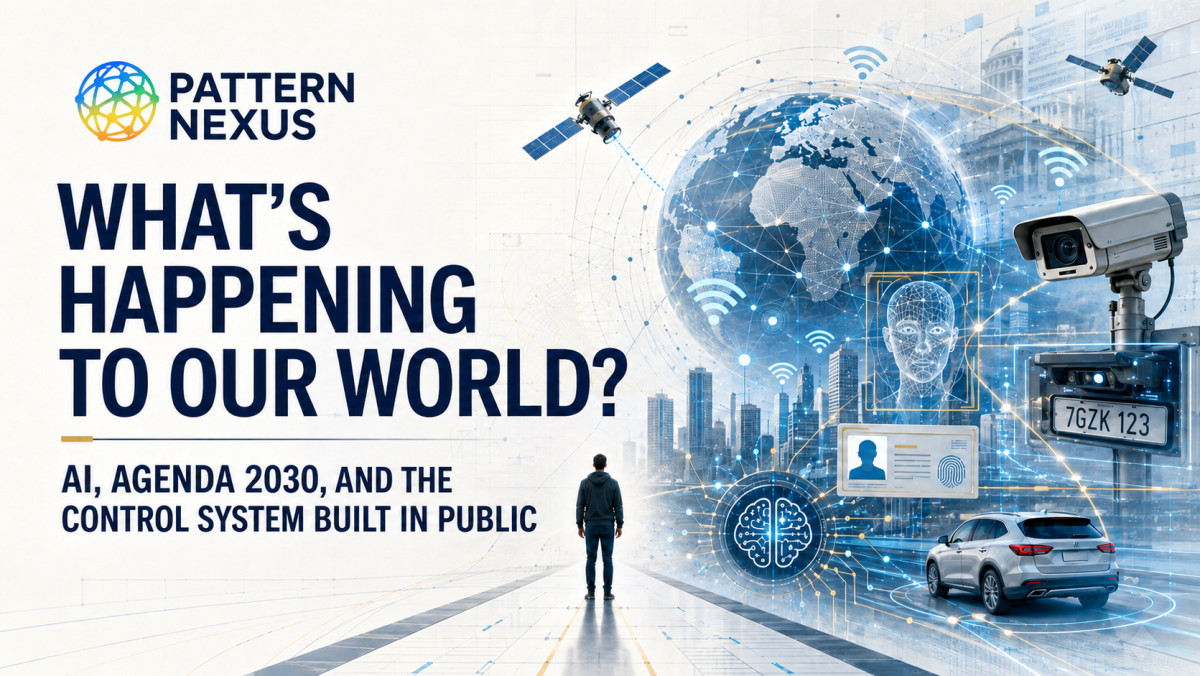
What’s Happening to Our World? AI, Agenda 2030, and the Control System Built in Public
I was reading these documents twenty years ago, when most people thought the warnings were insane. Now the architecture is everywhere. This personal systems essay connects humanity’s inability to absorb accelerating change with Agenda 21, Agenda 2030, post-9/11 legal infrastructure, Klaus Schwab’s own books, digital identity, smart-home surveillance, Wi-Fi sensing, Starlink passive radar, Flock cameras, connected cars and the AI layer that can finally fuse it all together.
 Pattern Nexus Premium Research
What’s Happening to Our World? AI, Agenda 2030, and the Control System Built in Public
I was reading these documents twenty years ago, when most people thought the warnings were insane. Now the architecture is everywhere: identity, metrics, smart devices, cameras, connected cars, satellites and AI. The documents were never the whole system. They were the map.
The world is not merely changing faster. Its control layers are finally converging.
- Human beings were built for a slower information environment. For most of history, a skill learned young could remain useful for decades. AI is now compressing the useful life of knowledge, work and institutions faster than people can rebuild their identities around the change.
- Agenda 21 was never a random internet rumor. It was adopted at the 1992 Rio conference as a global, national and local action plan. Its own chapters called for local authorities, education, public awareness, institutions and private organizations to carry the framework into daily life.[14][15][16]
- Agenda 2030 scaled the same model into a data architecture. The document pairs 17 goals and 169 targets with legal identity, disaggregated data, global indicators, geospatial information, public-private partnerships and recurring review.[17]
- The goals can sound humane while the machinery still becomes coercive. Identity helps people access services. Data helps locate need. Sensors can improve safety. But once those functions are fused, the same stack can classify, restrict, price, nudge or deny.
- Klaus Schwab did not hide the scale of the ambition. His Fourth Industrial Revolution framework describes a fusion of the physical, digital and biological worlds that changes how people live, work, relate and even understand themselves.[20][21]
- The post-9/11 legal shell came first. The PATRIOT Act, FISA Amendments Act, Section 702, military-detention language and a modernized domestic information environment expanded collection, sharing and state capacity across both Bush and Obama administrations.[23][24][25][26][27]
- The surveillance layer moved into ordinary life. Smart televisions, appliances, phones and cars became sensor platforms. The intelligence community now openly acknowledges using commercially available information, while the FBI has warned that connected household devices can create privacy and security access points.[28][29][30]
- Wi-Fi, cellular networks and satellite signals are not only communication channels. Researchers have reconstructed human pose through walls from radio reflections, standards bodies are developing integrated sensing and communication, and researchers have produced passive radar imagery using Starlink transmissions.[32][33][34][35][36]
- Flock cameras and connected vehicles turn movement into a permissioned data layer. A license plate becomes a persistent query key. A software-defined vehicle can monitor the driver, report data, intervene and eventually make access conditional.[37][38][39][40]
- AI is the missing fusion layer. The databases, cameras, devices and standards existed before. AI makes them searchable, predictive and responsive at a scale no human bureaucracy could manage. That is the actual threshold we are crossing.
This is not a debunking exercise. I am not going to pretend that a system is harmless because its documents use words like inclusion, resilience, safety, sustainability or partnership. I am going to read what the documents say, follow the infrastructure they created, and ask what that infrastructure can do once identity, data, sensors, money, mobility and AI occupy the same stack.
What is happening to our world?
If you study history long enough, you start to notice that change does not move in a straight line. There are long stretches when the basic texture of life barely changes, and then there are compressed periods when the old world seems to disappear all at once.
Human beings do not handle those compressed periods particularly well.
For most of our existence, the world a person entered as a child still resembled the world that person left as an old man. A trade learned young could feed a family for life. The institutions around you might change rulers, borders or names, but the rhythm of work, family, community and survival remained recognizable. Our minds were trained by that world. Our nervous systems still expect continuity even when our technology no longer provides it.
That continuity broke a long time ago. The technological acceleration after the 1940s never really stopped: nuclear energy, radar, jet travel, satellites, television, computing, networks, semiconductors, biotechnology, smartphones and cloud systems. Yet the human layer changed more slowly than the machines. A person could still learn one profession, live in one town, use the same basic institutions and pretend the floor was stable.
AI is about to remove that illusion.
The prior hundred years already strained our ability to adapt. Now the tools that produce knowledge, automate decisions, generate media, monitor systems, write software and optimize institutions are improving inside the same decade—sometimes inside the same month. Employers surveyed by the World Economic Forum expected 39 percent of workers’ core skills to change by 2030, and OECD work is already tracking how AI changes tasks, job quality and the pace of work.[44][45] The numbers will keep moving. The deeper point is that the half-life of competence is collapsing.
That is one half of what is happening.
The other half is that this acceleration is occurring inside systems of planned social management: states, international organizations, universities, foundations, corporations, standards bodies and local institutions. Some actors are benign. Some are self-serving. Some believe deeply in the larger agenda. Some are simply following the funding, the credential system, the compliance checklist or the career incentive in front of them. Some have no idea they are serving a design larger than their own job.
You do not need every participant to share one secret room. You need shared standards, shared metrics, interoperable databases, aligned incentives and a public trained to accept each layer one piece at a time.
We were built for a world that no longer exists
The problem is not merely that technology changes. The problem is that every layer now changes the other layers.
A new model changes software. The new software changes hiring. Hiring changes education. Education changes debt. Automation changes tax bases. Synthetic media changes trust. Sensor networks change policing. Digital identity changes access. Programmable finance changes what money can be used for. The public experiences each development as a separate headline, but the person living underneath them experiences one continuous loss of stability.
That produces a strange psychological condition. People know the world is moving, but they cannot tell which part is permanent. They build a career around one tool and the tool is replaced. They build an identity around one institution and the institution loses legitimacy. They learn one information environment and the algorithms reorder it. They think they are failing individually when the operating environment itself is being rewritten.
Research on digital work describes an evolutionary mismatch between human psychology—shaped in small, embodied social groups—and work mediated by remote systems, constant connectivity and abstract networks.[47] I think that mismatch is about to become one of the defining political facts of the AI era. A population that cannot orient itself becomes easy to sort, frighten, redirect and manage.
This is why acceleration and control cannot be analyzed separately. Rapid change weakens memory. It shortens attention. It makes yesterday’s outrage feel ancient. It forces people to depend on experts and systems they do not understand. Then the same institutions generating the complexity offer themselves as the only entities capable of managing it.
First the world becomes too complicated to navigate alone. Then navigation becomes a service. Then the service becomes permission.
I miss the old internet
I was talking about some of this twenty years ago.
During the Bush era, and then throughout the Obama era, I watched the legal and technological pieces move into place. I watched authorities expand, definitions widen and capabilities become normalized. I kept thinking about the future use of those powers, not only the official reason given on the day they were passed.
Most people thought that kind of thinking was crazy.
Now I see people post the same ideas as if they were discovered last week. Things that would get you laughed out of a room twenty years ago are now casually described as obvious: phones map movement, data brokers sell location, intelligence agencies acquire commercial data, social networks profile behavior, cameras query vehicles across jurisdictions, household devices create surveillance surfaces, and algorithms determine what information exists for practical purposes.
The frustrating part is that much of it was not hidden. The documents existed. The hearings existed. The technical papers existed. The officials occasionally said the quiet part out loud.
That was the old internet.
It was chaotic. It was full of garbage. There was no filter, which meant you had to build one inside yourself. But if you had discernment—if you learned to find original documents, compare claims and follow a thread past the polished explanation—you could stumble into a rare glimpse of truth. Search was less domesticated. Video archives felt less curated. Independent forums preserved strange fragments. A person with patience could move sideways through the system.
Today the internet is cleaner, faster, safer-looking and far more managed. The raw archive has been buried beneath recommendation systems, de-ranking, platform policy, monetization pressure and a flood of machine-generated sludge. Information is abundant, but discovery is permissioned.
If you remember the old internet, you know what I mean. If you do not, I am sorry. You missed a weird, dangerous and extraordinary window when the digital world was still porous enough to reveal how much was being built behind the official story.
The document was public. The implementation was local.
Agenda 21 came out of the 1992 United Nations Conference on Environment and Development in Rio. The official United Nations description calls it a comprehensive plan of action to be taken globally, nationally and locally by the UN system, governments and major groups in every area where human beings affect the environment.[14]
That sentence tells you the operating model.
Global framing. National adoption. Local execution. Institutional participation.
People spent years arguing over whether Agenda 21 was binding world law. That argument missed the mechanism. A framework does not need a global police force if it can move through grants, planning guidance, model ordinances, professional associations, university programs, reporting templates, procurement rules, land-use language and public-private partnerships.
Chapter 28 explicitly called on local authorities to enter dialogue with citizens, community organizations and private enterprises and to adopt a local Agenda 21.[15] Chapter 36 embedded education, public awareness and training across nearly every area of the agenda.[16] ICLEI—the global network of local and regional governments—reports that thousands of governments have participated in this kind of local sustainability work, and its own history describes more than 1,800 local governments in 64 countries establishing Local Agenda 21 processes.[18]
That is not a theory about implementation. That is implementation.
| Layer | Public language | Operational effect |
|---|---|---|
| Global | Shared goals and principles | Defines the vocabulary institutions use to describe progress. |
| National | Strategies, commitments and reporting | Connects goals to ministries, budgets, legislation and statistical systems. |
| Local | Planning, resilience and sustainability | Turns abstract goals into zoning, transit, housing, energy and land-use decisions. |
| Institutional | Education, awareness and professional training | Trains future managers and officials inside the same conceptual framework. |
| Corporate | Partnership, disclosure and responsibility | Makes private capital an enforcement and implementation channel. |
This is how modern governance spreads. Not through one dramatic order, but through thousands of respectable decisions made by people who can honestly say they were only improving a planning process, applying for a grant, updating a curriculum, complying with disclosure or using an accepted standard.
Agenda 21 mattered because it normalized the architecture. Agenda 2030 industrialized it.
Governance becomes a data stack
The 2030 Agenda was adopted in 2015. It contains 17 Sustainable Development Goals and 169 targets. Most people encounter it as a wall of harmless aspirations: end poverty, improve health, educate children, build infrastructure, protect the planet, promote peace.
I am not interested in arguing against clean water or literacy. That is a distraction.
The relevant question is: what machinery must exist to measure, coordinate and enforce progress across 169 targets, nearly every government, major corporations, universities, financial institutions and local communities?
Read the implementation sections.
Target 16.9 calls for legal identity for all by 2030. Target 17.18 calls for high-quality, timely and reliable data disaggregated by income, sex, age, race, ethnicity, migratory status, disability, geographic location and other characteristics. The agenda calls for systematic follow-up and review using global indicators. Paragraph 76 calls for public-private cooperation to exploit a wide range of data, including Earth observation and geospatial information. Goals 17.16 and 17.17 promote multi-stakeholder and public-private partnerships.[17]
Read that as an engineer, not as a partisan.
Identity creates the key. Data creates the profile. Geospatial systems create location. Indicators create the score. Partnerships connect state power to private infrastructure. Recurring review creates pressure. Finance creates compliance. AI creates automated interpretation.
That does not mean every school meal, clean-water project or identity program is sinister. It means the same architecture required to administer benefits can administer conditions. The same identity that proves entitlement can prove exclusion. The same data that detects inequality can classify a population. The same geospatial layer that maps a flood can map behavior. The same wallet that stores credentials can decide which credential is missing.
The United Nations Legal Identity Agenda, the World Bank’s Identification for Development work and the European Union’s digital identity wallet are not science fiction. The EU requires member states to provide digital identity wallets under the current framework, while the World Bank openly describes digital identity as part of broader digital public infrastructure tied to services and payments.[41][42][43]
The Principles for Responsible Management Education bring the same sustainable-development framework into business and management schools across more than 800 institutions in over 90 countries.[19] Again: education, corporations, government and international standards do not have to receive the same secret memo. They are being trained to speak the same operational language in public.
The most effective conspiracy is a published governance architecture that almost nobody reads. Its protection is not secrecy. Its protection is complexity, fragmentation and the public’s inability to imagine how benign components behave after they are connected.
Agenda 2030 is often defended as voluntary. That word comforts people who still imagine power as a policeman issuing a direct command. Modern power works upstream. It controls eligibility, interoperability, insurance, procurement, credit, accreditation, platform access, visibility and the data required to participate.
By the time an action feels compulsory, the coercion may not come from a law. It may come from the fact that every functional institution uses the same field, score, wallet, platform or standard.
Stop looking for one control room
The word conspiracy makes people imagine a dozen villains around one table, signing off on every traffic camera, university course and banking rule. That cartoon protects the real system because the real system does not require that level of coordination.
Large systems synchronize through incentives.
A mayor wants federal money. A university wants accreditation and grants. A corporation wants regulatory favor and capital access. A standards body wants adoption. A foundation wants measurable impact. A technology company wants recurring government contracts. An international institution wants comparable data. A bureaucrat wants the next promotion. A citizen wants convenience.
Give all of them a shared vocabulary and compatible software, and their separate motives begin constructing the same machine.
| Actor | What the actor believes it is doing | What the combined system gains |
|---|---|---|
| Government | Delivering services, safety and compliance | Identity, authority, legal compulsion and access to public records. |
| Corporation | Selling convenience, efficiency and risk reduction | Sensors, cloud infrastructure, behavioral data and automated enforcement. |
| University | Teaching modern standards and solving social problems | Legitimacy, trained administrators and reproduction of the framework. |
| International body | Coordinating common goals | Comparable metrics, common targets and cross-border normalization. |
| Citizen | Choosing convenience and personal security | Voluntary enrollment, normalized monitoring and continuous data production. |
This is why I keep writing about rails.
Political theater focuses attention on the faces at the podium. The durable power sits beneath them: identification, settlement, cloud access, payment networks, energy supply, communications, insurance, app stores, credit scoring, content ranking and mobility. Administrations change. The rails usually remain. My Script, Circus and Rails framework is built around that distinction.[3]
So here is the conspiracy version without the cartoon:
The world’s most powerful institutions have spent decades building interoperable systems for measuring, identifying, predicting and steering populations. They describe these systems in public as safety, efficiency, inclusion, sustainability and modernization. Each word can describe a real benefit. Together, the systems create a control capacity no prior state possessed.
The intention of every individual actor is not the deciding variable. Capability survives intention. Once a control surface exists, the next crisis supplies the reason to use it.
Klaus Schwab told you what was coming
You should read Klaus Schwab’s books.
Not a meme about the books. Not a clipped video from someone reacting to the books. Read the actual framework.
The Fourth Industrial Revolution describes a transformation of humankind driven by the fusion of physical, digital and biological technologies. It says the revolution will change how we live, work and relate to one another. It discusses changes to identity, privacy, ownership, consumption, work and the human body. Schwab’s own World Economic Forum essay warned that the technologies could effectively robotize humanity and remove qualities such as empathy and cooperation if the revolution is not shaped correctly.[20][21]
That is not me projecting a secret plan onto an innocent gardening manual. That is the declared scope.
Then came the Great Reset. In 2020, the World Economic Forum argued that the institutional changes produced during the COVID period showed how quickly society’s foundations could be reset, and it called for stakeholder capitalism, coordinated policy and a redesigned economic order.[22]
Schwab writes like an architect proud of the blueprint. The language is polished because he sees these transformations as necessary and desirable. That confidence is exactly why people should pay attention. The most consequential planners rarely describe themselves as tyrants. They describe themselves as stewards of a future too complex for ordinary institutions to manage.
The repeated message is that technological change is inevitable but its direction must be shaped by coordinated leaders across government, business, academia and civil society. In other words: the same cross-institutional management structure embedded throughout Agenda 2030.
People hear “stakeholder” and imagine broader participation. In practice, stakeholder governance can move authority away from voters and toward networks of executives, NGOs, foundations, regulators and expert bodies who claim to represent the future. The public becomes one stakeholder among many, even when it is the public expected to live under the result.
The Bush–Obama legal shell was built across party lines
One reason people dismissed the warning twenty years ago is that they evaluated every law by the emergency used to pass it.
I was evaluating the authority itself.
After September 11, the United States built a durable legal and technical shell around surveillance, information sharing, detention and national-security secrecy. The Bush administration opened the largest phase. The Obama administration inherited, defended, modified and normalized much of it. The point was never that the two administrations were identical. The point was that the system accumulated capacity regardless of the party controlling it.
| Year | Infrastructure | Why it mattered to the future |
|---|---|---|
| 2001 | USA PATRIOT Act | Expanded investigative authorities, records access and information sharing in the name of counterterrorism.[23] |
| 2008 | FISA Amendments Act / Section 702 | Created a programmatic framework for acquiring foreign-intelligence communications from electronic service providers, with Americans’ communications entering the collection environment.[24][25] |
| 2011–2012 | National Defense Authorization Act, Section 1021 | Affirmed military-detention authority under the post-9/11 authorization framework. Obama’s signing statement acknowledged the civil-liberties controversy while signing the law.[26] |
| 2012–2013 | Smith–Mundt Modernization | Changed the domestic-access firewall around material produced for foreign audiences, reflecting a media environment in which information no longer respects geographic borders.[27] |
Each authority had lawyers, procedures, targeting rules and an official purpose. That was not the warning.
The warning was that temporary emergency logic hardens into permanent infrastructure. Databases remain. Interpretations broaden. Contractors grow. Secrecy protects precedent. The next administration inherits the tool without having to build it or win the first argument.
This is what I meant when I kept asking how the laws could be used in the future. People heard the official use case. I was looking at the permission boundary.
Pattern Nexus readers will recognize the same structure in the national-security patent system: a public legal mechanism can place entire categories of technology behind secrecy orders without requiring the public to understand what disappeared.[6] The issue is not one party or one president. It is how emergency power, classification and institutional memory accumulate.
The surveillance layer moved inside the house
Look around your home.
Maybe you have a smart speaker. Maybe the television has a microphone. Maybe the thermostat learns your schedule. Maybe the doorbell recognizes motion. Maybe the microwave, dishwasher, refrigerator, vacuum, baby monitor, security system or exercise equipment is connected to Wi-Fi.
Each object arrives as a convenience. Together they form an occupancy map.
By the mid-2000s, the direction was already visible to anyone following ubiquitous computing and intelligence technology. In 2012, CIA director David Petraeus said the spread of connected household devices would transform clandestine tradecraft because items of interest could be located, identified, monitored and remotely controlled through technologies such as radio-frequency identification, sensor networks and embedded servers.[28]
The FBI later warned consumers that smart televisions and other Internet of Things devices can create security and privacy access points inside the home.[29] Meanwhile, the Office of the Director of National Intelligence now maintains a public framework for commercially available information—data that can be acquired from outside vendors instead of collected through a traditional intelligence operation.[30]
That distinction matters less to the person being mapped than it does to the lawyer approving the acquisition.
The old image of surveillance was a wiretap. A government agent needed to target a line. The new model is environmental. People buy the sensors, accept the terms, carry the identifier and generate the data continuously. The state can build its own system, purchase access, request records, issue legal process, work through a contractor or combine public and commercial sources.
In my LifeLog article, I traced the continuity between a canceled government life-logging concept and the private surveillance internet that arrived through social platforms, phones, data brokers and networked life.[2] The important word is not replacement. It is convergence. The public and private systems learned to feed each other.
People say, “They are tracking everything now.”
They have been tracking far more than most people understood for a very long time. What is new is the cost of making the record intelligible. AI can take the impossible ocean of device logs, purchases, location traces, faces, plates, voices, relationships and messages and turn it into a live model.
Wi-Fi and 5G can become sensing systems
Your Wi-Fi does not need a camera lens to reveal a body.
Radio waves fill a room, hit surfaces, move through some materials and reflect off people. Changes in phase, amplitude, timing and Doppler contain information about motion and shape. With enough signal processing and machine learning, communications infrastructure begins to act like radar.
MIT researchers demonstrated systems that capture human figures and estimate pose through walls using radio signals.[32] Carnegie Mellon researchers later showed dense human-pose estimation from commodity Wi-Fi signals, mapping radio measurements to body regions for multiple subjects.[33]
This is not one speculative patent. It is an entire research direction.
Cellular development is moving toward integrated sensing and communication, where the same network supports both data transmission and environmental sensing. 3GPP has a formal study on integrated sensing and communication, while major telecom research programs describe radar-like applications involving positioning, motion, object detection and environmental awareness.[34]
People get trapped arguing over whether a particular 5G tower is secretly imaging a particular person today. That misses the system-level fact. The infrastructure, frequencies, antenna arrays, timing and software are converging toward dual use. Communications and sensing are becoming one engineering problem.
Once that capability is embedded in ordinary networks, the permission question becomes more important than the hardware question. Who may run the sensing function? What data is retained? Can a landlord use it? Can an insurer? Can police query it? Can an algorithm infer occupancy, movement, respiration or identity without a camera ever entering the room?
The walls did not become transparent because someone installed a traditional camera. They became transparent because the radio environment became computational.
Starlink and the passive-radar planet
Starlink is sold as a communications network. From a systems perspective, it is also a moving field of powerful, known transmissions illuminating the Earth from low orbit.
A radar receiver does not always need to own the transmitter. Passive radar uses an existing signal—an “illuminator of opportunity”—and measures what returns from the environment. When the transmitter moves and the geometry changes, the observations can be combined into synthetic-aperture imagery.
Researchers have been explicit about this possibility. An Institution of Engineering and Technology paper described low-Earth-orbit communication constellations as illuminators of opportunity for passive radar and synthetic-aperture radar, emphasizing wide coverage, bandwidth and transmitter motion.[35] Researchers at Warsaw University of Technology have since reported experimental passive synthetic-aperture radar images produced from Starlink transmissions, while Fraunhofer has studied Starlink signals for remote sensing and target acquisition.[36]
So when I say Starlink can function like part of a giant synthetic-aperture radar environment, the consumer service page is irrelevant to the systems claim. The signal field itself has sensing value. The same satellite transmission can connect a rural terminal, serve military logistics, provide timing and become the illumination source for another receiver’s image.
This is the pattern people keep missing. Infrastructure has a marketed purpose and a capability envelope. Power lives in the envelope.
The planet is being surrounded by communications, navigation, Earth observation and sensing systems that can share timing and data. AI makes the fusion easier. The old categories—camera, radar, internet, telephone, map—are collapsing into one planetary perception layer.
Flock cameras turn the road into a query
Flock Safety calls its system the nation’s largest license-plate-reader network.[37]
Think about what that means operationally.
A plate reader does not merely photograph a car. It turns the vehicle into a searchable event: plate, time, location, direction, vehicle type, color and other visual attributes. Network sharing allows a local observation to become useful far beyond the pole that captured it. Reporting in 2026 described Flock-linked use across thousands of agencies in 49 states, while civil-liberties groups documented searches involving protesters, immigration enforcement and activity outside the narrow scenario residents thought they were buying.[38]
The old road camera watched one intersection. The networked road camera reconstructs movement.
This is why the usual privacy defense—“I am not doing anything wrong”—is so weak. The system does not need to accuse you today to create power over you tomorrow. It needs a durable key and a historical record. Once movement is queryable, the definition of suspicious can change after the movement occurred.
Flock is a perfect example of the broader control architecture because the sales pitch can be sincere. Communities want stolen cars recovered. Police want faster leads. Residents want violent crimes solved. The camera can do those things.
It can also normalize a nationwide movement database assembled town by town, homeowners’ association by homeowners’ association, school by school and business by business.
The benign use case finances the control surface. The control surface survives every use case.
Your car is becoming a machine that decides whether you may drive
Cars used to be mechanical property. You turned a key, fuel met air, and the machine moved.
A modern car is a software-defined sensor platform with cameras, microphones, cellular connectivity, location history, driver-assistance systems, remote updates, diagnostic telemetry and growing authority over acceleration, braking and steering.
The Federal Trade Commission has already warned that connected-car data can reveal sensitive details about where people go and what they do.[31] U.S. law directed the National Highway Traffic Safety Administration to advance impaired-driving-prevention technology capable of passively monitoring driver performance or detecting impairment and preventing or limiting vehicle operation if the standard is feasible.[39] In Europe, intelligent speed-assistance requirements have moved speed-limit recognition and driver feedback into new vehicles across the market.[40]
People get angry when this is described as a kill switch because they want to litigate the phrase. I care about the architecture.
The architecture is a vehicle that can sense the driver, know the rule, receive remote instructions, update its software, intervene in operation and report the event. The first criterion may be intoxication. The second may be speed. The third may be insurance status, licensing, a geofence, an emergency order, a payment condition, an emissions zone, a court restriction or a risk score that does not exist yet.
The machine does not need one red government button to become a permission layer. It needs the capacity to determine that a condition has not been met.
This is the future I was talking about: your car will increasingly tell you whether you can drive, where you can drive, how fast you can drive and under which account conditions it will continue operating. Some restrictions will prevent genuine harm. That does not erase the power created by the mechanism.
Convenience made the car observable. Safety makes it intervention-capable. Connectivity makes the intervention updateable. Identity and payments make it conditionable.
AI will connect the conditions.
AI is the engine that makes the control system live
Before AI, the surveillance state had a storage problem.
It could collect more data than any human bureaucracy could understand. Cameras produced footage nobody watched. Agencies accumulated reports nobody connected. Companies stored clicks, movement, purchases and messages inside separate databases. The system was enormous, but much of it remained dormant.
AI changes the economics of attention.
It can transcribe every recording, identify objects in every frame, cluster every relationship, translate every language, summarize every file, detect anomalies across billions of events and generate a prediction about what happens next. It does not need to understand a human life the way another person does. It only needs to make the record useful enough for a decision.
This is the threshold.
The camera sees a plate. The phone supplies location. The smart home supplies presence. The wallet supplies identity. The bank supplies transactions. The platform supplies interests and social relationships. The vehicle supplies movement and driver behavior. The satellite supplies geography. The model turns those fragments into one risk surface.
Then the system closes the loop. It does not merely observe. It changes price, visibility, access, priority, scrutiny or movement in response.
That is why AI safety cannot be reduced to whether a chatbot says something offensive. In Why Artificial Intelligence Needs an Ethical Approach, I argued that the important question is what values become embedded inside systems making consequential decisions.[13] A model does not enter a neutral environment. It enters institutions that already possess goals, classifications and power.
AI also attacks shared reality from the other direction. It can generate endless persuasive media, personalized narratives, counterfeit evidence and synthetic consensus. The same system can know more about the population while the population knows less about what is real.
That combination is historically new:
The institutions gain higher-resolution perception at the same moment the public loses confidence in perception itself.
A disoriented population faces an increasingly coherent machine.
How a control system captures society
Control does not usually arrive as one giant act. It arrives as a sequence.
I laid out this sequence in the Pattern Nexus Control Systems & Power Architecture hub: mapping, sorting, filtering, permissioning, normalization, dependency and enforcement.[1]
| Stage | What happens | Current examples |
|---|---|---|
| 1. Mapping | Make people, assets, movement and relationships visible. | Digital identity, devices, location data, plate readers and geospatial systems. |
| 2. Sorting | Place the mapped population into categories. | Eligibility classes, risk scores, watchlists, consumer segments and compliance tiers. |
| 3. Filtering | Decide what each category can see or receive. | Search ranking, content moderation, credit offers, insurance pricing and platform visibility. |
| 4. Permissioning | Make access conditional on identity or status. | Wallet credentials, KYC, platform accounts, vehicle software and benefit systems. |
| 5. Normalization | Make the control layer feel ordinary and inevitable. | Convenience, safety campaigns, default enrollment and crisis deployment. |
| 6. Dependency | Allow alternatives to wither after the new rail dominates. | Cashless services, app-only access, cloud concentration and digital-only records. |
| 7. Enforcement | Use the dependency to compel behavior. | Account suspension, transaction blocking, mobility limits, visibility removal and automated denial. |
The public usually notices stage seven. By then it is late.
The real political fight happens at stage one, when a new identifier is described as administrative modernization; at stage two, when the classification system is described as personalization; and at stage four, when permissioning is described as security.
This is also why control systems can survive scandal. Removing one official does not remove the map. Winning one election does not decentralize the cloud. Changing one platform policy does not restore the alternative rail. The infrastructure remains available to the next actor.
In The Modern Control System, I traced this same architecture through money: eurodollars, sanctions, tokenization, compliance and enforcement.[5] The object changes—speech, movement, money, energy—but the sequence stays recognizable.
The control articles are one connected map
This article is personal, but it sits inside a much larger Pattern Nexus research chain. The complete and continuously updated index is the Control Systems & Power Architecture hub.[1]
If you want to see how the pieces connect, follow this path:
- LifeLog Died. Facebook Launched. The Surveillance Internet Was Born. The bridge from state life-logging concepts to commercial data collection, brokers, phones, cameras and the post-9/11 surveillance environment.[2]
- The Script, the Circus, and the Rails. Why public personalities are less durable than the infrastructure governing visibility, settlement, energy, identity and access.[3]
- The Surveillance State: Does Humanity Need a Nanny? The uncomfortable question of surveillance after AI and dangerous decentralized technologies increase individual capability.[4]
- The Modern Control System. The enforcement stack running through money, sanctions, digital rails and tokenization.[5]
- The National Security Patent Act. How secrecy authority can remove technology from the public field before society knows what was withheld.[6]
- Yuri Bezmenov and the Four Stages of Ideological Subversion. The human and institutional capture process beneath political spectacle.[7]
- Tribalism Is a Control System. Why populations split into identity camps become easier to direct from above.[8]
- The Stablecoin Front. Digital dollars, sanctions, settlement and foreign-policy power inside programmable financial rails.[9]
- When Crime Becomes Content. How visibility systems and influencer incentives reshape deterrence, status and social behavior.[10]
- Money System & Dollar Operating Layer. The larger hub for sanctions, KYC, identity, programmable restrictions and permissioned money.[11]
- Why Artificial Intelligence Needs an Ethical Approach. Why values and institutional power matter before AI becomes the decision layer.[13]
- Start Here — Understanding the Nexus Worldview. The full operating-system map across money, energy, compute, shipping, information and human behavior.[12]
These are not separate obsessions. They are different interfaces to the same question: who owns the rails beneath ordinary life, and what can those rails make conditional?
2030 is not the end date. It is the integration date.
People talk about 2030 as if a curtain rises on January 1 and one completed world system appears.
That is not how infrastructure works.
2030 is a synchronization point—a date around which institutions align targets, capital plans, identity programs, emissions systems, workforce transitions, digital services, data capacity and measurement. Some targets will be missed. Some will be renamed. Some will be absorbed into 2040 or 2050 frameworks. The architecture does not disappear because a dashboard turns red.
What matters is what exists by the deadline.
- A far larger population tied to formal or digital identity.
- Government services increasingly delivered through digital public infrastructure.
- Cross-border standards for credentials, reporting and verification.
- More objects, vehicles, streets and buildings producing continuous data.
- AI models capable of interpreting the data in real time.
- Private platforms operating functions once associated only with states.
- Financial and mobility systems able to make access conditional.
- A generation of managers educated inside sustainable-development and stakeholder-governance frameworks.
The European digital identity wallet is scheduled for practical deployment before 2030, not after it.[41] World Bank digital-public-infrastructure programs already connect identity, payments and government services.[42] The World Economic Forum openly describes digital identity frameworks in relation to health, movement, travel and trade.[46]
Once those layers become interoperable, policy no longer needs to chase every person manually. The environment can enforce the policy.
That is the actual significance of 2030. Not a magic date. Not the completion of a comic-book plot. A threshold after which enough identity, data, sensor, financial and AI infrastructure may exist for society to be governed as a responsive digital system.
The machine is not finished, but the pieces can finally see each other
So what is happening to our world?
We are living through two accelerations at once.
The first is technological. AI is compressing the time between discovery, deployment and disruption. It will rewrite work, education, media, war, science, medicine, software and administration faster than human beings can build stable identities around the changes.
The second is institutional. The systems that identify, measure, watch, score and permission human behavior are becoming interoperable. Agenda 21 supplied an early global-to-local model. Agenda 2030 supplied targets, data and review. The post-9/11 era supplied legal and security capacity. Smartphones and platforms supplied behavioral data. Smart homes supplied environmental sensors. Flock supplied searchable roads. Connected cars supplied intervention-capable mobility. Digital identity supplies the key. AI supplies the fusion.
None of those systems has to be perfect. Control systems rarely need perfect information. They need enough information to change the cost of disobedience.
I do not think every person inside this architecture wakes up wanting tyranny. Some believe they are preventing disease, crime, fraud, poverty, pollution or war. Some are building a career. Some are selling a product. Some are chasing power. Some understand the larger direction and are proud of it. Some have never asked the question.
The result matters more than the private motive.
I also do not believe the answer is to reject every technology, every institution or every form of coordination. That is impossible, and it would surrender the field to the people least troubled by centralized power. The answer begins with refusing to be hypnotized by the marketed purpose.
Ask what the system can do.
Ask whether participation is optional in practice, not on paper. Ask whether identity can be separated from payment. Ask whether the device works offline. Ask who owns the historical record. Ask whether a denial can be appealed to a human being. Ask what happens during an emergency. Ask whether the code is updateable from somewhere else. Ask whether the data can be purchased without a warrant. Ask whether a future administration inherits the capability.
Most of all, preserve the ability to operate outside one rail.
Keep local knowledge. Keep physical skills. Keep human relationships that are not platform-mediated. Keep copies. Keep cash options where possible. Keep devices that still function when the account does not. Keep the ability to think without a feed telling you what deserves attention.
Twenty years ago, I sounded crazy because I was describing what the architecture could become.
Today people can see the cameras. They can see the identity wallets. They can see the connected cars, the data brokers, the smart speakers, the satellite networks and the AI models. The argument is no longer about whether the pieces exist.
The argument is about whether we will recognize the machine before dependency makes recognition irrelevant.
The documents were not a prophecy. They were an implementation map. AI is what turns the map into a live operating system.
FAQ
What is Agenda 21?
Agenda 21 is the action plan adopted at the 1992 Rio Earth Summit. Its official structure called for implementation at global, national and local levels, including local-government planning, education, public awareness and participation by major groups.
What is Agenda 2030?
Agenda 2030 is the United Nations framework adopted in 2015 around 17 Sustainable Development Goals and 169 targets. Beyond the goals, its implementation model relies on indicators, recurring review, disaggregated data, legal identity, geospatial information and partnerships among governments, institutions and private organizations.
Is Agenda 2030 legally binding?
Its goals do not function as one world statute. That misses how the system operates. The framework moves through national plans, local policy, development finance, procurement, reporting, accreditation, corporate standards and interoperable infrastructure. A voluntary global goal can still shape mandatory local conditions.
Why call this a conspiracy if the documents are public?
Because public disclosure does not prevent coordinated power. The architecture is fragmented across documents, agencies, standards and contracts that almost nobody reads together. The practical secrecy comes from complexity and compartmentalization, not necessarily from the absence of paperwork.
Did Klaus Schwab actually describe a transformation this large?
Yes. His Fourth Industrial Revolution framework explicitly discusses a fusion of physical, digital and biological technologies that changes how humans live, work, relate, identify and organize society. The Great Reset expanded the institutional argument toward coordinated redesign and stakeholder capitalism.
Can Wi-Fi really sense people through walls?
Yes. Academic research has demonstrated radio-based human detection and pose estimation through walls, including work using Wi-Fi measurements. The capability depends on hardware, geometry, signal processing and models; the important point is that communications signals can also function as sensing inputs.
Is Starlink literally an Earth-imaging radar?
Starlink is a communications constellation. Its transmissions can nevertheless act as illuminators of opportunity for passive radar. Researchers have published the passive synthetic-aperture concept and experimental images made from Starlink signals. The capability exists in the signal environment even if it is not the marketed consumer function.
What makes Flock cameras different from ordinary traffic cameras?
Networked license-plate readers turn a vehicle sighting into a searchable event and allow observations to be shared across agencies and jurisdictions. The power comes from the network, the query history and the ability to reconstruct movement—not only from the individual camera.
Will connected cars be able to prevent people from driving?
Vehicles already contain systems that can monitor drivers, recognize road rules and intervene in operation. U.S. impaired-driving legislation and European speed-assistance requirements move further in that direction. As identity, insurance, payments and remote software converge, the vehicle becomes capable of making mobility conditional on criteria set elsewhere.
Why is AI the turning point?
Because AI makes previously unmanageable data operational. It can connect identity, transactions, location, imagery, devices and relationships; classify the result; predict behavior; and trigger a response. It turns passive archives into decision systems.
Where can I read the other Pattern Nexus control articles?
Start with the Control Systems & Power Architecture hub. It collects the full control-system side of Pattern Nexus and links the surveillance, information, money, identity, behavioral and enforcement research in one place.
Pattern Nexus control research first; public documents and technical record second
The first 13 links connect this essay to the existing Pattern Nexus control-systems archive. The remaining sources are the public documents, official frameworks, technical research and current reporting used to extend the argument through August 27, 2026.
- [1] Pattern Nexus, Control Systems & Power Architecture.
- [2] Pattern Nexus, LifeLog Died. Facebook Launched. The Surveillance Internet Was Born.
- [3] Pattern Nexus, The Script, the Circus, and the Rails — How Control Actually Works.
- [4] Pattern Nexus, The Surveillance State: Does Humanity Need a Nanny?
- [5] Pattern Nexus, The Modern Control System: Eurodollars, Sanctions, Tokenization, and the Enforcement Stack.
- [6] Pattern Nexus, The National Security Patent Act: Energy, Solar and Electric Engines.
- [7] Pattern Nexus, Yuri Bezmenov, the Four Stages of Ideological Subversion, and System Capture.
- [8] Pattern Nexus, Tribalism Is a Control System: From Pharaohs and Rome to 2026.
- [9] Pattern Nexus, The Stablecoin Front: Dollar Tokens, U.S. Power and Venezuela.
- [10] Pattern Nexus, When Crime Becomes Content: The Influencer Economy and Social Deterrence.
- [11] Pattern Nexus, Money System & Dollar Operating Layer.
- [12] Pattern Nexus, Start Here — Understanding the Nexus Worldview.
- [13] Pattern Nexus, Why Artificial Intelligence Needs an Ethical Approach.
- [14] United Nations Sustainable Development, Agenda 21 — official publication and adoption record.
- [15] United Nations, Agenda 21, Chapter 28 — Local Authorities’ Initiatives in Support of Agenda 21.
- [16] United Nations, Agenda 21, Chapter 36 — Promoting Education, Public Awareness and Training.
- [17] United Nations Sustainable Development, Transforming Our World: The 2030 Agenda for Sustainable Development.
- [18] ICLEI, Local Government Implementation of Agenda 21; see also ICLEI’s current global network.
- [19] United Nations Global Compact, Principles for Responsible Management Education.
- [20] Klaus Schwab, World Economic Forum, The Fourth Industrial Revolution.
- [21] World Economic Forum, The Fourth Industrial Revolution: What It Means and How to Respond.
- [22] World Economic Forum, Now Is the Time for a “Great Reset”.
- [23] U.S. Department of Justice archive, USA PATRIOT Act legislative and legal materials.
- [24] U.S. Government Publishing Office, FISA Amendments Act of 2008 legislative text.
- [25] Privacy and Civil Liberties Oversight Board, Section 702 oversight and public reports.
- [26] U.S. Government Publishing Office, National Defense Authorization Act for Fiscal Year 2012; Barack Obama, signing statement discussing Section 1021.
- [27] U.S. Agency for Global Media, Smith–Mundt Modernization Act of 2012.
- [28] Wired, CIA Chief: We’ll Spy on You Through Your Dishwasher — March 2012.
- [29] Federal Bureau of Investigation, Tech Tuesday: Internet of Things security and privacy warning.
- [30] Office of the Director of National Intelligence, Commercially Available Information framework.
- [31] Federal Trade Commission, Cars & Consumer Data: On Unlawful Collection & Use; see also the FTC’s X-Mode location-data order.
- [32] MIT, Capturing the Human Figure Through a Wall; MIT CSAIL, RF-Pose.
- [33] Carnegie Mellon University Robotics Institute, Dense Human Pose Estimation From WiFi.
- [34] 3GPP, Study on Integrated Sensing and Communication; Ericsson, Integrated Sensing and Communication; Samsung Research, ISAC for 5G and beyond.
- [35] IET Radar, Sonar & Navigation, Low-Earth-orbit communication satellites as illuminators of opportunity for passive radar and synthetic-aperture radar.
- [36] Warsaw University of Technology, Starlink-based passive radar for Earth’s surface imaging: first experimental results; Fraunhofer FHR, Remote sensing and target acquisition using Starlink satellites.
- [37] Flock Safety, License Plate Readers — product and network description.
- [38] Associated Press, License-plate-camera surveillance and the 2026 backlash; Electronic Frontier Foundation, How police use Flock’s ALPR network; ACLU, Get the Flock Out.
- [39] National Highway Traffic Safety Administration, Report to Congress: Advanced Impaired Driving Prevention Technology; Federal Register, Advanced Impaired Driving Prevention Technology rulemaking notice.
- [40] European Commission, Intelligent Speed Assistance technical and regulatory framework.
- [41] European Commission, European Digital Identity Regulation; EU Digital Identity Wallet.
- [42] World Bank, Identification for Development (ID4D).
- [43] United Nations Statistics Division, United Nations Legal Identity Agenda.
- [44] World Economic Forum, Future of Jobs Report 2025 — Skills Outlook.
- [45] OECD, Artificial Intelligence, Job Quality and Inclusiveness; OECD, Skills in the AI Age.
- [46] World Economic Forum, Digital identity frameworks and applications across health, movement, travel and trade.
- [47] Human Relations, Evolutionary mismatch and the psychology of digital work.
This is a personal systems essay grounded in primary public documents, technical research and the linked Pattern Nexus archive. It tracks capability and convergence because a control surface matters before the crisis that activates it. The core argument is what becomes possible when identity, data, sensors, financial rails, mobility and AI become interoperable.
คุณมีปฏิกิริยาอย่างไร?
 ชอบ
0
ชอบ
0
 ไม่ชอบ
0
ไม่ชอบ
0
 รัก
0
รัก
0
 ตลก
0
ตลก
0
 ว้าว
0
ว้าว
0
 เศร้า
0
เศร้า
0
 โกรธ
0
โกรธ
0

Founder of Pattern Nexus. I research markets, macro, geopolitics, AI, history, ancient systems, and the patterns most people overlook. I’m also building Market Radar, a trading scanner designed to read pressure, risk, confirmation, and setup quality before chasing a move. Pattern Nexus is where I connect the dots between data, history, technology, and the bigger system playing out around us.
ความคิดเห็น (0)