

The Quantum Animal: Are We Underestimating How Life Perceives the Universe?
A robin may navigate with quantum-sensitive chemistry. Sea turtles remember magnetic locations. Crows transmit warnings across generations. Whales maintain social communication systems we are only beginning to measure. I follow the research, connect it to my earlier consciousness work, and ask what other sensory and…
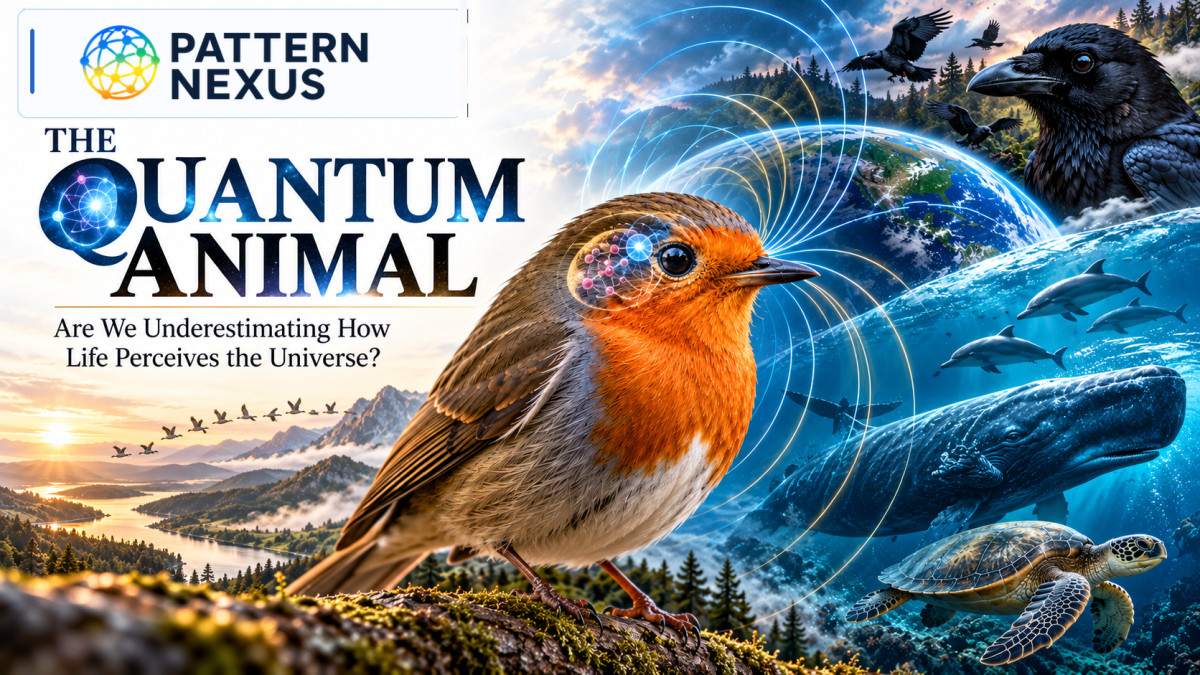
A robin may navigate with quantum-sensitive chemistry. Sea turtles remember magnetic locations. Crows transmit warnings across generations. Whales maintain social communication systems we are only beginning to measure. I follow the research, connect it to my earlier consciousness work, and ask what other sensory and…
Jump to a section
There is a European robin that may use quantum-sensitive chemistry to find its way across the planet. And that is only the beginning of this story.
I came across a post claiming a robin can detect Earth's magnetic field using quantum entanglement inside its eye. I expected a sensational headline. What I found was real science, a rather remarkable protein, and a much larger question about the animals we share this world with.
The research connects with years of questions I have explored about animal consciousness, whale communication, crows, intelligence, and the limits of human perception. I want to follow the evidence from a microscopic reaction in a bird's eye all the way through an ocean full of whale calls, then see what remains open to speculation.
The question running through all of it: what are other living things sensing and processing that we have never experienced ourselves?
Quick read: Robin cryptochrome 4 has shown magnetic sensitivity in a laboratory. Loggerhead turtles can learn magnetic-location cues. Bumblebees detect floral electric fields. Crows socially transmit knowledge about individual people. Whales and dolphins show structured communication and durable social memory. The possible connections among these abilities are the thought experiment—not a claim that quantum telepathy has been discovered.
Animals detect signals we do not naturally sense.
Light, magnetic fields, electricity, sound, and social memory can become biological information.
A proven sensory response is not proof of consciousness or a hidden communication channel.
How much of animal cognition remains outside the tools we use to study it?
01 · The ordinary thing that is not ordinary
The little bird that sent me down this rabbit hole
I came across a post about a robin, one of those little birds most of us have watched hopping through the yard without giving it much thought. The claim was that the bird has a quantum compass in its eye and can read Earth’s magnetic field. The post made it sound as though scientists are creating entangled particles in freezing laboratories while a robin does the same thing for free on a fence. I went looking into the actual work, and it is every bit as interesting as the headline—just more complicated.
We already knew many migratory birds orient using Earth’s magnetic field. What caught my attention was the possibility that the detection process depends on the behavior of electrons inside a light-sensitive protein. We are talking about quantum physics entering biology at a scale small enough to fit inside a cell, with a possible consequence large enough to guide an animal over an entire continent.
I want to begin there and bring you along through several other animals. By the end, we will be in the ocean with whales, looking at crow networks, questioning the way we measure intelligence, and asking how many signals are passing through our environment that we have never learned to recognize.
There was another problem with the post that I did not want to carry into the article. The research animal is the European robin, Erithacus rubecula. An American robin, the kind many people in the United States watch crossing their lawns, is a different species, Turdus migratorius. Both are birds, but that does not give us permission to transfer a specific protein experiment from one animal to another as if species names did not matter. The original post called attention to a real discovery. The scientific paper is where I wanted to start.
The more I followed the research, the more it intersected with something I have been writing about for a while: we keep evaluating other forms of intelligence using the information and experience available to a human being. We know that the world contains signals we cannot detect without instruments. We know animals do not all use the same senses. And now we have experiments showing biological systems detecting some of those signals at scales that run all the way down into quantum chemistry.
I do not want to turn that into a claim that everything in nature is quantum entangled or that a crow is secretly using a wireless network. That would be easy, and it would skip the interesting part. I want to understand where an ordinary chemical reaction becomes useful information, how an animal turns information into behavior, and what that tells us about minds we barely know how to study.
A robin’s quantum-sensitive protein is a real research finding. A complete demonstration that a living robin navigates by quantum entanglement is not. We can respect that boundary and still explore how extraordinary the evidence is.
02 · Building the baseline
We only experience a fraction of the signals around us
You probably learned about sight, sound, touch, smell and taste. Even that familiar list leaves out balance, body position, temperature and internal bodily sensing. We simplify sensory experience into categories because that is easier to explain. Nature is under no obligation to stop at the categories we chose.
The Earth has a magnetic field. We can measure it with instruments, and a compass needle responds to it. It is weak compared with the powerful magnets people use in a workshop, but it is present over enormous distances. Its strength and angle differ by location. Sound travels through water. Electrical charges shape tiny fields around flowers. Light has polarization and wavelengths outside what our eyes perceive.
Animals encounter all of this. Natural selection only needs a useful physical effect and a biological mechanism capable of taking advantage of it. A sensory system does not have to look like a human eye or ear to supply meaningful information to a nervous system.
Once you understand this, the question becomes much larger than whether one bird points north. What does the environment look like to an animal with access to another layer of information? Does direction feel like vision, like pressure, like instinct, or something we do not have an equivalent experience for? The research can often tell us what the animal does. It is much harder to tell us what that sensation feels like.
Think about what the word color means. It feels like a property that belongs to the object. Yet color is a perception built from light, receptors, and a nervous system. An animal sensitive to ultraviolet light may discriminate patterns on flowers that we never see. A shark following an electrical signal, or a bat assembling a moving world from returning echoes, does not need to operate inside our familiar picture of the environment.
The world has not changed between those observers. Their access to it has. A human walking through an empty meadow and a bee approaching the same flowers occupy the same physical location. They may be extracting quite different information from that location. Once you understand that, I think the idea of an additional magnetic sense becomes less outrageous, even if the quantum chemistry remains complicated.
Our senses are not a master list of reality. They are one biological interface with it.
03 · Quantum chemistry without the physics lecture
The quantum chemistry inside a bird’s eye
The important protein is called cryptochrome. Think of a protein as a microscopic machine built from molecules. Some cryptochromes respond to light. One version, cryptochrome 4 or CRY4, has been studied in the European robin. When light-driven chemistry happens inside it, electrons can form what physicists call a radical pair.
An electron has a property called spin. It is not a tiny basketball literally rotating; it is a quantum property that helps determine how electrons behave together. Inside a radical pair, the joint spin state can change over a very short period of time. A weak magnetic field can alter the probabilities of what chemical reactions happen next. If the animal can turn those probability changes into a biological signal, the direction of the field could become useful information.
That is the proposed chain: light activates a molecule → a radical pair forms → the magnetic field influences quantum spin dynamics → different chemical outcomes may be read by a sensory pathway. A picture of two glowing marbles tangled together in the bird’s eye is not an experiment. It is an illustration of a theory. The real effect is in chemistry and probabilities, not in a visible beam of energy.
In 2021, researchers isolated robin CRY4 and showed it responded to magnetic fields in controlled laboratory experiments. They also compared it with CRY4 from chickens and pigeons. The migratory robin version was more magnetically sensitive under the tested conditions. That is significant evidence for a candidate mechanism, but it did not record a robin’s visual experience or prove that entanglement is its operational compass in the wild. [1] [2] [3]
The word entanglement belongs in the scientific discussion because correlated electron states may occur in these systems. But scientists still debate exactly which quantum effects persist, how long they matter, and how a change in the protein reaches a nerve circuit that controls migration. The animal does not need a large-scale quantum computer. It needs a molecular response that biology can amplify into behavior.
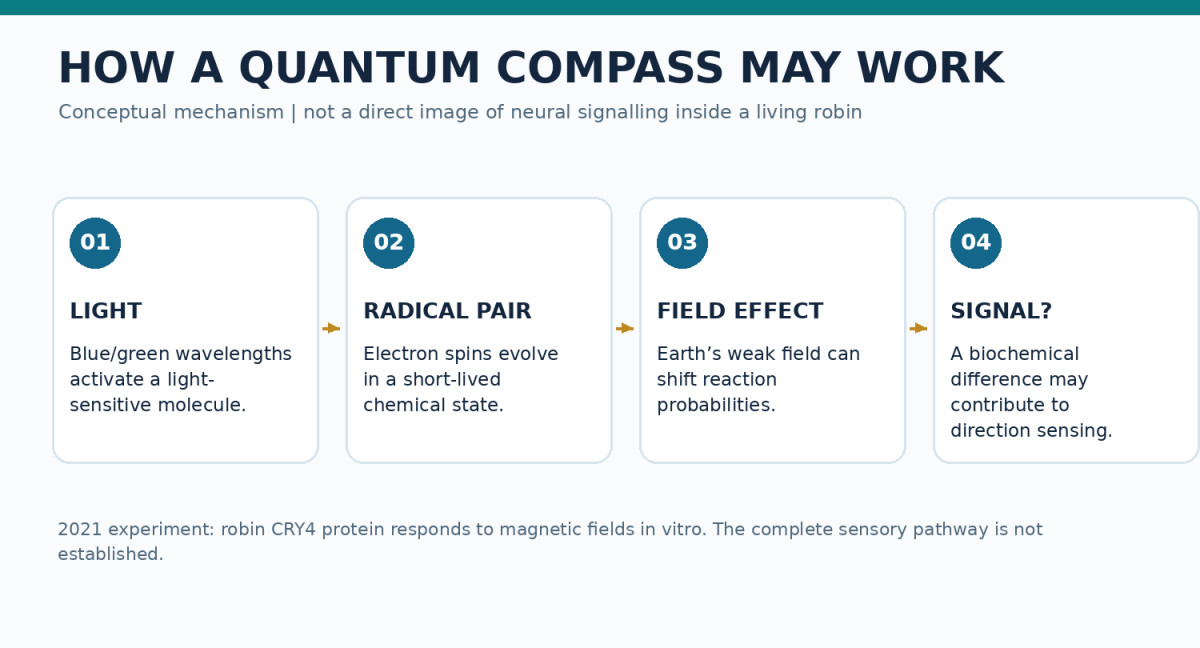
Here is a simpler way to picture the physics. Imagine two molecular pathways that do not quite have the same odds of happening. Most of the time the difference is extremely small. Now imagine that a weak magnetic field changes those odds depending on how the molecule is aligned. One reaction may become a little more likely while another becomes a little less likely. Repeat that process through enough molecules, and biology might be able to measure the difference. The signal is not a glowing compass needle inside an eye; it is a tiny shift in chemistry that can, in principle, be converted into a message for the nervous system.
That still leaves hard questions. Which cells actually contain the relevant protein in the right arrangement? How is its orientation maintained? Which chemical products change when the bird turns its head? Where does that information enter the brain? Is the response robust enough under normal light and environmental noise to guide a living bird? A good laboratory result identifies a serious candidate. It does not answer every step between molecule and migration.
People often hear quantum and imagine something exotic happening only inside a research laboratory. The laws of quantum mechanics underlie ordinary chemistry. What makes the robin candidate unusual is that the details of electron-spin behavior may provide usable directional information even in the weak magnetic field surrounding Earth. That is the claim worth understanding, without making the jump to long-distance entangled minds.
There is a difference between detecting magnetic sensitivity in an isolated protein and identifying the whole sensory pathway inside a living animal. The first has been shown. The second remains active research.
04 · A compass is not necessarily a picture
What would it actually feel like to have a compass?
I keep thinking about how we explain this using our own experience. Imagine looking across a forest and seeing familiar trees and colors. Now imagine that orientation information changes as you turn, not because of the trees but because the direction of Earth’s magnetic field changes relative to your body. You could be receiving a cue without ever seeing an arrow labeled NORTH.
An inclination compass can distinguish the orientation of magnetic field lines relative to gravity or the ground. That is not identical to the needle of a pocket compass, which points toward magnetic north. Some bird magnetic-compass experiments show dependence on light conditions and disruption under carefully controlled oscillating electromagnetic fields. Those results are part of the evidence supporting a radical-pair explanation. [2] [3]
Researchers have suggested visual modulation or some other kind of biological signal. We should not pretend we know whether a robin sees a pattern superimposed on the landscape. Its subjective experience is unknown. Still, try to imagine having access to direction in a way that never required pulling a phone out of your pocket. I think most people would call that remarkable.
Even the word see may be misleading here. Suppose the bird does not literally see a colored map floating across its vision. Suppose a change in head angle makes one part of the visual scene subtly more or less informative. Or suppose the magnetic response changes an internal signal that is then combined with familiar landmarks. Several explanations are plausible; we do not yet have a completed account of the experience. I find that uncertainty more interesting than a drawing that pretends we know what the bird sees.
Navigation also takes more than one input. Birds can use sun position, stars, landmarks, odor, and magnetic orientation, with different cues weighted differently depending on conditions. The remarkable accomplishment is not just possessing one sensor. It is bringing several imperfect signals together and getting somewhere useful, sometimes after traveling a distance that most of us would not attempt without a map, a phone, and a vehicle.
05 · A CONNECTION TO THE SUN
The Sun can disturb the compass the bird is trying to use
There is another piece of research that connects this directly to some of the space-weather work I follow. Earth's magnetic field is not an unchanging grid drawn across the planet. The Sun drives the solar wind, and disturbances in the near-Earth environment can temporarily alter geomagnetic conditions. Instruments detect those changes. Migrating birds are moving through the same changing environment.
A 2023 study in Proceedings of the National Academy of Sciences combined weather radar data with magnetometer measurements to investigate night migration during geomagnetic disturbances. The researchers reported fewer birds migrating during strong disturbances and evidence consistent with greater navigation difficulty under some conditions, particularly overcast autumn skies. Another 2023 study analyzing roughly two million banding records across many species found an association between geomagnetic disturbances and increased occurrence of some migratory birds far outside their usual routes. [25] [26]
I find that fascinating because it reaches from activity originating at the Sun to behavior of animals traveling across Earth. The papers are observational, with substantial controls, and the results are not a demonstration that every disoriented bird is being affected by quantum entanglement. But they are evidence that the magnetic environment is biologically relevant in the real world.
Think about how we normally divide these subjects. A physicist studies the Sun and Earth's magnetosphere. A biologist studies migration. A chemist studies a protein. A neuroscientist studies sensory input. The animal brings all of these layers into one operating system without knowing what any of our academic categories mean.
Solar activity → geomagnetic disturbance → a changed navigational environment → measurable changes in bird migration. That is a research-supported systems connection. The complete molecular pathway is still under investigation.
06 · The 2025 experiment that changed the conversation
A sea turtle can learn an invisible location
Now move from a bird crossing land to a young loggerhead sea turtle crossing the ocean. These animals travel across enormous stretches of water and can return to familiar feeding areas. In open ocean there are no highways, road signs, or convenient landmarks. Currents, smells, waves and other cues can help, but the magnetic environment itself contains geographic information.
Earth’s magnetic field has both a strength and an angle that vary across the globe. Particular combinations can serve as location cues. Researchers had suggested for decades that turtles learn these magnetic signatures, almost as though they are recording landmarks we cannot see.
In a study published in Nature in February 2025, researchers exposed young loggerheads to magnetic fields that simulated different ocean locations and associated one of those fields with food. The turtles later showed distinctive anticipatory behavior in the rewarded magnetic environment. They had learned a magnetic signature. That is not merely pointing north. It is associating a geographic-style field pattern with an experience. [4] [21]
The experiments were especially interesting because a radio-frequency treatment disrupted the magnetic compass response without disrupting the learned magnetic map response in the same way. The authors argued the results indicate at least two distinct magnetic-sensing mechanisms: one connected to compass orientation and another to map-like learning. The exact receptors remain to be identified.
Imagine what that means. The turtle may have sensory information comparable to a direction indicator and location-associated memory, but its maps need not be drawn in pictures as ours are. A biological system can solve a navigation problem without using the same representation a human engineer would design.
What I like about the turtle experiment is the design. The researchers did not simply track a turtle that swam in the right direction and infer that magnetism had to be responsible. They put young turtles in controlled magnetic environments that simulated locations elsewhere in the ocean. Food appeared consistently in one of those environments. Later, when food was absent, the turtles showed the characteristic anticipatory behavior in the rewarded magnetic field. The field itself had become associated with an experience.
That is learning. It does not prove that a turtle remembers a coastline the way we remember a photograph. It shows that a magnetic signature can be part of what the animal remembers about a place. It also gives researchers a controlled method for asking the next questions instead of relying entirely on migration tracks and assumptions.
Then the experiment separated the two functions. A radio-frequency magnetic treatment interfered with compass orientation but did not eliminate the learned location response. Two functions that sound like one human word, navigation, may rely on different sensory mechanisms. There may be one biological system for direction and another for the magnetic character of a place. We are still trying to identify the receptors.
In 2025, the turtle study demonstrated learned magnetic-location cues, not merely an inherited north–south response. That gives the story a direct connection to learning and memory.
07 · Other invisible signals are not rare exceptions
Flowers have electric signatures. Bees can read them.
Consider a monarch butterfly. Its autumn migration can carry it thousands of kilometers. Researchers have demonstrated that monarchs use a light-dependent inclination magnetic compass in controlled flight-simulator experiments, alongside an established time-compensated sun compass. Their antennae appear to be important to the magnetic response. Again, biological navigation is combining channels of information we separate into different subjects in a classroom. [5]
Then take a bumblebee approaching a flower. It does not have to make its decision using color and scent alone. Experiments showed bumblebees can learn differences in the weak electric fields around flowers. A visiting bee can alter those fields. To us the flower looks nearly the same a moment later; to a bee, there may be additional information about the visit and possible reward. [6]
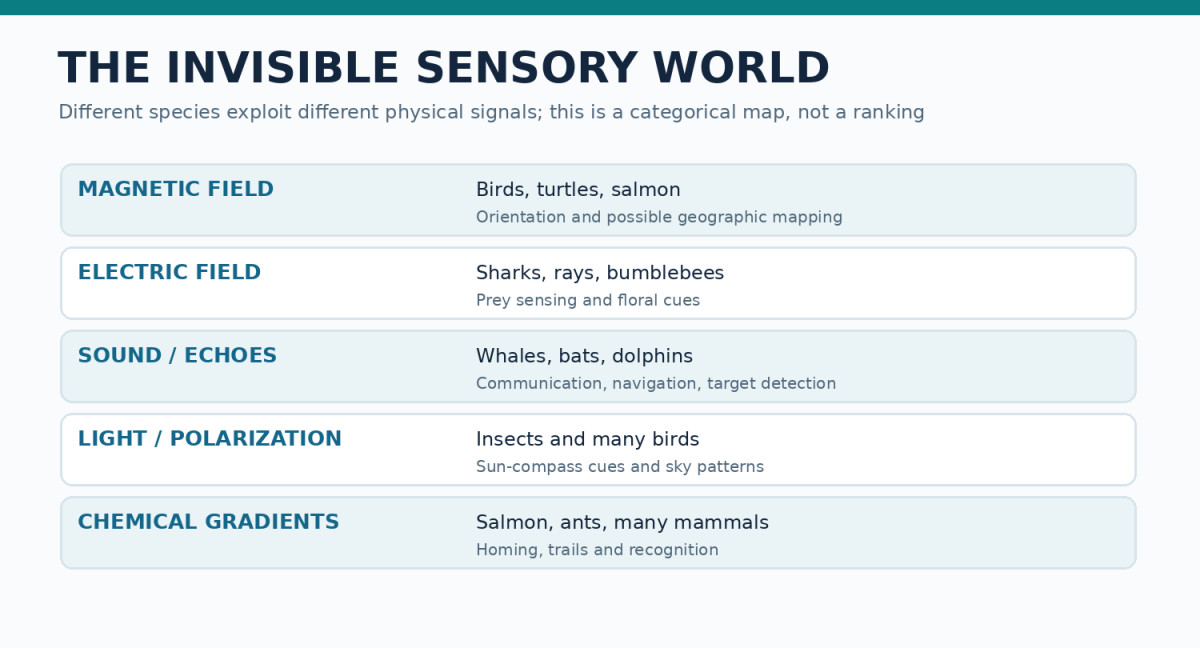
Sharks and rays sense weak electrical signals produced by other animals using specialized electroreceptive organs. Bats and dolphins use echoes to find and identify things around them. Fish and other migrating animals can integrate chemical, magnetic, celestial and mechanical cues.
I am not saying these are all quantum systems. They are not. A flower’s electric field, an ocean sound wave, a magnetic field and a radical-pair reaction are different physical mechanisms. What connects them is our tendency to undercount what another animal can perceive because we do not perceive it the same way.
The bee experiment offers another way to think about invisible information. An electric field does not have to carry a complex conversation to be useful. If it changes after an insect visits a flower, another insect may be able to use that change alongside scent and color. It can provide an extra clue about where food may be available. The same environment contains information that we would never recognize just by looking at it.
The platypus is another example that I think belongs in this discussion. It can detect electrical activity associated with prey in water. Its bill is not a human hand, nor is electroreception a human eye, yet it supplies information. Electric fish generate or sense electric fields. Sharks and rays can detect weak bioelectric signals. These are not all the same sense and they are certainly not all proof of quantum entanglement. They are examples of what happens when evolution encounters a physical signal and develops a way to use it.
08 · A WORLD WE FILTER
A few more animals make the problem impossible to ignore
Electric fish can detect disturbances in electrical fields around them and, in some species, produce electrical signals for orientation and communication. Bats receive returning echoes and construct useful information about movement and distance in darkness. Pit vipers use infrared-sensitive organs to detect thermal radiation. Many insects see ultraviolet patterns we cannot see without a camera. A compass is one example in a much larger family of nonhuman sensory capabilities.
I am not using these examples to create a universal ranking. The bat is not more intelligent than a person because it can echolocate, just as a person is not more intelligent than a bat simply because a person can read a book. The tasks are different. So are the inputs. A successful animal is usually combining whatever information helps it survive in its environment.
Our instruments can extend our own senses, but we typically experience the output through a familiar interface. We might see ultraviolet radiation displayed as visible colors on a screen. We might see a geomagnetic disturbance plotted as a line on a graph. That is a translation for humans. It tells us something about the signal, but it does not reproduce the animal's subjective experience of detecting it.
This is a recurring idea from my earlier work on consciousness: the model we construct to describe reality is not reality in its entirety. It is a tool for understanding a slice of it. Other organisms have developed different tools, and the information they retrieve changes what they can learn.
09 · Information without a human internet
The crow network is already real
In my earlier consciousness article, I spent a lot of time discussing crows because they are too intelligent and socially organized to dismiss as ordinary background wildlife. A crow can recognize a particular human face. More importantly, information about a dangerous face can spread to other crows that never experienced the original encounter.
One well-known research program used human masks during crow trapping. Wild crows learned to respond to the dangerous mask and not to neutral masks. Other birds learned socially by watching and hearing nearby crows; young birds also learned from their parents. In one experimental population, scolding spread at least 1.2 kilometers over five years. That figure comes from a measured study, not a claim that crows send information around the planet overnight. [7]
For me, that is already a living information network. It has memory, social links, recognition of individuals, threat classifications and the ability to transfer knowledge across generations. We did not build it. We only began measuring portions of it.
Now add a 2024 laboratory finding: crows could deliberately produce one, two, three or four calls in response to trained numerical cues. Properties of the first call predicted the total number of calls the crow intended to produce. That is a connection among quantity, planning and vocal output. It is not just random noise. [8]
And a 2025 field study equipped wild carrion crows with tiny recording devices. With AI-assisted analysis, researchers identified more than 127,000 adult focal vocalizations, including many soft calls that conventional listening would easily miss. A magnetometer inside the recording equipment measured motion/orientation; that does not establish that crows themselves were communicating magnetically. It demonstrates how much we can miss when our microphones and observation methods capture only the loudest part of an animal’s behavior. [9] [20]
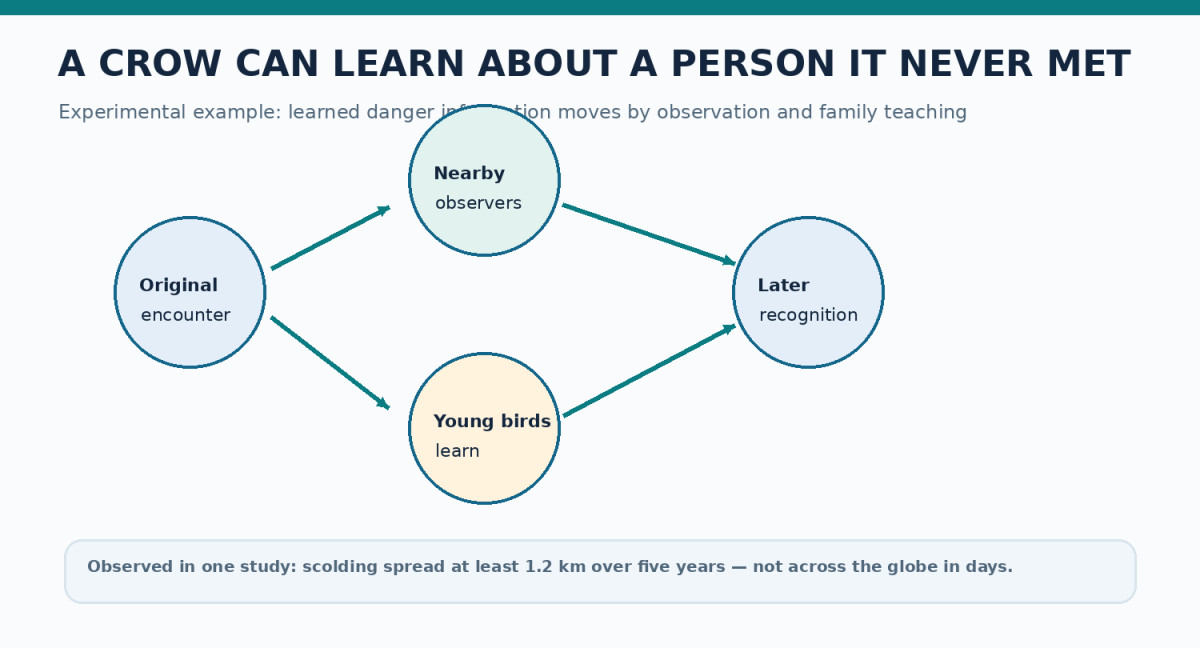
The first thing I think about with crows is not a single clever bird solving a puzzle. It is the group. One bird has an experience. Another bird witnesses the reaction. A younger bird later learns what to do without living through the original event. The information has survived the first encounter and moved into other individuals. That is a network in the functional sense: observations pass through social connections, and the collective retains usable knowledge.
Now imagine our understanding of that network being based on the small number of calls we can hear while standing nearby. We would miss soft calls, movements happening behind trees, quiet contacts between familiar birds, and events at times when nobody is there to watch. The modern biologger work begins to change that limitation. One study recorded more than 127,000 detected vocalizations from free-living carrion crows using lightweight instruments, and the devices also logged movement and other physical data. That is a huge increase in the resolution of observation. It is not a decoding of the entire crow language.
There is a tendency to take a finding like this and turn it into a story about crows transmitting names for humans across the planet in days. The underlying mask experiment established social learning and spread of a danger response over measured distances and years; it did not establish a worldwide crow communications system. I still think the real result is extraordinary. It shows information about a particular person becoming community knowledge.
A crow does not need to have seen you do something to learn that you are dangerous. Other crows can supply the information. That is a form of distributed social memory.
10 · Where I deliberately start speculating
How far could the crow network go?
This is where I want to ask something that has not been established. We know the vocal, visual and social components of crow information sharing exist. We know some other animals detect magnetic fields or electric fields. Is it possible that crows, or other highly social birds, also integrate environmental information that our current observations are not capturing? Could a shared sense of direction, changes in weather, pressure, light or other physical signals help a social group coordinate?
I think that is worth investigating. But I do not want to make the scientific leap from some birds can detect magnetic fields to crows communicate information through Earth’s magnetic field. Those are different claims. A compass gives you a reference. Sending a message requires a modulated signal, a transmitter, a receiver and evidence of information transfer. Earth’s background field is not automatically a bird-to-bird telephone.
If I were designing a research program, I would begin with synchronized acoustic recorders, GPS and motion trackers, environmental sensors, controlled playbacks, and safe magnetic-cue manipulations. The objective would be to ask whether coordination remains unexplained after known visual, acoustic, social and atmospheric cues are accounted for. If a new effect appeared, scientists could then try to isolate it.
I see a real opportunity for machine learning here. It can align tens of thousands of calls with individual identity, movements, interactions and environmental measurements. It can expose associations a person listening to a few recordings might never notice. But prediction is not translation, and a correlation between two signals is not evidence of an unknown communication channel.
I want to be precise about the word network. We already have good evidence for social connections, warnings, visual recognition, memory, and learning. That is enough to use the word responsibly. My speculation begins when I ask whether synchronized environmental cues help different birds coordinate the timing or direction of their responses, or whether there are quiet acoustic patterns we have not properly linked to behavior.
Could crows use the magnetic environment as one of several orientation references? It is a question we could investigate. Could they send detailed messages directly through the background geomagnetic field? No experiment I found establishes that, and sensing a field does not mean an animal can modulate it into a message for another individual. What I would test first are the simpler missing layers: soft calls, visual sightlines, air-pressure change, habitat, individual relationships, and the order in which birds join an event.
The network hypothesis becomes useful when it produces a prediction. If a bird responds before a known call could have reached it, is there a line of sight, an earlier quiet call, or a shared environmental change? If not, repeat the observation under controlled conditions. A new physical communication channel would require repeatable evidence of a transmitted signal, its receptor, and the information being carried. I do not see a reason to declare an unknown mechanism before that work has been done.
My hypothesis: the information available to a social animal may be richer than the individual calls and gestures we currently catalog. Testing that does not require assuming a quantum social network in advance.
11 · The whales change the scale of the problem
Whales live inside an ocean of information
Move into the ocean and the entire communication environment changes. Sound travels through water differently from air, often over very large distances depending on its frequency and ocean conditions. Visibility can be limited. Whales and dolphins live in a world where sound is central to orientation, group relationships and information exchange. They have evolved ways of doing things that would make little sense if you measured them against human speech at conversational distance.
Humpback whales learn elaborate songs socially, and song styles can spread between populations. Researchers have documented the transmission of song types between groups in the Pacific. In 2025, another study analyzed eight years of humpback songs and reported language-like statistical structure associated with repeated, culturally learned units. That is not a demonstration that whales speak human language. It is evidence of organized learning and structure that our older, simpler descriptions missed. [14] [15]
This interests me because the information is not only in the immediate sound. It is also in a population’s memory and in changes that move across groups over time. A song can be learned, altered and passed onward. That begins to resemble culture, not merely an animal making noise.
The ocean adds an unusual property: depending on sound frequency, temperature, depth, and other conditions, some sounds travel far beyond the distances we associate with ordinary conversation. Low-frequency calls can propagate through layers of water in ways that make a large ocean basin an acoustic environment. But the ocean is noisy, complicated, and changeable; there is no single distance that defines every whale call.
When I wrote about whales in my earlier consciousness article, I was interested in the lives occurring inside that environment: relationships, learned traditions, shared hunting methods, and the possibility that a population carries culture across generations. If one group of humpbacks changes its song and a neighboring population eventually adopts aspects of that song, we are watching social transmission on a scale far larger than one individual encounter.
The word culture should not be reserved only for a human library or an institution. When information or behavior is learned socially and persists or spreads through a population, scientists have a reason to investigate cultural transmission. That is what the humpback and orca studies bring into the conversation. These animals are not merely reacting to the immediate environment. They are responding inside social histories.
12 · Clicks, timing, structure and a 2026 finding
We have been undercounting the structure of whale communication
Sperm whales communicate through sequences of clicks known as codas. In a 2024 Nature Communications paper, researchers studying thousands of codas found a more complex system than previously described. They identified combinations involving rhythm, tempo and context-sensitive variations, including forms they called rubato and ornamentation. The signals were modified and imitated during exchanges between whales. [11]
In April 2026, researchers reported another layer: patterns in sperm whale codas that show vowel-like acoustic qualities and several organizing properties resembling aspects of human phonology. No, that does not mean the whales speak English underwater. It means the structure of their vocal system appears far more elaborate than a list of identical clicks. [12]
Another 2026 study looked at the extremely slow, loud clicks produced by male sperm whales. Modeling suggested some of these signals could remain detectable over an active range of up to about 70 kilometers under the studied conditions. The proposed communicative function remains open, and sound range is not equivalent to proving a completed conversation at that distance. Still, consider the physical scale. A signal made by one living organism can travel an enormous distance through the ocean. [13]
What we still do not know is most of the meaning. We can begin breaking down timing, social context, repeated patterns and responses. That is the equivalent of recognizing punctuation and syntax in a foreign system before you understand the words.
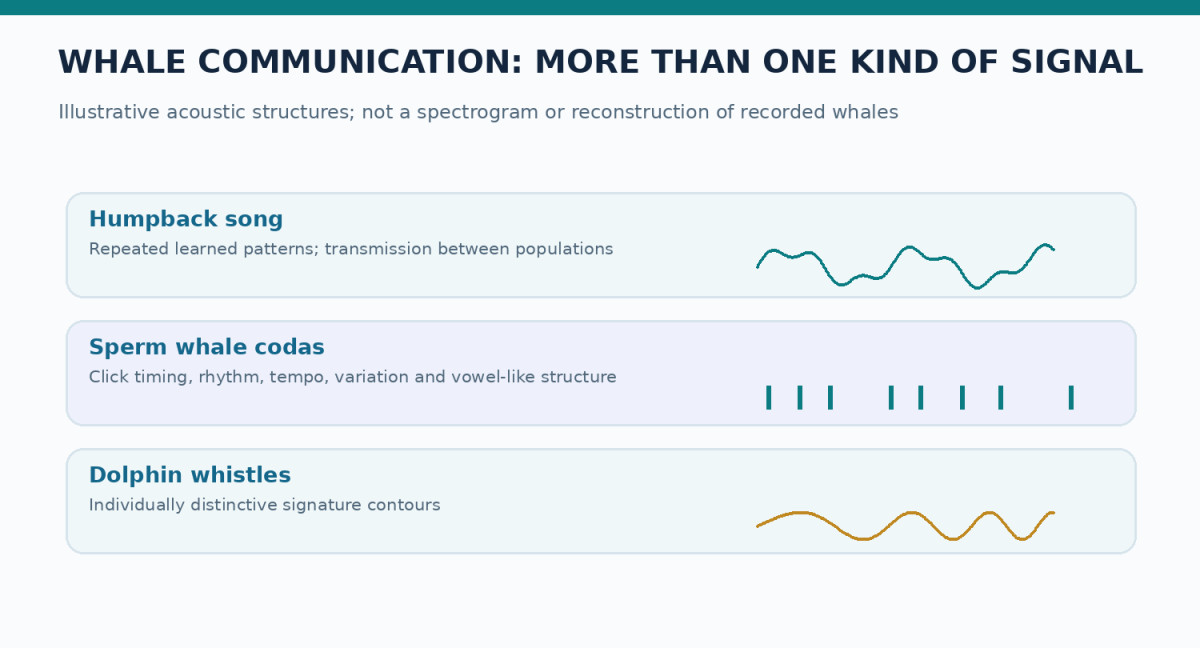
Consider what would happen if we listened to an unfamiliar spoken language but only counted how many sounds occurred in a sentence. We might conclude that one speaker made three noises and another made five. We would miss timing, stress, changes in sound quality, the identities of the speakers, and the way one utterance changed when another followed it. I suspect we have made versions of that mistake when approaching nonhuman communication.
The 2024 sperm-whale study described a repertoire of rhythmic and timing changes, some of them linked to conversational context. The 2026 paper went further by studying acoustic qualities that resembled aspects of vowels: distinctions in sound quality, duration, and influences between neighboring sequences. They did not publish a sperm-whale dictionary. They demonstrated structure that had not been adequately described by the older click-counting categories.
To me, this is the exciting part of machine learning and modern sensing. It does not require us to pretend that a model can suddenly ask a whale how its day went. It lets researchers identify repeatable structure, link individual sequences to behavior, and design experiments to see what a signal accomplishes. Every confirmed piece makes the next question more focused.
In the whale research, the measurable complexity is increasing faster than our ability to assign meaning. A limited human dictionary should not be confused with a limited animal communication system.
13 · Intelligence is not just a test score
Belugas, orcas, and dolphins belong in this conversation
I do not want to limit this to the species with the best headline. Beluga whales maintain complex social relationships and vocal communication. Orcas exhibit stable social cultures, learned foraging strategies, cooperation and behaviors passed through populations. Humpbacks sing, sperm whales click, belugas call, and dolphins use a range of sounds and behaviors. There is no reason to expect all of them to solve their problems in the same way.
Bottlenose dolphins develop individually distinctive signature whistles. Playback studies indicate these sounds can function as identity labels. In another study, dolphins recognized the signature whistles of former associates after separations of more than twenty years. Think about the memory involved in recognizing an individual you have not encountered for decades. That belongs in any serious conversation about animal minds. [16] [17]
The U.S. Navy has long trained dolphins for tasks such as locating underwater objects. Its own Marine Mammal Program describes their ability to find underwater mines in difficult shallow or cluttered conditions. [24] We have also developed marine-mammal protections because human activity can interfere with their lives. We already rely on these animals’ capabilities and recognize that their welfare can be affected by what we do. Yet we still know remarkably little about their subjective experience.
A 2020 beluga study found social groups that include both relatives and unrelated individuals, rather than always being organized around a close maternal family. In 2025, researchers reported southern resident orcas making kelp pieces and using them with partners for mutual grooming. These details expand the picture beyond sound into bonds, learned behavior and deliberate manipulation of objects. [22] [23]
I find it strange that we will recognize a machine as intelligent because it solves a problem, but hesitate to take seriously the entirely different problem-solving and social systems built by evolutionary processes. Intelligence is not a single ladder with a human at the top and every other species arranged beneath us. Different environments produce different demands and different capabilities.
I have talked before about belugas because their social lives deserve more attention. They have an extensive vocal repertoire and complex associations among individuals. Their groups are not reducible to one simple family pattern. An animal forming durable relationships, cooperating, and exchanging information is participating in a social system even if we have never translated a complete conversation.
Orcas take that another direction. Different populations have learned feeding traditions, recognizable calling patterns, and different social arrangements. A 2025 report on southern resident orcas documented kelp pieces being used in mutual grooming. That is an example of tool-related behavior occurring in a social relationship, not merely a predator finding food. Humpbacks, sperm whales, belugas, orcas, and dolphins differ in ecology and behavior; I am grouping them because they reveal different dimensions of cognition and communication, not because every species possesses the same intelligence.
And dolphins have this remarkable feature: an individually distinctive signature whistle that can act as an identity cue. In an experiment, some dolphins responded to recorded whistles from former associates they had not encountered for more than twenty years. That is not a story about sound travelling for twenty years. It is a story about a remembered identity surviving across two decades. When I think about animal communication, that memory is every bit as impressive as a long-distance signal.
The Navy's use of trained dolphins to locate underwater objects also says something about our relationship to animal ability. We have engineered elaborate sonar systems, yet a living animal can do specialized underwater detection work by using capabilities evolved in its own environment. I do not use that fact to infer anything mystical. I use it to question the assumption that our tools and measurements exhaust what a species can do.
14 · THE HUMAN MEASURING STICK
I keep coming back to the way we measure intelligence
In my article A Thought Experiment: Consciousness, I asked readers to think about how much of our understanding of the world comes from the labels humans created. We put names on territories, objects, categories, and behaviors. Those labels help us organize life, but the world and the living systems within it did not wait for the labels to exist.
I returned to a similar problem in We Don't Even Understand How Humans Think. How Can We Understand Artificial Intelligence?. Two people can use the same language to describe their thinking and still be talking about vastly different internal experiences. One person may experience a running inner monologue. Another may work through spatial relationships, images, or structures that are hard to explain in sentences. Even within our own species, a simple test based on speech cannot tell us the entire form of a mind.
Now apply the same humility to a whale, crow, turtle, or bee. It does not follow that all four are conscious in the same way, nor that any one is secretly doing advanced mathematics. It does follow that we ought to ask what information they can detect, how their memory stores it, what choices they make, and what their social systems preserve before declaring that their behavior is simple because it is unfamiliar.
That is also why I think the quantum-biology research belongs beside the animal-intelligence research. The protein itself does not establish intelligence. It raises a question about the input. A nervous system can only process the information it receives. If different species have access to different parts of the physical environment, we should expect some of their behavior to be strange to observers who lack those senses.
15 · Separating perception, navigation, communication, and consciousness
Sensation, memory, intelligence, and consciousness are different questions
This is an important part of the story. I want to bring these subjects together without collapsing them into one claim. A molecule reacting to a magnetic field is not proof of awareness. An animal learning a location is evidence of memory and behavior, but it does not reveal exactly what that location feels like from the inside. Vocal complexity does not automatically establish a human-style language. And even demonstrated conscious experience would not imply quantum entanglement as its cause.
At the same time, science has moved beyond dismissing the possibility of animal consciousness. The 2024 New York Declaration on Animal Consciousness states that there is strong scientific support for conscious experience in mammals other than humans and in birds, and a realistic possibility in a broader set of vertebrates and invertebrates. That does not settle every philosophical issue. It changes what responsible inquiry needs to take seriously. [18]
I wrote about this in A Thought Experiment: Consciousness. I argued that a whale does not need us to understand its social world for that world to exist. A beluga does not need our language for attachment to matter. A crow does not need a human label before it can recognize one of us. All of that applies here, only now we have an additional question: how much sensory information feeds into those minds? [19]
Perhaps what we dismiss as instinct sometimes contains sophisticated processing of information that is simply inaccessible to our own senses. But I would not treat instinct and intelligence as mutually exclusive. Evolution can build inherited tools, and an individual can still learn how to use those tools in changing circumstances.
In the earlier article about how humans think, I described how differently people can experience their own thoughts. Some work through words; some through mental imagery; some through combinations of spatial relationships, memory, and other forms of representation. Even among human beings, the subjective experience of thinking is not one simple universal description. If we have trouble communicating those differences between members of our own species, imagine the difficulty of describing how another species integrates a magnetic field, echolocation, or a particular kind of social memory.
I am not arguing that an animal has the same thoughts as I do. I am arguing that the absence of human language is a poor test for whether a different cognitive system has information, memory, or experience. Behavioral experiments can measure some of those abilities. Whether and how subjective consciousness accompanies them requires its own careful study.
Perception is the input. Communication transfers information. Memory retains it. Cognition uses it. Conscious experience is a further question. They can interact without being identical.
16 · The thought experiment
Now imagine living in the same world with a different interface
Imagine a human, a robin and a sea turtle standing—or swimming—within the same magnetic environment. We are all inside the same physical universe. We are not necessarily experiencing the same part of it. The human may read an instrument. The robin may respond to light-dependent magnetic cues. The turtle may associate a particular magnetic signature with a place it has encountered before.
Then imagine a crow hearing calls from nearby family members, identifying faces and taking account of its group. Imagine a dolphin recognizing an individual from a whistle. Imagine a sperm whale processing a low-frequency signal through the ocean while simultaneously dealing with movement, social identity, and perhaps acoustic context we have yet to decode.
If the brain builds its useful picture of the world from the information available to it, then the picture must differ across species. I cannot directly inhabit a dolphin’s sonar experience any more than a dolphin can read a human financial statement. That does not make one of those perceptual systems empty or inferior. They evolved around different problems.
This ties back to a much larger thought I keep exploring: we have built our understanding of reality around the inputs available to a human observer. We then assume that whatever we cannot see, hear, or intuit must be peripheral to the story. But perhaps we are the ones with the narrow window.
Take this one step further. Imagine that our basic sensory world resembles a user interface. It is practical, familiar, and limited to information a human nervous system is capable of collecting and organizing. We build machines to open another window: a magnetometer for Earth's field, a hydrophone for underwater calls, a thermal camera for infrared radiation, and a high-speed sensor for a phenomenon too fast to see.
Then we discover that some organisms arrived at functional versions of those capabilities through evolution. The biological implementation is not necessarily the one we would have designed. A turtle's learned magnetic cue is not a screen displaying coordinates. A dolphin's echolocation is not a handheld sonar monitor. A bee's detection of floral electric fields does not require it to know what an electrical engineer means by voltage.
When I hear people dismiss these behaviors as just instinct, I think they are using a label where an explanation ought to be. Instinct may be part of a behavior, but it does not tell us how much information an animal collects, what it learns through experience, or how the system combines the two. Those are questions for experiments.
What if much of what animals are doing looks like instinct to us because we cannot sense the information they are responding to?
17 · No science fiction required
Quantum entanglement does not give us animal telepathy
We should come back to the original phrase, “quantum entanglement,” because it can take a discussion off the rails quickly. In quantum physics, entanglement describes particular correlations between the states of systems. It does not provide a free method for sending a controllable message faster than light. It does not mean that two animals automatically share thoughts because molecules inside them have quantum properties.
The robin research does not require distant birds to be entangled with one another. The proposed radical-pair chemistry takes place locally, inside molecular systems. Quantum coherence and possible entanglement are relevant to the physics being investigated; they are not evidence of an invisible inter-animal messaging channel.
If I speculate about unknown biological signals, I want an experimental prediction attached to the idea. What changes when a known cue is removed? Can an animal distinguish one field from another? Can a specific environmental signal be reproduced in a controlled setting and produce a repeatable change in behavior? Do we have a receptor, a neural response, and a mechanism? Without those things, we are writing possibilities, not claiming discoveries.
For me the reality is good enough: one ordinary songbird may be using quantum-sensitive chemistry to solve an everyday navigation problem. We do not have to attach unsupported telepathy to it to make it extraordinary.
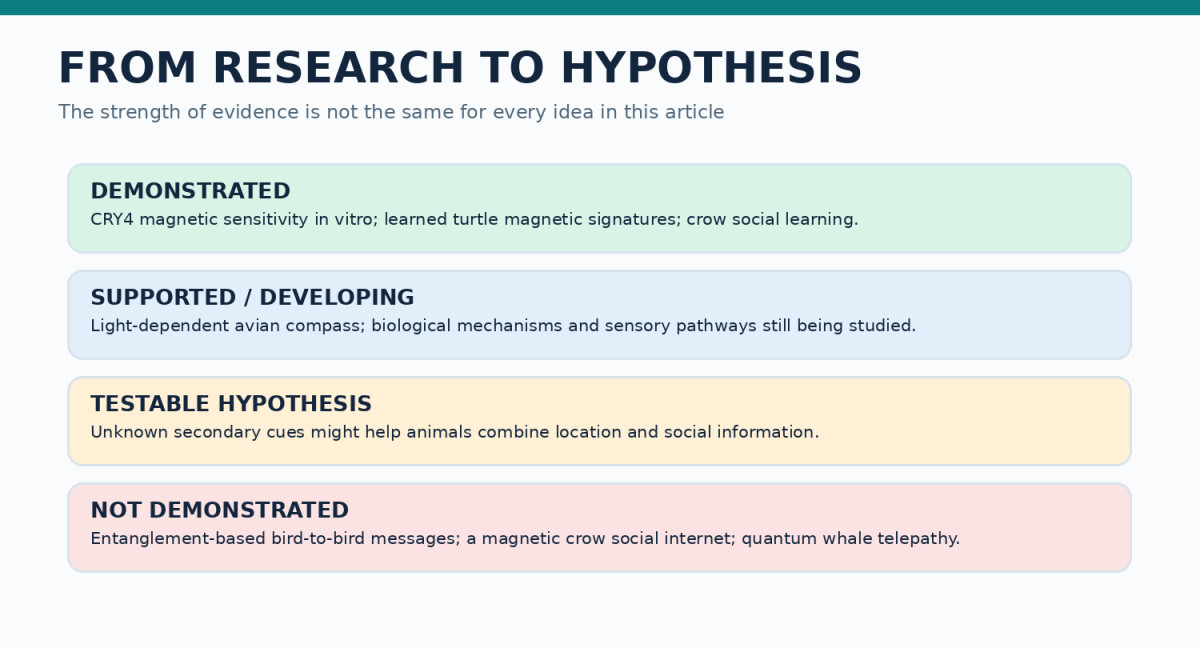
Quantum entanglement has a specific meaning in physics. It can produce correlations between systems that classical descriptions do not capture, but it does not let a robin send a controlled sentence to another robin without an ordinary communication channel. Molecular coherence can matter in a chemical reaction without an animal possessing anything like a human computer or an unlimited connection to other minds.
That does not mean every imaginative question must be thrown away. It means a hypothesis needs a physical mechanism and an observable consequence. If the crow network has a sensory layer we missed, we should be able to find some pattern of reception or behavior that survives tests against known explanations. If the robin's compass depends on a specific molecular spin process, experiments should isolate that process and follow the effects from chemistry to nerve activity to behavior.
18 · Turning curiosity into research
How I would investigate what we are still missing
Here are several questions I would put in front of researchers. First, can we identify exactly where the robin’s magnetic response enters the nervous system? That means connecting the protein, the field-dependent chemical outcome, the relevant receptor cells and the behavioral decision. This is the missing bridge between a compelling molecule and a complete sense.
Second, can the turtle’s learned magnetic map be linked to specific biological receptors and to memory circuits? The finding that map and compass respond differently to interference opens a particularly interesting path. The navigation system may have multiple components that can be separated experimentally.
Third, can we reconstruct the conditions under which crow warnings spread through a real social group? Identify the original witness, the bird carrying the information, the acoustic or visual signal, the receiver and the timing. Then test whether there are residual environmental factors helping coordination. That would reveal more of the network without presupposing a magical mechanism.
Fourth, can long-duration whale and dolphin recordings be matched to the exact individuals, activities and outcomes? Not just what a click sounds like, but who produced it, who answered, what happened next and whether the same sequence has a reliable function in multiple contexts.
Fifth, can AI recognize stable patterns across these systems without mistaking statistical regularity for meaning? A model can discover clusters. To assign semantics, researchers need controlled predictions and behavioral verification. Otherwise, we risk building an impressive-looking translation interface that is really just guessing.
Finally, can we compare sensory diversity and forms of intelligence in a way that does not use human speech or human problem-solving as the only standard? What information does a species detect, what does it remember, what can it communicate, and how does it change its behavior based on experience? That would be a much richer framework than handing every animal the same puzzle and ranking them by the answer.
There is a reason I like putting these ideas into the same article rather than treating them as unrelated science headlines. Each one has a measurable interface between an animal and its environment. The robin has a candidate chemical response. The turtle has learned magnetic conditions. The bee discriminates electric patterns. Crows transmit learned information socially. Dolphins retain the identity associated with a call. Sperm whales produce structured acoustic sequences. The next generation of research can begin connecting the environmental input, the biological receptor, the individual's history, and the eventual decision.
A proper experiment on crow coordination would have synchronized microphones around the nesting area, video from several directions, individual identifiers where feasible, and local measurements of wind, pressure, light, and electromagnetic variation. It would model which crows could hear or see which other crows at each moment. The test would not assume an unexplained field was involved. It would ask what the ordinary channels can account for and what is still left over.
For whales, researchers need long-running recordings with identification of the animals, social relationships, movement, and behavior. A pattern in the data should predict something observable. Does a particular sequence occur before a group reunites? Does one animal produce a response after another individual's call? Can a change in the acoustic structure alter the behavior of a listener in a carefully controlled playback? Those are more powerful results than an AI tool supplying an unverified human translation.
19 · WHAT WOULD COUNT AS EVIDENCE
How I would separate a discovery from a good story
There is a straightforward way to keep this investigation moving without turning it into an unsupported belief system. Put every claim on an evidence ladder. Start with a reproducible behavior. Identify the cue the animal responds to. Find a receptor or physical mechanism. Show the effect in the nervous system. Finally, demonstrate that the mechanism changes real behavior under the conditions in which the animal normally lives.
Not every question is at the same point. Crows socially transmitting a response to threatening faces is established by controlled behavioral work. The robin's CRY4 is magnetically sensitive in laboratory conditions, while the full in-vivo route remains unfinished. A hypothetical magnetic crow-to-crow message has none of that experimental chain. Treating those as equivalent would throw away the value of the research.
I would also insist on replication, enough individual animals to rule out convenient anecdotes, and research designs that can tell competing explanations apart. If an animal changes direction during a geomagnetic disturbance, did the field cause the response, or did weather, cloud cover, seasonal timing, or another factor move with it? If a whale sequence predicts a social event, does the pattern hold on new recordings from another population? If an AI model labels a crow call, can an experiment verify the label?
Speculation is useful when it produces a question somebody can disprove. It becomes less useful when every possible result is interpreted as confirmation. I want the research to lead, even when the outcome is less dramatic than the original idea.
20 · Research, technology, ecosystems, and responsibility
The consequences reach beyond biology
For biologists and physicists, understanding these mechanisms could identify new principles of sensing and information processing. An electron-spin-sensitive chemical reaction in a protein is a remarkable area of quantum biology. But practical engineering applications should be described as possibilities until an actual device demonstrates them.
For AI researchers, large-scale animal recording is opening a new field of analysis. We can detect quiet calls, match sound with movement, and study communication across longer periods. The challenge is verifying what a discovered pattern does, not just teaching a model to put an English word next to it.
For conservation scientists, shipping operators, infrastructure planners and policymakers, understanding animal sensing has immediate stakes. Noise can disrupt communication, artificial lighting can alter orientation, and some human-generated electromagnetic environments may interact with particular species’ navigational systems. Effects depend on the species and field conditions; they require measurement, not blanket claims. The same is true for fisheries, ocean transportation and habitat fragmentation.
For everyone else, there is a simpler point. Look at how much technical effort we invest in recreating basic abilities that living organisms have been refining for millions of years. Navigation, communication, distributed learning, pattern recognition and sensor fusion are not exclusively human inventions. Nature has been working on them far longer than we have.
I do not think we should romanticize every species or pretend all behavior is unexplained genius. I think we should give the evidence enough attention to notice how sophisticated some ordinary living systems already are.
There is also a conservation angle I do not think we should leave out. If an animal relies on acoustic cues, vessel noise can alter its ability to detect those cues. If a migratory species uses natural light and magnetic information, changes to those environments may affect its behavior. If a species depends on learned pathways, the loss of experienced animals may take knowledge with it. Technology, shipping, habitat changes, and ecological management interact with systems we do not completely understand.
Those effects should be evaluated case by case, not treated as a blanket claim that every electromagnetic source is harming every bird. Some disturbances matter under particular conditions; others may not. Getting the mechanism right makes conservation better, because it tells us which interventions are likely to work.
As a builder and a person who studies systems, I keep coming back to how elegant some of these biological solutions are. We spend enormous resources measuring weak fields, coordinating distributed information, improving pattern recognition, and designing autonomous navigation. Organisms in the natural world have faced versions of those same problems for millions of years. They did not solve them with our hardware, but they still found working solutions.
EVIDENCE CHECK
What we know and what I am proposing
Some of these claims are observations that researchers can reproduce. Others are candidate explanations for observed behavior. Others are my own questions. I want them visible side by side rather than blended into one extraordinary-sounding statement.
| Subject | Supported observation | Remaining question |
|---|---|---|
| European robin | CRY4 protein magnetically sensitive in vitro; bird migration can use light-dependent magnetic orientation | Exactly how molecule-to-brain navigation works in living birds |
| Loggerhead turtle | Can learn geographic-style magnetic signatures in experiments | Which receptors support map learning and compass orientation |
| Crows | Socially transmit recognition of dangerous human faces and produce extensive vocal signals | How complete is the acoustic, visual, and environmental coordination network? |
| Sperm whales | Codas have structured, context-linked acoustic variation | What meaning is carried by particular sequences? |
| My additional-field hypothesis | Not yet demonstrated | Can any unexplained coordination survive tests of known channels? |
21 · Where I want to leave you
We are one species inside a much larger system
The bird in the yard was never simply a bird in the yard. It was an animal integrating light, position, memory, movement and perhaps quantum-sensitive chemistry as it navigated a world we occupy alongside it.
The sea turtle may know something about geographic location through magnetic cues that we need instruments to detect. Crows learn who is dangerous and share that information. Whales maintain social lives and complicated acoustic systems across an ocean that we are only beginning to analyze in detail. Dolphins remember identity over decades. Bees read electricity around flowers. None of these capabilities exists because humans have named it.
This connects directly to my earlier work on consciousness and the problem with assuming the human version of reality is the complete version. I do not know whether other species have undiscovered sensing channels, or whether any of those channels play a role in communication we have not measured. I suspect our understanding is incomplete enough that those questions deserve real investigation.
But here is what I can say from the research we already have: we have not finished discovering what the animals around us are capable of sensing, learning and communicating. And I find that far more interesting than acting as though our current descriptions are the end of the story.
Next time you see a robin sitting on a fence, consider that it may be responding to an aspect of the planet that you cannot feel at all. The extraordinary part is not that we have found something magical. It is that the ordinary world appears to be carrying much more information than we ever learned to notice.
Nothing about this requires me to believe that a whale can hear another whale on the opposite side of the planet or that crows share an invisible form of quantum telepathy. The evidence already tells a story worth more attention than most of us give it. The research is revealing capabilities that were present long before we built the instruments to study them.
I started with a viral post about a bird supposedly keeping quantum entanglement alive inside its eye. I ended up reading about proteins that respond to weak magnetic fields, turtles learning invisible geographic cues, bees reading electricity around flowers, crows transferring memories of dangerous people, and whales producing sound structures we are only now learning to analyze. Some of these mechanisms are known in detail. Others are still incomplete. Each one changes the limits of what I thought we could reasonably ask about another organism.
The animal is not waiting for us to understand its world. It is already living in it. That is where I want to leave this thought experiment. We occupy a fraction of the same physical environment, and we keep finding that the rest of life has been extracting information from it in ways we barely recognized.
We are not standing outside nature looking in. We are one species inside a much larger system, still trying to understand what the rest of life is experiencing.
READER QUESTIONS
Questions I expect readers to have
Do robins really use quantum entanglement to navigate?
European robin CRY4 protein has demonstrated magnetic sensitivity in the laboratory, and a light-dependent radical-pair mechanism is a strong scientific candidate for the avian magnetic compass. Researchers have not conclusively shown that entanglement is the exact operating mechanism of navigation in a living robin.
What is a radical pair?
A temporary chemical state involving two unpaired electrons. Quantum spin behavior can influence which chemical reactions occur, and weak magnetic fields may shift the probabilities.
Can sea turtles use Earth’s magnetic field as a map?
A 2025 Nature experiment showed young loggerhead turtles could learn to associate simulated geographic magnetic signatures with food. The results also pointed toward separate map and compass mechanisms.
Can crows tell other crows about specific people?
Yes. Experiments show crows can socially learn to recognize and scold a threatening human mask, including birds without the original firsthand experience. Claims of worldwide instant transmission are not established.
Did AI translate crow language?
No. New recording systems and machine-learning models detected and classified more than 127,000 adult focal vocalizations in wild carrion crows. That is major progress in observing the signals, not a general-purpose translation of their meanings.
Can whales communicate over enormous distances?
Whale sounds can travel far underwater depending on frequency, environment and background noise. One 2026 sperm-whale study modeled an active signal range of up to roughly 70 kilometers for certain male slow clicks under studied conditions. That is not evidence that all whales converse at that distance.
Does quantum sensing prove quantum consciousness or animal telepathy?
No. Molecular quantum mechanisms, nervous-system processing, conscious experience and long-distance communication are separate questions requiring separate evidence.
What is the central hypothesis of this article?
Different species may be integrating more environmental and social information than our current instruments and categories capture. This can be tested through behavioral studies, sensor recordings, experiments and computational analysis.
Sources and further reading
Primary research is prioritized. Entries describe specific evidence discussed above; the speculative sections are identified in the body.
- Xu et al. (2021), Magnetic sensitivity of cryptochrome 4 from a migratory songbird, Nature
- Hore & Mouritsen (2016), The radical-pair mechanism of magnetoreception, Annual Review of Biophysics
- Lam & Malkemper (2026), Magnetosensation: the unsolved mystery, Physiological Reviews
- Goforth et al. (2025), Learned magnetic map cues and two mechanisms of magnetoreception in turtles, Nature
- Guerra et al. (2014), A magnetic compass aids monarch butterfly migration, Nature Communications
- Clarke et al. (2013), Detection and learning of floral electric fields by bumblebees, Science
- Cornell, Marzluff & Pecoraro (2012), Social learning spreads knowledge about dangerous humans among American crows, Proceedings B
- Liao et al. (2024), Crows count the number of self-generated vocalizations, Science
- Moreno et al. (2025), Capturing vocal communication in a free-living corvid, Animal Cognition
- Vocal communication in corvids: a systematic review (2025), Animal Behaviour
- Sharma et al. (2024), Contextual and combinatorial structure in sperm whale vocalisations, Nature Communications
- Beguš et al. (2026), The phonology of sperm whale coda vowels, Proceedings B
- Extreme Rhythm Keeping in Long-Range Slow Click Communication of Sperm Whales (2026)
- Arnon et al. (2025), Whale song shows language-like statistical structure, Science
- Allen et al. (2022), Song complexity during inter-population cultural transmission in humpbacks, Scientific Reports
- Janik & Sayigh (2013), Communication in bottlenose dolphins: signature whistle research
- Bruck (2013), Decades-long social memory in bottlenose dolphins
- The New York Declaration on Animal Consciousness (2024)
- Christopher Grenke (2026), A Thought Experiment: Consciousness, Pattern Nexus
- Earth Species Project (2025), Unlocking Avian Secrets: Crow Biologgers
- 2025 Nature research briefing, Sea turtles use magnetic map and compass
- O’Corry-Crowe et al. (2020), Group structure and kinship in beluga whale societies, Scientific Reports
- Center for Whale Research / Cell Press (2025), Orca kelp-tool grooming research
- US Navy NIWC Pacific, Marine Mammal Program
- Winger et al. (2023), Space weather disrupts nocturnal bird migration, PNAS
- Tonelli et al. (2023), Geomagnetic disturbance associated with increased vagrancy in migratory landbirds
Research and publication note · October 25, 2026: The robin CRY4 experiments involve isolated protein; they are not proof of a living bird using entanglement to communicate with another bird. The crow network examples refer to measured social learning, not instant global transmission. Figure schematics are original explanatory drawings, not recorded instrument plots. Observational links between geomagnetic conditions and bird migration do not by themselves identify the molecular cause. Evidence is linked above so that readers can check the original studies.
Pattern Nexus · The world is not limited to the part of it humans can perceive. Continue with A Thought Experiment: Consciousness.
What's Your Reaction?
 Like
0
 Dislike
0
 Love
0
 Funny
0
 Wow
0
 Sad
0
 Angry
0

Nexus (Christopher)
Founder of Pattern Nexus. I research markets, macro, geopolitics, AI, history, ancient systems, and the patterns most people overlook. I’m also building Market Radar, a trading scanner designed to read pressure, risk, confirmation, and setup quality before ch…
Related research
They Put a Fly Brain in Minecraft. The Mind-Uploading Pipeline Is No Longer Hypothetical.
A complete fruit-fly central nervous system can now be mapped at synaptic resolution, instantiated as a computational network and wired int…
2 shared topics, same research avenue.
CERN Just Put ESFD in a Testable Place: Higgs Decay, Off-Shell Z Bosons, and the Field Beneath the Particle
CERN’s ATLAS and CMS experiments have found strong evidence for entanglement in the spin structure of Higgs → ZZ* → 4ℓ decays. The result i…
2 shared topics, same research avenue.
The Trap of Reality: Consciousness, the Observer, and the Field Layer Beneath Spacetime
Donald Hoffman is closer to the truth because he is trying to step outside the interface. Tom Bilyeu is still trying to explain the interfa…
2 shared topics, same research avenue.
Artemis II Launches: Reopening the Deep-Space Stack
Artemis II has launched, but the real story is bigger than a lunar flyby. This Pattern Nexus analysis breaks down why the first crewed SLS-…
2 shared topics, same research avenue.
The Pattern Exercise: AI Workflow Collapse in 11 Minutes
A Pattern Nexus exercise demonstrating AI workflow collapse: idea to finished, indistinguishable output in ~11 minutes. Not about music—abo…
2 shared topics, same research avenue.
The Permission Stack: Narrative, Rails, Standards, Identity, and Continuity in the Age of Control Systems
A full Pattern Nexus systems paper on how narrative, money rails, standards, compute, and digital identity converge into a permission layer…
2 shared topics, same research avenue.
Comments (0)
Security Check
Please complete the captcha to verify you are human.