
Gold, CBDCs, and the Digital Return to Real Money
Exploring how CBDCs, tokenized stablecoins, and treasury-backed assets may reintroduce gold into the monetary system — digitally, not physically.

Gold, CBDCs and the Digital Return to Real Money – Pattern Nexus Perspective
People hear “gold returning as money” and picture coins clinking on a wooden counter. That’s not the future. The future is the same pattern we’ve seen for centuries: the real thing sits in vaults, and ownership moves at the speed of the network. Paper receipts solved that once; code will do it next. The world’s monetary architecture is now converging around central-bank digital currencies (CBDCs), tokenized Treasury bills, gold-backed stablecoins and programmable settlement railroads. Collateral is the power source, and control of the ledger is the game.
The Digital Consolidation: Why CBDCs Are a Big Deal
For the first time since Bretton Woods, nearly every central bank on Earth is simultaneously redesigning money. The Bank for International Settlements’ 2024 survey shows that 91% of 93 central banks are exploring digital currencies; wholesale projects are more advanced than retail ones, and preserving the role of central bank money amid falling cash use and rising tokenization is the central motivation (BIS 2024 CBDC survey). Meanwhile the Atlantic Council’s CBDC tracker reports that 137 countries and currency unions — representing 98% of global GDP — are researching a CBDC, with 72 in an advanced phase (development, pilot or launch) and 49 running pilots (Atlantic Council CBDC Tracker). India’s e-rupee pilot has already become the second-largest in the world, with circulation reaching ₹10.16 billion ($122 million) by March 2025; the Reserve Bank of India is expanding both retail and wholesale pilots with new use cases and offline functionality (Tracker: India). In the United States, President Trump halted retail CBDC development but continues to explore wholesale cross-border rails through projects such as Project Agorá (Tracker: United States, BIS Project Agorá).
CBDCs will be sold as convenience and efficiency: instant settlement, offline capability, programmable compliance. Under the hood they represent a state-controlled UI for behavioural finance. Every transaction, every wallet and every permission is programmable. Central banks can enforce negative rates, restrict spending, impose expiry dates or attach conditions to payments. This is not a conspiracy; it is an admitted design goal in many policy papers. Wholesale CBDCs will likely start as cross-border interbank settlement layers that replace correspondent banking, while retail CBDCs aim to replace cash.
Private Rails: Tokenized T-bills and Stablecoins
Alongside CBDCs, private markets are building a parallel system — less permissioned, more composable. The hottest asset class in 2025 isn’t meme coins; it’s tokenized U.S. Treasuries. BlackRock’s BUIDL — a tokenized money market fund launched with Securitize — holds a short-term portfolio of cash and U.S. Treasuries and has amassed about $2.9 billion in assets (coindesk.com).
In June 2025 BUIDL was accepted as collateral on Crypto.com and Deribit, allowing institutions to post the tokens as margin while earning yield on the underlying Treasuries (coindesk.com). This isn’t hype; the tokenized Treasury market grew roughly 400% in the past year to over $7 billion in market value (coindesk.com). The fund’s acceptance as margin turns cash balances into yield-bearing collateral — a structural change to how liquidity is managed.
Franklin Templeton’s OnChain U.S. Government Money Fund (FOBXX) is another bridge between traditional finance and blockchain. The fund is registered under the Investment Company Act and invests at least 99.5% of its assets in U.S. government securities, cash and repurchase agreements collateralized fully by U.S. government securities or cash (franklintempleton.com). In other words, it tokenizes T-bills and repos without exposing investors to bank credit risk. By bringing a 1940-Act money market fund on-chain, Franklin shows that regulated asset managers can issue digital shares that settle in seconds and yet remain anchored to the same collateral that underpins the traditional financial system.
Stablecoins are also evolving. Dollar-pegged tokens like USDC and USDT still dominate payments, but their backing is shifting from commercial-bank deposits to short-term U.S. Treasuries. Token issuers invest reserves in T-bill ladders and repos, turning payments tokens into de-facto money market shares. That linkage to sovereign collateral reinforces credibility while still offering on-chain settlement.
Gold’s Quiet Resurgence: The Ultimate Store of Value
Gold hasn’t disappeared; it’s gone quiet. Central banks have been buying over 1,000 tonnes of gold per year since 2022 (gold.org). The World Gold Council’s 2025 Central Bank Gold Reserves Survey notes that this pace is a dramatic acceleration from the 400–500 tonne annual purchases of the previous decade (gold.org). A record 95% of surveyed reserve managers expect global central-bank gold holdings to increase over the coming year, and 43% believe their own institution will buy more (gold.org). The survey also highlights that risk management, diversification and crisis performance are the top reasons for holding gold (gold.org).
The demand is showing up in the data. The WGC’s “Gold Demand Trends” report notes that total gold demand — including over-the-counter investment — hit a record 4,974 tonnes in 2024, with central bank buying topping 1,000 tonnes for the third year in a row (gold.org). The report attributes the surge to official-sector purchases and a return of Western ETF investment (gold.org). Reuters’ coverage of gold’s rally notes that central banks’ net purchases have exceeded 1,000 metric tons each year since 2022; Metals Focus expects them to buy around 900 tons in 2025, more than double the average annual pace of 457 tons in 2016–2021 (reuters.com). Developing countries are diversifying away from the dollar after Western sanctions froze nearly half of Russia’s reserves in 2022 (reuters.com).
Meanwhile, the dollar still dominates the medium-of-exchange role. Data compiled by SWIFT and cited in a Medium report shows that the U.S. dollar powered 49.1% of global payments in August 2024, up from 46% a year earlier, while the euro accounted for 21.6%, the British pound 6.5% and the Chinese yuan 4.7% (medium.com). When intra-Eurozone payments are excluded, the dollar’s share jumps to about 60% (medium.com). That’s Gresham’s Law in action: people spend the weaker unit and hoard the stronger collateral.
Tokenizing Gold: PAXG and XAUt
If CBDCs and tokenized T-bills are the rails, then tokenized gold is the ballast. Two leading tokens — PAXG and XAUt — show how gold can be digitized while maintaining verifiability and redeemability.
Pax Gold (PAXG) is issued by Paxos Trust Company and regulated by the New York State Department of Financial Services. The Paxos site explains that each PAXG token is backed by one fine troy ounce of gold stored in LBMA-accredited vaults in London. Holders own the underlying physical gold, which is allocated, audited monthly and custodied by Paxos (paxos.com). PAXG is redeemable: institutions can redeem tokens for LBMA Good Delivery bars or unallocated loco-London gold (paxos.com). Paxos provides a gold allocation lookup tool that lets token holders see the serial number and bar information corresponding to their tokens. In other words, PAXG transforms a 400-ounce bar into 400 digital claims, each fully backed, auditable and redeemable.
Tether Gold (XAUt) takes a similar approach. According to Tether’s FAQ, XAUt is a stablecoin that provides 1:1 ownership of one fine troy ounce of gold on an LBMA-standard bar (gold.tether.to). It allows fractional ownership down to six decimal places and aims to avoid the high storage costs and limited accessibility of physical gold (gold.tether.to). The FAQ notes that allocated gold is identifiable with a unique serial number, purity and weight so that holders can verify their bar details (gold.tether.to). XAUt tokens can be redeemed for physical gold or USD, and Tether will deliver physical gold bars to any address in Switzerland (gold.tether.to). The token trades 24/7 on exchanges, offering continuous liquidity (gold.tether.to). Like PAXG, XAUt sits at the intersection of physical scarcity and digital mobility.
These tokens are not perfect — trust in the issuer and jurisdiction still matters. But they illustrate how gold’s monetary function can return without shipping bars across oceans. It’s about verified custody, legal ownership, redemption rights and on-chain transferability.
Why This Matters: The Macro Liquidity Pyramid
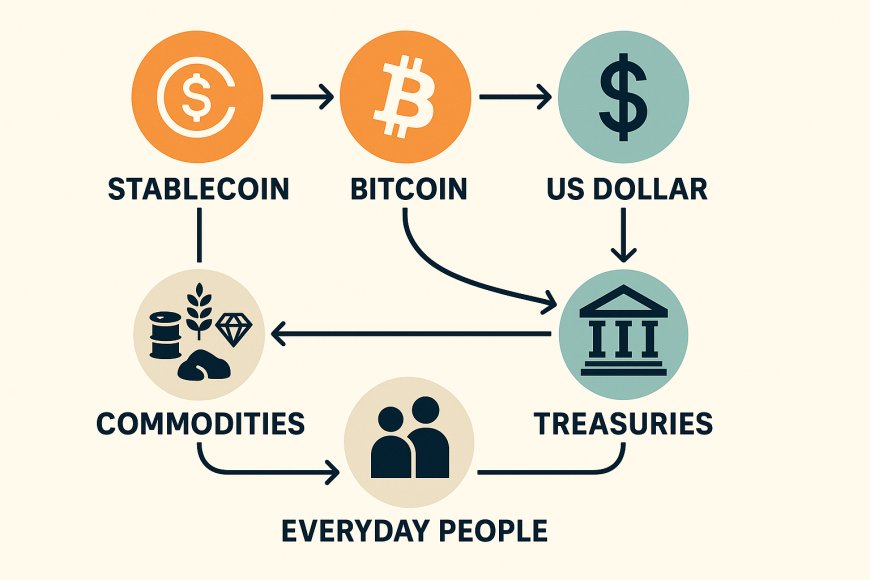
The modern liquidity pyramid has three pillars: sovereign collateral (U.S. Treasuries), hard collateral (gold), and programmable liabilities (CBDCs / stablecoins). Treasuries anchor yield and repo markets. Gold anchors credibility when geopolitical risk is high. Programmable liabilities provide the interface for everyday transactions and policy enforcement. The shift we’re witnessing is a re-collateralization of money after decades of paper promises: the world is monetizing the balance sheet of the U.S. Treasury (through tokenized T-bills) and the balance sheets of central banks (through digital currencies). At the same time, actors are hedging that exposure by quietly loading vaults with bullion.
When gold and Treasuries are tokenized, they don’t circulate physically; their ownership does. A digital gold standard would look like this: your wallet balance displays grams; your card swipe or wallet tap instantly converts those grams into CBDC units at the point of sale; vaults perform batch settlement between themselves periodically; and audited reports prove the bars or bills still exist. Prices would be denominated in grams or “digital dollars,” but behind the scenes the real base money would be grams of gold and T-bill units. The user experience would mirror today’s debit-card swipe — the difference would be the underlying collateral.
This is already happening at the institutional level. Large hedge funds don’t haul bars; they swap ETF shares, GLD units or PAXG tokens. Central banks swap digital claims on allocated bars held at the Bank of England or the Federal Reserve. Sovereign wealth funds and family offices are piling into tokenized money market funds and gold tokens because they want yield, liquidity, and verified collateral. In other words, the “return to gold” is not a nostalgic dream — it’s a live engineering project.
My View: Beware the Narrative, Follow the Pattern
As Pattern Nexus readers know, I care less about dogma and more about patterns of power, technology and narrative. CBDCs are sold as innovation but function as control. Tokenized T-bills are sold as crypto adoption but function as a way to monetize Treasury debt. Gold tokens are sold as digital convenience but function as insurance against issuer risk. The pattern here is that every player is trying to lock in their advantage. Governments want programmable liabilities to maintain monetary sovereignty. Asset managers want tokenized funds to lock in clients and flow fees. Individuals and non-aligned states want to hold hard assets outside the reach of sanctions.
The next crisis will likely accelerate these patterns. Liquidity will freeze, and regulators will turn on CBDCs for “emergency stimulus.” Investors will sell risk and pile into tokenized T-bills and gold tokens. Countries with reserves in dollars will realize that reserves can be frozen and will diversify into gold, yuan or a basket. The official adoption of a “digital gold standard” won’t happen via press conference; it will happen when enough users and institutions settle in grams and Treasuries because they no longer trust bank liabilities.
Tepkiniz Nedir?
 Beğen
0
Beğen
0
 Beğenmiyorum
0
Beğenmiyorum
0
 Aşk
0
Aşk
0
 Komik
0
Komik
0
 Vay
0
Vay
0
 Üzgün
0
Üzgün
0
 Öfkeli
0
Öfkeli
0



















Yorumlar (0)