
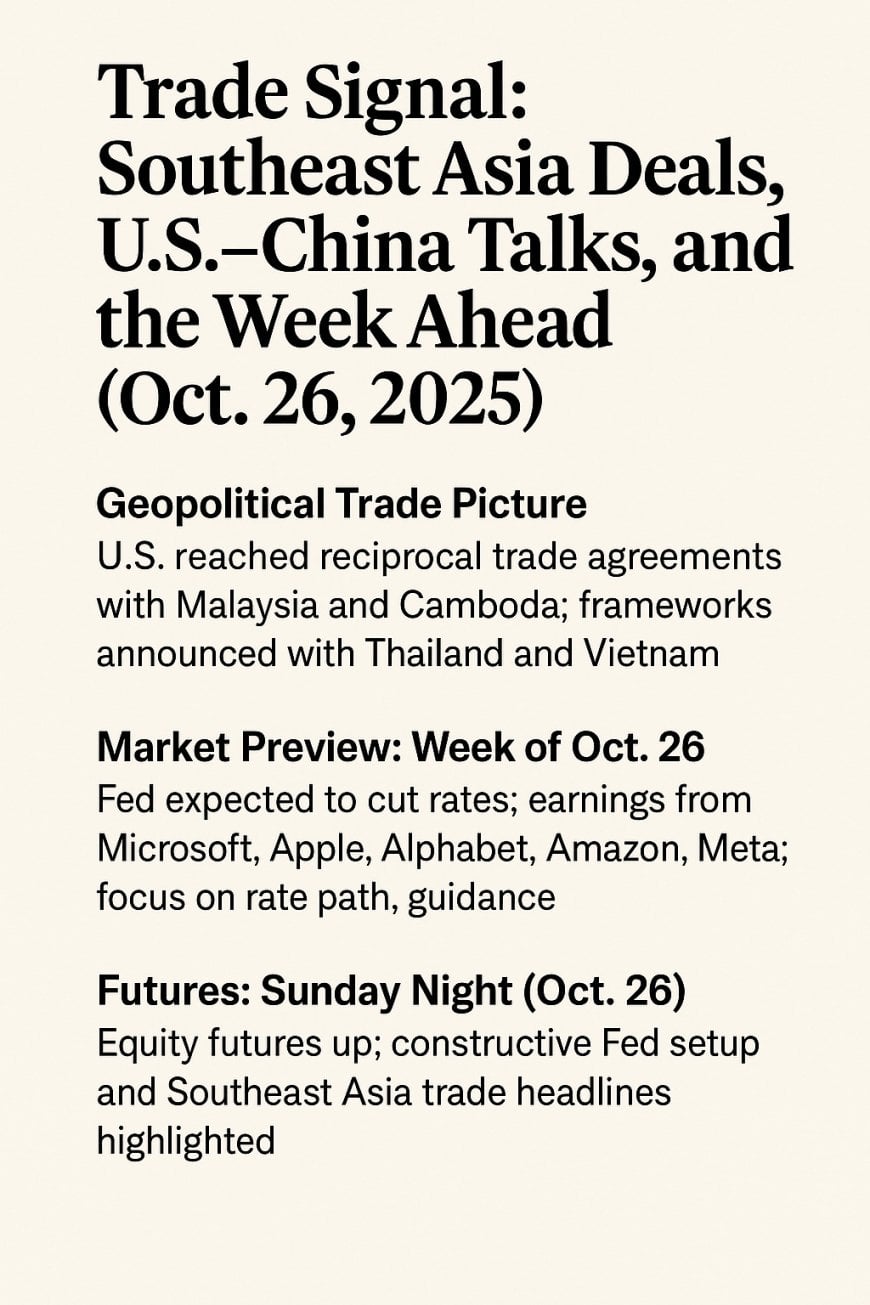
Trade Signal: Southeast Asia Deals, U.S.–China Talks, and the Week Ahead (Oct 26, 2025)
Geopolitics meets markets: new U.S. reciprocal trade deals in Southeast Asia, U.S.–China negotiations, a Fed preview, and what futures are signaling for the week of Oct 26, 2025.


Trade Signal: Southeast Asia Deals, U.S.–China Talks, and the Week Ahead (Oct 26, 2025)
Published October 26, 2025 • Pattern Nexus
Excerpt: Washington rolled out new reciprocal trade agreements across Southeast Asia while eyeing a managed reset with China. Here’s what those deals actually do, how they reposition supply chains and critical minerals, and what this means for the Fed week, earnings, and Sunday night futures.
The Geopolitical Trade Picture
Malaysia (Agreement on Reciprocal Trade). The U.S.–Malaysia pact pairs broad tariff preferences for U.S. goods with commitments to break non-tariff barriers (auto standards, FDA certificates for devices/pharma, streamlined steel licensing), open doors in critical minerals/rare earths, and keep digital trade open (no DST, support for a WTO e-transmissions moratorium). Currency-policy coordination and Section 232 linkages are flagged for national-security alignment.
Cambodia (Agreement on Reciprocal Trade). Cambodia eliminates tariffs on all U.S. goods and adopts wide digital-trade and IP enforcement commitments, plus GI rules that protect use of common food names. Labor and environmental enforcement pledges aim to de-risk compliance across U.S. supply chains.
Thailand (Framework for an Agreement on Reciprocal Trade). Thailand’s framework targets elimination of tariffs on 99% of goods, removal of key non-tariff frictions (vehicle/emissions acceptance, device/pharma certificates, ethanol permits), digital-trade openness, payment-rails liberalization, and headline commercial deals spanning ag, energy (including LNG), and aviation.
Vietnam (Framework for an Agreement on Reciprocal, Fair & Balanced Trade). Vietnam’s framework centers on near-comprehensive tariff relief for U.S. exports, non-tariff streamlining (vehicles to U.S. standards, remanufactured goods, device/pharma approvals), and commitments on IP, digital flows, and SOE behavior—plus sectoral commercial deals in ag, aerospace, and energy.
Strategic through-line. These pacts and frameworks work in tandem: 1) lock in market access and predictability for U.S. exporters, 2) secure critical-minerals and rare-earths flows outside China, 3) codify digital-trade and IP guardrails, and 4) coordinate labor/environment baselines. Net effect: a tighter U.S.–Southeast Asia trade architecture designed to harden supply-chain resilience and diversify away from single-point vulnerabilities.
U.S.–China: managed friction. Parallel to the Southeast Asia track, Washington and Beijing are testing a narrow de-escalation lane (tariffs/export controls vs. targeted concessions like purchases, chip flows, and magnet inputs). Expect “modest improvements” rather than a grand bargain—designed to stabilize expectations into year-end without conceding strategic leverage.
Market Preview: Week of Oct 26, 2025
Fed setup. Consensus looks for a 25 bps cut at this week’s FOMC, with a second trim tentatively priced for December. Balance-sheet runoff guidance is the swing factor: any signal toward tapering QT would ease financial conditions more than the headline cut.
Other central banks. The ECB and BOJ are expected to hold, with BOJ debate focused on whether conditions justify resuming hikes amid tariff-recession risk fading but political constraints lingering.
Earnings. Megacaps (Microsoft, Apple, Alphabet, Amazon, Meta) anchor the schedule. Watch AI capex cadence vs. margin discipline, ad-spend resilience, and cloud growth mix. Guidance will likely matter more than headline beats.
Macro calendar. Due to data disruptions, early-week U.S. releases are thinner than usual. Regional Fed surveys and any high-frequency labor/price proxies take on outsized importance for tape direction into the decision.
Positioning Grid (qualitative)
Equities: Sensitivity to rate-path and megacap guidance remains high; breadth improvement is the tell for durability. Rates: A dovish 25 bps + QT taper talk would bull-steepen; a “cut-and-keep-QT” outcome risks front-end relief but stickier term premium. FX: A softer Fed stance keeps the dollar contained vs. high-beta Asia FX if trade headlines don’t sour. Commodities: Energy balances on geopolitics; critical-minerals language in the deals is a medium-term bullish structural nudge for U.S. supply-chain investment.
Futures: Sunday Night Snapshot (Oct 26)
Into the Sunday evening open, equity futures leaned firmer alongside a constructive Fed setup and Southeast Asia trade headlines. Oil was mixed on the week, while retail gasoline trends edged modestly lower year-over-year. As always, overnight levels are provisional and can swing on Asia headlines and liquidity.
Why It Matters
Trade architecture is policy infrastructure. These agreements set the legal pipes for tariffs, standards, data flows, and minerals—quiet rules that compound over time. Pair that with a Fed pivot cycle and you get the contours of 2026 positioning: supply-chain re-routing, capex in critical inputs, and a market that will reward durable cash flows and policy-aligned growth lanes over narrative alone.
Tepkiniz Nedir?
 Beğen
0
Beğen
0
 Beğenmiyorum
0
Beğenmiyorum
0
 Aşk
0
Aşk
0
 Komik
0
Komik
0
 Vay
0
Vay
0
 Üzgün
0
Üzgün
0
 Öfkeli
0
Öfkeli
0
















Yorumlar (0)