
The Headline Is Late: How Pattern Nexus Mapped the Chokepoint War Before Hormuz Became Visible
The Iran-Hormuz crisis did not create the Pattern Nexus framework. It exposed it. For months, Pattern Nexus had already been mapping the deeper system beneath the headlines: liquidity plumbing, QT, reverse repo, QE 2026, AI power demand, stablecoin rails, Treasury collateral, Western Hemisphere force posture, energy chokepoints, China’s routing vulnerability, and the shift from globalization to permission. This long-form analysis uses the video transcript as an alignment test, then ties it back into the Pattern Nexus archive to show the real timeline: the headline arrived late because the structure moved first.
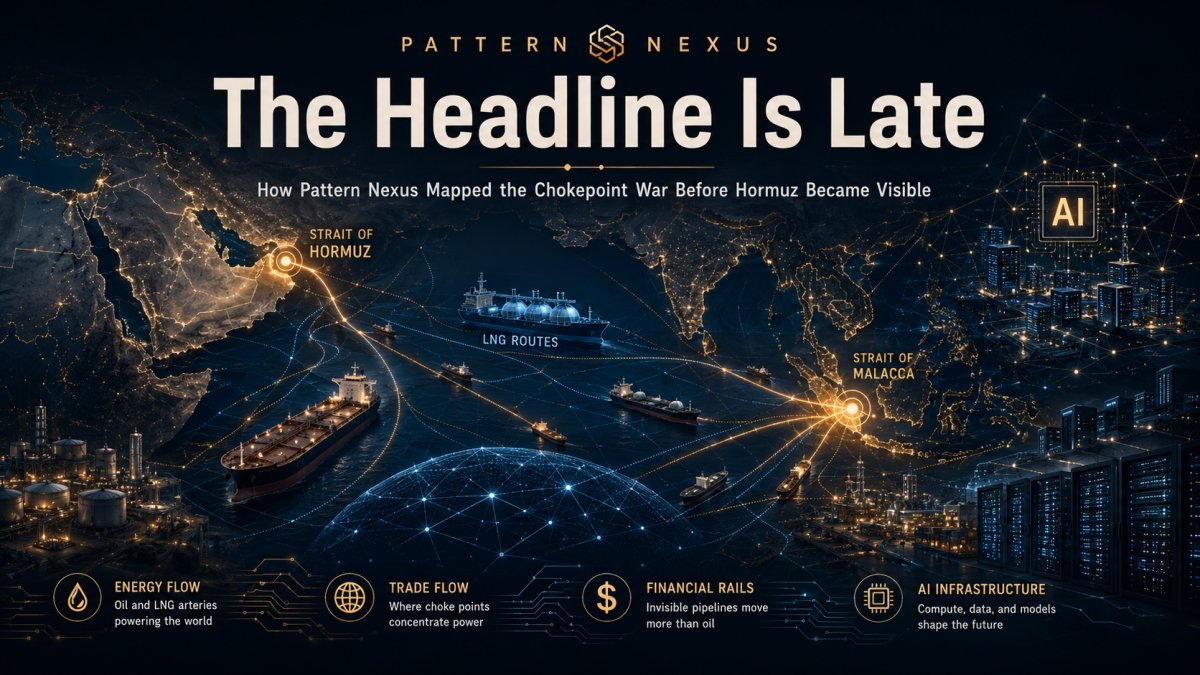
This article is not me discovering the pattern after watching a video. That would be the wrong timeline. The visible crisis may have broken open around Iran, Hormuz, energy, shipping, and war risk, but the underlying Pattern Nexus framework was already being built months earlier. I was already writing about reverse repo, QT ending, QE 2026, digital Treasury rails, CBDCs, stablecoins, AI power demand, data-center grid stress, Western Hemisphere force posture, gold repricing, and the shift from open globalization to controlled access before Hormuz became the headline.
This piece uses the video transcript as an alignment test, not as copied source material. The video is treated as a systems prompt, not as an authority. Claims that are speculative are framed as scenario paths, not settled facts. The transcript’s main claims are broken down, stress-tested, and rewritten through the Pattern Nexus lens. The article also uses the Pattern Nexus archive, including the October reverse-repo and CBDC/BRICS/energy-corridor work, the November Venezuela/SOUTHCOM and AI-power work, the November QE 2026 liquidity work, the November Pattern Nexus framework piece, the December SpaceX/megacorp-control-plane work, the January stablecoin/resource-war/Greenland pieces, the March Hormuz and liquidity-cover articles, and the April pressure/control pieces. The purpose is to show the full timeline accurately: the headline arrived late.
March was not the origin point. March was the visible break where the public finally saw a stack that was already forming.
The video matters because it confirms the architecture, not because it invented the architecture.
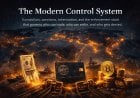
Liquidity, energy, compute, shipping, insurance, and military posture are not separate stories. They are interacting layers of the same control system.
The old world was sold as globalization. The new world is being rebuilt as permission.
The Headline Is Late
The biggest mistake people make with events like this is that they wait for the headline before they admit the structure exists.
They wait for the war before they see the logistics. They wait for the oil spike before they see the chokepoint. They wait for the shipping disruption before they see the insurance layer. They wait for the rate move before they see the liquidity stress. They wait for the AI regulation fight before they see the power demand. They wait for the draft conversation before they see the administrative rail. They wait for the platform crackdown before they see the permission stack.
Pattern Nexus is built to do the opposite.
Start with the structure. Then watch the event reveal it.
That is why the video transcript is useful, but not because I need to copy it, borrow its tone, or treat every prediction inside it as proven. I do not. Some of it is too certain. Some of it jumps from possibility to inevitability. Some of it uses language that needs more evidence before it should ever be published as a firm claim.
But structurally, the video walks through the same machine I have been mapping for months: Iran, Hormuz, energy routing, China’s import vulnerability, Russia’s alternative corridor logic, dollar-system stress, AI control infrastructure, draft infrastructure, defense-industrial mobilization, and the return of geography underneath finance.
That is the alignment.
The video did not create the Pattern Nexus thesis. The video stepped into it.
What the Video Actually Adds
The transcript makes several large claims. I am not going to repeat them as direct quotes because this article is not a transcript summary, and I do not want the article to become dependent on somebody else’s language. The useful parts are the structural nodes.
The video argues that the Iran war is not just about Iran. It frames the conflict through the dollar system, oil corridors, Russia-China-Iran alignment, Hormuz, China’s Middle East energy dependency, Europe and East Asia’s energy exposure, U.S. Western Hemisphere resource control, AI civilian monitoring, draft infrastructure, defense manufacturing, and the possibility that a regional war mutates into a much larger global contest.
That is a lot. Some of it is stronger than the rest. The strongest parts are the corridor logic, the energy dependency logic, the Iran-is-not-Iraq terrain logic, the insurance/chokepoint logic, the dollar-permission logic, the defense-industrial-base logic, and the AI-state logic.
The weaker parts are the high-certainty forecasts. Whenever somebody says a world war is effectively guaranteed, or that a specific leader will definitely take a specific constitutional path, or that one classified operational strategy is already locked in, I slow down. That does not mean the direction is wrong. It means the certainty is the problem.
Pattern Nexus does not need certainty theater. It needs structure.
The structure is enough.
What the Video Gets Right, and Where It Overreaches
The video gets the map right. That is the first thing.
It understands that Iran is not just a country on the edge of the Gulf. Iran is a corridor state. It touches the Gulf, the Strait of Hormuz, the Caspian-connected north-south logic, Central Asia, the Middle East, and the broader Eurasian bypass map. If Iran is broken or converted into a Western-aligned corridor, Russia and China lose a major route. If Iran survives and remains aligned against the U.S.-led system, the United States faces a corridor problem that cannot be solved by sanctions alone.
The video also gets the Hormuz problem mostly right. You do not need to physically sink every ship to impair a chokepoint. You only need to make the corridor too risky, too expensive, too difficult to insure, or too politically unstable for normal trade to continue. A chokepoint can be functionally constrained before it is physically sealed.
It also gets the China energy problem right in broad terms. China’s industrial power does not erase its routing exposure. Factories need energy, petrochemicals, shipping, inputs, and predictable flows. If Hormuz and Malacca become risk nodes at the same time, China’s industrial model is not destroyed overnight, but it is pressured at the routing layer.
Where the video overreaches is certainty. A regional war can become a global war. A draft rail can matter before a draft is active. AI can become civilian-control infrastructure. Russia and China can support Iran in ways that change the cost curve. All of that is plausible. But plausible is not the same as guaranteed.
The correct Pattern Nexus framing is this: the system is being pushed into conditions where wider escalation becomes easier, where intervention becomes more politically saleable, where resource corridors become strategic targets, where AI and energy become inseparable, and where digital financial rails become more attractive because the physical world is becoming harder to route through.
That is enough. It does not need to be dressed up as prophecy.
The Full Pattern Nexus Timeline
The timeline matters because it proves the point.
If the article starts in March, it makes it look like I reacted to the breakdown after the system had already exposed itself. That is not accurate. March was the visible confirmation layer. The deeper framework was already alive in October, November, December, and January.
October 31, 2025 — Reverse Repo, Fed Liquidity, and Market Plumbing
The reverse-repo article framed liquidity as plumbing, not vibes. It looked at the Fed’s overnight reverse repo facility, Treasury auctions, QT, QE, money markets, and the quiet mechanisms that tighten or loosen financial conditions before the public understands the headline version.
October 31, 2025 — CBDCs, BRICS, Energy Corridors, and the Next Security Era
The master brief connected digital sovereignty, tokenized Treasuries, BRICS trade, carrier posture, GPS warfare, oil markets, gold, stablecoins, mBridge, Belt and Road, and energy corridors into one security-era framework.
November 9, 2025 — Venezuela, SOUTHCOM, and the Western Hemisphere Power Map
The Caribbean was already being framed as a strategic theater, not an isolated headline. Carrier groups, JASSM bombers, Tomahawks, MEUs, ISR corridors, proxy interdiction, Guyana, Venezuela, and energy security were already part of the same map.
November 12, 2025 — AI Compute and Power Infrastructure
AI was already being treated as industrial infrastructure: data centers, nuclear energy, power grids, hyperscalers, compute deals, and the physical capacity underneath machine intelligence.
November 19, 2025 — QE 2026 and the Next Liquidity Wave
The QE 2026 piece tied QT, money-market stress, stablecoins, tokenized Treasuries, digital dollars, rent, wages, savings, and liquidity support into one future operating system.
November 2025 — Why Pattern Nexus Exists
This was the meta-anchor: Pattern Nexus was already defined as a lens for seeing macro, AI, power, liquidity, real estate, markets, and geopolitics as one machine instead of separate content categories.
December 16, 2025 — SpaceX, Megacorps, and Post-Sovereign Infrastructure
The SpaceX/megacorp article framed extreme valuation as a symptom of a deeper transition: private infrastructure becoming strategic continuity, and frontier corporations evolving into control-plane entities.
January 7, 2026 — Stablecoins, Treasuries, and the Synthetic Liquidity Engine
The January stablecoin piece moved the dollar thesis into the next rail: Treasury bills converted into digital dollars, then looped through a parallel liquidity system.
January 15, 2026 — WWII Was a Resource War Built on Credit
The resource-war article showed the older pattern: wars form through oil, steel, credit loops, sanctions, blocked valves, and political narratives that make the final break look sudden.
January 17, 2026 — Greenland, the Board of Peace, and the Fracturing Order
The Greenland piece pushed the framework into Arctic positioning, territorial leverage, trusteeship logic, synthetic dollar liquidity, and the shift from consensus-based multilateralism to capital-gated governance.
March 26, 2026 — The Hormuz Theory
Hormuz became the visible operational trigger. The key point was not “tankers.” The key point was that if the mission shifts from reopening transit to holding terrain, the war changes shape.
March 28, 2026 — Liquidity Needs a Cover
The liquidity-cover article stated the core mechanism directly: modern systems do not just need intervention. They need a trigger large enough to make intervention politically saleable.
April 2026 — Pressure, Control, and the Real Economy
The April pieces moved the same framework through Iran, inflation, labor softness, AI disruption, consumer stress, demand destruction, SpaceX’s public control-plane logic, and the deeper rails of control.
October 2025: Liquidity Plumbing Was Already Flashing
The first warning was not Iran. It was plumbing.
That is not as dramatic as a war map, but it is more important. The system usually tells you where the pressure is before the public gets the story it can emotionally understand. Repo, reverse repo, reserve floors, Treasury auctions, dealer capacity, QT, and future QE are not side details. They are the circulatory system of the modern financial order.
In the reverse-repo work, the whole point was that liquidity is not just “money printer go brrr.” It is market plumbing. It is where cash sits, who can access it, which collateral gets absorbed, which auctions clear, which institutions have balance sheet, and when the Fed has to quietly adjust the pipes because the visible surface still looks calm.[1]
This matters because wars do not hit a neutral financial system. They hit whatever system already exists. If the system is already liquidity-sensitive, already duration-sensitive, already dependent on Treasury issuance being absorbed smoothly, then an energy shock or geopolitical shock does not arrive as an isolated event. It arrives as a stress amplifier.
That is why I keep saying the headline is late. The war headline came after the plumbing framework had already been built.
October 2025: CBDCs, BRICS, Energy Corridors, and the Next Security Era
The second October layer was the monetary-security map.
The CBDC/BRICS/energy-corridor master brief mattered because it did not treat digital money, BRICS trade, tokenized Treasuries, carrier posture, GPS warfare, oil, gold, stablecoins, and Belt and Road as separate topics. It treated them as one security-era stack.[2]
That is the exact frame the video later walked into. The video talks about the dollar, BRICS, Russia, China, Iran, energy corridors, and the U.S. effort to maintain dominance through control of routes and settlement. That sounds new only if someone missed the earlier Pattern Nexus archive.
Money is not just a medium of exchange at this level. Money is access. It is permission. It is settlement. It is sanctions. It is reserve hierarchy. It is collateral. It is who can move through the world without being blocked, priced out, frozen, throttled, or forced onto another rail.
The dollar system does not need to disappear for the world to change. It only has to stop looking neutral.
Once settlement becomes political, countries start building escape routes. Some are realistic. Some are clumsy. Some are symbolic. Some will fail. But the direction matters: the old reserve system becomes less trusted at the sovereign layer even while the dollar mutates into digital rails, stablecoins, tokenized T-bills, and programmable settlement layers.
That is not dollar collapse in the cartoon sense.
That is dollar evolution under stress.
November 2025: The Western Hemisphere Map Was Already Moving
The November Venezuela/SOUTHCOM article already placed the Caribbean inside a much larger strategic pattern.[3]
That matters because the video’s Western Hemisphere argument sounds extreme if taken as personality commentary, but it becomes much more understandable if you read it as resource-fortress logic.
If the world is shifting from smooth globalization into corridor blocs, then the United States has to think differently about what is close to home: oil, gas, minerals, ports, canals, food systems, refineries, Arctic approaches, Caribbean sea lanes, and the political alignment of nearby states.
Venezuela is not just Venezuela inside that frame. Guyana is not just Guyana. Panama is not just Panama. Greenland is not just Greenland. Mexico and Canada are not just neighbors. They become pieces of a hemispheric operating map.
That does not mean every wild public statement becomes official policy. It means the strategic direction is visible: secure the hemisphere, harden the resource base, deny adversary access, and preserve military-commercial routes that matter when the global system becomes less reliable.
The 2026 National Defense Strategy later made this direction more explicit by emphasizing restoration of military dominance in the Western Hemisphere, protection of access to key terrain, and the need to secure areas from the Arctic to South America, including Greenland, the Gulf of America, and the Panama Canal.[19]
That is not a random policy note. That is the state saying the operating map is changing.
November 2025: AI Compute Was Already a Power-and-Grid Story
AI is another place where the public conversation is too shallow.
AI is usually discussed as software, labor disruption, chatbots, intelligence, creativity, education, coding, medicine, or philosophical risk. Those are real topics. But they are not the base layer.
The base layer is power.
AI requires chips, data centers, land, water, cooling, substations, transformers, transmission, gas turbines, nuclear uprates, copper, backup generation, capital, and political permission. That is why the November AI compute article mattered. It was not just about the “AI bubble.” It was about the industrial backbone underneath the intelligence layer.[4]
This is also why the Hormuz and AI stories are connected. If energy is structurally repriced higher, AI compute is repriced. If grids are strained, data centers become political. If nuclear restarts become necessary, AI becomes part of the energy-security state. If utilities raise rates to serve hyperscaler demand, the public eventually feels the AI buildout through power bills and infrastructure cost.
This is one of the strongest points from the Pattern Nexus Worldview Book: AI does not float above geopolitics. Advanced compute depends on specialized hardware, energy systems, water systems, fragile supply chains, transportation routes, security guarantees, export-control regimes, and industrial capacity.[13]
Technology did not replace geopolitics.
It deepened it.
November 2025: QE 2026, Tokenized Treasuries, and Digital Dollar Rails
The November QE 2026 piece is important because it already connected the next liquidity wave to stablecoins, tokenized Treasuries, rent, wages, savings, and the lived cost structure of ordinary life.[5]
This matters because the video frames the dollar as if it is simply a collapsing empire asset. I do not think that is precise enough.
The dollar system can remain dominant while becoming less trusted. It can lose moral neutrality while gaining technical reach. It can become more coercive and more programmable at the same time. It can lose some sovereign-reserve confidence while expanding through stablecoins, tokenized T-bills, settlement layers, regulated wallets, and platform rails.
That is the deeper transition.
The old system was banks, eurodollars, Treasuries, offshore dollar credit, correspondent accounts, oil trade, and U.S. naval protection. The next version can still use Treasuries, but distribute them through digital rails. It can still use the dollar, but make the dollar more programmable. It can still claim openness, while building more conditional access into the system itself.
That is why stablecoins are not just crypto. They are a dollar distribution layer.
And that is why war, energy shock, and liquidity stress all make the digital-dollar rail more important, not less.
November 2025: Pattern Nexus Was Already the Missing Lens
The November “Why Pattern Nexus Exists” piece is the article that explains why this entire discussion belongs together.[6]
Most analysis is still trapped in categories. Macro over here. Geopolitics over there. AI somewhere else. Housing in its own lane. Energy in another. Social fragmentation as a cultural problem. Markets as a chart problem. War as a foreign-policy problem.
Pattern Nexus rejects that structure.
Finance affects war. War affects energy. Energy affects inflation. Inflation affects rates. Rates affect housing. Housing affects household formation. Household formation affects demand. Demand affects industrial planning. Industrial planning affects compute, labor, debt, grid stress, and sovereignty.
That is not poetic. That is operational.
The Pattern Nexus Worldview Book states the same point in its cleanest form: the world is not actually divided into topics; it is divided into layers, and the layers interact whether people want them to or not.[13]
That is why the video fits. It is messy, speculative, and overconfident in places, but it is moving through the same stack: Iran, Hormuz, China, Russia, AI, draft infrastructure, dollar stress, energy routing, and domestic political stability.
The transcript is not the origin of the Pattern Nexus framework.
It is evidence that the framework is becoming harder for other people to avoid.
December 2025: SpaceX, Megacorps, and the Private Control Plane
December added another layer: the frontier corporation.
The SpaceX/megacorp article was not really about one person becoming richer. That was the headline hook. The deeper argument was that SpaceX was being repriced as post-sovereign infrastructure: launch, orbital communications, military relevance, continuity, Starlink, future AI adjacency, and strategic infrastructure that states cannot quickly reproduce.[7]
That belongs in this article because the future control system is not just state versus market. It is state plus frontier corporation.
AI runs through private clouds. Communications can run through private satellite networks. Payment rails can run through private platforms. Identity systems can be mediated by private accounts. Work, speech, visibility, monetization, commerce, and access increasingly move through corporate infrastructure.
The Pattern Nexus Worldview Book makes this point directly: the word “corporation” is increasingly too small for what some entities are becoming. A frontier corporation can hold data systems, model stacks, compliance architecture, payment relationships, cloud territory, hardware dependencies, identity layers, communications channels, and quasi-populations larger than sovereign states.[14]
That is why SpaceX matters inside a Hormuz article.
The future conflict map is not just ports and ships. It is also satellites, cloud, compute, payment rails, data centers, platform control, and who can keep continuity alive when the public system is under stress.
January 2026: The Missing Month Was Not Empty
January was not a blank space in the Pattern Nexus timeline. It was the month where several earlier threads started hardening into a clearer control-system framework: synthetic liquidity, Treasury-backed digital rails, resource-war history, territorial leverage, Greenland, Gaza trusteeship logic, and the fracturing of the old multilateral order.
On January 7, in Stablecoins, Treasuries, and the Synthetic Liquidity Engine, I was already writing about Treasury bills being converted into digital dollars, then looped through a parallel liquidity system. That matters because the dollar system was not simply “collapsing.” It was being re-railed through stablecoins, T-bills, tokenized collateral, and programmable settlement logic.[8]
On January 15, in WWII Was a Resource War Built on Credit, I walked through the older historical pattern: wars do not come from nowhere. They form through oil, steel, credit loops, sanctions, blocked valves, and political narratives that make the final move look sudden even when the pressure has been building for years.[9]
On January 17, in Greenland, the Board of Peace, and the Fracturing Order, the same framework moved into territorial leverage, Arctic positioning, trusteeship platforms, synthetic dollar liquidity, and the shift from consensus-based multilateralism to capital-gated governance.[10]
That fills the January gap. By the time Hormuz became the visible trigger in March, the Pattern Nexus framework had already moved through liquidity rails, resource-war history, territorial coercion, Arctic control, stablecoin collateral, and the breakdown of the old order.
March did not create the thesis.
March exposed it.
March 2026: Hormuz Becomes the Visible Trigger
March is where the framework turned into visible confirmation.
The March 26 Hormuz article was not written as a prediction dressed up as certainty. It was a scenario analysis. The core idea was simple: if maritime escorts alone cannot stabilize the Strait of Hormuz, outside forces could start thinking territorially instead of purely navally.
That is a major shift.
Convoy security is one thing. Holding ground is another. Once the mission moves from safe passage to coastal control, protected lodgments, local opposition groups, forward operating positions, or terrain shaping, the war is no longer just about ships. It becomes regime pressure, proxy logic, occupation risk, insurgency risk, and open-ended escalation.
That is why the key line from the March article matters: Hormuz is not only a tanker problem. If the mission shifts from reopening transit to holding terrain, the entire war changes shape.[11]
That is the bridge between the video and the archive. The video talks about the possibility of ground forces, forward operating bases, ethnic pressure points, and internal destabilization. My March piece had already mapped the escalation ladder from water to shore to ground-control logic.
The important word is ladder.
Escalation does not always arrive as one giant decision. It climbs.
March 2026: Liquidity Needed a Cover
Two days later, the liquidity-cover piece made the financial layer explicit.
The core claim was not that every event is scripted. That is too lazy and too easy. The core claim was that modern systems do not just need intervention. They need a trigger large enough to make intervention politically saleable.
That is how war becomes financial plumbing.
If the system already needs liquidity support but inflation is still alive, rates are still elevated, and the public still remembers price instability, then open intervention is politically harder. The system needs a reason. It needs a cover. It needs an explanation large enough to justify why extraordinary support is necessary again.
Sometimes that cover is a bank failure. Sometimes it is a credit accident. Sometimes it is a market plumbing event. Sometimes it is an energy shock. Sometimes it is war. Sometimes it is a chain reaction that starts in one domain and gives permission for action in another.[12]
This is why the Iran-Hormuz crisis cannot be read only as foreign policy.
It is also a liquidity event.
Oil becomes inflation. Inflation becomes rates. Rates become credit pressure. Credit pressure becomes political pressure. Political pressure becomes policy room. Policy room becomes intervention.
That is the loop.
April 2026: The Pressure Stack Becomes Obvious
By April, the pressure stack was no longer subtle.
In “Why I’ve Been Quiet,” the point was that too many layers were moving at once: Iran, markets, inflation, shipping, the 10-year, labor softness, private credit, AI disruption, media alignment, and control structures. That piece was not written as a calm market note because the situation was not calm. It was the system becoming too dense to cover with one clean headline.[15]
That matters because it is exactly what the average person misses. They want one cause. One villain. One event. One explanation.
But the real world does not move that cleanly.
A shipping shock can hit inflation. Inflation can hit the 10-year. The 10-year can hit refinancing. Refinancing can hit private credit. Private credit can hit jobs. Jobs can hit consumers. Consumers can hit political tolerance. Political tolerance can force government action. Government action can feed back into deficits, Treasury issuance, and liquidity support.
That is why April also connected to the control-rails work, the SpaceX control-plane work, the McDonald’s demand-destruction piece, and the UAE swap-line/T-bill funnel logic. These are not random articles. They are different windows into the same system.
Hormuz Is a Mechanism, Not Just a Strait
This is the central geopolitical point.
Hormuz is not just water. It is a mechanism.
It is a place where energy, shipping, military power, insurance, inflation, China, Europe, Japan, India, Gulf stability, LNG, fertilizer, and dollar settlement all touch the same narrow geography.
The International Energy Agency describes the Strait of Hormuz as one of the world’s most important oil chokepoints. In 2025, around 20 million barrels per day of crude oil and oil products moved through it, representing roughly one-quarter of global seaborne oil trade. Hormuz also matters for LNG: Qatar and the UAE rely heavily on the Strait, and the IEA estimates that flows through Hormuz represented about 19% of global LNG trade in 2025.[16]
Those numbers are not trivia. They explain why a local military event can become a global economic event.
You can have the ship. You can have the buyer. You can have the seller. You can have the port. But if the route cannot be insured, protected, financed, scheduled, or politically tolerated, movement becomes conditional.
Conditional movement is permission.
That is why Hormuz belongs in the permission-stack framework.
Energy, LNG, Fertilizer, Insurance, and the Real Transmission Layer
Most people talk about oil because oil is familiar. But Hormuz is bigger than oil.
It is LNG. It is condensate. It is petrochemicals. It is fertilizer inputs. It is refined products. It is diesel. It is jet fuel. It is shipping insurance. It is maritime risk premiums. It is refinery feedstock. It is Asian manufacturing. It is European substitution risk. It is Gulf food import vulnerability. It is the hidden dependency structure beneath the “normal” world.
This is why energy shocks do not stay in the energy sector. Oil becomes diesel. Diesel becomes trucking cost. Trucking cost becomes food cost. LNG becomes power cost. Power cost becomes industrial cost. Industrial cost becomes margin pressure. Margin pressure becomes layoffs. Layoffs become politics. Politics becomes policy.
That is the transmission layer.
The video’s useful point is that Iran does not need to defeat the United States militarily to create leverage. It can stress the global system at the exact point where energy, shipping, insurance, inflation, and political tolerance all meet.
That does not mean Iran controls the world. It means the world built too much continuity through too few nodes.
China’s Weakness Is Routing, Not Factories
China is not weak in the cartoon way American commentary likes to pretend.
China has industrial scale, manufacturing depth, shipbuilding capacity, battery capacity, rare-earth leverage, ports, engineers, and the ability to move faster than the West in many physical sectors.
But China has a routing problem.
China needs energy. It needs raw materials. It needs food inputs. It needs seaborne trade. It needs petrochemicals. It needs maritime corridors to stay predictable enough for an industrial system of that scale to operate.
That is why Hormuz and Malacca belong in the same paragraph.
Hormuz is one side of the energy exit. Malacca is one side of the Asian intake. If both become strategic pressure points, China does not lose its factories overnight. But it has to price its industrial model differently. It has to spend more on security. It has to accelerate pipelines and overland routes. It has to deepen Russia, Central Asia, Pakistan, Iran, and Belt and Road routing logic. It has to build around the maritime constraint.
That is why the U.S.-China story is not only Taiwan, chips, tariffs, or the South China Sea.
It is routing.
The Dollar Is Not Simply Collapsing. It Is Being Re-Railed.
The video frames the petrodollar system as a Ponzi-like imperial mechanism. There is a truth buried there, but the better framing is more precise.
The dollar system is not just money. It is settlement, collateral, reserves, sanctions, legal reach, payment clearing, Treasury markets, military protection, energy trade, and institutional habit.
The dollar became dominant because the United States built the postwar operating system around itself: industrial capacity, military reach, sea-lane protection, deep capital markets, legal infrastructure, reserve assets, and allied dependency.
But after sanctions, asset freezes, and payment-system weaponization became more visible, the dollar stopped looking neutral to many non-Western states. It still looked useful. It still looked liquid. It still looked hard to escape. But it no longer looked apolitical.
That is the distinction.
The dollar can remain dominant while becoming less trusted. It can be indispensable and resented at the same time. It can lose neutrality while gaining digital reach.
That is where stablecoins, tokenized Treasuries, Gulf liquidity, T-bill rails, and swap-line discussions matter. The U.S. does not need the old dollar system to remain frozen in its twentieth-century form. It can rebuild the dollar stack into new rails.
The January stablecoin article is central here because it shows the next rail forming before the public fully understood what it was looking at: Treasury collateral, stablecoin distribution, synthetic liquidity, and programmable settlement layered together.[8]
The future dollar system may be less neutral, more programmable, more trackable, more conditional, and more deeply embedded into platform infrastructure.
That is not collapse.
That is controlled mutation.
Why War Gives Liquidity Political Permission
Liquidity is technical until it becomes political.
That is one of the most important points in this whole article.
Central banks and Treasuries can do a lot when markets are breaking. The problem is not only capability. The problem is permission. When inflation is still alive, households are still angry about prices, and asset owners already look like they benefited too much from the last cycle, it becomes politically harder to openly restart support.
War changes the permission structure.
Energy shock changes the permission structure.
Shipping disruption changes the permission structure.
Treasury market stress changes the permission structure.
Suddenly the intervention is not framed as a bailout. It is framed as stability. It is framed as national security. It is framed as market functioning. It is framed as keeping energy flowing, defending allies, preserving payment systems, protecting supply chains, or preventing a worse collapse.
That is why the March liquidity-cover framework matters so much. It did not claim every event was scripted. It argued that stress creates narrative room, and narrative room creates policy room.
That is how the system moves.
Iran Is Not Iraq
The video is strongest when it discusses terrain.
Iran is not Iraq.
That sentence matters because a lot of American strategic imagination is still haunted by old templates. Iraq conditioned people to think in decapitation logic: shock, air dominance, regime collapse, capital seizure, and then management of the aftermath.
Iran is a different problem.
Iran has larger population depth, harder terrain, mountainous regions, hardened facilities, dispersed missile capacity, drone systems, proxy networks, internal factions, religious command structures, and a state that has spent decades preparing for pressure from the United States and Israel.
That does not make Iran invincible.
It makes Iran expensive.
Expensive is the key word.
The United States does not like expensive wars anymore. It wants airpower, sanctions, cyber, proxies, allied burden-sharing, special operations, drones, AI targeting, and escalation without full domestic mobilization.
Iran’s terrain and military logic fight that model.
If the first phase does not produce surrender, the system starts looking for other tools: blockades, infrastructure pressure, internal destabilization, protected zones, local partners, and long-war mechanisms.
The Shoreline Problem and the Ground-Control Ladder
This is where the March Hormuz Theory article connects directly to the video.
A maritime problem can become a shoreline problem.
If the threat to shipping is land-based, then naval escorts may not be enough. Planners start asking different questions. Can the threat systems be suppressed from the air? Can coastal batteries be destroyed? Can islands be controlled? Can ports be secured? Can a safe corridor be established? Can local partners hold ground? Can a protected zone be created? Can enough terrain be shaped to make the waterway usable again?
That is the ladder.
The public hears “secure shipping.” The system hears “shape terrain.”
Once you start holding terrain, even indirectly, you inherit everything attached to it: civilians, governance, resupply, local factions, insurgency, propaganda, medical support, perimeter defense, and the political cost of every mistake.
This is why the phrase “reopen Hormuz” can hide a much larger war structure inside it.
Watch the language. If the public story starts shifting from transit, shipping, and maritime security toward protected corridors, coastal access, safe zones, local partners, opposition groups, or durable threat suppression, the theory stops being abstract.
The Draft Infrastructure Layer
The draft section needs precision.
Automatic Selective Service registration is not the same thing as an active draft. The Selective Service System states that there is no draft at present, and that returning to a draft would require a national emergency and action by Congress and the President. Selective Service also states that if a draft were authorized, its structure is designed to deliver first inductees within 193 days after the onset of a crisis and the law being updated.[20]
So no, the clean statement is not “the draft is active.”
The clean statement is that the registration rail is being automated.
That still matters.
Systems are built before they are activated. Databases are built before names are called. Legal rails are built before emergency powers are used. Financial rails are built before capital moves through them. Identity rails are built before eligibility is enforced.
The state lowering friction inside the mobilization stack is not the same thing as mobilization. But it tells you how the state is thinking.
It is thinking in readiness terms.
It is thinking in automation terms.
It is thinking in crisis-conversion terms.
The AI Civilian-State Layer
The video also points toward an AI civilian-state concept: the idea that online behavior, digital identity, communication, prediction, and control become increasingly integrated.
That should not be written as cartoon surveillance panic. It should be written as systems architecture.
AI is becoming a coordination layer. A sorting layer. A risk-scoring layer. A logistics layer. A targeting layer. A compliance layer. A moderation layer. A cyber layer. A battlefield layer. A fraud-detection layer. A border layer. A benefits layer. A hiring layer. A policing layer. A financial layer.
The White House AI Action Plan discusses frontier AI in national-security terms, including assessments of foreign frontier AI projects, coordination across national-security agencies, and evaluation of AI risks tied to cyber, CBRNE, critical infrastructure, vulnerabilities, and adversary use.[21]
That does not mean every AI system is a weapon. It means AI is moving into the national-security operating layer.
The Pattern Nexus point is deeper: once AI connects to financial rails, identity systems, cloud platforms, border systems, law enforcement databases, public-benefits administration, private platforms, military logistics, and emergency authorities, the civilian world starts becoming part of the same command architecture.
The system does not have to ban you if it can bury you.
The lender does not have to accuse you if it can quietly worsen terms.
The platform does not have to openly censor everything if it can throttle visibility.
The state does not have to directly administer every restriction if private systems already make unwanted behavior difficult, unprofitable, or impossible.
That is the AI civilian-state layer.
What Happens From Here
I do not think the right question is “does this become World War III?”
That question is too blunt. It forces a complex system into a yes-or-no frame when the real world usually moves through gradients.
The better question is: what escalation path is the system selecting?
The critical signal is not one dramatic declaration. It is whether the language shifts from maritime security to terrain control, from market stress to liquidity support, and from AI innovation to AI national-security infrastructure.
Scenario One: De-escalation, but the Permission Stack Remains
In the mildest version, the acute fighting cools, shipping resumes under higher risk premiums, energy prices settle below panic levels, and policymakers declare stabilization. But even in that scenario, the world does not go back to normal. The lesson remains: Hormuz is vulnerable, energy corridors are political, the dollar rail is coercive, and AI-defense-industrial planning keeps moving forward.
This is the version that fools people the most because the headline pressure fades while the architecture stays. Tankers move again, markets breathe, politicians claim they handled it, and the public moves on. But the people who actually run systems do not forget the chokepoint. Insurers do not forget it. Militaries do not forget it. Energy buyers do not forget it. China does not forget it. Gulf states do not forget it. Treasury planners do not forget it.
That is how the permission stack grows. Not always through open collapse. Sometimes it grows through a scare that justifies new routing, new surveillance, new insurance pricing, new military agreements, new sanctions logic, new data-sharing, and new liquidity facilities that remain after the crisis fades.
Scenario Two: Controlled Attrition
This is the grinding scenario. No clean settlement, no clean world war, no clean collapse. Instead, the system moves through shipping disruption, periodic strikes, insurance stress, refinery pressure, Gulf route workarounds, sanctions enforcement, tanker seizures, and selective escalation. This is where markets keep repricing risk without one final dramatic event.
Controlled attrition is the hardest scenario for normal people to understand because there is no single moment where everything breaks. Prices stay elevated. Insurance stays nervous. Oil moves in violent ranges. LNG and refined products become more important than the crude headline. The 10-year yield responds in waves. Credit stress leaks into the real economy. The Fed and Treasury start talking more about market functioning, reserves, collateral, and liquidity management.
That is not a side effect. That is the transmission mechanism.
In this version, the system does not collapse. It tightens around the population. That is the part people miss. The crisis becomes the justification for more control, more monitoring, more intervention, more military spending, more energy planning, more AI-driven logistics, and more conditional access to the rails.
Scenario Three: Corridor Escalation
This is where maritime security starts becoming terrain logic. If the language shifts toward protected corridors, safe zones, coastal access, local partners, or durable suppression of land-based threats, the war changes shape. That is the Hormuz Theory scenario.
This is the scenario I take most seriously because it follows the ladder. First, the public hears that shipping needs protection. Then the language shifts to threat suppression. Then the threat is described as land-based. Then land-based threats require persistent monitoring. Persistent monitoring requires staging. Staging requires partners. Partners require protection. Protection requires presence. Presence creates targets. Targets create escalation.
That is how water becomes shoreline.
That is how shoreline becomes ground-control logic.
That is how a limited maritime mission becomes a long-war structure without the public ever voting on the real mission at the beginning.
Scenario Four: Eurasian Reinforcement
Russia and China do not need to enter the war in the most dramatic way to change the cost curve. Financing, intelligence, air defense, logistics, energy deals, diplomatic cover, alternative settlement, and overland routing all matter. If Iran becomes the hinge of a larger Eurasian bypass system, then the war is no longer only about Iran.
This is where the video’s Russia-China-Iran framing matters, even if some of the predictions are too certain. The deeper structure is real. Russia does not want its southern flank opened. China does not want its energy routing permanently exposed to U.S.-controlled maritime pressure. Iran does not want to be isolated from the Eurasian backfield. All three have different interests, but those interests overlap at the corridor layer.
The United States does not have to be defeated directly for the old system to weaken. It only has to lose exclusive control over the routing table. If alternative routes become good enough, if non-dollar settlement becomes usable enough, if shadow fleets become protected enough, if overland corridors become resilient enough, and if Gulf energy becomes politically harder to fully control, then the old permission system starts losing monopoly power.
Scenario Five: Liquidity Intervention Under National-Security Cover
If energy shock, Treasury stress, private credit pressure, and real-economy strain intensify at the same time, policymakers get more room to justify liquidity tools. That does not have to look like old QE. It can show up through repo support, Treasury cash management, standing facilities, swap lines, targeted backstops, digital Treasury rails, stablecoin regulation, or industrial-policy financing.
This is the part that ties directly into the QE 2026 framework. People keep waiting for one old-school announcement where somebody says the money printer is back on. That may not be how the next version works. The next version can be more fragmented, more technical, more politically shielded, and more routed through specific rails.
Liquidity can come through Treasury-market support. It can come through repo facilities. It can come through stablecoin rules that create structural demand for T-bills. It can come through defense production. It can come through AI infrastructure financing. It can come through energy-security programs. It can come through swap lines and allied backstops. It can come through anything that lets officials say they are not stimulating markets; they are preserving national stability.
That is what I meant when I wrote that liquidity needs a cover.
Scenario Six: Domestic Stress Becomes the Real Constraint
Fuel, food, insurance, credit, labor softness, AI disruption, housing pressure, and political fatigue all hit the domestic system differently than foreign-policy models assume. The United States can have enormous military capacity and still face a political-duration problem. That is where the war comes home without needing missiles to land here.
The domestic constraint is not just whether people support or oppose a war in the abstract. It is whether they can afford the system while the war works its way through prices, jobs, credit, taxes, insurance, utilities, food, rent, mortgages, and market volatility.
This is where the social layer becomes part of the geopolitical layer. People do not need to understand Hormuz to feel Hormuz. They feel it through diesel. Through food. Through utility bills. Through interest rates. Through job cuts. Through the cost of borrowing. Through lower liquidity. Through higher volatility. Through the sense that nothing works and nobody is telling the truth about why.
That domestic pressure becomes its own battlefield.
What I Am Watching Next
The next phase is not about one headline. It is about the stack.
I am watching actual Hormuz flow, not just rhetoric. Tanker movement, AIS behavior, insurance pricing, war-risk premiums, port congestion, Fujairah and Khor Fakkan workarounds, Gulf LNG schedules, and refined-product movements matter more than speeches.
I am watching Brent, WTI, diesel, jet fuel, freight, and fertilizer. Crude is the public chart. Refined products and inputs are where the real economy feels the shock.
I am watching the 10-year yield, term premium, Treasury auctions, repo conditions, dealer capacity, and whether the Treasury/Fed language starts shifting toward “market functioning” again.
I am watching China’s energy sourcing, especially whether the system accelerates Russian, Central Asian, or overland substitution.
I am watching Russia’s shadow-fleet enforcement and whether tanker seizures keep moving from sanctions enforcement into naval confrontation.
I am watching the language around the Western Hemisphere: Greenland, Panama, Venezuela, Gulf of America, Caribbean, Arctic, and resource security.
I am watching draft-administration implementation, not because the draft is active, but because the registration rail tells you how mobilization friction is being reduced.
I am watching the AI-defense-industrial layer: data centers, power plants, classified AI contracts, nuclear policy, grid interconnects, and the way national-security language absorbs civilian infrastructure.
And I am watching the narrative layer.
Because when the system needs to move, the story changes first.
The most important thing to watch is not one single confirmation. It is convergence. If shipping risk, energy repricing, Treasury stress, AI infrastructure language, draft-administration updates, Western Hemisphere posture, and dollar-rail changes all keep moving in the same direction, then the article’s central thesis is not weakening. It is strengthening.
Pattern Nexus Lens
The video transcript did not change my framework. It reinforced why the framework matters.
The mistake most people make is that they wait for the visible event before they admit the structure exists. They wait for the war before they see the logistics. They wait for the price spike before they see the energy dependency. They wait for the credit break before they see the plumbing. They wait for the AI regulation fight before they see the power demand. They wait for the draft debate before they see the database. They wait for the chokepoint crisis before they understand the corridor.
Pattern Nexus is built to do the opposite.
Start with the structure.
Then watch the event reveal it.
That is what happened here. The Iran-Hormuz crisis is not some isolated foreign-policy event. It is a systems event. It touches energy, inflation, shipping, insurance, China, Russia, Treasuries, stablecoins, AI compute, defense production, domestic politics, and the wider transition from globalization to permission.
The timeline matters because it proves the point. This did not start when the waterway became a headline. The waterway became a headline because the deeper system was already under pressure.
The headline is late.
The structure moves first.
That is the whole Pattern Nexus lens in one sentence.
The event is not the beginning. The event is the reveal.
References
References are separated between Pattern Nexus archive references and outside factual anchors.
Pattern Nexus Archive References
- Pattern Nexus — “The Reverse Repo Trap: How the Fed Quietly Controls Liquidity & Markets.” Published Oct. 31, 2025. Slug: reverse-repo-trap-fed-liquidity-control.
- Pattern Nexus — “The Pattern Nexus Master Brief: CBDCs, BRICS, Energy Corridors, and the Next Security Era.” Published Oct. 31, 2025. Slug: the-pattern-nexus-master-brief-cbdcs-brics-energy-corridors-and-the-next-security-era.
- Pattern Nexus — “Venezuela, SOUTHCOM, and the New Western Hemisphere Power Map.” Published Nov. 9, 2025. Slug: venezuela-southcom-and-the-new-western-hemisphere-power-map-2025-update-pattern-nexus.
- Pattern Nexus — “AI Compute and Power Infrastructure in 2025 — The New Industrial Backbone.” Published Nov. 12, 2025. Slug: ai-compute-and-power-infrastructure-2025.
- Pattern Nexus — “QE 2026: The Trigger, the Mechanics, and How the Next Liquidity Wave Hits Your Life.” Published Nov. 19, 2025. Slug: qe-2026-the-trigger-the-mechanics-and-how-the-next-liquidity-wave-hits-your-life.
- Pattern Nexus — “Why Pattern Nexus Exists: The Missing Lens for Macro, AI, and Markets.” Published Nov. 2025. Slug: why-pattern-nexus-exists-the-missing-lens-for-macro-ai-and-markets.
- Pattern Nexus — SpaceX/Musk megacorp article. Published Dec. 16, 2025. Core frame: SpaceX as post-sovereign infrastructure and first megacorp control-plane signal.
- Pattern Nexus — “Stablecoins, Treasuries, and the Synthetic Liquidity Engine.” Published Jan. 7, 2026. Slug: stablecoins-treasuries-synthetic-liquidity.
- Pattern Nexus — “WWII Was a Resource War Built on Credit.” Published Jan. 15, 2026. Slug: ww2-plumbing-oil-steel-credit-sanctions-narrative.
- Pattern Nexus — “Greenland, the Board of Peace, and the Fracturing Order.” Published Jan. 17, 2026. Slug: greenland-board-of-peace-liquidity-order-fracture.
- Pattern Nexus — “The Hormuz Theory: Could a Coastal Safe Zone Become the Front Edge of a Long War in Iran?” Published Mar. 26, 2026. Slug: hormuz-theory-coastal-safe-zone-long-war-iran.
- Pattern Nexus — “Liquidity Needs a Cover: War, Control Systems, and the False Stability of the Modern Economy.” Published Mar. 28, 2026. Slug: liquidity-needs-cover-war-control-systems.
- Christopher Grenke — Pattern Nexus Worldview Book. Core framework: money, liquidity, collateral, energy, compute, chokepoints, corridors, sovereignty, control systems, and the next normal. Slug: pattern-nexus-worldview-book-164.
- Christopher Grenke — Pattern Nexus Worldview Book, sovereignty/megacorp/control-plane sections. Core frame: frontier corporations as functional infrastructure layers, not merely ordinary firms.
- Pattern Nexus — “Why I’ve Been Quiet.” Published Apr. 11, 2026. Slug: why-ive-been-quiet.
Outside Factual References
- International Energy Agency — Strait of Hormuz overview. Oil and LNG chokepoint data, bypass limits, and disruption implications. IEA Strait of Hormuz.
- U.S. Energy Information Administration — Strait of Hormuz oil and LNG data. EIA Today in Energy.
- Reuters/AP reporting on 2026 Hormuz/Gulf disruptions, route stress, OPEC+ response, and current energy-market strain.
- U.S. Department of War — 2026 National Defense Strategy. Western Hemisphere key terrain, Indo-Pacific deterrence, allied burden-sharing, and defense-industrial-base emphasis. 2026 National Defense Strategy.
- Selective Service System — Automatic registration and return-to-draft process. Selective Service System.
- White House — America’s AI Action Plan. Frontier AI, national-security coordination, AI risk evaluation, and infrastructure implications. America’s AI Action Plan.
Closing note: The headline is late because the structure moves first. Hormuz did not create the Pattern Nexus framework. It exposed it.
Frequently Asked Questions
Qual é a sua reação?
 Curtir
0
Curtir
0
 Não Gostar
0
Não Gostar
0
 Amor
0
Amor
0
 Engraçado
0
Engraçado
0
 Uau
0
Uau
0
 Triste
0
Triste
0
 Bravo
0
Bravo
0

Founder of Pattern Nexus. I research markets, macro, geopolitics, AI, history, ancient systems, and the patterns most people overlook. I’m also building Market Radar, a trading scanner designed to read pressure, risk, confirmation, and setup quality before chasing a move. Pattern Nexus is where I connect the dots between data, history, technology, and the bigger system playing out around us.








Comentários (0)