

WWII Was a Resource War Built on Credit: Oil, Steel, Sanctions, and the Narrative Layer
WWII wasn’t a cartoon morality play. It was a systems collision built on oil, steel, credit loops, and diplomatic valves that closed. This piece follows the official record from interwar financing to Japan’s war talks, sanctions, the Hull Note, and the Pearl Harbor timing strike.
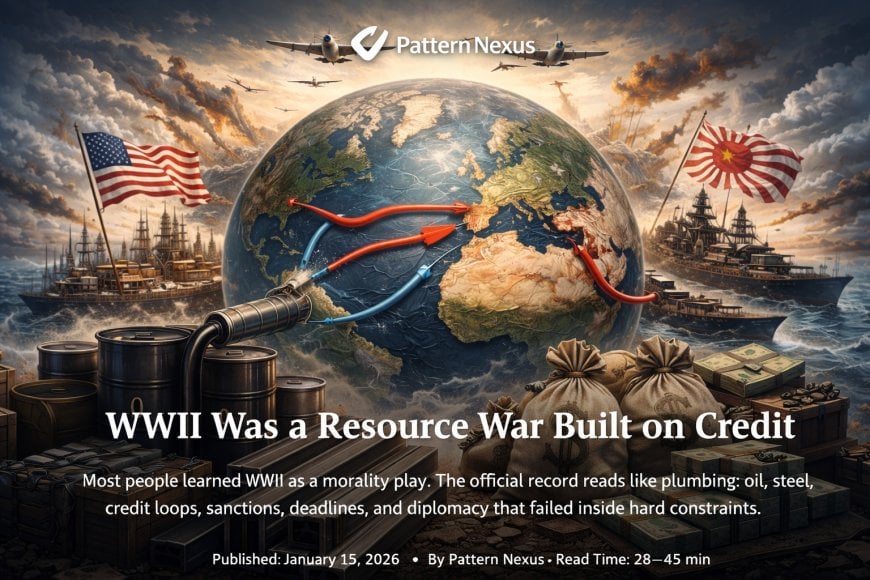
WWII wasn’t a cartoon morality play. It was a systems collision built on oil, steel, credit loops, and diplomatic valves that closed. This piece follows the official record from interwar financing to Japan’s war talks, sanctions, the Hull Note, and the Pearl Harbor timing strike.
Jump to a section
![[HERO_IMAGE_ALT: WWII plumbing map of oil/steel/credit flows across the Atlantic and Pacific]](https://patternnexus.com/uploads/images/202601/image_870x_6969d2a52d51a.jpg)
Stop watching flags. Watch valves. Oil, steel, credit, licensing, and shipping lanes decide what “choices” states actually have.
Warning: When you treat “sanctions” like a moral statement instead of economic warfare, you miss the moment they become a countdown clock.
“They attacked out of nowhere” is a narrative. The record is a sequence: trade integration, tightening controls, asset freeze, failed proposals, deadlines, then execution.
History vs Narrative: Why Most People Don’t Know What Happened
I realized something that most people never confront: what you call “history” is usually narrative. It’s not the raw record. It’s the version that survived institutions, gatekeepers, and national myth-making. It’s simplified for cohesion, moral clarity, and repeatability. The parts that don’t fit get omitted, delayed, buried, or softened.
That’s why WWII is taught like a comic book. Hitler = evil. Japan = evil. America = reluctant savior. End of story. Convenient, clean, emotionally satisfying, and mostly useless for understanding how the world actually works.
This piece is about how WWII looks when you treat it like systems analysis, not cinema. When you follow the plumbing: industrial inputs, resource dependency, credit, sanctions, deadlines, and diplomatic documents that show what each side believed it could or could not do.
Nations don’t act on slogans. They act inside constraints. If you want real causality, you don’t start with “who was good.” You start with “what were the constraints,” “who controlled the inputs,” and “what happened when the valves closed.”
The Board After 1918: Roaring 20s, a New Central Bank, and U.S. Industrial Leverage
There’s a lot you could cover from 1900 to 1918, but for the premises of this article, I’m focusing after that: the Roaring 20s through the lead-up to WWII.
The Roaring 20s roll around. America’s dealing with prohibition and an expanding economy. America just got a central bank. Europe is recovering from WWI, and its production capacity is limited. The U.S., meanwhile, is sitting on the oil and steel boom, and that matters more than most people understand.
Here’s the key premise you need to carry forward: through the 1920s into WWII, the United States is supplying the world with cheap oil and steel. Not because the U.S. is “evil,” but because that’s where the industrial scale is. When Europe is rebuilding and capital is scarce, the supplier becomes the lever.
| Year | U.S. production (thousand barrels) | Approx. share of world production (%) |
|---|---|---|
| 1920 | 442,929 | ~65% |
| 1921 | 472,183 | ~66% |
| 1922 | 557,531 | ~68% |
| 1923 | 732,407 | ~70% |
| 1924 | 713,940 | ~70% |
| 1925 | 620,373 | ~68% |
| 1926 | 770,874 | ~67% |
| 1927 | 901,129 | ~66% |
| 1928 | 901,474 | ~65% |
| 1929 | 1,007,323 | ~63% |
| 1930 | 898,011 | ~60% |
| 1931 | 851,081 | ~58% |
| 1932 | 785,159 | ~57% |
| 1933 | 905,656 | ~58% |
| 1934 | 908,065 | ~57% |
| 1935 | 993,942 | ~56% |
| 1936 | 1,098,513 | ~55% |
| 1937 | 1,277,653 | ~55% |
| 1938 | 1,213,254 | ~54% |
| 1939 | 1,264,256 | ~53% |
| 1940 | 1,503,176 | ~55% |
| 1941 | 1,404,182 | ~60% |
If you read my piece on why the Midwest got its industrial advantages, you already know why the U.S. scaled so hard: the Mississippi River system and deep internal ports created a logistics advantage that made mass production cheaper here than almost anywhere else. That advantage didn’t just build factories. It built leverage.
So when we talk about “who enabled” what later, don’t think in terms of secret rooms and villains. Think in terms of structural position. The supplier and financier of the system shapes the system, even if it claims neutrality.
Industrial dominance is power without permission. If you produce the oil, steel, machine tools, and credit, you can “shape behavior” without firing a shot. That’s the real starting point.
The Credit Loop: Reparations, War Debts, and the Dawes Plumbing
The post-WWI world didn’t just have wrecked cities and bitter politics. It had a financial structure that was unstable by design: reparations, war debts, and interlocked obligations that turned Europe into a debt machine that needed constant refinancing.
Germany owes reparations. Britain and France owe war debts. The United States is the creditor at the center. When that system seizes up, you don’t get “peace.” You get economic collapse, political extremism, and revisionist states that decide the system is rigged and must be broken.
| Component / Flow | Direction | Period | Volume (approx.) | Notes |
|---|---|---|---|---|
| Foreign loans to Germany (mostly U.S.) | U.S. private capital → German state & firms | 1924–1930 | ≈ 25–29 bn RM | Capital inflow driven by Dawes Plan; majority sourced from U.S. banks and investors. |
| Reparations paid by Germany | Germany → Allied governments | 1924–1931 | ≈ 10–11 bn RM | Reparations effectively financed out of foreign loans; phased repayment schedule under Dawes/Young. |
| Allied war-debt payments to U.S. | Britain/France/etc. → U.S. Treasury | mid-1920s–early 1930s | ≈ $2.6 bn | Debt repayment on WWI obligations; U.S. refused cancellation linkage to reparations. |
| Underlying obligation structure | Germany → foreign bondholders | Issued 1924 & 1930; serviced to 1933+billions RM face value | Dawes & Young bonds remained even after reparations suspension; long tail on repayment. |
The Dawes framework is not a conspiracy. It’s a documented attempt to stabilize a broken system using capital markets. But it also proves a deeper point: the West, and especially the United States, wasn’t outside the story. It was inside the plumbing of Europe’s survival.
That matters later because when the global financial system collapses in 1929, Germany doesn’t just “get sad.” It gets annihilated socially. The middle class gets crushed. Savings evaporate. Institutions lose legitimacy. Extremists become “solutions.”
- WWI ends, but the settlement leaves Germany politically and economically boxed in.
- Reparations and debts create a circular dependency on refinancing.
- 1929 breaks the system, and the political center collapses with it.
When the same architecture that financed stability also financed dependency, it created a world where collapse was not a surprise. It was a feature. And when it collapsed, it selected for regimes that would break rules instead of obey them.
Germany: Collapse Mechanics, K-Shaped Society, and War as a Built-In Outcome
Germany didn’t ignite Europe because “one bad guy wanted war.” The system that came out of WWI made another war highly likely, and Germany was the pressure point where everything converged.
Start with the destruction layer: occupation crises, reparations pressure, political humiliation, then the Ruhr shock. France and Belgium moved into the Ruhr in 1923. The German government encouraged passive resistance, and here’s the part people skip: Berlin financed it. They paid wages and covered costs for workers who weren’t producing. To do that, they printed. That helped turn an already unstable situation into full hyperinflation.
| Phase | Approx. dates | Key events | Financing / monetary mechanics | Currency / price effects |
|---|---|---|---|---|
| Postwar inflation & debt overhang | 1919–mid 1922 | Versailles reparations; 1921 London Schedule sets large cash and in-kind payments; Weimar inherits war debts and fiscal deficits. | Gold standard suspended; government finances war and postwar deficits via borrowing from the Reichsbank and money creation, rather than taxation. | Mark slides from prewar ~4.2 per US$ to hundreds per US$ by early 1922; inflation high but not yet hyperinflation. |
| Hyperinflation ignition | mid 1922–Dec 1922 | Reparations crisis; political turmoil; foreign confidence breaks; capital flight accelerates. | Reichsbank buys foreign currency “at any price” to try to meet obligations; rapid expansion of the paper-mark supply as the state monetizes deficits. | Exchange rate collapses from ~320 marks per US$ (mid-1922) to ~7,400 per US$ by Dec 1922; prices begin to move on a monthly, then weekly basis. |
| Ruhr occupation & passive resistance | Jan 1923–Aug 1923 | French and Belgian forces occupy the Ruhr after a reparations default; Berlin orders “passive resistance” (strikes and non-cooperation) in the key industrial region. | Government pays wages of striking Ruhr workers and compensates firms for lost output by printing money; tax receipts shrink as real activity in the Ruhr collapses. | Money supply and prices surge; the currency’s decline accelerates into true hyperinflation as confidence erodes and expectations de-anchor. |
| Currency death spiral | Aug 1923–Nov 1923 | Government ends passive resistance but damage is done; political instability and loss of monetary credibility drive a full breakdown in trust in the mark. | Printing continues to cover fiscal gaps; households and firms dump marks for goods or foreign currency as soon as they receive them, driving velocity and prices even higher. | By Nov 1923, ~4.2 trillion paper marks buy 1 US$; everyday goods (e.g., bread) move from hundreds of marks to hundreds of billions; barter and cigarette money emerge as de facto media of exchange. |
| Stabilization & Rentenmark | Nov 1923–mid 1924 | Stresemann government; Hjalmar Schacht takes key monetary roles; new Rentenmark introduced; later, Dawes Plan restructures reparations and brings in foreign capital. | Issue of Rentenmark strictly limited and backed by mortgage claims on agricultural and industrial assets; Reichsbank stops discounting new Treasury bills and ends direct monetization of deficits. | Hyperinflation stops within weeks; 1 Rentenmark defined as equal to 1 trillion old paper marks; prices stabilize and, with Dawes-era credit inflows, the mark transitions to the new Reichsmark system. |
Then comes the psychological break. You can stabilize currency with a new unit, but you don’t magically restore a destroyed middle class. And that’s the part I keep bringing up because it’s the part that explains the politics: Germany became what it became because the population got bifurcated. A K-shaped society forms. Asset owners survive. The middle class gets wiped. If you had no assets, you fall into dependency. The state prints and patches and tries to hold it together.
When the global economy collapses in 1929, that fracture becomes a canyon. At that point, “extremism” is not a mystery. It’s the predictable output of a broken social contract.
This is why I keep saying: ideology mattered, but collapse was the fuel. Nazism didn’t appear in a vacuum. It grew inside a population that believed it had been destroyed, humiliated, and looted by the postwar order.
Once rearmament and expansion become the internal recovery model, peace starts looking like collapse. In that world, war stops being a “choice” and becomes the default trajectory.
Add the diplomatic failures on top: appeasement, broken guarantees, and the Munich-era belief that concessions could buy peace. Then Germany invades Poland and the European war formally begins. None of that is random. It’s escalation by structure.
Japan: The Resource Trap and the Sanctions Ladder
Japan’s path to war is the cleanest example of why “resource constraints” matter more than slogans. Japan was an industrial power with almost no domestic oil and limited critical materials. It ran on imports. A huge portion of that oil came from the United States before 1941.
That means U.S. economic policy wasn’t just trade policy. It was existential leverage.
| Metric | Approx. value | Notes / context (pre-1941) |
|---|---|---|
| Domestic oil production share | ≈ 7% | Japan produced only minor volumes from domestic fields (e.g., Niigata/Akita); negligible relative to total consumption. |
| Import dependency (total) | ≈ 90–93% | Japan was almost fully dependent on foreign petroleum to fuel its navy, aviation, and industry. |
| Share of imports from United States | ≈ 80–85% | U.S. was the overwhelmingly dominant supplier in the late 1930s; created extreme vulnerability to U.S. export restrictions. |
| Share of imports from Dutch East Indies | ≈ 10% | Secondary supply source under European control; later became a military objective to secure oil after embargoes. |
| Other suppliers (Venezuela, Sakhalin, etc.) | ≈ 5–10% | Small volumes; insufficient to offset U.S. or DEI supply losses. |
| Strategic dependency (military fuel) | Severe | Carrier groups, aviation gasoline, and mechanized forces were entirely dependent on imported petroleum products. |
| Effect of 1940–41 U.S. embargoes | Supply collapse | Export controls and then full embargo cut Japan off from its primary source, pushing it toward Southeast Asian resource seizure and Pearl Harbor. |
Japan expands in China, then moves into Indochina. The U.S. responds with escalating restrictions. The key is that it’s not one switch, it’s a ladder. Export controls tighten, licensing tightens, strategic materials get restricted. Then the system reaches the real cutoff: the asset freeze and effective oil denial.
| Sanctions valve | Date(s) | Scope / channel affected | Strategic effect on Japan |
|---|---|---|---|
| Financial assets & dollar clearing | Jul 1940 – Jun 1941 | Export licensing, forex pressure, credit tightening | Begins choking payments for oil; drains reserves to maintain imports |
| Industrial materials embargo | Jul–Sep 1940 | Scrap iron, steel, tool steels, aviation alloys, machine tools | Constrains aircraft & naval production; increases forex strain |
| Partial fuel embargo (aviation) | Jul 1940 | Aviation gasoline, high-octane fuels, aviation lubricants | Hits air power directly; naval fuel still flowing |
| Asset freeze & full oil embargo | Jul 26, 1941 | Dollar assets, payment settlement, crude & refined petroleum | Cuts Japan off from primary oil supply; creates crisis decision window |
| Allied synchronization | Aug 1941 | UK + Dutch East Indies embargo alignment | Eliminates secondary supply options; no safe diversification remains |
From the Japanese perspective, this was economic strangulation. In their framing, it was an encirclement problem: the ABCD pressure box (American, British, Chinese, Dutch). Whether you agree with their framing is irrelevant. The important part is what they believed it meant operationally.
Inside Tokyo, they did the math: with no new oil, you get a hard deadline. Once you hit that deadline, the navy is dead, the empire is dead, and the regime is dead. So the options collapse into two:
- Back down, unwind the empire, accept U.S. terms, and absorb domestic political collapse.
- Seize the resource zone (especially Dutch East Indies oil), and fight the U.S. to buy time.
This is the part where my framing will annoy people: Japan didn’t build that system alone. The United States supplied oil and industrial inputs for years. The West enabled the build phase. Then the West tried to shut the valves. Japan knew that. Japan understood the system. And when it moved for the Dutch East Indies, it knew the U.S. would respond.
The War Talks: Proposals, Deadlines, Imperial Conferences, and the Hull Note
The lead-up to Pearl Harbor isn’t “Japan randomly attacked.” The official record shows negotiations running in parallel with war preparations, with deadlines set at the highest levels.
This is where people get uncomfortable because it ruins the clean narrative. The U.S. and Japan negotiated intensely in 1941. Japan presented proposals. The U.S. responded. People argue about “ultimatums,” but the real takeaway is that both sides were negotiating inside incompatible constraint sets.
| Node | Date | Document / Action | Function in negotiation | Decision consequence |
|---|---|---|---|---|
| 1 | Jul 1940 | Co-Prosperity Sphere doctrine | Signals Japan’s strategic intent in Asia | Triggers U.S. alarm over regional alignment |
| 2 | Jul 2, 1940 | U.S. Export Control Act | Creates legal framework for phased sanctions | Enables later resource embargoes |
| 3 | Sep 27, 1940 | Hull Principles Letter | Defines U.S. non-negotiables (China, Open Door) | Sets incompatible demands baseline |
| 4 | Sep 27, 1940 | Tripartite Pact (Axis) | Formal alliance commitment | Increases U.S. threat perception |
| 5 | Apr 13, 1941 | Japan–Soviet Neutrality Pact | Secures northern flank | Enables southward resource strategy |
| 6 | Jul 1941 | Southward Advance decision | Moves toward DEI oil zones via Indochina | Triggers U.S. asset freeze |
| 7 | Jul 26, 1941 | U.S. asset freeze + oil embargo | Removes oil acquisition channel | Creates hard time fuse for Japan |
| 8 | Apr–Nov 1941 | Nomura–Hull negotiations | Diplomatic channel maintained | No convergence on China question |
| 9 | Nov 7, 1941 | Japan Proposal A | Seeks sanctions relief without China withdrawal | Rejected as insufficient |
| 10 | Nov 20, 1941 | Japan Proposal B | Final Japanese compromise attempt | U.S. delays response |
| 11 | Nov 26, 1941 | Hull Note | Demands China & Indochina withdrawal | Japan perceives as diplomatic dead-end |
| 12 | Dec 1, 1941 | Imperial Conference decision | Authorizes war | Negotiations terminated |
| 13 | Dec 7, 1941 | Pearl Harbor attack | Operational execution | Secures DEI oil access window |
The Japanese side explored a summit track, with internal division between “make a deal” and “prepare for war.” The U.S. side wanted concrete commitments, especially on withdrawal and non-expansion. The summit path failed because the Japanese leadership could not deliver what Washington required without detonating internal politics.
Then comes the dual-track reality that the Japanese archival record makes explicit: negotiate, but prepare for war if negotiations fail. The September 6, 1941 Imperial Conference is a key marker in the record because it formalizes the policy: continue negotiations while preparing for war, with readiness deadlines baked in.
The late November sequence matters because it shows the collapse:
- Japan submits late-stage proposals (including what’s often called Proposal B).
- A temporary “modus vivendi” concept is drafted on the U.S. side and then abandoned.
- The U.S. delivers the November 26 note (commonly called the Hull Note).
- Japanese leadership treats the terms as incompatible with survival and proceeds toward war authorization.
By December 1, the Imperial Conference decision for war is recorded, and the machine is already moving. That’s the real story: diplomacy didn’t “suddenly fail,” it failed inside a countdown environment where both sides had already positioned themselves for collision.
The documents don’t read like moral theater. They read like statecraft: licensing, freezing assets, exchanging proposals, setting deadlines, and recording decisions. If you only consume the simplified narrative, you miss the real structure.
Pearl Harbor: A Timing Strike to Buy a Resource Window
Pearl Harbor wasn’t about “conquering America.” It was about time. Japan’s planners understood they could not win a long industrial war against the United States. The only viable path was to buy a window:
- Hit the Pacific Fleet to delay U.S. operational response.
- Seize the resource zone across Southeast Asia, including Dutch East Indies oil.
- Build a defensive perimeter that would be too expensive to immediately crack.
- Force a settlement before American industrial mobilization overwhelmed Japan.
This is why the “Dutch East Indies” point matters. Japan wasn’t attacking randomly. It was moving toward the oil. The Dutch East Indies were a Western colonial resource node. Japan knew moving there would trigger U.S. response, and that’s why it tried to preempt the U.S. fleet.
| Resource | Key pre-1941 source region | Share / significance | Controlling power(s) pre-1941 | Strategic relevance to Japan |
|---|---|---|---|---|
| Oil | Dutch East Indies | Major world reserves | Netherlands | Fuel for navy & aviation; war-sustaining input |
| Rubber (natural) | Malaya, DEI, Indochina | ≈ 75% of global production | U.K., Netherlands, France | Tires, vehicles, seals, boots; irreplaceable input |
| Tin | Malaya, DEI | ≈ 70% of global production | U.K., Netherlands | Alloys, solder, munitions, machinery |
| Bauxite (aluminum) | DEI, Malaya | Major Asian reserves | Netherlands, U.K. | Aircraft & industrial metals supply |
| Rice & food staples | Burma, Indochina | Regional surplus | U.K., France | Troop sustainment & logistics |
People want this to be simple: “they attacked because evil.” That’s a children’s explanation. The adult explanation is that sanctions created a deadline, and the deadline forced a gamble.
The First-Shot Constraint: Isolationism, Casus Belli, and Political Physics
Here’s the layer most Americans don’t like to discuss: the United States in 1940–1941 had a public that leaned heavily isolationist. The country didn’t want foreign entanglement, even while it supported aid. That means any administration trying to escalate toward war had a political physics problem: you needed a clean casus belli that unified the public.
Japan misread this. Japan believed Americans would resist a long war and would negotiate after a shock. In reality, the shock unified the public and unlocked full mobilization.
| Period | Public opinion position | Policy expression | Strategic effect |
|---|---|---|---|
| 1939–1940 | Oppose war; support aid | Cash-and-Carry; limited exports | U.S. enters indirectly as supplier |
| 1940–early 1941 | Support major aid; oppose war | Destroyers-for-Bases; Selective Service | U.S. builds capacity without belligerency |
| March–mid 1941 | High support for aid; low support for war | Lend-Lease enacted | “Arsenal of democracy” phase begins |
| mid–late 1941 | Increasing support for naval protection; still no majority for war | Convoy escorts; undeclared naval clashes | Partial naval engagement without declaration |
| Dec 1941 | Public opinion flips after attack | Congress declares war | Constraint removed; full entry |
This is also why the “first shot” language shows up in historical discussions. The U.S. wanted Japan to be the visible initiator. Not because the U.S. wanted to be attacked, but because the political system required Japan to be the obvious aggressor for national unity.
Saying “Washington understood the squeeze could trigger war” is not the same as saying “Washington wanted Pearl Harbor.” This article is about constraints and incentives, not fan-fiction.
Who Enabled Both? The West’s Industrial-Financial Architecture
Now we land the question I asked my audience because it’s the question that breaks narrative programming: which country enabled both Japan and Germany to become what they became?
If you strip the mythology out and look at the plumbing, the uncomfortable answer is not “a villain in a movie.” It’s the Western-centric industrial-financial system, with the United States and Britain at the center, moving oil, steel, and credit around the world for profit and strategic positioning.
America was supplying Japan and Germany with oil, steel, and the financing and credit they needed to leverage all of it. America was also supplying European allies. America was playing both sides in the way empires play both sides: by being the supplier and the banker while the board is being set.
This is why Japan’s war logic matters in your head: Japan knew its supply vulnerability. Japan knew the West had enabled its industrial growth. Japan also knew the West could close the valves. When the valves closed, Japan interpreted it as an existential threat and acted accordingly.
Same with Germany: post-WWI settlement chaos, currency collapse, depression, and a destroyed middle class produced the conditions. But the interwar system also involved Western finance and trade relationships that helped stabilize and then re-entangle Germany inside global capital flows until the political outcome became catastrophic.
So yes, a lot of people won’t like my framing, but I blame the West. Not because Japan and Germany had no agency. They did. Not because ideology didn’t matter. It did. But because the West built the boundary conditions, financed and fed the system, then acted shocked when the output wasn’t “peace.”
The West supplied the inputs, financed the stability, tolerated the buildup, then weaponized access. The war was what happened when the valves finally closed.
| Theater | Resource deficits | Target resource zones | Blockade power | Chokepoints | Decision timer |
|---|---|---|---|---|---|
| Europe / North Africa | Fuel, grain | Ukraine, Caucasus, Middle East | Britain (maritime) | Suez, Gibraltar, Atlantic lanes | Soviet output + fuel clock (1941–42) |
| Asia / Pacific | Fuel, rubber, tin | DEI, Malaya, Indochina | U.S. / U.K. (naval) | Malacca, South China Sea, Hawaii | Oil embargo burn clock (1941–42) |
Pattern Nexus Lens
The Pattern Nexus way to read WWII is not “who was right.” It’s “what system produced this.” When you follow the actual levers, WWII becomes a case study in how industrial supply and finance create power, and how sanctions convert trade into a countdown.
This is also why “history” gets rewritten. Once the war is over, the winners don’t want the public thinking in valves and incentives. They want the public thinking in morality and slogans, because that’s easier to govern and easier to repeat.
If you want to understand geopolitics, stop asking “who started it” like it’s schoolyard drama. Ask “who controlled the inputs,” “what deadlines existed,” and “what did the official documents say they believed would happen next.”
FAQ
Are you excusing Japan or Germany?
No. Explanation is not absolution. This article is about causality. War crimes, ideology, and atrocities are real. They don’t disappear because you understand the constraint layer that made war more likely.
Are you saying the U.S. “wanted” Pearl Harbor?
No. I’m saying U.S. leaders understood sanctions and asset freezes could trigger conflict, and that U.S. domestic politics favored Japan being the visible initiator because the public was isolationist. That’s not a conspiracy claim. That’s political physics.
If sanctions can create deadlines, does that mean sanctions are “bad”?
Sanctions are tools. They can deter, punish, or escalate. The important part is to stop pretending they’re just moral statements. If you cut an industrial power off from the inputs it needs to exist, you are pushing it toward surrender or war. If surrender is politically impossible, you just created a war clock.
What should I read first if I want the raw record?
Start with the primary documents linked below: Executive Order 8832, the U.S. note of November 26, the Japanese note of December 7, and the JACAR summaries of the Imperial Conferences. Then read the interwar debt and Dawes-plan material so you understand Europe’s plumbing layer.
Sources
Primary documents and high-quality institutional references supporting the sanctions timeline, the U.S.–Japan negotiation record, Japanese decision conferences, interwar finance plumbing, and the prewar escalation chain in Europe.
- FRUS: Executive Order 8832 (July 26, 1941) freezing Chinese and Japanese assets
- Federal Register: Executive Order 8832 entry (published July 29, 1941)
- FDR statement on freezing Japanese assets (July 26, 1941)
- FRUS: “The Export of Petroleum Products to Japan” memo (April 9, 1941)
- Yale Avalon: U.S. Note to Japan (Nov 26, 1941) commonly called the Hull Note
- Yale Avalon: Japanese Note to the U.S. (Dec 7, 1941) “Fourteen Part Message”
- JACAR: War talks and the Sept 6, 1941 Imperial Conference summary
- FRUS: Konoe/Tojo internal policy conflict referenced in postwar diplomatic record
- TIME archive: Stimson diary excerpt on the “first shot” framing
- Office of the Historian: Dawes Plan, Young Plan, reparations, and inter-allied debts
- Princeton IFS: “American ‘Reparations’ to Germany, 1919–33” (Schuker)
- EIA: U.S. field production of crude oil (historical series)
- Federal Reserve: Federal Reserve Act of 1913 (central bank establishment)
- USHMM: German invasion of Poland (Sept 1, 1939) initiating WWII in Europe
- Yale Avalon: Munich Agreement text (Sept 29, 1938)
- National WWII Museum: “The Great Debate” (isolationism vs intervention)
- Gallup Vault: U.S. opinion at the start of WWII (aid vs direct entry)
- Teaching American History: Gallup polls April–October 1941 (public opinion snapshots)
- Imperial War Museums: Japan’s oil dependency context and the road to Pearl Harbor
- German History in Documents and Images: Hitler’s memo on autarky and war preparation (Aug 1936)
What's Your Reaction?
 Like
0
Like
0
 Dislike
0
Dislike
0
 Love
0
Love
0
 Funny
0
Funny
0
 Wow
0
Wow
0
 Sad
0
Sad
0
 Angry
0
Angry
0

Nexus (Christopher)
Founder of Pattern Nexus. I research markets, macro, geopolitics, AI, history, ancient systems, and the patterns most people overlook. I’m also building Market Radar, a trading scanner designed to read pressure, risk, confirmation, and setup quality before ch…
Related research
The Clock Starts at Hormuz: Oil Corridors, Timed Failure, and the Real Architecture of Dependency
the-clock-starts-at-hormuz-oil-corridors-timed-failure
4 shared topics, 1 shared asset.
The Modern Control System: Eurodollars, Sanctions, Tokenization, and the Enforcement Stack
Part Three centers the modern era: offshore dollars, eurodollars, sanctions as rail-denial, and the current pivot into stablecoins and inst…
3 shared topics, 1 shared asset, same research avenue.
From Pearl Harbor to Petrodollar: Surrender Calculus, Cold War Plumbing, and the Energy Enforcement Era
Part Two continues from Pearl Harbor to Japan’s surrender and beyond. It challenges the simplified “bombs ended the war” narrative by cente…
7 shared topics, 1 shared asset, same research avenue.
The “Empty” Tanker That Needed a Submarine
An “empty” Venezuelan tanker drew U.S. Coast Guard pursuit, Russian diplomatic pressure, and reported naval and submarine escort. Pattern N…
3 shared topics, 2 shared assets.
Market Wrap 01.05.26: The Duration Bid Turns On Everything
Stocks ripped, metals ripped, and the 10-year backed off to ~4.16% as weak ISM data and Venezuela geopolitics pushed investors into duratio…
3 shared topics, 2 shared assets.
Market Wrap-Up 12/31/2025: Silver Flush, Rates Pop, and the Year-End Reality Check
On the final session of 2025, equities drifted lower while commodities stayed violent: silver flushed hard, gold slid, yields popped, oil s…
2 shared topics, 2 shared assets.
Market Wrap-Up 12/30/2025: Metal Whiplash, Quiet Index Drift, and the Year-End Liquidity Tell
Stocks drifted lower in holiday-thin trade while commodities stayed unstable: gold and silver rebounded after margin-driven turbulence, oil…
2 shared topics, 2 shared assets.
The Monetary Break: How Nixon, Silver, & the Eurodollar Rewired the Global System (1968–1979)
Between 1968 and 1979, the collapse of the gold window, the rise of the Eurodollar, and the Petrodollar shift transformed the global moneta…
4 shared topics, 2 shared assets.
Comments (0)
Security Check
Please complete the captcha to verify you are human.