
Why I’ve Been Quiet
A Pattern Nexus analysis of Iran, markets, inflation, control structures, labor softness, AI disruption, and the broader geopolitical and economic pressure building beneath the surface.

I’ve been quiet because too many major systems are under pressure at the same time, and too much of what people are being told is filtered through fog, incentives, and managed interpretation. The same day we attacked Iran, the 10-year was below 4 and sitting in danger territory. I’m not saying that alone proves causation. I’m saying the timing matters when jobs are stalling, inflation is rising, households are under stress, private credit looks fragile, and the Fed appears confused and divided. Iran is not an isolated story. It sits on top of market stress, labor weakness, debt pressure, shipping changes, geopolitical realignment, AI disruption, and a broader control structure shaping what people see and what they are trained to ignore.
Incentives, interests, bottlenecks, narrative alignment, and power consolidation are doing more explanatory work right now than surface-level headlines.
Inflation, labor softness, duration risk, private credit exposure, household strain, and energy pass-through are all pressing on the same machine.
The Iran file is full of conflicting claims, indirect signals, and state-mediated interpretation, which makes certainty dangerous.
The Quiet
I’ve been quiet. It’s been mostly intentional. I usually have a very good understanding of the games that play, the systems that work, and the intent of the situation. Long before any of it occurs. I’ve been doing this now for two decades. I know I’ve only been doing it publicly for six months, but the people that know me personally have watched me correctly predict world events over and over again with high accuracy. Maybe not the exact details of the event, but the timelines and the way it shapes out. You’ve seen some examples of that, early calls on Iran, and my calls on Venezuela.
I’ve been quiet because too many layers are moving at once, and too much of what’s being presented publicly is being filtered through fog, incentives, and managed interpretation.
Markets, Inflation, Shipping, and Pressure
There’s a lot going on in the financial markets. I don’t really want to get conspiracy theory here, but the same day we attacked Iran, the 10-year was below 4 and in danger territory. I’m not saying there’s causation, but on top of that, we have stalled jobs growth. We have spiking inflation, which I wrote about when I talked about oil a month ago, before the Iran crisis even began, when I was writing about this. They create conditions throughout the world that change things. Trump’s suspension of the Maritime Act allowing foreign-flagged vessels to transmit cargo between U.S. ports, the Jones Act specifically, is unprecedented. All these foreign ships heading to U.S. ports to grab money. There are so many angles here. I couldn’t possibly cover them all. That’s why I’ve been quiet. So much going on. So many different pieces of this puzzle.
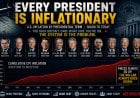
And there actually are hard numbers under some of that pressure. The March CPI release showed headline inflation at 3.3% year over year, up from 2.4% in February, while the energy index was up 12.5% over the year. That matters because once energy starts moving, it does not stay contained to one line item. It bleeds through freight, logistics, food, manufacturing, margins, sentiment, and eventually policy. The 10-year Treasury yield was 4.29% on both April 8 and April 9, 2026, which is not some irrelevant market footnote when the whole system is built on leverage, refinancing pressure, and the cost of duration. And on shipping, the reason the Jones Act angle matters is because U.S. law generally reserves domestic coastwise trade between U.S. points to U.S.-built, U.S.-owned, U.S.-documented, U.S.-crewed vessels, with waivers treated as national-defense exceptions rather than normal operating posture. That means when that structure gets touched, you are not looking at some tiny technical adjustment. You are looking at a signal that pressure is already showing up somewhere in the machine.
And then you have Lindsey Graham, who’s spent my entire life advocating for the destruction of Iran, and now says the goal has always been a diplomatic solution. Some of these things these people say are so absurd. It’s, did they switch you? Are you a different person? Because there’s no way you’re the same one that’s been ranting for 20 years. I knew this was all going down. I wrote about it. I made a post early January. I said, when Chuck Schumer and Lindsey Graham visit the White House in the same week, look out. And since then, the world’s been very chaotic. Those two are connected in ways to things they don’t really want to talk about. But regardless, it’s very obvious to see. It’s not the premise of where I’m going here.
Iran, Fog of War, and Narrative Failure
We need to actually cover this Iran conflict in some way, but there’s no truth right now. There’s speculation, false tweets, media misinterpretations, fog of war, and the other enemy side’s interpretations. There are multiple factions of both sides competing for power. There’s power competition in the Middle East. Iran somehow thinks it has some kind of ground or leverage. I don’t know what that is. I know we’ve lost a lot of missiles and spent a lot of money, and regardless of what people want to say, we haven’t really achieved much. I don’t expect these talks to go anywhere. I’ll be shocked if they do. I’ll be less surprised if we’re bombing again soon.
There’s word that China is flying in equipment to Iran and selling Iran air defenses and, among other things. Is this true? There’s so much fog of war, misinformation, direct information, direct government, the government story if you will. The cleanest way to say it right now is that Reuters reported on April 11 that U.S. intelligence indicates China is preparing a shipment of advanced air-defense systems to Iran, and Reuters had also reported in February that Iran was nearing a deal for Chinese anti-ship missiles while also discussing surface-to-air systems and other weapons. That does not make every social media version of the story true. It means there is enough smoke around the transfer issue that it cannot be dismissed out of hand, but it is still intelligence-reporting territory, not clean public confirmation.
So the reason I’ve been quiet is because I can’t understand what’s going on. We’re in this weird geopolitical global stalemate where the main players are all at a precipice, but nobody wants to make any kind of maneuver that will cause the other side to interpret it as a threat, so instead they make indirect maneuvers that are still interpreted as a threat. We could talk about Cuba versus Russia. We could talk about Venezuela. We could talk about Iran. We can go on and on and on. We could talk about the fact that the United States is involved in counterterrorism and counternarcotics operations in Ecuador and bombing places in Colombia, and the Colombian government is claiming the United States is invading. But that’s not making the U.S. news at all either.
Economic Fracture and Household Stress
We could talk about private credit, its effect that it’s about to blow up. We could talk about all the parallels to 2008 right now. We could talk about the fact that inflation is spiking, and if energy prices hold up, inflation will continue to rise. We could talk about job loss. We could talk about AI displacement. We could talk about some people’s misuse and misunderstanding of AI. We could talk about economic destruction that’s currently occurring. We could talk about the stress on households, the amount of consumer debt that is in default, the car manufacturers cutting back, the dismal reports from auto manufacturers. We can pile on the negative economic numbers.
And again, this is where the system-level stress stops being abstract. New York Fed data shows total household debt at $18.8 trillion at the end of 2025, with credit card balances at $1.28 trillion and auto loan balances at $1.67 trillion. That is before you layer on higher energy costs, weaker job quality, tighter credit, and the kind of margin compression that starts pushing people from “still making it” into “one bad quarter from breaking.” Private credit is another one of those areas that looks stable right up until it doesn’t. The BIS has already flagged how rapidly private credit lending has grown in exposed pockets, including software and SaaS lending, which is not exactly comforting in an economy being structurally disrupted by AI and tighter capital conditions. And on autos, even the mainstream reporting is already showing mixed demand, tariff pressure, model delays, production shifts, and weaker guidance in key areas. None of that means collapse tomorrow morning. It means the stress is broad, layered, and not isolated to one dashboard.
We can talk about the lies in the BLS data, the manipulated data. We could talk about the fact that the data that came out last month had seasonal adjustments due to cold weather, even though March was one of the warmest Marches in the history of the United States. We can go on and on and on and on. But the facts of the matter are that all the data is pointing to something really broken, and we’re just trying to flip the narrative into something to distract.
The labor data is one of those places where the headline and the feel of the economy do not line up cleanly. March payrolls rose by 178,000 after a revised 133,000 decline in February, and BLS said payroll employment had changed little on net over the prior 12 months. That is not the kind of labor backdrop that inspires confidence, especially when people are already feeling squeezed on necessities. It looks more like a labor market trying to maintain appearance while the underlying structure gets softer.
I’m going to quote Gerald Celente here again. I still think he’s a nut job, but I did listen to him a lot back in 2006. And he said when the powers that be lose control, they take you to war. And it just holds true every time. It’s ridiculous.
Fed Confusion and the Danger Zone
I remember I’ve been predicting economic trouble in 2026 since before September. None of this stuff is surprising me. It’s all just confirming that there’s deterioration in the economy, and the Fed’s over here confused, lost, dazed, and worried about Powell, and I don’t even think they know what’s going on. They know the data is manipulated, but they won’t say anything, won’t do anything about it. And then the Fed is divided on where to go and what the proper policy maneuver is going forward. And every time the Fed has policy errors, we get a crisis. We get a recession, but dare I say it, a depression, if they’re wrong enough.
And we are in that danger zone. We are bouncing between up and down. The bulls and the bears of the market, if you metaphorically understand what I’m saying, are in a battle of their lives. And the winner takes it all at this point.
That Fed confusion is not imaginary. In the March 17–18 FOMC minutes, officials said upside risks to inflation and downside risks to employment were both elevated. In the March projections, 17 of 19 participants saw upside risks to PCE inflation, and 16 of 19 judged uncertainty around inflation and unemployment to be higher than usual. That is not a picture of an institution with clear line of sight. That is an institution boxed in between inflation pressure, labor softness, geopolitical risk, and credibility risk, trying to decide which fire matters more.
We can cover the K-shaped recovery. We can cover the fact that to live comfortably in America, you need about $120,000 a year, and the average American income is less than 50. We could talk about the loss of available jobs to a certain subsection of the economy and economic cohort and intelligence bracket. I know we don’t like to talk about intelligence. It misdirects people. It causes immediate emotional reaction, but that’s not the point. Intelligence equals opportunity equals the amount of things you can conceptualize and understand and take advantage of in our society, so intelligence is very important.
Intelligence, AI, and Structural Disadvantage
And the lower end of the intelligence cohort, remember, on a spectrum, everyone’s between about 90 and 110, most people, and then you get to standard deviations above and below that. I’m saying the economy of the world is getting to the point where you need at least 115, 120 IQ to be able to completely understand the world, and that’s most doctors there. So maybe it’s actually higher than that. Which means most people are functionally disadvantaged to the structure of the world as it sits today, to even be able to understand it, to make coherent decisions about what it means for them and their future and the greater impacts on society as a whole.
That is one of the most under-discussed parts of what is happening right now. The system is not just becoming harsher. It is becoming more cognitively demanding. It is becoming more layered, more abstracted, more mediated by technology, more dependent on interpretation, and less forgiving to people who cannot model second-order and third-order effects. That does not mean those people are bad. It means the structure itself is increasingly hostile to average comprehension, average planning ability, average attention span, and average reaction speed. And when a society gets too complex for most of the population to accurately interpret, that society becomes easier to manipulate, easier to redirect, and easier to emotionally govern.
We face so many. There’s never been a time like this, other than basically the invention of steam travel throughout the world, the first industrial revolution if you will, that massively changed global society on a scale we’ve never seen. And every advancement since then, other than the internet, maybe the cell phone, along with computer, but AI is bigger than all of that. AI is bigger than all of that combined. AI is the encapsulation of all of that and so much more, because AI is not a consciousness, it’s intelligence. And intelligence is the key to unlocking productivity and the understanding of our world around us.
Even those subsets of the intellectual bracket will struggle to use AI to its full capability to advance themselves beyond where they already are in society. AI is just a tool. I can give you a circular saw or a screw or the best impact gun ever made. That doesn’t mean you can effectively drill 100 screws in. That requires skills most people don’t have.
And that’s the part people keep missing. They talk about AI like access equals advantage. It does not. Access is not the same thing as competence. Access is not the same thing as abstraction. Access is not the same thing as judgment. Access is not the same thing as being able to formulate the right question, interpret the right output, reject the wrong output, and integrate the result into real-world action. Most people are going to use AI the same way they use every other powerful tool: badly, superficially, emotionally, reactively, or only within the confines of the life they already understand. That still changes society. But it does not distribute capability evenly.
How I Think
I have a lot of skills. I’m not doing this to brag. I’m not saying this in a way that is inflammatory. I have a lot of skills because I like to accumulate skills, knowledge, and the ability to do anything I want to try to do. I don’t see something and hire somebody. I see something and I figure it out. I’ll take apart a car, I’ll take apart an engine, I’ll rebuild something, I’ll do something I never did before, because that’s how you learn. And my viewpoint is, another human created it, I should be able to take it apart and put it back together and understand it. It’s not that complex. Most things aren’t. People are afraid of understanding.
The fact that I have a high 3D spatial videographic mind makes it a lot easier for me. I don’t think in words. I understand that most people think in words, sentences. I think in 3D models overlaid on top of 3D models, on top of everything else I’m thinking about, which at any one time is hundreds of different subjects or topics. In a conversation with you, I can switch between basically the entire cohort of existence and back and forth with vast understandings of most things I talk about, because I’ve spent decades studying them all.
Everything interests me. I’ll watch a video or I’ll read an article on just about anything, even things that are stupid. Why women buy a certain makeup brand or something. I’m not kidding. I read. There is no limitation to what I’ll read, because even if I don’t agree with it, I’d like the perspective of the person writing it. It gives me more understanding and a basis to form my own opinions. A lot of people get in a broad tunnel and try to find things that fit their narrative. I find the things that oppose my narrative directly. I want more information to confirm or deconstruct my understanding. Because if my understanding is wrong, there’s missing information. And I need that. I want to absorb that missing information so I can have a better understanding.
I don’t believe my understanding is correct. I believe my understanding is the best understanding with the information I have. And I know that I could be wrong because I could be lacking information. This is one of the most important aspects of intelligence, and the majority of the human cohort does not understand it.
That right there is the difference between intelligence and ideology. Intelligence, real intelligence, is not certainty. It is not confidence theater. It is not emotional attachment to a conclusion. It is not trying to win the room. It is not curating evidence after the fact to defend a fixed position. It is the willingness to attack your own model, to expose your own assumptions, to let new information break something you thought was stable, and then rebuild cleaner. Most people do not do that. Most institutions do not do that. Most media absolutely does not do that. They build narratives first and then go shopping for evidence. That is why their interpretations fail so often under stress.
Manipulation, Media Alignment, and Control Structures
And I’m sorry I’ve been all over the place in this article, but I guess the premise of this article is we’re being manipulated with the same Iran story. I don’t know what’s going on. I would accurately predict that it’s not going to be good and we’re just buying for time while we reload and reposition assets to try to do something else. I don’t think the Iranian regime is going to capitulate, and I don’t think America can agree to the terms that they have as they are right now. The terms are ever-changing, the goalpost is moving. I could cover directly what it is, but it doesn’t really matter. It’s not the point of this. The point of this is we’re in a state where everything we’re being told is manipulated for someone’s point of view.
And the government and media seem to be aligning broadly in ways they usually don’t align. And that’s scary. People may blame that on Trump, but that has nothing to do with Trump. That has to do with our national security state and the way the world works. And the people in power that own these companies and corporations and the way they align their interests. It’s really simple. Incentives and interests and control structures. I write about it extensively.
But where we are, how that piece is playing out, what direction we’re heading, I don’t know. I would anticipate an escalation before I would anticipate what the market thinks is going to be the end of this. Because for a long time, there’s no backing out if you start this. We’ve started this twice now. Unless we want to just basically surrender on paper, that would end it. But maybe, again, I don’t know what’s happening. I don’t know where we’re going. So that’s why I’ve been quiet, and I’ll continue to be quiet until we have confirmation of the direction where we’re headed as a global society, as the world order unfolds and its dynamic changes and realigns faster than we can interpret.
And everybody argues about issues that don’t matter. The media keeps posting trivial, inflammatory content to distract from all the key issues going on. And what happened to all the riots over immigration and everything else? How did those people not switch into this Iran conflict and have anything to say? You should ask. That should be a question in your head, and the answer I won’t direct you to. But follow the money. And once you do, it’ll always lead you to the same places and the same political groups and power structures.
And there’s so much evidence out there throughout every country, throughout every part of society. You can read books that talk about how to manipulate populations, how to bring governments down, how to destroy a country from within. When studied throughout history, great minds don’t think about trivial issues within their populations. They think about how to conquer the globe in some great conquest of all humanity. I’m not saying that’s right. I don’t support it. I’m just saying that at some point, the world becomes boring for these people, and the only thing left is geopolitical risk on a scale most humans can’t understand.
That is why the surface-level framing is so useless now. Everyone wants the simple explanation, the digestible explanation, the partisan explanation, the moralized explanation, the explanation that lets them preserve their prior worldview and still feel informed. But the real explanation is layered, ugly, incentive-driven, nonlinear, and full of actors whose objectives only partially overlap. That is why everything feels incoherent. It is not because nothing makes sense. It is because too many people are trying to explain a control structure through the language of isolated events.
So I’ll leave you with those thoughts today, and we’ll see how the next four to five months play out as the global pieces realign. There’s pressure all over the world in ways we haven’t seen pressure since, well, not in my lifetime, and not in the majority of people still alive today’s lifetime. We don’t know how close we are because our understanding of the history is manipulated. But the precedents, the parallels, they’re broad, vast, and hidden right below the layers of society that the control structure is designed to make you misinterpret, intentionally dismiss, or already not pay attention to at all. And that’s no one’s fault except for the control structure of the world.
Pattern Nexus Lens
This piece is not really about one headline, one strike, one data release, one politician, or one media cycle. It is about stacked pressure across multiple layers that are all interacting at once. Energy pressure feeds inflation. Inflation narrows policy flexibility. Policy uncertainty collides with labor softness. Geopolitical escalation collides with debt structure, shipping risk, and market fragility. Media framing then cuts that entire multi-layer process down into isolated emotional narratives for mass consumption.
What is being sold publicly as isolated developments is actually stacked pressure across integrated systems, filtered through incentives and control structures.
That is how control structures work. They do not just censor. They route attention. They shape interpretation. They assign urgency. They create acceptable emotional lanes. They divide public attention into fragments while power operates across integrated systems. When the public is trained to see events in isolation, the people running integrated systems gain the advantage by default.
That is also why this moment feels so unstable. Too many major systems are under visible stress at the same time, and the institutions tasked with managing those systems no longer project coherence. Markets are signaling pressure. Households are signaling pressure. Geopolitics is signaling pressure. The labor structure is signaling pressure. The information environment is signaling pressure. And the deeper issue underneath all of it is that the modern world has become too layered for most people to interpret without mediation. Once that happens, the people who control mediation gain disproportionate power over reality itself.
FAQ
Why have you been quiet?
Because there are too many moving pieces, too much fog of war, too much manipulated narrative, and too much systemic pressure building across markets, geopolitics, labor, inflation, and AI all at once.
What is the core point of the piece?
The core point is that we’re in a state where everything we’re being told is manipulated for someone’s point of view, while the deeper structure underneath it is under visible pressure and realigning faster than most people can interpret.
Why does the Pattern Nexus lens matter here?
Because this is not one issue. It is a layered system problem involving incentives, interpretation, media framing, market stress, state behavior, and control structures operating together.
Sources
These sources support the added factual anchors on inflation, labor, Fed posture, household debt, and China-Iran reporting referenced in the article.
- U.S. Bureau of Labor Statistics — Consumer Price Index, April 10, 2026
- U.S. Bureau of Labor Statistics — Employment Situation Summary
- Federal Reserve — FOMC Minutes, March 17–18, 2026
- Federal Reserve Bank of New York — Household Debt and Credit Report, Q4 2025
- Reuters — U.S. intelligence indicates China preparing weapons shipment to Iran
What's Your Reaction?
 Like
0
Like
0
 Dislike
0
Dislike
0
 Love
0
Love
0
 Funny
0
Funny
0
 Wow
0
Wow
0
 Sad
0
Sad
0
 Angry
0
Angry
0

Founder of Pattern Nexus. I research markets, macro, geopolitics, AI, history, ancient systems, and the patterns most people overlook. I’m also building Market Radar, a trading scanner designed to read pressure, risk, confirmation, and setup quality before chasing a move. Pattern Nexus is where I connect the dots between data, history, technology, and the bigger system playing out around us.















Comments (0)