

Copper in the AI-Industrial Era: Why the World Is Running Out of the Metal That Powers Everything
Copper has entered a new macro-industrial regime. AI data centers, global grid expansion, renewable infrastructure, collapsing ore grades, and a decade of underinvestment have fused into a structural deficit that will define the next decade. This is the deep technical and strategic picture as of November 2025.
Copper has entered a new macro-industrial regime. AI data centers, global grid expansion, renewable infrastructure, collapsing ore grades, and a decade of underinvestment have fused into a structural deficit that will define the next decade. This is the deep technical and strategic picture as of November 2025.
Jump to a section
Copper in the AI-Industrial Era: Why the World Is Running Out of the Metal That Powers Everything
The 2025 Shift: Copper Snaps Into a New Regime
Copper did not just drift higher in 2025. It shifted regimes.
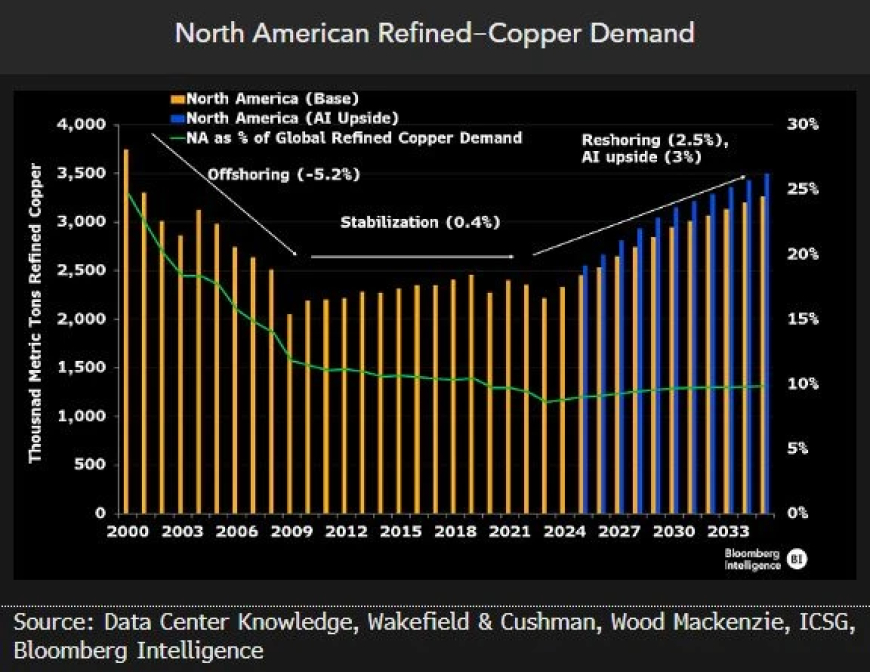
Prices ripped higher from early 2025 into the final quarter, but the move was not about CPI prints, headline inflation narratives, or short-lived speculation. The shift was driven by something deeper and far more persistent: a multi-year structural deficit where the world’s physical build-out is colliding with the hard limits of copper supply.
Across institutional research, the message keeps repeating under different labels: copper has become the limiting reagent of electrification, the energy transition, and AI-era infrastructure. The rally in 2025 was not an isolated event. It was the market starting to price that structural reality in advance.
The Demand Stack: Energy, Grids, AI, and Legacy Construction
Copper demand is now a four-layer stack. The mistake is to focus on one layer at a time. The stress comes from all four compounding at once.
Energy transition: EVs, solar, wind
The energy transition alone is enough to keep copper on a structural up-trend. Studies of long-run demand show global refined copper usage nearly doubling by the mid-2030s, with electric vehicles, solar, wind, and related infrastructure accounting for a large share of the growth. Every solar farm, wind park, and charging corridor is effectively a copper project in disguise.
Grids: the unsung giant
Global grid spending has surged into the hundreds of billions of dollars per year, and that spend is overwhelmingly copper-intensive. High-voltage lines, substations, transformers, distribution networks, and behind-the-meter wiring all draw from the same pool of refined metal. The more intermittent and distributed the generation mix becomes, the more grid copper you need just to keep the system stable.
AI and data centers: small base, explosive trajectory
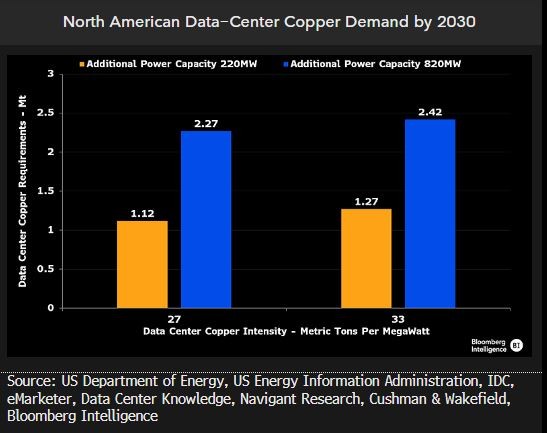
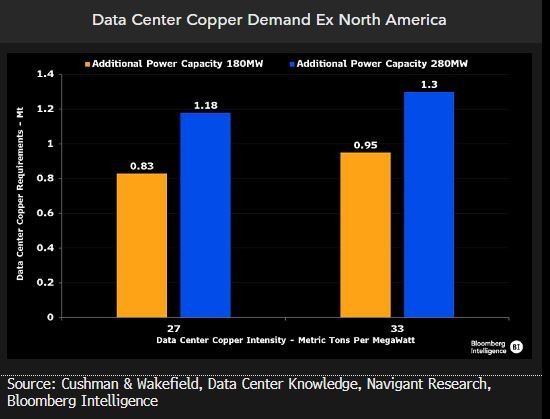
On paper, AI and data centers still account for a small slice of global copper consumption. But that slice is expanding fast. Estimates show data-center copper demand more than tripling between 2020 and 2025, with AI-heavy facilities using far more copper per megawatt than legacy centers. Some forecasts suggest AI and data centers alone could add around one million tonnes of annual copper demand by 2030.
Relative to total global consumption, that might look modest. In a tight market running thin inventories, it is not. It is the marginal wedge that decides whether stockpiles are merely low or effectively gone.
Legacy construction and industry: the heavy base
Underneath the energy transition and AI narratives sits the heavy base of traditional demand: construction, transportation, white goods, conventional industry. Analysts regularly remind the market that the bulk of copper usage still comes from these sectors. They do not grow explosively, but they do not disappear either. They form the floor under the demand curve.
The Silent Supply Crisis: Ore Grades, Permitting, and Project Delays
If demand is the headline, supply is the quiet crisis behind it.
Ore grades and aging mines
The core producing regions for copper, especially in South America, are wrestling with falling ore grades and aging assets. Lower ore grades mean more rock must be moved, more energy must be burned, and more capital must be deployed to produce the same tonne of copper. That raises the marginal cost of supply and makes it harder to ramp production when prices spike.
Multi-decade project timelines
New greenfield mines are not quick decisions. Typical timelines from discovery to first production run well over a decade. Even brownfield expansions are increasingly tangled in permitting, litigation, environmental standards, local stakeholder negotiations, and infrastructure bottlenecks. In practical terms, the copper output available in the early-to-mid 2030s is largely determined by investment decisions that should already be on the books.
The ghost pipeline
When analysts reconstruct the future supply curve, a striking share of projected tonnage comes from projects that are not yet financed, permitted, or fully defined. Some long-range base-case scenarios require millions of tonnes of new supply by 2035 from assets that currently exist only in slide decks and preliminary studies.
Friendshoring versus reality
Major economies are now treating copper as a strategic material and talking about friendshoring, domestic mining, and secure supply chains. On the ground, large projects in North America and other “safe” jurisdictions remain stalled by legal battles, community opposition, and regulatory complexity. Classification as critical does not magically shorten timelines or solve permitting gridlock.
The Conflicting Narratives: Bulls, Skeptics, and What’s Actually True
The copper debate in 2025 has split into two loud camps: structural bulls and cyclical skeptics. Both see part of the picture; neither has the full frame on their own.
The structural bull view
The bullish side argues that a decade of underinvestment has left the market unable to supply the metal required for electrification, grids, and AI infrastructure. They point to long lead times, declining ore grades, rising costs, and a pipeline dominated by uncommitted projects. In this view, the world is heading toward multi-million-tonne annual shortfalls unless prices move high enough to force new investment and substitution.
The cyclical skeptic view
The skeptical side pushes back by pointing to macro cycles and sentiment. They note that parts of the 2025 rally look correlated with expectations of central-bank easing and a broad bid for cyclicals. They highlight that AI and defense demand, while fast-growing, are still small compared to air conditioning, construction, appliances, and traditional industrial uses. In their framing, copper can still see sharp drawdowns if global growth slows or if key consuming regions stumble.
The reality is that both narratives hold. The long-run constraint is real, but the path from here to there is not a straight line. It is a series of overshoots and corrections around a rising structural floor.
The AI-Grid Bottleneck: Why Data Centers Matter More Than Anyone Admits
The interesting part of the copper story is not that AI suddenly consumes the majority of global tonnage. It is that AI concentrates stress on the grid in specific places and timeframes.
High-density AI data centers pull massive, continuous loads from regional grids. They demand new substations, upgraded lines, thicker conductors, more transformers, and more redundancy. All of that is copper-heavy. In regions like Northern Virginia, Texas, and parts of Europe and Asia, data-center build-outs are already forcing accelerated grid investment schedules.
On a global chart, AI may still look small. On a regional copper balance, it can be the factor that flips a system from tight to critically short. When this effect is layered on top of EV rollouts and renewable-heavy grid upgrades, the margin for error collapses.
 .
.Macro Lens: Liquidity, Industrial Cycles, and Commodity Tightness
Copper sits at the intersection of physical scarcity and monetary policy. It is deeply tied to industrial production and construction, but it also trades like a leveraged proxy on global liquidity. When central banks shift from aggressive tightening toward balance-sheet expansion or rate cuts, structurally constrained commodities tend to respond disproportionately.
In an environment where the energy transition proceeds, AI infrastructure expands, and governments lean on fiscal stimulus and industrial policy, copper becomes a natural outlet for excess liquidity. Capital flows chase scarce, hard assets. Every incremental easing cycle that lands on top of a tight physical market turns into a magnifier.
This is why the same metal can look overvalued to short-horizon macro traders and under-supplied to anyone staring at 2030–2035 project lists. Both perspectives are correct at different time scales.
Deep Lens: Copper as a Strategic Material in a Fragmenting World
The geopolitical layer adds another twist. Copper is no longer just a line item in industrial statistics. It has become a strategic variable in national security and industrial policy.
Refining and processing capacity are geographically concentrated. A small number of countries dominate smelting, refining, and exports. At the same time, pressure is building for more aggressive environmental standards, labor protections, and community safeguards at mine sites. This combination of concentration and constraint raises the risk of supply disruptions, export controls, and politicized trade flows.
Major economies are responding with critical-mineral strategies, stockpiling, long-term offtake agreements, and attempts to carve out “friendly” supply corridors. But these responses compete with each other. They raise the possibility that copper becomes not just a commodity, but a lever in larger strategic confrontations.
Conclusion: The Metal That Sets the Speed of the Future
As of late 2025, the signal emerging from research, trade data, mining project lists, and policy documents is consistent:
- Demand for copper from energy, grids, AI, and legacy sectors is rising and compounding.
- Supply growth is slow, capital-intensive, and constrained by geology, regulation, ESG, and politics.
- The project pipeline relies heavily on assets that are not yet permitted or financed.
- Refining and processing are concentrated in a handful of countries.
- Geopolitical fragmentation is increasing, not decreasing.
Copper is not simply another industrial metal in this environment. It is the physical bottleneck that determines how fast the energy transition can proceed, how quickly AI infrastructure can scale, and how resilient national grids can become.
The future is not limited by ideas or capital. For the first time in decades, it is being limited by the availability of a specific set of atoms. Copper is at the center of that constraint.
Copper’s Price Trajectory: From Commodity Range to Structural Breakout
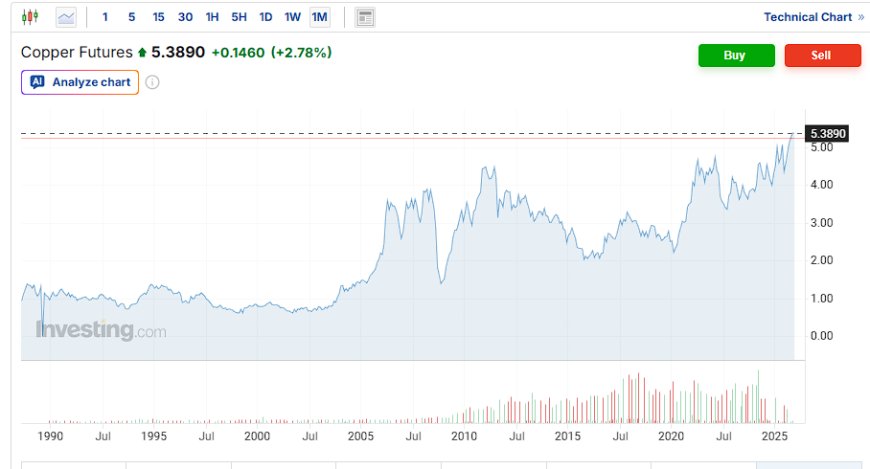
The long-term copper futures chart is not just noise on a screen. It is a visual record of a regime change. For almost three decades, copper oscillated inside a relatively stable range, roughly between one and four dollars per pound. That era corresponded to a world where mines were still young, ore grades were higher, and the build-out of grids, EVs, and AI infrastructure mostly lived in the future.
The first clear rupture came in the early 2020s. The 2021 spike was dismissed as a post-pandemic kink. But by 2024–2025, copper was probing fresh highs again, grinding toward the mid-five-dollar range and refusing to mean-revert back into its old band. That is not typical cyclical behavior. It is what a structural constraint looks like when it collides with a new wave of industrial demand.
When we overlay Autocad-style industrial planning curves (what needs to be built) with the Nexus-F3 structural framework (what can actually be built, given mines, grids, and capex cycles), the result is a set of forward paths that cluster well above the old range. In that combined view, the three-decade $1–$4 band stops being an anchor and becomes a historical artifact of an easier world.
- Legacy regime: ample supply, slower electrification, limited AI and data-center load, low-to-moderate grid expansion.
- New regime: aging mines, falling ore grades, slow permitting, aggressive grid and renewables build-out, and a compounding AI power footprint.
Under Nexus-F3, even optimistic supply scenarios show the global system sliding into a persistent structural deficit from the mid-2020s onward, with inventories repeatedly flirting with exhaustion. In that context, the chart’s breakout is not the end of a move; it is the opening act of a materials-constrained industrial decade.
Autocad tells you the theoretical build path for grids, EV fleets, and AI campuses. Nexus-F3 tells you the physical and temporal limits of copper, capex, and throughput. The gap between those two curves is where price lives. As long as the world keeps planning for an AI-electrified future faster than it invests in mines and infrastructure, that gap will remain open—and copper will continue to price it in.
Sources
- S&P Global – Copper on the Rise: The Future of Copper and the Looming Supply Gap
- S&P Global – The Future of Copper: Will the Looming Supply Gap Short-Circuit the Energy Transition?
- UNCTAD – Global Trade Update: Copper in the New Green and Digital Economy
- UNCTAD – Smarter Copper Trade as Bottlenecks Threaten the Global Transition
- Wood Mackenzie – Is Soaring Copper Demand an Obstacle to Future Growth?
- Wood Mackenzie – A Reality Check on Trends in Copper Supply and Demand
- Trafigura – AI Could Add 1 Million Tons to Copper Demand by 2030
- Data Center Dynamics – AI to Add 1 Million Tons to Copper Demand by 2030
- Financial Times – BHP Warns AI Growth Will Worsen Copper Shortfall
- UNCTAD – Critical Minerals and the Energy Transition
- International Copper Association – On Copper Demand
- S&P Global – Looming Copper Supply Shortfalls and Net-Zero Goals
Menene Martaninka?
 Kamar
0
Kamar
0
 Karya
0
Karya
0
 Kauna
0
Kauna
0
 Ban dari
0
Ban dari
0
 Wao
0
Wao
0
 Bacin rai
0
Bacin rai
0
 Fushin
0
Fushin
0

Nexus (Christopher)
Founder of Pattern Nexus. I research markets, macro, geopolitics, AI, history, ancient systems, and the patterns most people overlook. I’m also building Market Radar, a trading scanner designed to read pressure, risk, confirmation, and setup quality before ch…
Related research

Texas Turns AI Data Centers Into a Grid-Admission Audit
Texas Gov. Greg Abbott directed PUCT and ERCOT on August 3, 2026 to conduct a comprehensive verification and audit of data centers advancin…
5 shared topics.
AI Data Centers Move the Power Plant Behind the Fence
Reuters reported that at least 57 off-grid U.S. power plants are proposed or under construction to serve individual data centers, totaling …
5 shared topics.
AI Load Starts Breaking the Grid Operator, Not Just the Grid
Surging data-center demand is pushing PJM from a reliability problem into a governance problem. Bloomberg reporting carried by the Los Ange…
5 shared topics, same research avenue.
Google’s CO2 Battery Bet: Why AI Data Centers Are Pulling Long-Duration Storage Out of the Lab and Onto the Grid
Google and Energy Dome are scaling 10-hour CO2-based long-duration energy storage (20MW/200MWh-class) to close the renewables-to-AI reliabi…
5 shared topics.
NextEra’s 30-Gigawatt Bet: AI Data Centers Just Forced a Utility Supercycle
NextEra Energy just committed to 15–30 GW of new power generation for U.S. data-center hubs by 2035—spanning gas, nuclear restarts, renewab…
5 shared topics.
Google’s Space-Based AI Data Center Gambit: Project Suncatcher and the New Compute Frontier
Google just revealed plans to build the first space-based AI data-center constellation — a solar-powered orbital compute cluster designed t…
5 shared topics.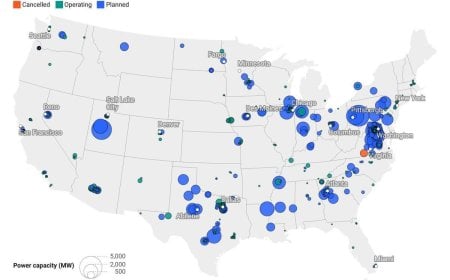
America’s New Map of Power: Data Centers, Grid Shortfall, and the AI Industrial Build-Out
A single map of U.S. data centers reveals the real AI-industrial build-out: clustered power demand, a 40–50 GW grid shortfall, forced nucle…
5 shared topics.
AI Compute and Power Infrastructure in 2025 — The New Industrial Backbone
A deep Pattern Nexus investigation into the 2025 AI industrial build-out — tracking every major compute deal, hyperscaler expansion, and th…
5 shared topics.
Sharhu (0)
Security Check
Please complete the captcha to verify you are human.